In This Article
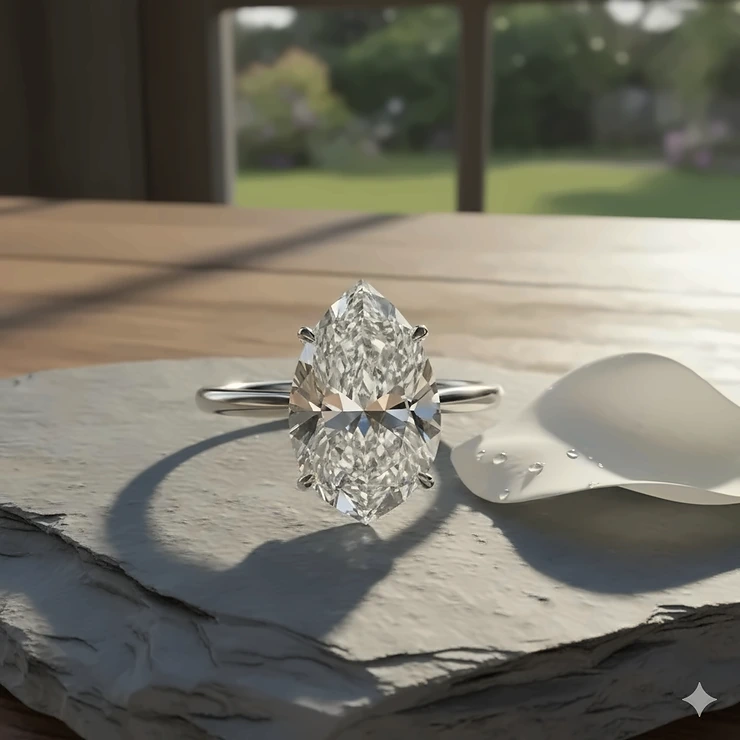
Pear shaped engagement rings are rings built around a teardrop-cut center stone: one rounded end that tapers to a single point. The cut borrows the sparkle of a round brilliant and the long, leggy line of a marquise. You can wear the point toward your fingertip or turn it sideways for an east-west look. It’s the shape that says “I like classics, but I don’t like crowds.”
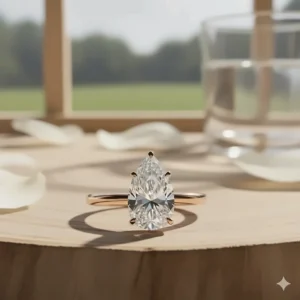
The Gemological Institute of America calls the pear a graceful, tapered, flattering choice for an engagement ring. Jewelers say the same thing in more words. The shape also tends to look bigger than a round or princess cut of identical carat weight, because its weight is spread lengthwise across the finger instead of piled into depth.
It has momentum, too. The Knot’s 2026 data, as cited by jeweler Barkev’s, puts pear at roughly 8% of US engagement rings, in the same pack as emerald, marquise and princess. Round and oval are still the headliners. And 2026 is a year when buyers are gravitating toward elongated shapes and away from the predictable.
So why does shopping for pear cut engagement rings feel harder than it should? Three reasons. Ratios vary wildly, the dreaded “bow-tie” shadow is real, and the cheapest listings often hide their dimensions in the fine print. A pear shaped diamond engagement setup has more variables than a round solitaire. A wrong guess shows up fast, because the point is the first thing anyone notices.
This guide cuts through it. You’ll get seven real options from budget silver to solid 14k gold, plus honest analysis of what the specs mean on an actual hand. You’ll also get setting advice, a buying framework, and the regulations that matter when someone sells you a “diamond” that isn’t one. No fluff. Plenty of pears.
Quick Comparison: Pear Shaped Engagement Rings at a Glance
Here’s the lineup before we get into the weeds. Price ranges are approximate and shift constantly, so check the current price before you commit.
| Ring | Center Stone | Metal | Price Range | Best For |
|---|---|---|---|---|
| Wuziwen Pear Cubic Zirconia Bridal Set | 9x7mm pear CZ | 925 sterling silver | Around $60-$70 | Tight budgets, promise rings |
| Oivley 2CT Pear Shaped Sterling Silver Ring | Pear CZ | Sterling silver, 18K white gold plated | Budget tier, check current price | Trying the teardrop look cheaply |
| WES 2ct Pear Moissanite Bridal Set | Pear moissanite | 925 sterling silver | Budget to lower mid-range | Sparkle plus stackable bands |
| IMOLOVE 2CT Pear Moissanite Halo Ring | Pear moissanite | Silver, 18K gold plated | Budget to lower mid-range | Halo glamour on a budget |
| Rosec Jewels 2ct 7x10mm Pear Moissanite Solitaire | 7x10mm pear moissanite | Silver, 10K-18K gold options | Roughly $250-$400 depending on metal | Choosing your metal |
| Kobelli Payton 12×8 Pear Moissanite Ring | 12x8mm pear moissanite | Solid 14k gold | Around $2,400-$2,600 | A durable statement ring |
| Grown Brilliance Shyra 1 1/3 ctw Pear Ring | 1 ct pear lab-grown diamond | 14K white gold | Mid-$2,000s | A certified diamond |
Look at the spread. The cheapest and priciest rings here differ by roughly 40x, but only the last row contains an actual diamond. The Rosec Jewels solitaire is the sweet spot if you want a bigger-looking stone without paying for solid gold. The Kobelli Payton and Grown Brilliance Shyra are the “buy once, wear for decades” picks. Budget buyers should know the Wuziwen set trades stone hardness for a very low entry price.
💬 Just one click — help others make better buying decisions too!😊
Top 7 Pear Cut Engagement Rings: Expert Analysis
These seven span budget, mid-range and premium. Each review rests on listed specs, aggregated review data where it exists, and plain analysis. None of it comes from hands-on ownership. Where a rating base couldn’t be verified, I say so rather than guess. Several of these brands sell through multiple retailers, so confirm the seller and return policy on the listing you’re buying from.
1. Wuziwen Pear Cubic Zirconia Bridal Set — best budget set with a matching band
The headline here is simplicity: a pear engagement ring and a wedding band arrive together in one box.
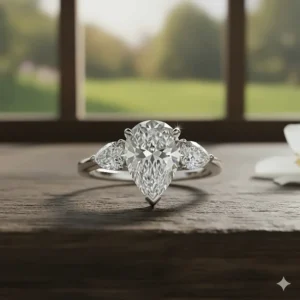
The listing describes a 9x7mm pear center, 925 sterling silver, and 64 cubic zirconia stones across the set. Do the math on that 9×7 footprint and you get a length-to-width ratio near 1.3. That’s a plumper, rounder teardrop than the lean 1.5-plus pears on fine-jewelry sites. On a hand it reads sweet and bold rather than long and dramatic, so don’t expect much finger-lengthening.
Based on the spec comparison, this is a smart “try the shape” purchase. It suits a promise ring, a placeholder before a custom piece, or a first ring for a shopper who can’t yet say whether pear is the shape. Cubic zirconia is softer than moissanite or diamond, so expect more haze and micro-scratches over years of daily wear.
At the time of research, the listing showed roughly 4.6 stars across more than a thousand reviews, which is a sizeable base for a budget set. Treat that as aggregated sentiment, and read the recent critical reviews for wear complaints.
Pros:
- ✅ Ring and matching band arrive together
- ✅ Plump 9x7mm pear looks big for the money
- ✅ Large review base on the listing
Cons:
- ❌ CZ dulls faster than moissanite or diamond
- ❌ Wider ratio elongates the finger less
Price: around $60-$70 range, so check current price. Verdict: outstanding entry-level value, not an heirloom.
2. Oivley 2CT Pear Shaped Sterling Silver Ring — simplest way to test the teardrop look
The standout feature is the low-risk teardrop silhouette in plated sterling silver.
The listing pairs a 2CT-marketed pear cubic zirconia with sterling silver finished in 18K white gold plating. Here’s the first thing to understand about “2CT” on a CZ ring: it’s a marketing size cue, not a certified weight. CZ is denser than diamond, so the stone is sold by approximate visual size. Check the millimeter dimensions in the listing instead of trusting the carat number.
Here’s what to weigh. White gold plating gives a bright finish but wears at contact points over months to years, and the exposed silver beneath can tarnish. That’s not a defect. It’s how plating works. If you take the ring off for dishes, lotion and workouts, it lasts noticeably longer.
This one suits someone who wants a pear-shaped look this season and may change settings later. A verified, substantial review base wasn’t available for this exact listing at the time of research. Read the newest one- and two-star reviews before buying, and focus on plating and stone-security comments.
Pros:
- ✅ Classic teardrop look at a bargain tier
- ✅ White gold plating gives bright, cool shine
- ✅ Silver base is lightweight on the finger
Cons:
- ❌ Plating will eventually wear at contact points
- ❌ “2CT” is a size cue, not a certified weight
Price: budget tier, check current price. Verdict: fine for fashion or a stand-in, less ideal as a lifetime ring.
3. WES 2ct Pear Moissanite Bridal Set — moissanite sparkle with stackable bands
This is the first rung up in stone quality, with moissanite taking over from CZ.
The listing advertises a 2ct pear moissanite bridal set in hypoallergenic 925 sterling silver, with D-color VVS1 grades and a stackable design. Those grades come from the seller, and moissanite isn’t graded on the GIA diamond scale, so read them as marketing shorthand. What matters in practice is that moissanite is harder than CZ and throws more colorful fire. Expect rainbow flashes that look more disco than diamond.
On paper, the stackable approach is a quiet advantage. A set lets the band hug the pear’s curve with less gap, which solves a classic pear problem (more on that later). It also makes upgrading easy later: keep the band, swap the center.
Who’s it for? Someone who loves bling and wants real hardness without paying for gold. The tradeoff is metal. Sterling silver is soft, so bent prongs are the true risk, not the stone.
Aggregated review data for this exact set wasn’t verifiable at the time of research, so I won’t characterize customer sentiment. Check current review counts before purchase.
Pros:
- ✅ Moissanite is much harder than CZ
- ✅ Stackable set hugs the pear’s curve
- ✅ Hypoallergenic silver suits sensitive skin
Cons:
- ❌ Seller-listed color and clarity grades aren’t independent
- ❌ Silver prongs can bend over time
Price: budget to lower mid-range, check current price. Verdict: strong value if you want moissanite fire without a gold budget.
4. IMOLOVE 2CT Pear Moissanite Halo Ring — halo drama in gold-plated silver
The standout here is the halo, which pushes visual size well beyond the center stone.
The listing describes a 2CT pear moissanite with a teardrop halo in sterling silver with 18K gold plating, graded D color VVS1 by the seller. A halo does two jobs. It adds sparkle around the stone, and it makes the center look larger. That second effect matters for pears, where the halo follows the point and gives the ring a delicate crown.
The compromise is maintenance. Halos collect lotion and dust in the small gaps, and gold plating over silver will wear. If you like warm yellow tones but want a lower price than solid gold, plated is the budget route, with an expiry date on the finish.
It suits someone who wants a bold, glamorous pear and doesn’t mind a brief cleaning routine. Reviewers on third-party roundups describe it as eye-catching, but those pieces are informal, so I’m not leaning on them. Treat the ring’s real-world durability as unproven until you’ve read recent verified-purchase reviews.
Pros:
- ✅ Halo makes the stone look larger
- ✅ Warm gold-plated finish at a lower price
- ✅ Moissanite brings strong fire and hardness
Cons:
- ❌ Halo gaps trap lotion and dust
- ❌ Gold plating will fade with wear
Price: budget to lower mid-range, check current price. Verdict: maximum impact per dollar, with realistic maintenance.
5. Rosec Jewels 2ct 7x10mm Pear Moissanite Solitaire — metal choices from silver to 18K gold
The standout is flexibility: the same 7x10mm pear solitaire is offered in sterling silver and in 10K, 14K and 18K gold.
At 7x10mm, the ratio is about 1.43. That’s a slightly broad, classic pear, a touch plumper than the 1.5-plus favorites. And “2 carat” here is almost certainly a diamond-equivalent figure, so ignore it and trust the millimeters. The listed D-VS1 grading is seller-stated, but the real asset is the solitaire’s cleanliness. No halo means nothing to snag and nothing to scrub.
Here’s what most buyers overlook: a solitaire in solid gold from this brand sits at a very different price tier than the silver version. If you want a long-term ring but can’t stretch to the Kobelli Payton, going for the 10K or 14K version of this ring is the rational middle path. Sterling is the starter option.
The brand’s own site advertises a 4.8/5 average, though that’s self-reported, so weigh it accordingly. Walmart listings I checked had very thin review counts. Verify on the specific listing you’re buying from.
Pros:
- ✅ Choice of silver or 10K-18K gold
- ✅ 7x10mm pear gives a classic, balanced shape
- ✅ Clean solitaire is easy to maintain
Cons:
- ❌ “2 carat” is a diamond-equivalent claim
- ❌ Independent review base looks thin
Price: roughly $250-$400 depending on metal, so check current price. Verdict: the best-balanced value in this lineup.
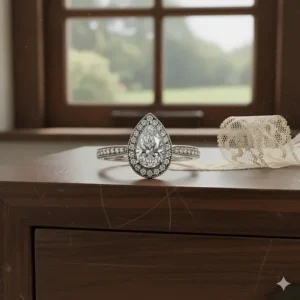
6. Kobelli Payton 12×8 Pear Moissanite Ring — solid 14k statement stone
The standout is scale plus substance: a 12x8mm pear in solid 14k gold.
Kobelli describes the center as a 12x8mm pear moissanite (about 3.5 carats diamond-equivalent weight). A hidden halo of lab-grown diamonds and a pavé semi-eternity band round out the design, all in a slim basket setting. The ratio works out to 1.5, right in the sweet spot most jewelers recommend. In plain English: it’s large, elegant, and proportioned the way pear people prefer.
Solid gold changes everything about ownership. It doesn’t plate off, it can be resized by most jewelers, and repairs are routine. The hidden halo adds sparkle from the side without a loud ring-of-stones look, which suits minimalists who still want presence.
Who is it for? Buyers who want a big-statement stone without the price of a comparable natural diamond. The tradeoff is that moissanite, while hard and fiery, is not a diamond. FTC rules require sellers to say so clearly.
A verified review base for this specific model wasn’t available at the time of research, though the brand has a long US manufacturing history. Confirm the seller and return policy.
Pros:
- ✅ Solid 14k gold, built for decades
- ✅ 1.5 ratio is a flattering pear shape
- ✅ Hidden halo adds sparkle without bulk
Cons:
- ❌ Moissanite is not a diamond
- ❌ Premium price for a simulant center
Price: around $2,400-$2,600, so check current price. Verdict: great design and build, priced for the metal and craftsmanship.
7. Grown Brilliance Shyra 1 1/3 ctw Pear Ring — certified lab-grown diamond benchmark
The standout is the IGI-certified lab-grown diamond center, so you’re comparing a real diamond to all the stones above.
The listing describes a 1 ct pear lab-grown diamond, D color, VVS clarity, set in 14K white gold with a hidden halo of round lab-grown diamonds (about 0.32 ctw, 1.32 ctw total). Because this is a genuine diamond (lab-grown, chemically the same as a mined one), you get hardness of 10 on the Mohs scale and no “simulant” asterisk. The ring is made to order, which usually means a wait but also means a fresh build.
What the spec sheet won’t say: at one carat, a pear still looks larger than a one-carat round, but it’s smaller than the 12x8mm Kobelli Payton. You’re buying quality of material rather than sheer size. Ask for photos or video to evaluate bow-tie visibility, since IGI certificates don’t grade it.
Aggregated review sentiment for this exact ring wasn’t verifiable at research time. This retailer is a dedicated jeweler rather than a marketplace seller, so check whether the purchase path you choose offers certification and returns.
Pros:
- ✅ Certified lab-grown diamond, hardness 10
- ✅ Hidden halo adds side sparkle
- ✅ 14K white gold with made-to-order build
Cons:
- ❌ Smaller visual size than 12x8mm moissanite
- ❌ Made-to-order timelines can run long
Price: mid-$2,000s, so check current price. Verdict: the most future-proof purchase here, priced fairly for a real diamond.
Top 7 Spec Snapshot
| Ring | Center Stone | Setting Style | Price Range | Verified Ratings Data | Best For |
|---|---|---|---|---|---|
| Wuziwen Pear Cubic Zirconia Bridal Set | 9x7mm pear CZ | Halo-style set | Around $60-$70 | ~4.6 stars, 1,000+ reviews (listing) | First-time buyers |
| Oivley 2CT Pear Shaped Sterling Silver Ring | Pear CZ | Solitaire-style | Budget tier | Not verified | Fashion wear |
| WES 2ct Pear Moissanite Bridal Set | Pear moissanite | Stackable set | Budget to lower mid | Not verified | Stackers |
| IMOLOVE 2CT Pear Moissanite Halo Ring | Pear moissanite | Halo | Budget to lower mid | Not verified | Glam seekers |
| Rosec Jewels 2ct 7x10mm Pear Moissanite Solitaire | 7x10mm pear moissanite | Solitaire | $250-$400 | Brand-reported 4.8/5 | Metal flexibility |
| Kobelli Payton 12×8 Pear Moissanite Ring | 12x8mm pear moissanite | Hidden halo, pavé | $2,400-$2,600 | Not verified | Lasting statement |
| Grown Brilliance Shyra 1 1/3 ctw Pear Ring | 1 ct pear lab-grown diamond | Hidden halo | Mid-$2,000s | Not verified | Real-diamond buyers |
Looking at the table above, the Rosec Jewels solitaire delivers the best balance of quality and cost if you can accept moissanite in a gold or silver band. If you want the largest visible stone for the money, the Kobelli Payton wins at 12x8mm. Budget buyers should note that the Wuziwen set is the only listing here with a large visible review base, but also the softest stone.
✨ Don’t Miss These Exclusive Deals!
🔍 Take your ring search to the next level with these carefully selected options. Click on any highlighted item to check current pricing and availability. These picks will help you find a pear shaped engagement ring that suits your style, budget and finger shape!
Practical Usage Guide: Your First 30 Days With a Pear Shaped Ring
A pear has one quirk no other common shape has: a point. Treat it with respect and it will outlast the trend. Ignore it, and it will find your sweater.
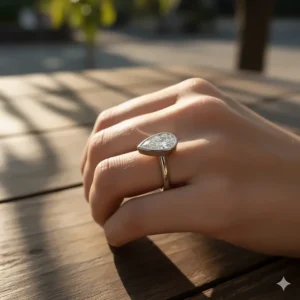
Week one: confirm the fit. Slide the ring on in the afternoon, when fingers are slightly larger. A pear’s weight shifts toward the wide end, so a slightly loose ring will rotate until the point faces sideways. If it spins, size down a half step or add a sizing bead.
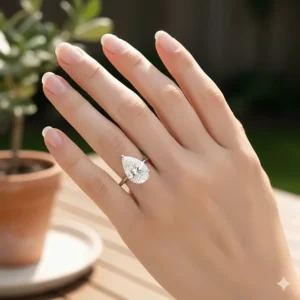
Week one to two: choose your point direction. Pointing toward the fingertip is traditional and elongates the finger. East-west places the stone across the hand for a modern, unexpected look. Neither is wrong. Try each for a day and notice which catches less on pockets and gloves.
Weeks two to four: build a care routine. Take the ring off for lotion, workouts, cleaning and swimming. Silver and plated options tarnish and wear faster with chemicals. Once a week, soak in warm water with a drop of dish soap, brush gently under the stone with a soft toothbrush, rinse, and pat dry. A halo setting, like the IMOLOVE design, needs this more than a solitaire like the Rosec Jewels ring.
Common first-30-day mistakes: wearing it to the gym, ignoring prong checks, and storing it loose with other jewelry. Check the point (the most exposed prong) every week by gently pressing on it. If you feel movement, stop wearing the ring and see a jeweler.
Real-World Scenarios: Which Ring Fits Which Buyer?
Specs are abstract. Here’s how they land in real situations.
Scenario 1: The college student on a tight budget. You’re 22, working part time, and want a ring that photographs well. You wear it to class and shifts, so chemical exposure is high. Budget under $100. The Wuziwen set is the logical fit. It’s inexpensive, includes a band, and the 9x7mm pear gives you real presence. Plan on replacing the ring or upgrading in a couple of years. Budget for it mentally as a fashion purchase.
Scenario 2: The couple saving for a “forever” ring. You’ve got a $3,000 budget and a long-term plan, with daily wear in an office. The Grown Brilliance Shyra gives you a certified lab-grown diamond in 14K gold. You get diamond hardness and a hidden halo at a price a natural diamond of this size wouldn’t match. If you’d rather have more visible stone and don’t mind moissanite, the Kobelli Payton gives you a much larger face-up look.
Scenario 3: The in-between buyer. You want solid metal without spending thousands. Here a gold-band Rosec Jewels solitaire makes sense. You avoid plating wear and get a classic setting, and you keep room in the budget for insurance and a contour wedding band later. Frequency of use is daily, environment is mixed, and the plan is to wear it for at least a decade.
Problem → Solution Guide for Pear Shaped Engagement Rings
Every shape has pain points. Here are the five pear owners hit most often, with fixes.
Problem 1: The point snags on clothes. Solution: choose a setting with a protective V-prong or bezel tip. A bezel tip is the safest. Among our picks, the basket settings on the Kobelli Payton lean protective, while a plain solitaire like the Rosec Jewels ring relies on standard prongs, so check them regularly.
Problem 2: The ring spins or the point drifts sideways. Solution: resize half a size down, or add a sizing bead. Top-heavy stones rotate more.
Problem 3: A gap appears between the ring and a straight wedding band. Solution: use a contour band that follows the pear’s curve. This is the reason the WES stackable set is attractive. If you buy separate pieces, a jeweler can also notch a band to fit.
Problem 4: A dark bow-tie shows across the center. Solution: on diamonds, ask for video under overhead and window light and choose a stone where the shadow is subtle. On moissanite and CZ, the cut is more forgiving but not immune. A smaller table or slightly deeper stone can hide it.
Problem 5: The stone looks cloudy after a few months. Solution: this is usually lotion buildup. Soak, brush and rinse. If the ring is plated silver, tarnish may be the cause, and a polishing cloth helps. Hold the ring in a light and check whether the haze is surface or in the stone.
How to Choose Pear Shaped Engagement Rings
Shopping is easier with a checklist. Work through these in order.
- Decide your stone type first. Natural diamond, lab-grown diamond, moissanite and CZ differ in price and hardness. Settling this narrows the field fast.
- Shop by millimeters, not carats. Moissanite and CZ are sold by diamond-equivalent weight, which is a size cue. A 12x8mm pear tells you what you’ll actually see.
- Check the length-to-width ratio. Most jewelers cite roughly 1.45-1.75 as the classic range. Divide length by width yourself.
- Look for the bow-tie. A shadow across the center is normal in pears. Ask for video or large photos in natural light.
- Protect the point. A V-prong or bezel tip guards the most vulnerable spot.
- Pick a metal you can live with. Solid gold lasts. Plating and silver cost less but need care.
- Confirm returns and certificates. For diamonds, ask for IGI or GIA reports. For anything, confirm the seller’s return window.
The best pear is the one that suits your hand and your lifestyle, not the one with the biggest number on the listing.
Pear Shaped Diamond Engagement: Ratio, Bow-Tie and Orientation
Let’s get technical, but briefly. Three details make or break the look of any pear shaped diamond engagement ring.
Ratio. Retailers disagree, and that’s useful information. One jeweler’s guide cites 1.45-1.75 as the usual range. Rare Carat’s pear cut guide suggests a tighter 1.45-1.55. Another shop prefers 1.55-1.75. So there’s no single magic number, just personal taste. A lower ratio looks short and wide, while a higher one looks long and slender. Apply this to our picks: the 9x7mm Wuziwen stone is about 1.29, the 7x10mm Rosec Jewels is about 1.43, and the 12x8mm Kobelli Payton is 1.5.
Bow-tie. Nearly every pear shows some darker shape across the center, where light leaks instead of returning to your eye. Some pears hide it better than others. Depth percentage affects it, and one guide suggests roughly 58-64% depth helps reduce it. Grading labs don’t note bow-tie, so you have to judge visually.
Orientation. Point-to-fingertip is the traditional, elongating choice. East-west is the trendy alternative. This is easy to test in the first week of ownership.
For pear shaped diamond rings, symmetry matters more than for most shapes. If the curve on one side doesn’t match the other, the eye catches it instantly. That’s why serious diamond shoppers insist on certificates showing strong symmetry grades.
Pear Shaped Diamond Rings vs Round, Oval and Marquise
Choosing a shape means choosing a personality. The National Jeweler report on 2026 trends shows round at 26% and oval at 25% of The Knot’s surveyed couples. That makes them the safe choices. Pear sits in the “distinctive but not eccentric” tier.
| Shape | Look | Finger Effect | Snag Risk | Best For |
|---|---|---|---|---|
| Pear | Soft curve plus one point | Elongating | Medium (the point) | Style-forward classicists |
| Round | Symmetrical, traditional | Neutral | Low | Maximum sparkle |
| Oval | Soft, rounded oval | Elongating | Low | Comfort and trend |
| Marquise | Two points | Very elongating | High (two points) | Bold dramatic looks |
Looking at the table above, pear and oval offer similar finger-lengthening, but pear adds personality through its point. Round wins on sparkle and simplicity. Marquise is the boldest, with the highest snag risk. If you like oval but want something a little less common, pear is the natural upgrade.
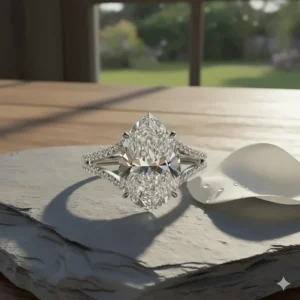
Pear Cut Engagement Rings: Diamond, Lab-Grown, Moissanite or CZ?
The stone type affects price, durability and what you’re allowed to call it. According to The Knot’s 2026 study, lab-grown stones account for about 61% of US engagement ring center stones, a major shift in a few years.
| Stone Type | Price Tier | Hardness (Mohs) | Strength | Best For |
|---|---|---|---|---|
| Natural diamond | Highest | 10 | Heirloom value | Traditional buyers |
| Lab-grown diamond | Mid to high | 10 | Real diamond for less | Value-minded diamond fans |
| Moissanite | Low to mid | About 9.25 | Fire and durability | Big stone on a budget |
| Cubic zirconia | Lowest | About 8-8.5 | Affordable sparkle | Short-term wear |
The table makes the tradeoffs clear. Lab-grown diamond, like the Grown Brilliance Shyra, gives you a real diamond at a lower price than a mined stone of equal quality. Moissanite, like the Kobelli Payton, gives you size and fire but isn’t a diamond. CZ, like the Wuziwen set, is the cheapest, and also the softest. If you plan to wear the ring every day for years, pick moissanite or diamond.
Features That Actually Matter (And Those That Don’t)
Marketing language is loud. Here’s the filter.
Matters: the millimeter size, the ratio, the setting’s point protection, the metal quality, return policy, and certificates for diamonds. These determine how the ring looks, wears and holds up.
Matters less: “D-VVS1” on a moissanite listing. Those grades are seller-stated and don’t map neatly to diamond grading. Also unimportant: the “carat” figure on a moissanite or CZ ring, since it’s a size shorthand. A pear’s face-up look comes from millimeters.
Doesn’t matter much: a long list of side stones. A dozen tiny accents add shimmer but not value. Pay for the center and the metal, not the sparkle count.
Worth the extra: a hidden halo or bezel tip if you have an active lifestyle. A contour-ready or low-profile design if you plan to add a wedding band.
Common Mistakes When Buying Pear Shaped Engagement Rings
Five errors show up again and again.
- Buying on carat weight alone. A long, narrow pear and a short, plump one can share a carat weight and look nothing alike.
- Ignoring the ratio. Too narrow looks anemic, too wide looks stubby.
- Skipping the bow-tie check. If you only see a studio photo, you can’t judge the shadow.
- Forgetting about the wedding band. A straight band may leave a gap, so budget for a contour band.
- Trusting plating to last. Gold-plated silver is great for short-term wear and risky for a lifetime ring.
One more: assuming “diamond” means diamond. If a listing doesn’t say “lab-grown” or “simulated,” ask. We’ll cover why next.
Long-Term Cost, Maintenance and Disclosure Rules
Total cost of ownership matters more than sticker price. A $65 ring that needs replacing every two years costs more per year than a mid-range gold ring worn for fifteen. Silver and plated rings may need polishing, replating or resizing. Solid gold needs occasional prong checks and professional cleaning. Diamonds need little beyond periodic inspection. Add insurance, which typically costs a modest percentage of ring value annually, and you have a realistic budget.
Then there’s labeling. The FTC’s Jewelry Guides draw a hard line. According to JCK’s explainer on lab-grown diamond disclosure, sellers of lab-grown diamonds must clearly and conspicuously disclose that origin. Simulants like moissanite and CZ may look like diamonds but have different composition, and they shouldn’t be marketed as diamonds. As a shopper, that means a trustworthy listing says “lab-grown diamond” or “moissanite” plainly, near the word “diamond,” not buried in the fine print. If the language is vague, that’s a yellow flag.
FAQ: Pear Shaped Engagement Rings
❓ Which way should the point face on pear shaped engagement rings?
❓ Do pear cut engagement rings need a special wedding band?
❓ Is a pear shaped diamond engagement ring practical for everyday wear?
❓ What length-to-width ratio is best for pear shaped diamond rings?
❓ Are engagement rings pear shaped more expensive than round?
Conclusion
Pear shaped engagement rings reward buyers who do a little homework. The teardrop is flattering, distinctive and currently in style, but it demands attention to ratio, symmetry, bow-tie and point protection.
If budget is the main driver, the Wuziwen Pear Cubic Zirconia Bridal Set and Oivley 2CT Pear Shaped Sterling Silver Ring let you wear the shape for very little. If you want moissanite fire without gold prices, the WES 2ct Pear Moissanite Bridal Set and IMOLOVE 2CT Pear Moissanite Halo Ring are sensible. The Rosec Jewels 2ct 7x10mm Pear Moissanite Solitaire is the balanced middle, particularly in gold. And for a ring meant to last, the Kobelli Payton 12×8 Pear Moissanite Ring (maximum size) and Grown Brilliance Shyra 1 1/3 ctw Pear Ring (certified lab-grown diamond) lead the field.
Decide on stone type, measure in millimeters, protect the point, and budget for a contour band. Do those four things and you’ll end up with a ring you actually enjoy wearing.
Recommended for You
- 2 Carat Princess Cut Diamond Ring: 7 Stunning Picks (2026)
- 6 Carat Oval Diamond Ring: 7 Stunning Picks Worth Buying (2026)
- 5 Carat Oval Diamond Ring: 7 Stunning Picks for 2026
Disclaimer: This article contains affiliate links. As an Amazon Associate, I earn from qualifying purchases. If you purchase products through these links, we may earn a small commission at no additional cost to you.
✨ Found this helpful? Share it with your friends! 💬🤗
