In This Article
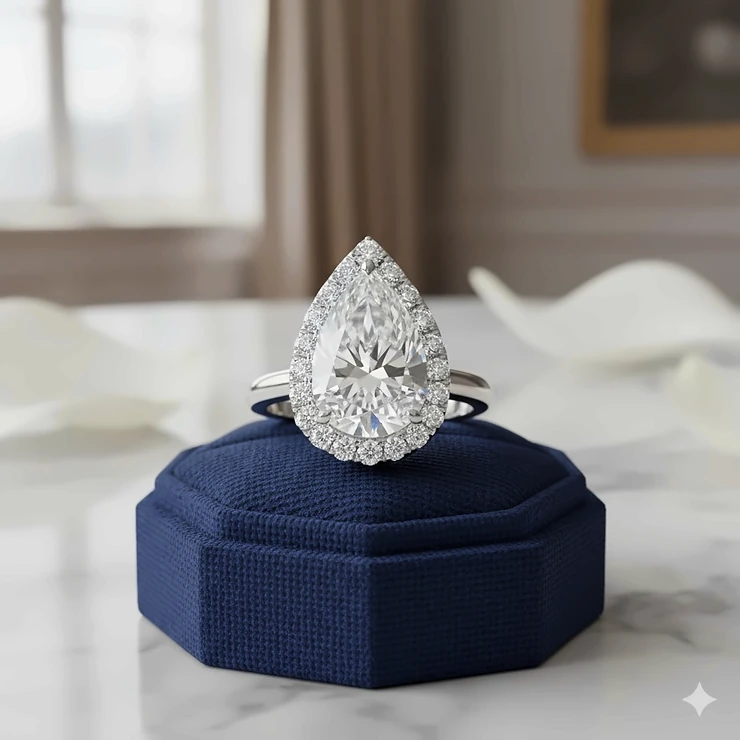
A pear halo engagement ring pairs a teardrop-shaped center stone, round at one end and pointed at the other, with a circle of small accent stones around it. The halo makes the center look bigger, adds sparkle, and frames the delicate tip. Pear shaped halo engagement rings suit anyone who wants vintage romance with modern shine.
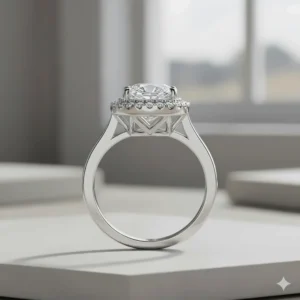
Here’s the thing about the teardrop: it looks like it has a story. The pear is a hybrid, part round brilliant and part marquise. Wikipedia’s overview of diamond cuts places it among the fancy shapes, and the 58-facet pear is a modified brilliant. Add a halo and the stone gets a spotlight, the outline gets a frame, and a one-carat center can read like something much larger.
Shopping for one is trickier than scrolling past a pretty photo, though. The point needs protection. Many pears show a dark “bow-tie” shadow across the middle. The length-to-width ratio can run from a plump 1.45 to a willowy 1.75, and that changes the whole personality of the ring. Then there’s the stone itself: mined diamond, lab-grown diamond, or moissanite, each with different rules for how it can be described.
This guide cuts through that. I researched seven real pear halo engagement ring options, from sterling-silver moissanite to solid-gold lab-grown diamond. Each gets a spec breakdown, plain-English commentary, and an honest value read. Prices are ranges because they move, so check current listings before you commit.
Pear Halo Engagement Ring Quick Comparison: 7 Options at a Glance
Before the deep dive, here’s the lineup. Think of it as the cheat sheet you screenshot and send to a friend.
| Ring | Center Stone | Price Range | Best For |
|---|---|---|---|
| Rosec Jewels 1.30 Ct Pear Moissanite Halo Ring | Moissanite, 5×7 mm | Around $300 | Tight budgets, big look |
| She Said Yes “You Are the Unique One” Pear Cut Halo Ring | Lab diamond, moissanite or gemstone, 6×9 mm | $600-$700 range | Vintage lovers on a solid-gold budget |
| Bellisa Paula Pear Forever Halo | Moissanite or IGI-certified lab diamond | Check current price | Custom, made-to-order buyers |
| Kay Now + Forever Pear-Shaped Lab-Grown Halo | Lab diamond, 3/4 ct tw | $1,000-$1,500 range | Shoppers wanting a retail backup |
| Kobelli Venus Twist Pear Halo Bridal Set | Lab diamond, about 0.70 ct center | Check current price | Anyone who wants the band included |
| Allurez Pear & Round Lab Diamond Halo (1.82 ct) | Lab diamond, 1.50 ct, 9×6 mm | $2,000-$2,500 range | Balanced size, quality and price |
| Allurez Pear Lab Diamond Halo (4.69 ct) | Lab diamond, 4.25 ct | Around $7,000 | A true statement stone |
Looking at the table, the Rosec Jewels 1.30 Ct Pear Moissanite Halo Ring delivers the most visual presence per dollar, but it trades away solid-gold construction. The Allurez Pear & Round Lab Diamond Halo (1.82 ct) is the sweet spot if you want a certified-size lab diamond in 14k gold without a luxury markup. If you want the wedding band handled in one purchase, the Kobelli Venus Twist Pear Halo Bridal Set is the only two-ring option here.
💬 Just one click — help others make better buying decisions too!😊
Top 7 Pear Halo Engagement Ring Picks: Expert Analysis
Every ring below is judged on real specs and real listing details, not on mood lighting. Where I couldn’t verify independent customer reviews, I say so rather than pretend.
1. Rosec Jewels 1.30 Ct Pear Moissanite Halo Ring — biggest teardrop for the smallest budget
The pitch here is size per dollar, and moissanite is why it works. The listing describes a 5×7 mm pear-shaped center with D-color, VS1-grade claims, set in 925 sterling silver plated with 14k gold.
Moissanite rates about 9.25 on the Mohs scale versus diamond’s 10, so scratch resistance is excellent for daily wear. Moissanite also weighs roughly 10% less than a diamond of the same diameter, so compare millimeters rather than carat labels. The weak link is the plating. On any plated silver ring, gold wear shows first at the high-friction spots, usually the underside of the band.
My read: this is a smart “first ring” for a couple who’d rather fund the honeymoon, or a stand-in ring while you save for something permanent. Plan on re-plating down the road.
I couldn’t verify a meaningful pool of independent reviews for this exact listing at the time of research, so check the return window before you buy.
Pros:
- ✅ Large 5×7 mm center for the money
- ✅ Moissanite resists everyday scratching well
- ✅ Easy to replace or upgrade later
Cons:
- ❌ Gold plating over silver will eventually wear
- ❌ No verified independent review pool found
Price: around $300 at the time of research. Strong value for the look, as long as you accept plated silver.
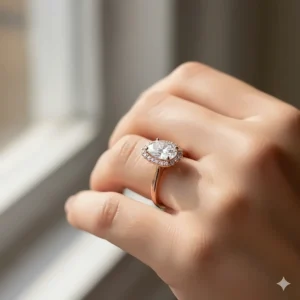
2. She Said Yes “You Are the Unique One” Pear Cut Halo Ring — vintage vine detail in solid gold
This one’s personality is in the details. The basket carries a vine-like engraving, and the shank has a delicate twist that keeps it from looking like every other halo.
The 1.5 ct version uses a 6×9 mm pear (a 1.5 length-to-width ratio, right in the classic zone) with about 70 tiny 0.9 mm round accents totaling roughly 0.28 ct. The band is only 1.7 mm wide and about 1.0 mm thick. That’s elegant, but a slim band is the first thing to bend on someone who lifts, climbs, or gardens. Those 0.9 mm stones are also small enough that a yearly prong check is worth the five minutes.
The listing offers lab-grown diamond, moissanite, or gemstone centers, in 10K, 14K, or 18K solid gold or platinum. That flexibility is the real draw: you can pick your own point on the budget curve.
The retailer page shows a modest review count, but I couldn’t read the content, so I won’t summarize sentiment I haven’t seen.
Pros:
- ✅ Solid gold and platinum options available
- ✅ Distinctive twisted shank and engraving
- ✅ Plump 1.5 ratio looks balanced
Cons:
- ❌ Thin 1.0 mm band can flex under hard wear
- ❌ Tiny accent stones need regular checks
Price: roughly the $600-$700 range at the time of research. Excellent value for solid gold with this much design.
3. Bellisa Paula Pear Forever Halo — cathedral shank and a certified lab-diamond option
Bellisa builds this ring to order in Toronto, in solid 14k gold. The cathedral shank lifts the halo off the finger a touch, which gives light more room to enter the stone from the sides.
The halo is about 20 or more round stones at 1.2 mm, roughly 0.18 ct total. Choose a VVS D-color moissanite center, or a lab-grown diamond that’s VS+ clarity, E-F color, and IGI certified. The band measures 1.75 mm wide and 1.6 mm thick, noticeably sturdier than the previous ring, which means better long-term resilience. Photos show a 9×6 mm stone.
The catch is patience. Allow roughly three to four weeks for production, so this isn’t a last-minute proposal ring. Bellisa also states a one-year craftsmanship warranty on its engagement rings, a useful safety net.
I found no independent review pool to summarize. The brand’s own claims are all I can report.
Pros:
- ✅ Solid 14k gold with a sturdier band
- ✅ IGI-certified lab-diamond center available
- ✅ Cathedral shank lifts the halo
Cons:
- ❌ Three-to-four-week made-to-order wait
- ❌ No independent reviews found
Price: I couldn’t confirm a current figure, so check the listing. Value depends on your center-stone choice.
4. Kay Now + Forever Pear-Shaped Lab-Grown Halo — the retail-store safety net
Sometimes the most romantic feature is “I can walk into a store if something goes wrong.” This 14K rose gold ring has a pear-shaped lab-grown diamond haloed by round lab-grown diamonds, with more stones along the shank and milgrain detailing on the bridge.
Total weight is 3/4 ct, graded F color and VS2 clarity, and it’s described as independently certified. Notice what that weight means: this is a modest-carat ring, so the halo is doing real work to build visual size. Kay’s listing says its lab-grown diamonds share the optical, chemical and physical properties of mined ones, and lists trade-in eligibility under its own policy.
Rose gold flatters warmer skin tones and helps the white halo stones pop. It’s also a popular choice if you want something less “default white metal.”
I didn’t retrieve review data for this specific ring.
Pros:
- ✅ Certified lab-grown diamonds throughout
- ✅ Physical store access for service
- ✅ Milgrain detail adds vintage charm
Cons:
- ❌ Modest 3/4 ct total weight
- ❌ Sale pricing may change quickly
Price: about the $1,000-$1,500 range at the time of research. Fair value, with service access as the bonus.
5. Kobelli Venus Twist Pear Halo Bridal Set — the band is already solved
Here’s a quiet problem with pear rings: a straight wedding band leaves an ugly gap against the rounded base. This set sidesteps it by including a chevron V-shaped wedding band that nests against the engagement ring.
The engagement ring features a certified pear lab-grown diamond of about 0.70 ct with excellent polish and symmetry, EF color and VS clarity. It has over 100 round lab-grown side diamonds (about 0.60 ct total) running down a twist crossover shank. Total weight is about 1.3 ct across both rings in 14k gold. The low center setting means less snagging on sleeves and hair, a real everyday-wear win.
My take: this is a “set it and forget it” purchase. You get matching rings, plus a pre-solved contour problem.
I couldn’t verify review data for this set.
Pros:
- ✅ Matching chevron wedding band included
- ✅ Low setting resists snagging
- ✅ Certified excellent polish and symmetry
Cons:
- ❌ Dense pavé needs periodic stone checks
- ❌ Less resizing flexibility with stones on the shank
Price: I couldn’t confirm a current figure, so check the listing. Likely strong value because you’re buying two rings.
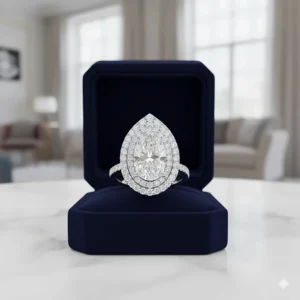
6. Allurez Pear & Round Lab Diamond Halo (1.82 ct) — plump 1.5 ratio, real presence
This is the “grown-up” middle of the lineup. A 1.50 ct, 9×6 mm lab-grown pear is the center, ringed by 20 side stones totaling 0.32 ct, in 14k white gold weighing about 4 grams.
That 9×6 mm footprint is a 1.5 ratio, the plump, friendly teardrop. It reads as intentional rather than skinny, and it tends to hide the bow-tie better than very elongated pears. About 4 grams of gold is a reassuring heft for a halo ring.
Allurez advertises a free one-year limited warranty covering sizing, prong tightening, and polishing. Its “everyone else” price comparisons are marketing, so ignore them and compare against other 1.5 ct lab pears yourself.
Independent reviews weren’t something I could verify here.
Pros:
- ✅ 14k white gold with meaningful metal weight
- ✅ Balanced 1.5 ratio pear shape
- ✅ Warranty covers sizing and prong tightening
Cons:
- ❌ “Savings” claims are marketing, not proof
- ❌ No verified review pool found
Price: about the $2,000-$2,500 range at the time of research. Strong value for 1.5 ct of lab-grown diamond in gold.
7. Allurez Pear Lab Diamond Halo (4.69 ct) — a true statement stone
If a ring should be visible from across the room, this is it. A 4.25 ct pear lab-grown diamond is surrounded by 22 round accents (about 0.44 ct) on a thin, smooth 14k white gold band.
At this size, two things matter more than they do on smaller stones. First, request the certificate and look at the bow-tie in video from several angles. A shadow that’s invisible on a 1 ct stone gets bigger on a 4 ct one. Second, a thin band under a heavy center needs regular checks, since the stone can lever against the prongs if the ring takes a hit.
It’s a lab-grown route to a size most people couldn’t afford in mined diamond, and the thin band keeps the focus where it belongs.
I couldn’t verify review data for this listing.
Pros:
- ✅ Dramatic 4.25 ct pear presence
- ✅ Thin band keeps focus on the stone
- ✅ Wearable as engagement or anniversary ring
Cons:
- ❌ Heavy center needs diligent prong checks
- ❌ Bow-tie may be more visible at this size
Price: around $7,000 at the time of research. Reasonable for the size, but verify certification first.
Here’s every ring side by side for specs and fit.
| Ring | Metal | Accent Detail | Notable Spec | Best For |
|---|---|---|---|---|
| Rosec Jewels 1.30 Ct Pear Moissanite Halo Ring | Plated 925 silver | Halo | 5×7 mm center | First ring, budget buyers |
| She Said Yes “You Are the Unique One” Pear Cut Halo Ring | 10K-18K gold, platinum | About 70 stones | 1.0 mm thick band | Vintage style fans |
| Bellisa Paula Pear Forever Halo | 14k gold | 20+ stones at 1.2 mm | 1.75 mm band | Custom, certified buyers |
| Kay Now + Forever Pear-Shaped Lab-Grown Halo | 14K rose gold | Halo + shank | F color, VS2 | Store-backed buyers |
| Kobelli Venus Twist Pear Halo Bridal Set | 14k gold | 100+ stones | Two rings | Set shoppers |
| Allurez Pear & Round Lab Diamond Halo (1.82 ct) | 14k white gold | 20 stones | 9×6 mm center | Balanced value |
| Allurez Pear Lab Diamond Halo (4.69 ct) | 14k white gold | 22 stones | 4.25 ct center | Statement seekers |
Read the table as a value ladder. The Rosec Jewels 1.30 Ct Pear Moissanite Halo Ring and the She Said Yes “You Are the Unique One” Pear Cut Halo Ring are the two budget-friendly entries, but only the She Said Yes “You Are the Unique One” Pear Cut Halo Ring offers solid precious metal at that level. For durability-minded buyers, the sturdier band on the Bellisa Paula Pear Forever Halo is worth more than its looks suggest.
✨ Don’t Miss These Exclusive Deals!
🔍 Ready to narrow it down? Click on any highlighted ring name to check current pricing and availability. Whichever pear halo engagement ring you land on, these picks give you a head start on a ring she’ll actually wear every day!
How to Choose a Pear Halo Engagement Ring
Choosing a pear halo engagement ring comes down to six decisions, roughly in this order:
- Pick the ratio first. Aim for 1.45-1.75 length-to-width. Closer to 1.5 reads plump and romantic; near 1.75 reads sleek and long.
- Decide the center stone type. Mined diamond, lab-grown diamond, and moissanite look similar to most observers, but they differ in price, hardness and how they must be described.
- Insist on tip protection. A V-prong or bezel cap on the point is non-negotiable, since that’s where pears chip.
- Inspect symmetry. GIA doesn’t assign a cut grade to fancy shapes, so look for Excellent or Very Good polish and symmetry on the report.
- Match the halo to her lifestyle. Classic halos maximize sparkle, hidden halos keep the silhouette clean, and double halos add drama (and maintenance).
- Check the band. Thin looks elegant, but 1.6 mm or more of thickness is kinder to busy hands.
That last step matters more than most buyers realize. A gorgeous center on a flimsy shank is a short-lived romance.
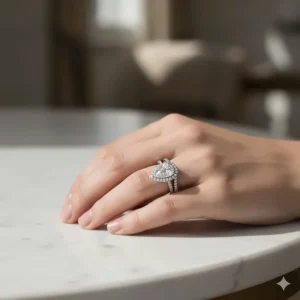
Pear Shaped Halo Engagement Rings: Classic, Hidden and Double Halo Styles
Pear shaped halo engagement rings come in three main flavors, and each changes the ring’s character.
Classic halo. Small round stones circle the pear in the open, adding visible sparkle and making the center look larger. It’s the most popular approach, and it’s what the Rosec Jewels 1.30 Ct Pear Moissanite Halo Ring and the Allurez Pear & Round Lab Diamond Halo (1.82 ct) use.
Hidden halo. The accent stones sit under the center stone’s crown, invisible from straight above and revealed as a flash of sparkle from the side. It keeps the pear’s outline crisp, a favorite for minimalists.
Double halo. Two rings of stones push the look toward bold and glamorous. The tradeoff is more crevices to clean and more tiny stones to monitor.
One design note applies to every style: the point of a pear is the most vulnerable spot, and the halo should never replace a proper prong there. Look for a V-prong cap, or a halo that wraps close enough to shield the tip without hiding it.
What to Expect: Real-World Performance of a Pear Halo Engagement Ring
Pears sparkle like rounds at one end and like marquises at the other, which makes them “busy” in an appealing way. The same geometry creates the pear’s signature quirk: the bow-tie.
According to GIA’s guide to pear shaped diamonds, many pears show a dark pattern resembling a bow-tie, and on a well-cut stone it should be minimal while still giving good contrast. Grading labs don’t give fancy shapes a cut grade, so the bow-tie is something you must judge with your own eyes, ideally in video, under the lighting the ring will actually live in.
A few practical notes on what you’ll actually see:
- Ratio changes the shadow. Very elongated pears tend to show a more obvious bow-tie, while plumper ones (near 1.5) typically hide it better.
- Color shows at the tip. Pears tend to show warmth toward the point, so lean toward higher color grades if that bothers you.
- Halos soften shadows. The sparkle of the surrounding stones draws attention away from a mild bow-tie, one reason pear halo engagement rings are so forgiving.
- Finger-lengthening effect. The pointed tip draws the eye along the finger, which flatters nearly any hand.
If the shadow looks distracting in video, move on. There are plenty of pears.
Moissanite vs Lab-Grown vs Natural: Which Center Stone Suits a Pear Halo Engagement Ring?
This is the biggest budget lever in your decision, so it’s worth slowing down.
| Factor | Moissanite | Lab-Grown Diamond | Mined Diamond |
|---|---|---|---|
| Hardness (Mohs) | About 9.25 | 10 | 10 |
| Typical cost | Lowest | Mid | Highest |
| Look | Very fiery, can flash colorful | Identical to mined | Reference standard |
| Documentation | Often vendor claims | IGI/GIA reports common | GIA/AGS reports common |
| Best For | Budget and sparkle lovers | Value-minded diamond fans | Tradition and resale buyers |
Moissanite is surprisingly durable and offers a livelier “disco” sparkle, though to some eyes it looks slightly different from diamond. Lab-grown diamonds are chemically the same as mined ones and typically cost far less. Mined diamonds carry the tradition, and the trade-off is price.
One regulatory point shapes how sellers talk about lab-grown stones. As JCK’s breakdown of the FTC’s revised Jewelry Guides explains, the FTC removed the word “natural” from its definition of a diamond but still requires clear disclosure of a diamond’s lab-grown origin.
In practice, moissanite wins on sparkle per dollar, lab-grown wins on “it’s literally a diamond” peace of mind, and mined wins on tradition. Pick the one that matches why you’re buying. Sparkle fans go moissanite, diamond purists go lab-grown, and heritage-minded buyers go mined.
Features That Actually Matter (And Those That Don’t)
Marketing copy loves to shout. Here’s what’s worth your attention and what isn’t.
What matters:
- Tip protection. A V-prong or bezel cap on the point prevents chips.
- Symmetry. Balanced shoulders and a centered point make the stone look intentional rather than lopsided.
- Band thickness. Under about 1.5 mm and you’re asking the shank to behave like a paperclip.
- Setting height. A lower setting snags less; a higher one shows more of the stone.
- Certification. For lab-grown diamond centers, an IGI or GIA report is your proof of what you’re buying.
What matters less:
- Accent stone clarity. Tiny halo stones are about sparkle, not grading.
- “Carat total weight” headlines. Total weight blends center and accent stones, so focus on the center’s millimeter dimensions.
- Dramatic discount banners. A “50% off” tag compared against an inflated “everyone else” price tells you little. Compare finished specs across sellers instead.
If a feature can’t change how the ring looks, wears or lasts, it’s probably decoration for the listing, not for the ring.
Common Mistakes When Buying a Pear Halo Engagement Ring
Most regrets with a pear halo engagement ring come from a handful of avoidable errors.
Buying on ratio alone. A 1.5 ratio can still be badly proportioned if the shoulders are uneven. Always view the actual stone, not just the spec line.
Skipping the tip. A pear with an unprotected point is a chip waiting to happen. Make sure the setting caps it.
Ignoring the band. A gorgeous halo on a 1 mm shank can bend. Match band thickness to her daily activities.
Forgetting the wedding band. Straight bands leave a gap against the rounded base. A contoured or chevron band nests better, which is why the Kobelli Venus Twist Pear Halo Bridal Set includes one.
Trusting plating forever. Plated silver, like the Rosec Jewels 1.30 Ct Pear Moissanite Halo Ring, will need refreshing. That’s fine if you plan for it.
Overlooking return policy. For made-to-order rings like the Bellisa Paula Pear Forever Halo, read the policy before paying. Custom pieces often have narrower return terms.
Long-Term Cost & Maintenance
The sticker price is only chapter one. A pear halo engagement ring has more pieces than a solitaire, which means more upkeep, and it’s smart to price that in.
Annual checks. Have a jeweler inspect the prongs and halo stones once a year. The pointed tip and pavé stones are the usual trouble spots. Many sellers include warranty coverage for a year, as Allurez 1.82 ct and Bellisa Paula state, which is a good time to use it.
Re-plating. Plated silver and white gold may need re-plating over the years. For plated silver, that’s closer to a recurring cost than an occasional one.
Resizing. Rings with stones far down the shank resize less easily, so confirm sizing flexibility before you buy.
Insurance. Anything above a few hundred dollars deserves a rider on renter’s or homeowner’s insurance. Keep the certificate and a photo handy.
Cost-per-year thinking helps. A ring that costs more upfront but survives a decade without drama can be cheaper than a budget ring you replace at year three. That’s not a verdict against budget picks, just a reason to match your purchase to how long you intend to keep it.
Practical Usage Guide: Your First 30 Days With a Pear Halo Engagement Ring
New rings get abused in the first month, usually by accident. A simple routine prevents most of it.
Week one: learn the ring. Wear it for a few days before relying on it. Notice how the point sits against your finger, and if the ring catches on sleeves, a lower setting is the fix.
Week two: build habits. Take it off for the gym, gardening, cooking with heavy pans, and swimming (chlorine isn’t kind to metals or plating). Keep a small dish by the sink.
Week three: clean gently. Warm water, mild soap and a soft brush are enough. Brush behind the halo where lotion collects, then rinse and pat dry.
Week four: check the stones. Tilt the ring under a bright light and gently press on the halo stones with a fingernail. Any rattle means a jeweler visit.
Common first-30-day mistakes:
- Sleeping in the ring
- Storing it loose with other jewelry (moissanite and diamond can scratch other pieces)
- Using ultrasonic cleaners on rings with delicate pavé without checking with a jeweler
Do this and your ring will look new longer than most.
Real-World Scenarios: Which Pear Halo Engagement Ring Fits Your Life?
Specs mean nothing until they meet a real life. Here are three buyer profiles and the rings that fit them.
The grad student with a $400 budget. She wants maximum look for minimum spend and plans to upgrade in five years. The Rosec Jewels 1.30 Ct Pear Moissanite Halo Ring fits: large 5×7 mm center, easy replacement later, and moissanite handles daily wear. Keep a spare in the drawer for gym days.
The nurse who washes her hands 40 times a shift. She needs something durable and low-profile. A sturdier band like the one on the Bellisa Paula Pear Forever Halo or a low setting like the Kobelli Venus Twist Pear Halo Bridal Set suits constant glove-wearing better than a tall, thin ring. Take it off during shifts if protocol requires.
The couple with a $2,500 budget and a September wedding. They want one purchase that handles both rings. The Kobelli Venus Twist Pear Halo Bridal Set is the logical fit, though if they prefer a bigger center, the Allurez 1.82 ct gets them to 1.5 ct.
The theme: choose for the life she has, not the one in the photo.
Safety, Regulations and Honest Labeling: What the FTC Says About Lab-Grown Stones
You don’t need a law degree to shop sensibly, but a little regulatory context protects you from vague listings.
The FTC’s Jewelry Guides cover how stones can be described. According to the FTC’s business guidance on describing lab-created diamonds, sellers of simulated or lab-created stones should make clear they aren’t mined, and the Guides apply even on social media. The practical takeaway: a legitimate listing for a lab-grown pear will say “lab-grown” or “laboratory-created” clearly, not bury it.
Moissanite deserves its own honesty check. It’s a different material from diamond, so any seller implying it’s a mined or lab-grown diamond is misleading you. For lab-grown diamonds, labs like GIA and IGI inscribe the report number and a lab-grown notation on the girdle, giving you a permanent record.
Watch for red flags:
- “Real” or “natural” used loosely to describe a lab-grown stone
- Vague terms like “simulated diamond” on a ring priced like a diamond
- Missing certificate numbers on rings advertised as certified
When in doubt, ask for the report number and verify it with the issuing lab.
Pear Halo Engagement Ring FAQ
❓ How much should I spend on a pear halo engagement ring?
❓ Which way should a pear halo engagement ring point?
❓ What wedding band fits a pear halo engagement ring?
❓ Can you resize a pear halo engagement ring?
❓ Are pear shaped halo engagement rings cheaper than round ones?
Conclusion: Which Pear Halo Engagement Ring Should You Choose?
A pear halo engagement ring is one of the few designs that photographs beautifully and wears comfortably, as long as you handle the details. The tip needs protection. The bow-tie needs a quick visual check. The band needs enough thickness for real life. Get those three right and almost any ring on this list will look gorgeous.
If you’re watching every dollar, the Rosec Jewels 1.30 Ct Pear Moissanite Halo Ring gives you the most look for the least cash. For solid gold without a four-figure bill, the She Said Yes “You Are the Unique One” Pear Cut Halo Ring is a standout. Buyers who want store-backed service should look at the Kay Now + Forever Pear-Shaped Lab-Grown Halo, and those who want both rings handled should consider the Kobelli Venus Twist Pear Halo Bridal Set. Bigger budgets are well served by either Allurez option.
Whatever you choose, verify the certificate, read the return policy, and confirm current pricing. Pear shaped halo engagement rings reward careful buyers.
🎉 Ready to find the one? Click any highlighted ring name above to check current pricing and availability, and go find the teardrop that feels like her. 💍✨
Recommended for You
- Pear Shaped Engagement Rings: 7 Stunning Picks for 2026
- 2 Carat Princess Cut Diamond Ring: 7 Stunning Picks (2026)
- 6 Carat Oval Diamond Ring: 7 Stunning Picks Worth Buying (2026)
Disclaimer: This article contains affiliate links. As an Amazon Associate, I earn from qualifying purchases. If you purchase products through these links, we may earn a small commission at no additional cost to you.
✨ Found this helpful? Share it with your friends! 💬🤗
