In This Article
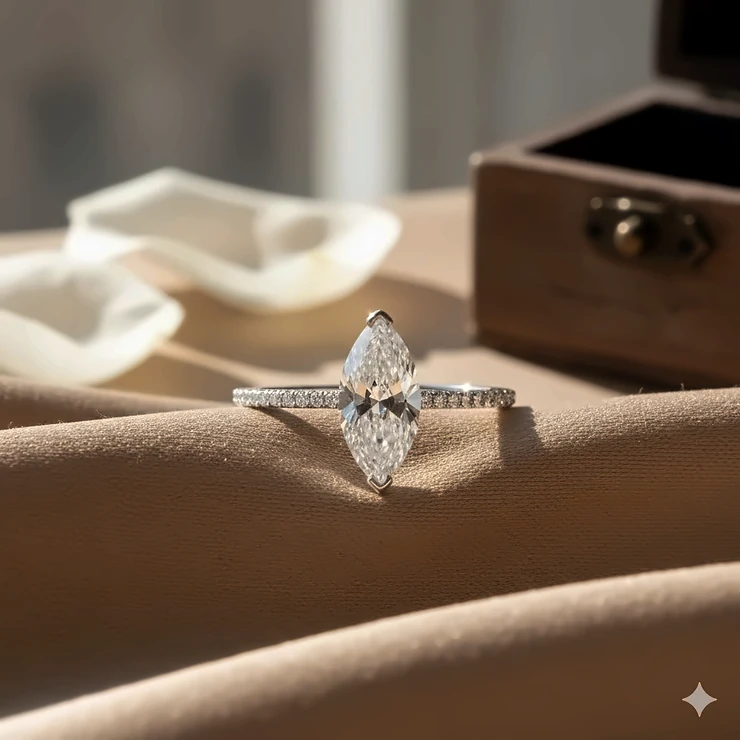
A 4 to 5 Carat Marquise Diamond Ring is an engagement or statement ring built around a pointed-ended, boat-shaped brilliant-cut center stone weighing between four and five carats. Its weight is spread across length rather than depth, so it faces up larger than a round of equal weight and visually lengthens the finger.
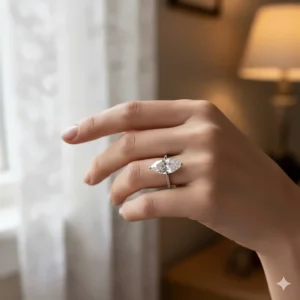
Some shapes whisper. This one makes an entrance. Marquise stones face up roughly 10-15% bigger than a round of the same carat weight, and at this scale that is a lot of stone. According to GIA’s marquise buying guide, the classic proportion is about twice as long as it is wide, with most stones that GIA grades falling between 1.6:1 and 2.2:1.
Size comes with homework, though. A 4 carat marquise diamond ring and a 5 carat marquise diamond ring are both rare in the natural-diamond world, where the stone alone can run from the tens of thousands into six figures. That is why most of the options you can realistically buy online are lab-grown diamonds, with a few moissanite alternatives for buyers who want the look at a fraction of the cost.
Here is the honest part. During research I found seven real Amazon listings that fit the brief, and most are made-to-order rings sold across a 1-5 carat range, so you must select the right carat option at checkout. I could not verify current prices or reliable review data for them. That is why you will see price ranges, “check current price” language, and analysis grounded in the specs instead of invented praise. The goal is simple: help you read a listing like a pro before you spend serious money.
Quick Comparison: 4 to 5 Carat Marquise Diamond Ring Options
| Product | Center Stone | Metal / Setting | Carat Option | Best For |
|---|---|---|---|---|
| Ringora 4 CT Marquise Solitaire | Lab-grown, IGI, E-F, VVS1-2 | 10K/14K/18K white gold, solitaire | 4 CT | Minimalists who want clean specs |
| Lab Grown Forever 4 CT Hidden Halo | Lab-grown, IGI, E-F, VVS1-2 | 10K/14K/18K gold, hidden halo | 4 CT | Side-profile sparkle |
| DIAMSLAND 4 Carat Marquise | Lab-grown, IGI, E, VVS2 | 14K/18K gold or platinum | 4 CT | Paperwork-first buyers |
| Houston Diamond District 3-4 Carat Side Stone | Lab-grown, E-F | 14K white gold, side stones | 3-4 CT | Extra finger coverage |
| LAB ICE Vintage Cathedral Marquise | Lab-grown, IGI, E-F, VVS2/VS1 | 14K rose gold, split shank | 1-5 CT | Vintage romantics |
| Aura 1–5 CT Marquise Moissanite | Moissanite, VVS1, colorless | 10K-18K white gold or 925 silver | 5 CT approx. | Big look, small budget |
| Marquise Moissanite Halo Solitaire (1-5 Ct) | Moissanite, VVS, colorless | 925 silver or solid gold, halo | 5 CT | Maximum size per dollar |
Read the table by tier. The first three are the “diamond-first” picks, with certified lab-grown stones and clear grades. The Houston Diamond District 3-4 Carat Side Stone and LAB ICE Vintage Cathedral Marquise trade a little purity for design personality. The two moissanite rings are not diamonds at all, and they are the only realistic route to a full five carats of visual presence on a modest budget. Amazon ratings are left out on purpose, because I could not verify them.
💬 Just one click — help others make better buying decisions too!😊
Top 7 4 to 5 Carat Marquise Diamond Ring Picks: Expert Analysis
Each pick below gets the same treatment: what the specs mean in practice, who it suits, and where the catches hide.
1. Ringora 4 CT Marquise Solitaire — cleanest spec sheet for the money
The headline here is a combination that is hard to find at this size: an IGI-certified lab-grown marquise graded VVS1-VVS2 clarity and E-F color, set in solid 10K, 14K or 18K white gold. In practice, E-F color reads as icy white next to white metal, and VVS clarity means inclusions are essentially invisible even at ten-times magnification. At four carats, the larger table acts like a bigger window for flaws, so strong clarity gives you headroom. A real-world caveat: you would likely not see the difference from a VS2 stone with the naked eye.
Based on the spec comparison, this is a ring for purists. The slim solitaire design lets the stone do all the work and maximizes that finger-lengthening effect. The trade-off is that a minimalist setting leaves the two points exposed unless the prongs are V-shaped, so confirm that before you order. I could not verify review themes for this listing at the time of research, so scan the verified-purchase reviews for comments on prong security and sizing accuracy.
Pros:
- ✅ IGI-certified lab-grown center stone
- ✅ Colorless E-F grade suits white gold
- ✅ Choice of 10K, 14K or 18K solid gold
Cons:
- ❌ Minimalist setting exposes the marquise points
- ❌ Review history unverified during research
Check current price. Finished lab-grown 4 carat rings generally land around $4,000-$10,000 according to market guides, so treat a listing far below that as a reason to ask questions.
2. Lab Grown Forever 4 CT Hidden Halo — sparkle that shows from the side
The standout feature is the hidden halo: a ring of small accent diamonds tucked beneath the center stone, invisible from above but glittering in profile. For comparison, a similar hidden-halo marquise at another retailer used 12 tiny rounds totaling about 0.05 carats. That is a design flourish, not extra size. The listing advertises IGI certification, E-F color, VVS1-2 clarity and 10K, 14K or 18K solid gold, with rose gold among the color options.
What the spec sheet will not tell you is the maintenance story. Every extra stone is another prong to check, and the underside collects lotion and soap film faster than a plain solitaire. If you love the idea of a ring that sparkles when your hand is resting on a table, this is the fit. If you want zero fuss, look at pick number one.
I could not confirm review sentiment here, so read the one- and two-star reviews first; they usually reveal sizing and finish issues quickly.
Pros:
- ✅ Hidden halo adds side-profile sparkle
- ✅ IGI-certified E-F, VVS1-2 center stone
- ✅ Rose, yellow and white gold choices
Cons:
- ❌ More crevices to clean and inspect
- ❌ Accent stones add little real size
Check current price; expect it to sit in the same band as other solid-gold lab-grown 4 carat rings, slightly higher for the added stones.
3. DIAMSLAND 4 Carat Marquise — most documentation, plus a platinum option
This listing leans into paperwork: an IGI-certified E color, VVS2 clarity lab-grown stone, 14K or 18K gold in white, yellow or rose, a platinum option, and a gold purity XRF report card alongside the IGI certificate. That report card is more useful than it sounds. It documents the metal’s purity, which is exactly the claim a mislabeled gold ring would fail.
The platinum option deserves attention at this stone size. Platinum is denser and holds prongs more securely over years of daily wear, which matters when two sharp points are the weak spot. The trade-off is weight and cost. For comparison, an E/VS1 IGI-certified platinum 4 carat marquise solitaire at another retailer sat in the mid-$5,000s at the time of research.
Review themes could not be verified for this exact listing. The 21 listed ring sizes are a good sign for fit, but confirm sizing and resizing policy before purchase.
Pros:
- ✅ IGI certificate plus gold purity report card
- ✅ Platinum option for prong durability
- ✅ 21 sizes listed for a better fit
Cons:
- ❌ Platinum raises price and ring weight
- ❌ Review sentiment unverified in research
Price range: broadly in line with solid-gold lab-grown peers, higher for platinum. Check current price.
4. Houston Diamond District 3-4 Carat Side Stone — extra finger coverage
The standout is the side-stone design: a prong-set marquise flanked by accent diamonds in 14K white gold, listed with E-F color and a VS-range clarity grade (confirm the exact clarity on the page). The same seller’s lineup also includes a channel-set 4 carat marquise graded G-H color and VS2-SI1 clarity, a sensible route if you want to trim cost.
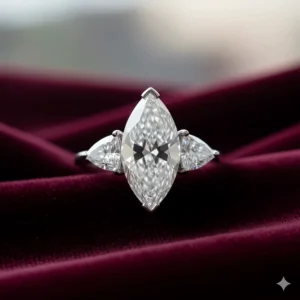
Here is the insight most buyers overlook: the “3-4 Carat” label means the total weight may include side stones. Other retailers show the pattern clearly, such as a 4 ctw ring with a 3 carat center and a 4.18 total carat ring built around a 3 carat marquise. Before you buy, confirm the center stone weight, not just the total. A side-stone ring can look wide and impressive, but a 3 carat center is not a 4 carat center.
I could not verify review themes for this listing. Ask the seller for measurements in millimeters.
Pros:
- ✅ Side stones widen the overall look
- ✅ Lower-grade G-H variant cuts cost
- ✅ 14K white gold suits colorless stones
Cons:
- ❌ Total weight may not equal center weight
- ❌ Clarity wording needs confirming on listing
Check current price; side-stone rings often cost less than a certified 4 carat solitaire center, but verify what you are really getting.
5. LAB ICE Vintage Cathedral Marquise — romance in rose gold
The standout is the vintage cathedral split-shank in 14K rose gold, with an IGI-certified E-F, VVS2/VS1 marquise offered across a 1-5 carat range and about 0.90 carats of round accent stones. The cathedral arches lift the center stone, and the split shank spreads the visual weight across your finger.
On paper, that raised profile is gorgeous and a little riskier. A tall setting on a 4 or 5 carat marquise catches on sleeves and gloves more easily, so it suits desk-and-dinner lifestyles better than hands-on jobs. Rose gold also adds warmth that can flatter an E-F stone by contrast, though some buyers prefer to keep a colorless stone in white metal. Because the listing covers a wide carat range, check that you have selected exactly 4 or 5 carats at checkout.
Review sentiment could not be confirmed during research, so look for comments on finish quality around the split shank.
Pros:
- ✅ Cathedral setting lifts and showcases the stone
- ✅ IGI-certified E-F center stone
- ✅ 14K rose gold adds vintage warmth
Cons:
- ❌ Tall profile can snag on clothing
- ❌ More metalwork to clean and inspect
Check current price; accent stones and 5 carat selections move it toward the upper end of solid-gold lab-grown rings.
6. Aura 1–5 CT Marquise Moissanite — the budget route to a five-carat look
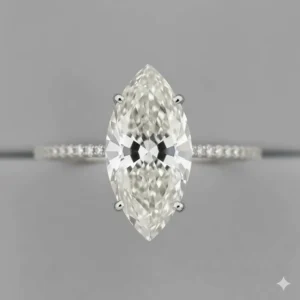
This is not a diamond, and that is the point. The listing describes a roughly 5 carat marquise brilliant moissanite, VVS1 and colorless, in a prong-set knife-edge solitaire, available in 10K, 14K or 18K white gold or 925 sterling silver, with a gold purity XRF report card on gold purchases.
Moissanite is known for more fire than diamond, which means more rainbow flash and a slightly different sparkle personality. Market guides put 5 carat moissanite rings at around $1,600-$1,900 for custom solid-gold designs, and sterling silver versions sit well below that. One caution: moissanite is lighter than diamond, so a “5 carat” moissanite can be sized by diamond-equivalent weight. Ask for the millimeter dimensions so you know the stone you are getting.
Review sentiment is unverified here, so lean on the listing’s measurements and return policy instead.
Pros:
- ✅ Five-carat visual scale at a low cost
- ✅ Gold purity report with gold purchases
- ✅ Knife-edge shank looks slim and refined
Cons:
- ❌ Moissanite is not a diamond
- ❌ Carat claims may be diamond-equivalent
Price range: far below lab-grown diamonds; check current price and metal choice.
7. Marquise Moissanite Halo Solitaire (1-5 Ct) — maximum size per dollar
The standout is the halo: round moissanites circling a 5 carat marquise center in 925 silver or solid 10K-18K gold. The listing cites a Mohs hardness of 9.25 and a refractive index of 2.65 for moissanite, which are the seller’s claims and worth treating as such. Diamond sits at 10 on the Mohs scale, so moissanite is tough but a notch softer.
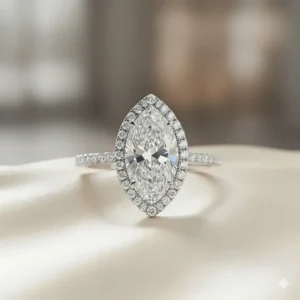
Halos change how a marquise reads. A retailer’s guidance suggests picking a slightly higher length-to-width ratio when you add a halo, because the halo makes the stone look wider. In practice that means a slimmer marquise inside the halo looks balanced instead of squat. The trade-off is bulk on the finger, and sterling silver is softer than gold, so expect more wear on the band.
I could not verify review themes. Because 925 silver is often plated, ask about rhodium plating and how often it needs refreshing.
Pros:
- ✅ Halo adds apparent width and glitter
- ✅ Very low cost for five carats
- ✅ Gold and silver options available
Cons:
- ❌ Silver band wears faster than gold
- ❌ Halo adds bulk and cleaning effort
Price range: the budget end of this list. Check current price.
Practical Usage Guide: Your First 30 Days With a Marquise Ring
Think of the first month as setting good habits for a ring that has two pointed weak spots.
- Verify before you celebrate. Match the IGI report number to the stone’s laser inscription or the lab’s online lookup, and keep the XRF gold purity card with your documents. Get an insurance appraisal within the return window.
- Inspect the points. Look under bright light at each tip. A V-shaped prong should cover the point completely, with no gap you can slide a fingernail into.
- Do the sizing carefully. A ring with a heavy stone spins if it is too loose, which makes the stone turn sideways. Sizing bands help, and solid gold rings can usually be resized, but ask about limits before you buy.
- Learn your cleaning routine. Warm water, mild soap and a soft brush every week or two keep the underside clear. Be careful with ultrasonic cleaners if your setting has many small accent stones.
- Schedule a prong check. Have a jeweler check prongs twice a year. For white gold and silver, ask when rhodium replating will be due; the FTC’s guides treat rhodium plating as something sellers should disclose.
- Know the first-month mistakes. Wearing the ring to the gym, leaving it on while washing dishes, and tossing it loose into a bag are the usual culprits.
Real-World Scenarios: Three Buyers, Three Rings
Here are three hypothetical buyers, matched to the options above with the reasoning shown.
Priya, the minimalist (budget: around $6,000). She wants a clean look, wears the ring daily, and likes jewelry that does not shout over her outfit. The Ringora 4 CT Marquise Solitaire or the DIAMSLAND 4 Carat Marquise in platinum matches her. The certificate and metal documentation protect a purchase this size, and platinum prongs suit a ring she wears daily.
Marcus, the budget-conscious size-chaser (budget: under $1,500). He wants maximum visual impact for a proposal and accepts that the stone is moissanite, not a diamond. The Aura 1–5 CT Marquise Moissanite gives him five carats of presence, as long as he asks for the stone’s millimeter dimensions and tells his partner what the stone is.
Jo, the vintage romantic who is active on weekends (budget: $4,000-$7,000). She loves rose gold and an antique look but climbs, cooks and carries bags. The LAB ICE Vintage Cathedral Marquise captures the style, though a lower profile like the Houston Diamond District 3-4 Carat Side Stone suits her lifestyle better. A smart compromise is a lower cathedral height plus V-prongs.
Buyer’s Decision Framework: If This, Choose That
Use this as a quick priority checklist.
- If certificates and paperwork matter most, choose the DIAMSLAND 4 Carat Marquise, because the IGI certificate and gold purity card are included.
- If you want a pure solitaire, choose the Ringora 4 CT Marquise Solitaire, because the specs are clean and nothing competes with the stone.
- If you want sparkle from every angle, choose the Lab Grown Forever 4 CT Hidden Halo, because the hidden accents glitter in profile.
- If you want a wider look, choose the Houston Diamond District 3-4 Carat Side Stone, but confirm the center stone weight.
- If you want vintage charm, choose the LAB ICE Vintage Cathedral Marquise, but mind the profile height.
- If size matters more than origin, choose the Aura 1–5 CT Marquise Moissanite or the Marquise Moissanite Halo Solitaire (1-5 Ct), and tell the recipient what the stone is.
✨ Ready to compare these rings side by side?
🔍 Take your search for a 4 to 5 Carat Marquise Diamond Ring to the next level with these carefully selected options. Click on any highlighted product to check current pricing and availability. A well-chosen ring can become the piece your family talks about for years!
How to Choose a 4 to 5 Carat Marquise Diamond Ring
Start with this seven-step checklist. It works whether you are looking at a lab-grown diamond or a moissanite.
- Pick your origin first. Natural, lab-grown or moissanite each has a very different price and resale story, so decide this before anything else.
- Check the length-to-width ratio. Aim for roughly 1.85 to 2.10 for a classic look. Stones above about 2.25 are more prone to a pronounced bow-tie.
- Judge the bow-tie by eye. It is a dark shadow across the center and it is not graded on certificates, so ask for photos or video. Per Whiteflash’s marquise guide, some bow-tie is common; the problem is when it is large and distracting.
- Prioritize certified stones. A GIA or IGI report gives you measurements to calculate the ratio yourself.
- Balance color and clarity. In white metal, stay near the colorless range; in yellow or rose gold you can relax a little. At this size, eye-clean clarity matters more than the top grade.
- Protect the points. Look for V-tip prongs or a bezel-style protection for the tips.
- Match the setting to your life. Low profile for active hands, cathedral or halo for dressier use.
4 Carat Marquise Diamond Ring: Size, Price and Who It Suits
A 4 carat marquise diamond ring is the sweet spot for many buyers. One guide lists a typical 4 carat marquise at about 16.48 mm by 8.24 mm by 5.03 mm, a large presence that still fits comfortably on most hands.
The price spread is dramatic. In June 2026, a market guide showed natural 4 carat marquise stones ranging from roughly $39,000 to $210,000, with an average near $96,000. A lab-grown stone of the same size, by contrast, was recently tracked at roughly $2,000-$2,500 for the stone alone, and a finished ring typically runs a few thousand dollars on top. That gap is why nearly every 4 carat marquise diamond ring you will find on Amazon is lab-grown.
Who does it suit? Buyers who want a bold statement without the practical headaches of a five-carat ring. A 4 carat marquise diamond ring also tends to pair well with a plain band, which keeps the whole look elegant rather than overloaded. The Ringora 4 CT Marquise Solitaire, the Lab Grown Forever 4 CT Hidden Halo and the DIAMSLAND 4 Carat Marquise are the clearest fits for this size.
5 Carat Marquise Diamond Ring: When Bigger Is Smarter (and When It Isn’t)
A 5 carat marquise diamond ring pushes into serious territory. Scaling up from the 4 carat benchmark, expect a stone around 17.5 to 18 mm tip to tip. That is long enough to dominate a hand, which is thrilling for some wearers and impractical for others.
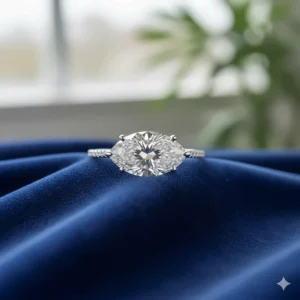
Where does bigger make sense? If you wear rings on a larger or longer finger, a 5 carat marquise diamond ring looks proportional rather than overwhelming. If you work with your hands, type all day or put on gloves often, the length and weight can become a daily irritation. East-west orientation, where the marquise sits sideways across the finger, is one design answer that some jewelers use for very long stones.
Value is the other factor. At five carats, the lab-grown versus moissanite question becomes a budget decision. A five carat lab-grown marquise remains a premium purchase, while the Aura 1–5 CT Marquise Moissanite and the Marquise Moissanite Halo Solitaire (1-5 Ct) deliver the look for a fraction of the cost. The LAB ICE Vintage Cathedral Marquise also lists a 5 carat option within its range.
Lab-Grown vs Natural vs Moissanite: What Changes at This Size
| Feature | Natural Diamond | Lab-Grown Diamond | Moissanite |
|---|---|---|---|
| Stone cost at 4 carats | Roughly $39,000-$210,000 | Roughly $2,000-$2,500 | Not a diamond; far lower |
| Chemistry | Diamond | Chemically a diamond | Different material |
| Hardness | Mohs 10 | Mohs 10 | Mohs about 9.25 |
| Resale outlook | Strongest | Typically lower | Typically lowest |
| Best For | Heirloom investment buyers | Ringora 4 CT Marquise Solitaire and DIAMSLAND 4 Carat Marquise buyers | Aura 1–5 CT Marquise Moissanite buyers |
Looking at the table, the cost gap is the story. Natural diamonds at this size are priced like real estate, while lab-grown stones give you the same chemistry for a tiny fraction. If you are buying purely as an investment, one buying guide warns to think twice before choosing a cheaper synthetic stone. Moissanite is the budget wildcard: you get the visual scale, but it is a different gem, with a different sparkle and a different resale picture.
Common Mistakes When Buying a 4 to 5 Carat Marquise Diamond Ring
Marquise rings are unforgiving of shortcuts. These are the traps worth dodging.
- Treating total weight as center weight. A “4 ctw” ring can hold a 3 carat center, as retailer examples show.
- Ignoring the length-to-width ratio. A stone that is too short looks stubby, and one that is too long can look narrow and show a heavy bow-tie.
- Chasing the top clarity grade. At these sizes, a clean VS2 can look identical to VVS to the naked eye. Spend on cut and proportions instead.
- Skipping the certificate. Without a report, you cannot confirm measurements or grades. Marquise stones are especially hard to judge because GIA does not give them an overall cut grade.
- Forgetting point protection. A chipped tip is the most common heartbreak with this shape.
- Buying “diamond” language blindly. A moissanite sold as a diamond, or a lab-grown stone with unclear labeling, is a red flag.
- Ordering the wrong carat option. Many listings cover a 1-5 carat range, so double-check the selection before you pay.
Long-Term Cost & Maintenance: The Real Price of Ownership
The sticker price is only the opening bid. A 4 to 5 Carat Marquise Diamond Ring needs insurance, periodic prong checks and, for white metals, occasional replating.
| Ring Type | Typical Finished Cost Range | Ongoing Costs | Best For |
|---|---|---|---|
| Natural 4 carat marquise | Roughly $20,000-$136,000+ | Higher insurance, prong checks | Heirloom buyers |
| Lab-grown 4 carat marquise | Roughly $3,650-$45,000 | Insurance, prong checks | Ringora 4 CT Marquise Solitaire buyers |
| 5 carat moissanite marquise | Roughly $1,600-$1,900 for gold | Replating if silver or plated | Aura 1–5 CT Marquise Moissanite buyers |
For context, a Brilliant Earth pricing guide puts a 4 carat natural ring at roughly $20,150 to $136,650 and a lab-grown version at roughly $3,650 to $45,150, both with a simple solitaire setting. The analysis is straightforward. Lab-grown rings win decisively on upfront cost, while natural stones hold value better. If you wear the ring daily, factor in an annual jeweler visit, and remember that a Marquise Moissanite Halo Solitaire (1-5 Ct) in sterling silver will likely need more frequent attention than a solid-gold design.
Safety, Labeling and FTC Rules Every Buyer Should Know
The Federal Trade Commission’s Jewelry Guides are the rulebook behind these listings, and they matter more when the stone is lab-grown or a simulant.
- Lab-grown disclosure is required. The FTC’s 2018 revision stopped treating “natural” as part of the definition of a diamond, but sellers must still clearly disclose a lab-grown origin. Recommended terms include laboratory-grown, laboratory-created and manufacturer-created, according to JCK’s coverage of the update.
- Avoid loaded words. The guides caution against using “real,” “genuine” or “natural” in ways that imply a lab-grown diamond is not a diamond, and the reverse applies to simulants.
- Moissanite is not a lab-grown diamond. Sellers shouldn’t blur that line.
- Plating and metal marks matter. The FTC treats rhodium plating disclosure as part of honest labeling, and karat marks should match the metal.
- Carat weight is a measurement. One carat equals 0.2 grams.
The practical takeaway: if a listing says “diamond” without a qualifier and the price looks too good, ask questions before paying.
FAQ
❓ How many millimeters is a 4 carat marquise diamond ring?
❓ Is a 5 carat marquise diamond ring practical for daily wear?
❓ Are lab-grown stones in a 4 to 5 Carat Marquise Diamond Ring worth buying?
❓ Can I safely buy a 4 to 5 Carat Marquise Diamond Ring on Amazon?
❓ What setting makes a 5 carat marquise diamond ring look best?
Conclusion
A 4 to 5 Carat Marquise Diamond Ring is one of the boldest choices in jewelry, and the right one rewards careful shopping. If you want certified lab-grown quality, the Ringora 4 CT Marquise Solitaire, the Lab Grown Forever 4 CT Hidden Halo and the DIAMSLAND 4 Carat Marquise form your strongest shortlist. If you want a wider or more romantic look, the Houston Diamond District 3-4 Carat Side Stone and the LAB ICE Vintage Cathedral Marquise bring personality. And if a full five carats of presence matters more than the stone’s origin, the Aura 1–5 CT Marquise Moissanite and the Marquise Moissanite Halo Solitaire (1-5 Ct) deliver it for much less.
Whichever you choose, verify the certificate, check the length-to-width ratio, protect those points and confirm exactly which carat option you selected. A 4 carat marquise diamond ring and a 5 carat marquise diamond ring are both showpieces; the smart move is making sure the specs behind the sparkle are real.
🔍 Ready to find your ring? Click on any highlighted product above to check current pricing and availability, and give yourself the ring she (or you!) will never stop admiring. 💍✨
Recommended for You
- 1 to 3 Carat Marquise Diamond Ring: 7 Stunning Picks 2026
- Vintage Marquise Engagement Rings: 7 Stunning Picks for 2026
- Unique Marquise Engagement Rings: 7 Stunning Picks for 2026
Disclaimer: This article contains affiliate links. As an Amazon Associate, I earn from qualifying purchases. If you purchase products through these links, we may earn a small commission at no additional cost to you.
✨ Found this helpful? Share it with your friends! 💬🤗
