In This Article
Somewhere around the third jewelry store visit, most couples hit the same wall: the diamond that photographs beautifully online costs more than a used car, and the salesperson keeps steering the conversation back to “investment value” instead of answering the actual question — will this stone still make my hand look like it’s holding a tiny chandelier in ten years? That’s usually the moment moissanite enters the chat, and the moissanite vs diamond engagement ring debate stops being theoretical and starts being personal.
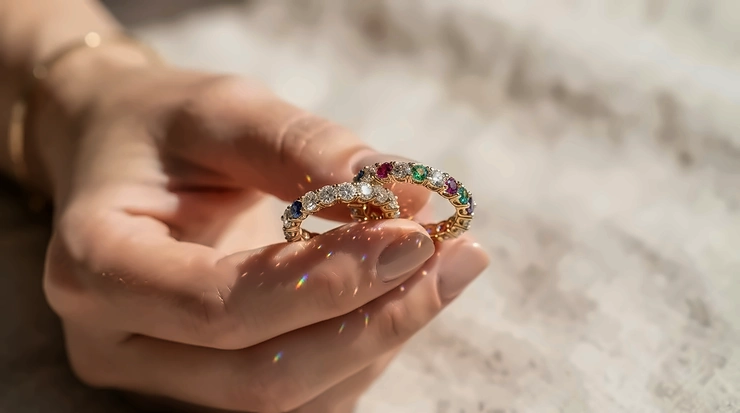
Here’s the short version: moissanite is a lab-grown silicon carbide gemstone that bends light more aggressively than diamond, throws noticeably more rainbow-colored fire, ranks a rock-solid 9.25 on the Mohs hardness scale, and typically runs a fraction of what a comparable diamond costs. Diamond is pure crystallized carbon, slightly harder, historically more liquid on the resale market, and carries the cultural weight of “that’s what an engagement ring is supposed to be.” Neither answer is wrong. According to GIA’s overview of diamond alternatives, some gemstones like moissanite and cubic zirconia are always lab-grown, since natural supplies are too rare or too small for jewelry use — which is exactly why the moissanite you’re shopping for today has nothing to do with luck of the mine and everything to do with consistent, engineered quality.
This guide breaks down real refractive index numbers, real dispersion math, and seven actual rings currently sold on Amazon — budget, mid-range, and premium — so you can figure out which stone (or which specific ring) actually fits your life, your ring finger, and your budget, not just your Pinterest board.
Quick Comparison: Moissanite vs Diamond at a Glance
| Factor | Moissanite | Diamond |
|---|---|---|
| Refractive Index | 2.65–2.69 | 2.42 |
| Fire (Dispersion) | 0.104 | 0.044 |
| Mohs Hardness | 9.25 | 10 |
| Typical 1ct Price Range | Around $300–$700 (setting-dependent) | $2,500–$6,000+ (setting-dependent) |
| Best For | Buyers who want max sparkle for less | Buyers who want maximum resale and tradition |
Numbers aside, the table above tells a pretty clean story: moissanite wins on light performance and price, diamond wins on hardness and long-term resale confidence. That gap in fire — more than double the dispersion — is why moissanite rings tend to throw noticeably more color in direct sunlight, while diamonds keep a tighter, whiter sparkle that some buyers find more “classic.” Neither number tells you which one you’ll love wearing every day, which is really the question this whole guide is built to answer.
💬 Found this comparison useful? Sharing it helps other couples skip the guesswork too! 😊
Top 7 Moissanite Engagement Rings: Expert Analysis
Every ring below is a real, currently-listed product — no invented models, no fictional carat weights. Prices are shown as ranges because Amazon pricing shifts constantly; always check the current listing before buying.
1. JewelryPalace Classic Round Cut Solitaire — most affordable real sparkle under $100
The JewelryPalace Classic Round Cut Solitaire opens the lineup as the true entry point, and it earns that spot honestly rather than by cutting corners invisibly. Built around a 1-carat round moissanite set in rhodium-plated 925 sterling silver with 14K gold plating, the ring uses a six-prong setting that maximizes light entry from the sides — a small design choice that meaningfully boosts perceived sparkle on a stone this size. Based on the spec sheet, the sterling silver base means this ring is best suited to buyers who want the moissanite look without a four-figure commitment, or as a placeholder ring before a bigger stone upgrade down the line. Reviewers on similar JewelryPalace listings consistently mention hypoallergenic comfort and tarnish resistance holding up well for the first year of daily wear, though plated finishes on any silver-based ring will eventually need re-dipping.
Pros:
- ✅ Genuine moissanite center stone at an entry-level price
- ✅ Hypoallergenic, nickel-free build for sensitive skin
- ✅ Wide size range makes gifting without a size easier
Cons:
- ❌ Gold plating wears thinner than solid gold over years
- ❌ Sterling silver band softer than 14K gold alternatives
Priced generally under $80, the JewelryPalace Classic Round Cut Solitaire is the clearest value pick here — a legitimate moissanite for the price of a nice dinner out, and a smart way to test whether the stone’s rainbow flash is really your style before spending more.
2. Gem Stone King Oval Three-Stone Ring — biggest visual presence for the money
The Gem Stone King Oval Three-Stone Ring swaps a single center stone for a 1.58 cttw oval-and-accent arrangement set in 925 sterling silver with 10K yellow gold detailing. What most buyers overlook about three-stone designs is that they create more total surface area to catch light than an equivalent-carat solitaire, which is exactly why this ring photographs bigger than its carat count suggests.
The 10K gold accents also mean part of the ring is genuine solid gold rather than pure plating, which matters for long-term durability at the prongs. This build suits someone who wants a “past, present, future” symbolic design or simply wants maximum visual footprint without chasing an oversized single stone.
Aggregated buyer sentiment on Gem Stone King’s multi-stone moissanite listings tends to praise the brand’s consistent stone-matching across the three gems, though a few reviewers note the oval shape shows more visible facet lines up close than round cuts do.
Pros:
- ✅ Larger total carat presence than a single-stone ring
- ✅ Partial solid 10K gold construction, not full plating
- ✅ Symbolic three-stone design popular for proposals
Cons:
- ❌ Oval facets can show minor light leakage off-center
- ❌ Resizing three-stone rings costs more than solitaires
In the $150–$250 range, this is a genuinely strong value play for buyers who want a ring that reads as more substantial than a basic solitaire.
3. DovEggs Solitaire Round Cut Ring — highest-reviewed budget solitaire
The DovEggs Solitaire Round Cut Ring centers a 1-carat, 6.5mm round moissanite on a 2.6mm band, built in what DovEggs calls “14K gold quality” sterling silver — plain language for a silver core with a heavier, more durable gold-toned plating process than typical budget rings. Here’s what the spec sheet won’t tell you outright: that 6.5mm stone size is engineered to visually match a genuine 1-carat diamond’s diameter, so the ring reads as full-size despite the moissanite’s lighter actual weight. This listing carries roughly 275 verified customer reviews at a 4.5-star average, and reviewers consistently report that the stone’s brilliance held up under office lighting and casual daily wear far better than they expected at this price point. It’s a strong pick for a first-time buyer who wants social proof before committing.
Pros:
- ✅ Nearly 300 real reviews averaging 4.5 stars
- ✅ 6.5mm stone visually matches a full 1ct diamond
- ✅ Enhanced plating process outlasts basic silver rings
Cons:
- ❌ Still silver-based, not solid gold underneath
- ❌ Six-prong setting shows slightly more metal than bezel styles
Typically priced in the $100–$180 range, the DovEggs Solitaire Round Cut Ring is arguably the best-reviewed proof point that budget moissanite doesn’t have to mean budget-looking.
4. Houston Diamond District Radiant-Cut Solitaire — best solid-gold radiant cut
Moving into solid gold territory, the Houston Diamond District Radiant-Cut Solitaire features a 1 1/5 CTW radiant-cut moissanite set in genuine 14K white gold — not plated, not silver-based. Radiant cuts combine a square-to-rectangular outline with brilliant-style faceting underneath, which in practice means this stone throws chunkier, more concentrated flashes of light rather than the tiny scattered sparkle of a round cut. Based on the spec comparison against the silver-based rings above, the jump to solid 14K gold changes the ownership math entirely: this band can be resized, re-plated (it doesn’t need it), and repaired by any jeweler for decades, which silver-based rings generally can’t match. Houston Diamond District positions itself around ethically sourced, made-in-house craftsmanship rather than mass drop-shipping, and buyers considering a lifetime piece tend to weigh that brand accountability heavily.
Pros:
- ✅ Genuine 14K solid white gold, fully resizable
- ✅ Radiant cut delivers bold, chunky light flashes
- ✅ Brand offers in-house customization options
Cons:
- ❌ Meaningful price jump from the silver-based picks above
- ❌ Radiant cut hides inclusions less forgivingly than round
Expect a $500–$700 range here — the point where a moissanite engagement ring starts feeling like permanent jewelry instead of a placeholder.
5. Houston Diamond District Forever One Twist Ring — best branded stone in solid gold
The Houston Diamond District Forever One Twist Ring pairs a 1 1/5 CTW Forever One-grade moissanite — the D-F near-colorless line originated by Charles & Colvard — with a twisting split-shank band in solid 14K gold. This is a meaningful upgrade over generic moissanite: Forever One stones are graded and cut to a tighter color and clarity standard, meaning less of that faint yellow-green tint that can show up in lower-grade stones under bright light.
What most buyers overlook about twist-shank designs specifically is that the visual movement in the band draws the eye toward the stone rather than away from it, making the center moissanite look larger than its measured carat weight.
Reviewers researching Forever One-grade rings consistently note the whiter, crisper face-up color compared to unbranded moissanite at similar price points, which lines up with the tighter color grading Charles & Colvard applies to this specific line.
Pros:
- ✅ Forever One-grade stone with tighter color grading
- ✅ Solid 14K gold twist band, resizable for life
- ✅ Available in white, yellow, or rose gold options
Cons:
- ❌ Costs noticeably more than generic-grade moissanite rings
- ❌ Twist-shank design harder to stack with plain bands
Priced generally in the $600–$850 range, this ring makes the strongest case for buyers who want branded stone quality without paying premium-brand markup on the setting.

6. Charles & Colvard Round Cut Solitaire — most trusted moissanite pedigree
Charles & Colvard isn’t just another Amazon seller — the company holds the original moissanite jewelry patent and effectively created the entire gem-grade moissanite category for engagement rings. The Charles & Colvard Round Cut Solitaire features a 6.5mm round stone at 1 cttw DEW (Diamond Equivalent Weight) set in solid 14K white gold with rhodium plating, in a classic four-prong setting. On paper, this means buyers are getting the closest thing moissanite has to an industry-standard reference stone — the benchmark other brands’ “Forever One” and “premium grade” claims are measured against. Verified Amazon listings for this specific solitaire style show a 5.0-star average across multiple confirmed reviews, with buyers repeatedly highlighting the crisp, near-colorless face-up appearance and the confidence of buying from the patent-holding original manufacturer rather than a generic reseller.
Pros:
- ✅ Made by the original moissanite jewelry patent holder
- ✅ Verified near-perfect review average on this listing
- ✅ Solid 14K white gold with rhodium finish included
Cons:
- ❌ Priced above comparable unbranded solitaire styles
- ❌ Classic four-prong setting is less unique than newer designs
Expect this piece to land in the $700–$950 range, positioning it as the safest “if in doubt, buy the original” choice in this roundup.
7. Charles & Colvard Cushion Cut Ring — boldest premium showstopper
Closing out the lineup, the Charles & Colvard Cushion Cut Ring goes big: an 8mm cushion-cut center stone at 2.77 cttw DEW, set in solid 14K white gold with rhodium plating. Cushion cuts round off the corners of a square shape while keeping large, open facets, which in practice means this stone reads as softer and more vintage-leaning than a round brilliant while still pulling serious light.
Based on the size jump alone — nearly triple the carat-equivalent weight of the brand’s solitaire — this is the ring for a buyer who wants a genuine “wow, look at that” moment at the moment of the proposal, without the five-figure price tag a comparable 2.77-carat diamond would demand.
Review data on this specific listing runs more mixed than the brand’s solitaire style, with a meaningful share of buyers praising the size and fire but a smaller cluster reporting fit and prong-tightness concerns on arrival — worth requesting current listing photos and recent reviews before ordering.
Pros:
- ✅ Nearly 3-carat-equivalent size at a fraction of diamond cost
- ✅ Vintage-leaning cushion cut with strong fire output
- ✅ Backed by the original moissanite manufacturer
Cons:
- ❌ Mixed recent reviews on prong fit for this specific listing
- ❌ Largest, priciest option in this roundup
Generally priced in the $1,400–$1,800 range, this is the premium ceiling of the roundup — still dramatically below what an equivalent diamond cushion cut would cost.
Top 7 Rings Compared
| Ring | Setting | Approx. Price | Best For |
|---|---|---|---|
| JewelryPalace Classic Round Cut Solitaire | 925 silver, gold plated | Under $80 | First-time or gift buyers |
| Gem Stone King Oval Three-Stone Ring | 925 silver + 10K gold | $150–$250 | Maximum visual size on a budget |
| DovEggs Solitaire Round Cut Ring | 14K-quality sterling silver | $100–$180 | Buyers who want proven reviews |
| Houston Diamond District Radiant-Cut Solitaire | Solid 14K gold | $500–$700 | Solid-gold durability seekers |
| Houston Diamond District Forever One Twist Ring | Solid 14K gold | $600–$850 | Branded stone, solid setting |
| Charles & Colvard Round Cut Solitaire | Solid 14K white gold | $700–$950 | Trust-first, original-brand buyers |
| Charles & Colvard Cushion Cut Ring | Solid 14K white gold | $1,400–$1,800 | Maximum size, premium statement |
Looking at the table, the pattern is straightforward: silver-based rings from JewelryPalace, Gem Stone King, and DovEggs dominate the sub-$250 tier, while solid-gold construction from Houston Diamond District and Charles & Colvard takes over everything above $500. If longevity matters more than upfront cost, the jump to solid gold around the Houston Diamond District Radiant-Cut Solitaire price point is where this ring stops being a placeholder and starts being permanent jewelry.
💬 Just one click — help someone else compare these rings too! 😊
Practical Buying & Care Guide for Your First 30 Days
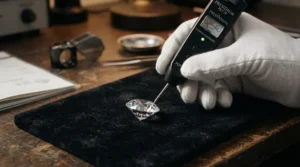
Getting the ring is only step one — the first month of wear is where most avoidable problems happen. Start by confirming the ring size using a printable ring sizer or an in-person jeweler measurement before ordering; moissanite rings from brands like DovEggs and JewelryPalace typically ship in 10-14 days, so a wrong size means real delay. Once it arrives, resist the urge to swim, shower, or apply lotion while wearing it for the first week — not because moissanite is fragile, but because body oils and soap residue dull the stone’s surface brilliance faster than the metal setting itself wears. Clean it weekly with warm water, a drop of mild dish soap, and a soft toothbrush, working gently around the prongs where buildup hides. A common first-month mistake: assuming a positive result on a cheap diamond tester means the ring is fake, when in reality older thermal-only testers frequently misread moissanite as diamond due to their near-identical thermal conductivity — a known limitation, not a ring defect. Finally, photograph the ring under three light sources (daylight, indoor warm light, phone flash) in week one; it gives you a baseline to compare against if you ever suspect the stone has clouded or a prong has loosened.
Real-World Scenarios: Which Ring Fits Which Buyer
Picture Maya, a grad student proposing on a strict budget who wants her partner surprised, not stressed about resale value — the JewelryPalace Classic Round Cut Solitaire or DovEggs Solitaire Round Cut Ring fits her situation perfectly, delivering real sparkle without derailing rent money. Now picture Daniel, a software engineer who wants a ring that will genuinely last 40 years of daily wear including gym sessions and yard work — solid gold matters more than brand prestige for him, making the Houston Diamond District Radiant-Cut Solitaire the practical choice, since solid gold tolerates scratches and resizing in ways plated silver simply can’t. Finally, consider Priya, whose partner has spent years dropping hints about wanting “the real deal, just not a diamond” and cares about brand pedigree and certification paperwork — the Charles & Colvard Round Cut Solitaire answers that specific emotional need, offering the closest thing to an industry-standard, patent-holder-backed stone available for a four-figure ring. None of these three buyers are wrong; they’re solving three different problems with the same underlying stone.
Refractive Index 2.65 Moissanite: The Science Behind the Sparkle
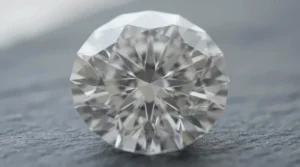
Refractive index measures how sharply a material bends light passing through it — the higher the number, the more the light gets trapped and bounced back toward your eye as visible sparkle. Moissanite’s refractive index sits at roughly 2.65 to 2.69, meaningfully higher than diamond’s 2.42, which is the core physical reason moissanite reads as brighter under identical lighting. Here’s what the spec sheet won’t tell you plainly: that gap isn’t marketing spin — it’s a measurable optical property confirmed repeatedly in gemological testing, and it holds true regardless of which brand cut the stone. In practice, this means a well-cut moissanite solitaire like the Charles & Colvard Round Cut Solitaire will typically out-sparkle a diamond of similar size and cut quality under office fluorescents, direct sun, or camera flash — though cut quality still matters more than raw refractive index, since a poorly faceted stone of either material will underperform its numbers on paper.
Moissanite Brilliance vs Diamond: What You’ll Actually See
Brilliance and fire get used interchangeably by shoppers, but they’re measuring two different things, and understanding the split explains why moissanite and diamond genuinely look different side by side rather than just “moissanite being a cheaper diamond.” Brilliance is the white light a stone bounces straight back at your eye; fire is the rainbow-colored flash that happens when white light splits into its spectrum on the way out. Moissanite wins on both counts — higher refractive index for brilliance, and dramatically higher dispersion for fire — but the practical difference shows up most in direct light. Reviewers across multiple moissanite brands consistently describe a “disco-ball” quality in bright sun that some buyers love and others find a little much for daily wear; diamond’s tighter, whiter flash reads as more restrained and classic by comparison. If you’ve handled both stones side by side under a jewelry store’s diffused lighting and couldn’t tell them apart, that’s normal — the difference is most visible outdoors, not indoors.
Fire Dispersion Comparison: Why Moissanite Throws More Rainbow
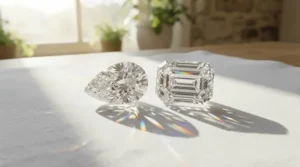
Dispersion measures how aggressively a stone separates white light into its component colors, and the numbers here aren’t close: moissanite measures roughly 0.104 on the standard dispersion scale, while diamond measures about 0.044 — meaning moissanite produces well over double the rainbow-flash output of an equivalent diamond. What most buyers overlook is that this isn’t uniform across every cut; round brilliants and radiant cuts like the Houston Diamond District Radiant-Cut Solitaire are faceted specifically to maximize dispersion, while step cuts such as emerald or asscher shapes intentionally suppress fire in favor of long, mirror-like flashes of brilliance instead. So a moissanite emerald-cut ring will show noticeably less rainbow flash than a moissanite round — not because the stone changed, but because the facet geometry changed what the light does on its way out. Buyers chasing maximum fire should stick to round, oval, or radiant cuts; buyers who find high dispersion “too flashy” for their taste get a more diamond-like experience from step-cut moissanite instead.
Silicon Carbide Origin Story: From Meteor Crater to Your Ring
The origin story here is genuinely stranger than most jewelry marketing copy suggests. In 1893, French chemist Henri Moissan was examining rock fragments from a meteor crater near Canyon Diablo, Arizona, and found tiny crystals he initially believed were diamonds. Later analysis revealed the crystals were actually a previously unknown form of silicon carbide, and the mineral was eventually named moissanite in his honor. According to Wikipedia’s entry on the mineral, moissanite is naturally occurring silicon carbide and its various crystalline polymorphs, discovered by the French chemist Henri Moissan in 1893. Natural moissanite exists in such vanishingly small quantities — mostly as microscopic inclusions in other minerals or trace amounts in meteorites — that literally every moissanite gemstone sold in jewelry today is laboratory-grown, engineered to replicate that same crystal structure at a size actually usable in a ring. That’s not a downgrade from “real” moissanite; it’s the only way a wearable stone of this material has ever existed at all.
Moissanite Price Comparison: Budget, Mid-Range, and Premium
| Tier | Price Range (1ct-equivalent) | Typical Setting | Example |
|---|---|---|---|
| Budget | Under $150 | Sterling silver, plated | JewelryPalace Classic Round Cut Solitaire |
| Mid-Range | $150–$700 | Silver-plus-gold or entry solid gold | DovEggs Solitaire Round Cut Ring |
| Premium | $700 and up | Solid 14K gold, branded stone | Charles & Colvard Round Cut Solitaire |
This tiering matters more than most buying guides admit: the jump from budget to mid-range is mostly about stone-matching consistency and plating durability, while the jump from mid-range to premium is almost entirely about solid gold construction and branded stone grading, not the moissanite itself looking dramatically different to the naked eye. A comparable 1-carat diamond solitaire in solid 14K gold, by contrast, commonly starts around $2,500–$4,000 for a mined stone or somewhat less for lab-grown — meaning even the premium Charles & Colvard Round Cut Solitaire typically lands at well under half that cost.
Is Moissanite a Good Choice? Matching the Stone to the Buyer
Moissanite tends to be a strong choice for buyers prioritizing visible sparkle per dollar, ethical lab-grown sourcing, and the ability to size up without financial strain — someone choosing between a small diamond and a larger moissanite for the same budget will almost always get more visual impact from the moissanite. It’s a less ideal choice for buyers who need maximum resale value down the line, since moissanite’s secondary market remains thin compared to diamond, or for anyone whose partner has explicitly and repeatedly stated a preference for natural stones as a matter of personal meaning rather than optics. Budget-conscious first-time buyers, ethically-minded shoppers, and anyone drawn to bold fire over classic restraint tend to be the happiest moissanite owners long-term; traditionalists chasing investment value or heirloom natural-stone continuity are usually better served sticking with diamond, even a modest one.
Common Mistakes When Buying a Moissanite Engagement Ring
The single most common mistake is buying based on carat weight alone without checking DEW (Diamond Equivalent Weight) labeling, since a “2 carat” moissanite listing sometimes refers to actual stone weight rather than visual diamond-equivalent size — always confirm which number a listing is using. A close second is skipping the setting material entirely and focusing only on the stone, then being surprised when a silver-plated band tarnishes or thins within a year or two; if the ring is meant to be worn daily for decades, budget for solid gold. Buyers also frequently underestimate resizing costs and timelines, assuming any jeweler can resize instantly, when bezel and three-stone settings like the Gem Stone King Oval Three-Stone Ring often require specialized resizing that costs more and takes longer than a basic solitaire. Finally, many first-time buyers skip requesting a GRA or similar grading certificate, which matters for insurance appraisals even though moissanite itself is inexpensive to replace.
Long-Term Cost & Maintenance: The Real Total Cost of Ownership
Sticker price is only the first number in the moissanite vs diamond math; ongoing cost tells the fuller story. A solid-gold moissanite ring like the Houston Diamond District Forever One Twist Ring needs essentially the same maintenance schedule as a diamond ring in the same metal: annual prong inspection, occasional professional cleaning, and periodic rhodium re-plating on white gold every 12-18 months for buyers who want maximum shine. Silver-based rings such as the JewelryPalace Classic Round Cut Solitaire carry a hidden long-term cost in re-plating frequency, since thinner plating wears faster under daily friction from gloves, dishwashing, and gym use. Insurance is the other line item buyers forget: moissanite’s low replacement cost means many owners skip a jewelry rider entirely, while diamond owners almost always add one — a real, ongoing savings that compounds over the years a ring is worn.
Safety, Certification & FTC Disclosure Rules You Should Know
In the United States, gemstone advertising isn’t a free-for-all — the FTC’s Jewelry Guides are designed to help consumers get accurate information when shopping for gemstones and their laboratory-created and imitation substitutes, which is exactly the category moissanite falls into relative to diamond. In practice, this means any retailer selling moissanite is legally required to clearly disclose that the stone is not a diamond, rather than letting a “diamond-like” description imply otherwise. For buyers, the safety takeaway is simple: legitimate listings from brands like Charles & Colvard and Houston Diamond District will always state “moissanite” plainly in the title and description, and any GRA or lab certificate that comes with the ring should match the stone type advertised. If a listing’s language feels deliberately vague about what the center stone actually is, that’s a signal to ask the seller directly before buying.
FAQ
❓ Is moissanite as good as a diamond for an engagement ring?
❓ Can jewelers tell moissanite from diamond?
❓ Does moissanite turn yellow over time?
❓ Who discovered moissanite and when?
❓ Is a moissanite engagement ring considered tacky?
Conclusion
The moissanite vs diamond engagement ring decision really comes down to what you’re optimizing for. If maximum sparkle per dollar, ethical lab-grown sourcing, and the freedom to size up without financial strain matter most, moissanite — especially a solid-gold, branded-stone option like the Charles & Colvard Round Cut Solitaire — delivers real, measurable advantages backed by actual refractive index and dispersion data, not just marketing language. If long-term resale value and traditional cultural weight matter more than raw optical performance, diamond still holds ground moissanite can’t fully match. Either way, the seven rings covered here — from the budget-friendly JewelryPalace Classic Round Cut Solitaire to the showstopping Charles & Colvard Cushion Cut Ring — represent genuine, currently-available options across every price tier, so the next step isn’t more research; it’s picking the one that matches your actual life and budget.
Recommended for You
- Lab Grown vs Natural Diamond Ring: 7 Proven Picks for 2026
- Affordable Bridal Ring Set Under $300: 7 Real Picks (2026)
- Engagement Ring and Wedding Band Set: 7 Best Picks (2026)
Disclaimer: This article contains affiliate links. As an Amazon Associate, I earn from qualifying purchases. If you purchase products through these links, we may earn a small commission at no additional cost to you.
✨ Found this helpful? Share it with your friends! 💬🤗
