
In This Article
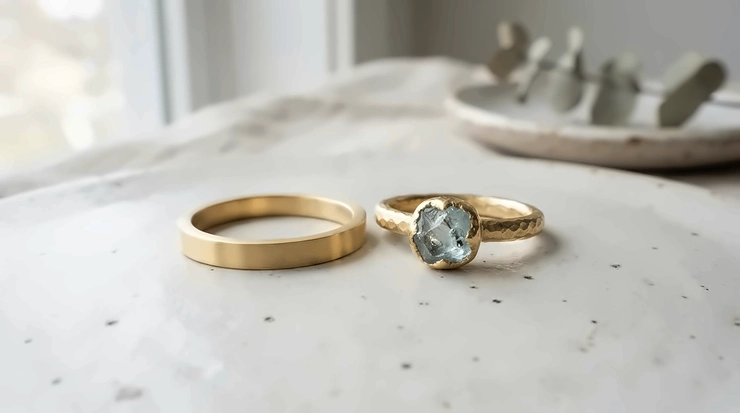
Spacer rings for stacking multiple bands are thin, low-profile bands, usually 1mm to 2.5mm wide, worn between your larger rings as a buffer. They keep prongs, pavé and gemstones from grinding on their neighbors, fill small gaps, and help the whole stack sit evenly on your finger.

A ring stack looks like a still life. It behaves like a mosh pit. Every time you grip a steering wheel, wash a dish or dig through a tote bag, your bands slide, tilt and knock together. Most days that’s harmless. Over months, it isn’t. The GIA’s ring stacking guide treats stacking as a style playground, and it is one. It’s also a small engineering problem: hard edges, softer metals and thousands of tiny daily collisions.
That’s where a spacer earns its keep. One slim band slipped between a prong-set engagement ring and a pavé wedding band takes the scuffs so your good pieces don’t. A well-chosen spacer band to prevent ring rubbing costs a fraction of a prong repair, and it blends into the stack like it was always meant to be there.
This guide covers seven real options sold on Amazon, from solid 14K gold to budget silver and stainless steel, plus a silicone alternative for loose fits. We also dig into spacer band thickness, the slow reality of metal wear friction, smart band separation, and ring spacers for stacking wedding bands. Everything here comes from published specs, jeweler guidance and aggregated review themes, not from claims of hands-on testing. Prices appear as ranges and change often, so check current price before you buy.
Quick Comparison: 7 Spacer Rings for Stacking Multiple Bands at a Glance
| Product | Width | Material | Price Range | Best For |
|---|---|---|---|---|
| JewelHeart 14K Solid Gold Wedding Band | 1mm | Solid 14K white or yellow gold | Roughly $100-$150 | Near-invisible gold buffer for delicate stacks |
| MAX + STONE 1MM Thin Wedding Band | 1mm | Solid 14K gold in yellow, white or rose | Roughly $100-$175 | Matching mixed-color stacks |
| Amazon Collection Classic Fit 14K Plain Wedding Band | 2mm | 14K gold | Varies with gold market | Sturdy everyday buffer beside prongs |
| Amazon Essentials Rhodium Plated Sterling Silver Stacking Ring Set of 3 | 1.3mm each | Rhodium plated sterling silver | Under $50 | Budget starter spacers |
| Jude Jewelers 1.5mm Stainless Steel Plain Stackable Band | 1.5mm | Stainless steel | Budget tier, often under $25 | Tough spacer for fashion stacks |
| PAVOI 14K Gold Plated CZ Eternity Band | 1.8mm | 14K gold plated 925 sterling silver with CZ | Under $40 | Sparkly decorative separator |
| Eiito Ring Sizers 16-Pack | Fits 1mm-8mm bands | TPU silicone | Under $15 | Loose rings and spinning stacks |
Looking at the table, the solid gold options (JewelHeart, MAX + STONE and the Amazon Collection band) cost more up front but are the only ones that behave like real heirloom-grade buffers. The Amazon Essentials set and Jude Jewelers band make sense when you want protection or a fashion stack without a gold-sized bill. The Eiito Ring Sizers are a different animal: they fix the looseness that makes rings slam together in the first place. Prices are approximate ranges at the time of research and will move, especially for gold.
💬 Just one click — help others make better buying decisions too!😊
Top 7 Spacer Rings for Stacking Multiple Bands: Expert Analysis
I picked these seven to cover budget, mid-range and premium tiers, and to include both plain protective bands and decorative separators. Where real reviews couldn’t be verified directly, the review notes below rely on aggregated summaries and say so.
1. JewelHeart 14K Solid Gold Wedding Band 1mm — slimmest solid-gold buffer for tight stacks
At 1mm wide, JewelHeart is about as close to invisible as a real gold spacer gets. That matters when an engagement ring, wedding band and anniversary band already crowd one finger. Solid 14K in white or yellow gold keeps the spacer in the same metal family as most wedding bands, which sidesteps the hard-versus-soft mismatch behind most metal wear friction complaints. Sizes are listed in whole numbers from 5 to 8, so confirm yours before ordering.
Based on the spec comparison, it suits stacks where two textured or stone-set bands need a thin barrier and you still want a clean look. The trade-off is geometry: 1mm leaves a narrow contact edge, so it will likely nick or bend more easily than a 2mm band if you smack it on a countertop. Reviewer comments in third-party roundups describe it as sturdier than it looks, with one wearer keeping it on at the gym and in the kitchen, while another buyer found 1mm too thin and swapped to 2mm.
Pros:
- ✅ Genuine solid 14K gold, no plating to wear through
- ✅ Near-invisible 1mm profile keeps stacks tidy
- ✅ Hypoallergenic and water-safe per listing summaries
Cons:
- ❌ Some buyers find 1mm too delicate
- ❌ Only white and yellow gold, no rose
It sits in roughly the $100-$150 range at the time of research, which is fair value for solid gold, though you should check current price because gold markets swing.
2. MAX + STONE 1MM Thin Wedding Band — widest color choice for matching stacks
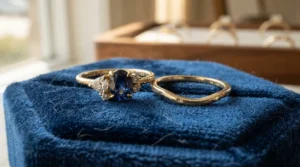
Color matching is the quiet headache of stacking, and MAX + STONE tackles it by offering yellow, white and rose gold in the same 1mm width. Solid gold can be polished back to life instead of flaking like plating. Sizes run from 4.5 to 10, which helps smaller and larger fingers that whole-size lineups tend to ignore. One catch: the listing title mentions both 14k and 10k, so confirm the karat you select. It matters because a harder alloy next to a softer ring shifts wear onto the softer one.
This is the pick if your stack mixes metal colors or you’re matching a rose gold anniversary band. The spec sheet won’t tell you how you’ll feel about a near-invisible band, and reviewers split on it. One wearer says it doesn’t irritate skin during daily wear, while another notes you can barely tell what gold color it is. That’s a plus for a stealth buffer and a minus for a visible accent.
Pros:
- ✅ Three gold colors in one 1mm width
- ✅ Nickel-free and hypoallergenic per listing summaries
- ✅ Includes gift box, polishing cloth and velvet pouch
Cons:
- ❌ Nearly invisible for buyers wanting presence
- ❌ Costs more than same-width alternatives
Expect roughly the $100-$175 range, a modest premium over JewelHeart that’s only worth paying if color flexibility matters to you.
3. Amazon Collection Classic Fit 14K Plain Wedding Band 2mm — sturdiest width for daily wear
Two millimeters is the sweet spot many jewelers keep coming back to for spacers. It gives you enough metal to absorb scuffs without turning into a chunky third band. The listing describes this Amazon Collection band as handcrafted in America from recycled, conflict-free materials. A plain polished finish means no bumps or texture to catch a neighbor’s prongs, which is exactly what you want in a spacer band to prevent ring rubbing.
On paper, the extra width makes it more dent-resistant than the 1mm bands, and it can double as a standalone wedding band if you ever want a plain look. It also pairs well with a low-set solitaire, since the band tucks underneath without crowding the stone. One reviewer bought the rose gold version to complement a morganite engagement ring and called it solid and feminine, but warned it ran small. If you’re between sizes, plan to size up.
Pros:
- ✅ 2mm width gives a durable buffer
- ✅ Made in the USA per listing details
- ✅ Plain polished look matches most stacks
Cons:
- ❌ Reviewers report it runs small
- ❌ Can look heavy beside very delicate bands
Gold-market swings make its price move more than silver options, so check current price and compare against the 1mm gold bands above.
4. Amazon Essentials Rhodium Plated Sterling Silver Stacking Ring Set of 3 — three slim spacers, minimal spend
This Amazon Essentials set includes two ball-beaded rings and one rounded plain band, each 1.3mm wide, and listing summaries call them nickel-free and hypoallergenic. For spacer duty, the plain band is the workhorse. The beaded pair adds texture, but those little bumps create contact points, so save them for decorative stacks. Sterling silver is softer than gold or platinum, so it scratches first. For a sacrificial buffer, that’s a feature, not a flaw.
The honest caveat is plating. Rhodium is a thin surface layer, and constant stack friction can wear plated finishes over time, so expect these to age faster than solid gold. Aggregated review summaries for the set note customer satisfaction with quality, durability, consistent fit and comfort for sensitive skin. If you want to test the spacer idea before spending on gold, this is a low-risk way to do it.
Pros:
- ✅ Three rings for one low price
- ✅ Slim 1.3mm profile blends into stacks
- ✅ Hypoallergenic per listing summaries
Cons:
- ❌ Rhodium plating may wear with friction
- ❌ Soft silver dents and scratches easily
Under $50 is the working range, which makes this a smart trial pack rather than a forever solution.
5. Jude Jewelers 1.5mm Stainless Steel Classical Plain Stackable Wedding Band — toughest budget spacer
Stainless steel doesn’t scratch easily, and at 1.5mm the Jude Jewelers band lands in the middle of the slim-spacer range. Here’s the twist most listings skip: hardness cuts both ways. A hard spacer sitting between soft gold rings can shift wear onto the gold instead of absorbing it. So this band suits stainless, silver or fashion stacks better than a heirloom 14K set. It’s also hard to resize, so measure carefully.
Reviewers describe it as a durable everyday ring, with one wearer reporting no irritation or discoloration. Reviewers of other Jude Jewelers widths mention inconsistent sizing, so read the sizing notes and consider ordering a half size either way. Based on the spec comparison, it’s a good bridge for a loose stack on a tight budget, but not the buffer I’d choose beside diamonds.
Pros:
- ✅ Very low price for a plain band
- ✅ Hard-wearing stainless resists scratches
- ✅ No skin discoloration reported by reviewers
Cons:
- ❌ Hard to resize if the fit is off
- ❌ Harder than gold, so it may wear softer neighbors
It sits in the budget tier, often under $25, which makes it a low-stakes experiment for fashion stacks.

6. PAVOI 14K Gold Plated 925 Sterling Silver CZ Eternity Band 1.8mm — sparkle spacer on a budget
This PAVOI band wraps a 1.8mm sterling silver base in 14K gold plating and prong-set cubic zirconia. That sparkle is the point, but it changes the job: a stone-set band is a decorative separator, not a protective buffer. Stones and prongs can still catch on a neighbor, so it works best between plain bands or fashion rings, not between two fine diamond pieces.
Reviewers like its dainty look and use it to stack with other rings, even a smart ring, and some wear it as a simple wedding band. Complaints are real, though: one buyer reported losing a couple of stones within months, and others mention plating discoloration. Treat it as a budget accent with a limited lifespan. If you want a plain protective layer, pick a smooth band instead.
Pros:
- ✅ Thin 1.8mm profile stacks easily
- ✅ Adds sparkle without a diamond price
- ✅ Hypoallergenic claims per listing
Cons:
- ❌ CZ stones can loosen over time
- ❌ Gold plating may wear or tarnish
Roughly under $40, it’s good value as a trend piece but not as an heirloom guard.
7. Eiito Ring Sizers 16-Pack — silicone fix for loose, sliding bands
Not every stack problem needs another metal ring. The Eiito Ring Sizers 16-Pack uses soft TPU silicone with 12 insert-style pieces and 4 spiral-style pieces, fitting bands from 1mm to 8mm wide. Loose rings move more, and more movement means more rubbing, so tightening one band can reduce friction across the whole stack. Roundup summaries say they reduce fit by only about half to one size, which keeps expectations realistic.
Let’s be clear: these won’t create a physical gap between two rings the way a metal spacer does. Think of them as an anti-spin tool. Reviewers praise their near-invisibility, comfort and tool-free install, while common complaints are that they’re temporary and that oils and lotions can wear silicone down. The third-party roundup’s own testing claims are unverified, so treat specs as listing-level details.
Pros:
- ✅ Fits a wide range of band widths
- ✅ Reusable and tool-free to install
- ✅ Nearly invisible once in place
Cons:
- ❌ Only reduces fit by half to one size
- ❌ Silicone may degrade with oils and lotions
It’s a budget fix, likely under $15, and worth keeping in a drawer for winter-versus-summer finger swings.
Side-by-Side: Specs, Price Ranges and Review Themes
| Product | Width | Price Range | Main Review Theme | Key Trade-Off |
|---|---|---|---|---|
| JewelHeart | 1mm | Roughly $100-$150 | Sturdier than it looks | May feel too thin |
| MAX + STONE | 1mm | Roughly $100-$175 | Skin-friendly, subtle | Nearly invisible |
| Amazon Collection | 2mm | Varies with gold | Solid feel, runs small | Size up |
| Amazon Essentials | 1.3mm | Under $50 | Quality and fit consistency | Plating wears |
| Jude Jewelers | 1.5mm | Often under $25 | No skin discoloration | Hard to resize |
| PAVOI | 1.8mm | Under $40 | Dainty look, some lost stones | Stones loosen |
| Eiito | 1-8mm bands | Under $15 | Invisible, easy install | Temporary |
The best value for real protection is the gold trio, since solid metal can be polished and won’t flake. If you’re building a fashion stack and expect to rotate pieces, the Amazon Essentials set and Jude Jewelers band give you flexibility for far less. Buyers fighting a loose fit should start with Eiito Ring Sizers before adding more metal.
How to Add a Spacer Band to Your Stack: A Practical Setup Guide
A spacer only works if it’s sized, placed and maintained properly. Here’s the sequence that avoids the usual first-month regrets.
- Size for the whole stack. Stacks take up more room than a single ring, and jewelers suggest going up a quarter to half size and wearing the full stack for a day before committing. Fingers swell in heat and shrink in cold, so test in both.
- Pick the width. Blue Nile says its spacers are typically 2.5mm wide or thinner, with many popular ones between 1.8mm and 2.4mm. If you’re unsure, start at 1.5mm to 2mm.
- Match metal and karat. Keep the spacer in the same metal family as your most valuable ring.
- Place it where contact happens. The usual order is engagement ring, spacer, wedding band, especially when prongs or milgrain face the next ring.
- Clean on a schedule. Warm water, mild soap and a soft brush monthly. Trapped grit acts like sandpaper between bands. Have a jeweler check prongs periodically.
Common mistakes in the first 30 days: buying 1mm and expecting it to hold a loose ring in place, pairing hard stainless with soft gold, and skipping the full-day fit test. A thirty-day review is cheap insurance. If you see new scratches on the spacer rather than your main rings, it’s doing its job.
Real-World Scenarios: Matching Spacer Rings for Stacking Multiple Bands to Your Life
Specs are abstract. Daily life isn’t. Here are three buyer profiles and the logic behind each match.
Scenario 1: The hand-washer. Picture a nurse or teacher washing hands 30 times a day with a diamond solitaire and a pavé wedding band, on a mid-range budget. Soap, water and constant movement make a stack slippery. A solid gold buffer like JewelHeart or MAX + STONE separates the stone-set rings, doesn’t tarnish, and sidesteps plating wear.
Scenario 2: The fashion stacker. Someone layers silver and gold fashion rings plus a smart ring on a tight budget. A PAVOI band adds sparkle between plain pieces, and the Amazon Essentials set gives spare spacers for swapping looks. Expect to replace plated pieces eventually.
Scenario 3: The winter-loose finger. Fingers shrink in cold weather, so a wedding band that fits in July spins in January. A Eiito Ring Sizers insert tightens the fit for the season, and a Amazon Collection 2mm band adds a sturdy filler if you want a metal option. This is band separation and fit control in one move.
Ring spacers for stacking wedding bands work best when matched to your hands, your work and your budget, not just your Pinterest board.
✨ Ready to Build a Stack That Lasts?
🔍 Take your ring stack to the next level with these carefully selected spacers. Click on any highlighted product to check current pricing and availability. A slim band in the right spot could save your favorite rings years of wear! 💍
Problem and Solution: Fixing the Most Common Stack Headaches
Problem 1: Scratches between bands. Metal-on-metal contact leaves micro-scratches. Solution: add a smooth spacer such as Amazon Collection 2mm or JewelHeart 1mm, and polish occasionally.
Problem 2: The stack keeps spinning. A loose fit lets heavier rings rotate. Solution: size up a quarter size for stacks, or use Eiito Ring Sizers to tighten the fit.
Problem 3: Gaps between curved bands. Contour bands rarely nest flush. Solution: a thin spacer, 1mm to 1.5mm, can fill small gaps without adding bulk.
Problem 4: Bulk and pinching. Too many wide bands feel clumsy. Solution: use slim 1mm to 1.5mm spacers and keep the stack to three to five rings.
Problem 5: Plating wearing off the spacer. Gold plate and rhodium can wear under friction. Solution: treat plated spacers like Amazon Essentials or PAVOI as replaceable, or move to solid gold.
For anything involving heirloom stones, a solid gold spacer remains the safer long-term answer.
How to Choose Spacer Rings for Stacking Multiple Bands
- Decide what you’re protecting. If prongs, pavé or milgrain touch another ring, you need a real metal buffer. If you only want a style gap, a decorative band works.
- Match the metal. Same metal family, same karat where possible, so wear stays even.
- Pick the width. For most stacks, 1.5mm to 2mm balances protection and subtlety.
- Check the edge profile. Flat or rounded smooth edges beat textured ones in a protective role.
- Confirm sizing. Stacks need extra room, and some bands run small.
- Weigh the price against the use. Solid gold costs more now, but lasts; plated and stainless options are cheaper but replaceable.
The best spacer band to prevent ring rubbing is the one that matches your most delicate ring’s metal and sits flat against it. Resist the urge to buy on looks alone, because the whole point is protection first and style second.
Spacer Band Thickness: How Thin Is Too Thin?
Spacer band thickness is a tug-of-war between protection and invisibility. Go too thin and the band becomes a glorified wire that bends and nicks. Go too thick and it stops being a spacer and starts being another ring.
| Thickness | Best For | Trade-Off |
|---|---|---|
| 1mm | Delicate stacks, stealth buffer | Easier to nick or bend |
| 1.5mm | All-purpose balance | Slightly more visible |
| 2mm | Sturdy daily buffer | Can look chunky between thin bands |
| 2.5mm and up | Statement stacks | Reads as a full band |
Jewelry community members often favor roughly 1.5mm to 2mm spacers, and some like knife-edge profiles for minimal contact. Height matters too: one retailer’s 1mm spacer lists a 1.7mm depth, so width alone doesn’t tell the whole story.
Looking at the numbers, 1.5mm to 2mm is the practical zone for most buyers. Go to 1mm only if your stack is already crowded and you accept more careful wear. Go beyond 2.5mm only if you want the spacer to count as a visible band.
Metal Wear Friction: What Actually Happens Inside a Stack
Metal wear friction is slow, quiet and cumulative. Two metals touch, one is harder, and the harder one gradually removes microscopic material from the softer one. On the Mohs scale, pure gold and silver sit around 2.5 to 3, while platinum sits around 4 to 4.5. Mohs was designed for minerals, so treat those numbers as directional rather than exact for alloys. The principle still holds.
Three factors speed things up. First, mixed metals, since the harder one wears the softer one. Second, dirt, because trapped grit acts as an abrasive. Third, plating, which can wear through to the base metal under constant rubbing. A spacer works as a sacrificial layer: it takes the contact instead of your most valuable ring.
That’s also why spacer choice matters. A soft silver spacer between two gold rings will wear first, which is fine. A hard stainless spacer between soft gold rings may do the opposite. Keep metal wear friction in mind when you mix materials.
Spacer Band to Prevent Ring Rubbing: Where Contact Really Happens
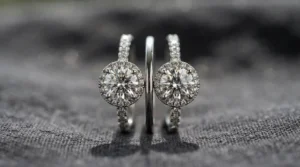
Rubbing isn’t random. It concentrates at specific points: engagement ring prongs against a wedding band, milgrain edges against a flat band, and pavé or side stones against neighboring metal. Diamonds touching diamonds can chip, and loose stones can fall out over time.
A spacer band to prevent ring rubbing works best when it covers those contact zones. Place it directly between the two surfaces that touch, not at the far end of the stack. If your wedding band is plain and your engagement ring has a smooth low gallery, you may need less protection. If either has stones facing sideways, a spacer is cheap insurance.
Some people have a spacer spot-soldered to one ring to stop it moving, which is permanent but eliminates gaps and shifting. Whether you go loose or soldered, the goal is the same: keep delicate surfaces from meeting. Choose a smooth, plain spacer for protection and save textured ones for style.
Ring Spacers for Stacking Wedding Bands: Advice by Buyer Type
Ring spacers for stacking wedding bands aren’t one-size-fits-all.
- Newlyweds with a solitaire and pavé band: choose a solid gold spacer in the same karat. This is the highest-risk combination for prong wear.
- Contour or curved band wearers: a thin spacer can fill the gaps curved shapes leave, which also reduces spinning.
- Vintage or antique ring owners: soft silver and delicate detailing are more prone to damage, so jewelers recommend thin plain bands as buffers.
- Minimalists: a single 1mm gold spacer keeps the look clean and still protects.
- Budget stackers: start with the Amazon Essentials set or Jude Jewelers band, then upgrade to gold if you love the look.
Whatever your profile, use ring spacers for stacking wedding bands to protect what matters most: the engagement ring’s setting and the wedding band’s finish.
Band Separation: Gaps, Spacing and Visual Balance
Band separation is both practical and aesthetic. Curved bands leave small gaps. Straight bands sit flush. A spacer fills awkward gaps and keeps the stack from looking like one solid block.
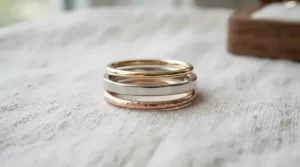
A few styling rules help. Odd numbers, three or five rings, tend to look balanced. Mix widths, with a thin spacer beside a medium band, so nothing feels stranded. Add texture with a beaded or twisted spacer if you want the separation to read as a design choice. And avoid piling on too many thick bands, which gets bulky and uncomfortable.
If gaps keep bothering you, check fit first. A loose ring tilts and opens gaps, and a Eiito Ring Sizers insert may solve it without adding metal. If you want deliberate band separation, a 1.5mm to 2mm spacer creates a tidy visual break, while a 1mm band keeps things subtle. Band separation done well looks intentional rather than accidental.
Spacer Bands vs Soldering vs Guard Rings: Benefits Compared
| Option | Protects Settings | Flexibility | Best For |
|---|---|---|---|
| Plain spacer band | Yes | High, easy to swap | Most stacks |
| Soldering rings together | Yes | Low, permanent | Fixed engagement and wedding sets |
| Silicone sizer | Indirectly, by reducing movement | High | Loose rings |
| No spacer | No | High | Plain, flush bands |
Soldering eliminates gaps, spinning and rubbing entirely, but it’s permanent, so you lose the ability to wear rings separately. A spacer is reversible and cheap by comparison. A silicone sizer treats the cause of movement but doesn’t separate surfaces.
For most people, a plain spacer is the sweet spot of protection and flexibility, and a spacer band to prevent ring rubbing can be removed if your style changes. Soldering suits couples who never separate their set.
Long-Term Cost & Maintenance
Here’s the quiet math. A solid gold spacer in the $100-$150 range, worn daily for five years, works out to well under a dime a day. Even a budget set under $50 replaced yearly lands around 14 cents a day at the top of that range. Compare that with repairing worn prongs or refinishing a scratched band, and the spacer looks like a bargain.
Maintenance is simple. Clean monthly with warm water, mild soap and a soft brush. Rotate your stack occasionally. Keep karats consistent, since Jewelers Mutual advises against layering 14k and 18k because the softer gold gets scratched. Check the spacer itself: when it’s visibly worn, that’s proof it protected something more expensive. Replace plated spacers sooner, since plating thins with friction.
FAQ
❓ Do I need spacer rings for stacking multiple bands if my rings have no stones?
❓ What is the best spacer band thickness for an engagement ring and wedding band?
❓ Can I wear a stainless steel spacer between gold rings?
❓ How do I stop stacked rings from spinning or sliding?
❓ Are gold plated spacer bands worth buying?
Conclusion
A good stack is a conversation between rings, and a spacer keeps that conversation civil. Among the seven options here, JewelHeart and MAX + STONE are the picks for slim solid gold buffers, with MAX + STONE winning on color choice. The Amazon Collection 2mm band is the sturdier choice if you want visible protection. On a budget, the Amazon Essentials set and Jude Jewelers band make low-risk starters, while PAVOI adds sparkle for fashion stacks and Eiito Ring Sizers solve looseness without adding metal.
Whatever you choose, keep the same metal family as your best ring, aim for 1.5mm to 2mm unless you have a reason not to, and place the spacer where prongs and stones actually touch. Do that, and spacer rings for stacking multiple bands will do the quiet, unglamorous work of making your favorite rings last. Prices are approximate and shift often, so check current price before buying.
Recommended for You
- Stackable Rings For Nurses And Frequent Hand Washing: 7 Best (2026)
- Stackable Rings That Do Not Spin Or Slide: 7 Smart Picks For 2026
- Stackable Rings Sets For Layering On One Finger: 7 Best Picks (2026)
Disclaimer: This article contains affiliate links. As an Amazon Associate, I earn from qualifying purchases. If you purchase products through these links, we may earn a small commission at no additional cost to you.
✨ Found this helpful? Share it with your friends! 💬🤗
