In This Article
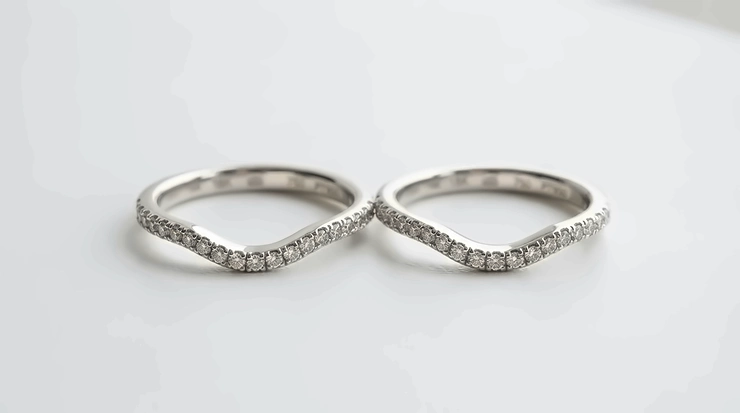
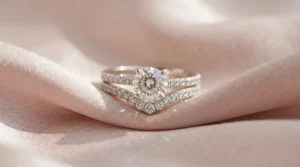
Here’s the thing nobody tells you at the jewelry counter: your engagement ring and your wedding band are about to spend the rest of forever touching each other, and if they don’t get along, you’ll feel it every single day. A curved wedding band is a ring shaped with a built-in dip or arc so it hugs the base of an engagement ring’s center stone instead of butting up against it in a straight, awkward line. Sometimes called a contour band or a shadow band, it’s the quiet fix for a problem most brides don’t see coming until they try on a plain band and watch it teeter on top of their setting like a see-saw.
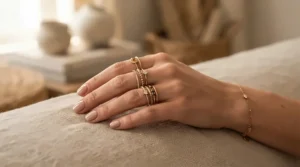
If you’ve been Googling curved wedding bands for curved engagement rings at 1 a.m., trying to figure out why your gorgeous halo or solitaire won’t sit flush with anything straight, you’re in good company. This guide walks through seven real, purchasable curved bands spanning sterling silver stacking rings under $30 to solid-gold statement pieces well into four figures, plus the fit logic, shank science, and buying pitfalls that most product listings conveniently skip. According to GIA’s 4Cs education, diamond quality and setting height both affect how a band needs to curve around a stone — which is exactly why “one curve fits all” is a myth worth busting early.
We’ll cover budget picks, mid-range diamond bands, and splurge-worthy solid gold options, along with the shank shapes, notch styles, and custom routes that make the difference between a ring stack that looks intentional and one that looks like two strangers thrown together at a wedding.
Quick Comparison: 7 Curved Wedding Bands at a Glance
| Band | Metal Options | Curve Style | Price Range | Best For |
|---|---|---|---|---|
| EAMTI Sterling Silver Wave Band | 925 sterling silver | Gentle wave | Under $25 | Budget stacking |
| Mameloly V-Shaped CZ Band | 14K gold plated | Sharp V/chevron | Under $30 | Pear or marquise centers |
| Dazzlingrock Collection Curved Guard | 10K–18K gold | Deep curved guard | $400–$650 | Real diamonds on a budget |
| KATARINA Diamond Twist Band | 14K gold | Twisted curve | $450–$900 | Classic bridal look |
| Kobelli Diamond Wavy Stackable Set | 14K rose/white/yellow gold | Wavy, 3-ring set | $400–$600 | Stack lovers |
| Kobelli Open-C Diamond Band | 14K gold | Open-C curve | $350–$500 | Low-set solitaires |
| Gabriel NY Curved Band (AN15554) | 14K/18K gold, platinum | V-shaped curve | $1,400–$1,700 | Premium solid gold |
Looking at the spread above, the gap between the cheapest and priciest option isn’t really about how well a band curves — it’s about metal purity and diamond content. The EAMTI Sterling Silver Wave Band and Mameloly V-Shaped CZ Band solve the visual-gap problem for less than a dinner out, while the Gabriel NY Curved Band solves it with solid gold and real diamonds meant to be worn daily for decades. Everything in between splits the difference with genuine diamonds on more affordable gold alloys.
💬 Already eyeing one? Tap through to check today’s price before it changes!😊
Top 7 Curved Wedding Bands for Curved Engagement Rings: Expert Analysis
Before diving in, a quick honesty note: carat weights, stone counts, and finishes on made-to-order and marketplace jewelry can shift by seller and by size, so treat the specs below as the band’s typical configuration rather than a guarantee, and always check the current listing before buying.
| Product | Stone Type | Approx. Total Carat/Count | Metal | Price Range |
|---|---|---|---|---|
| EAMTI Sterling Silver Wave Band | Cubic zirconia | Pavé row | Sterling silver | Under $25 |
| Mameloly V-Shaped CZ Band | Cubic zirconia | Pear/round accents | 14K gold plated | Under $30 |
| Dazzlingrock Collection Curved Guard | Natural diamond | 0.60–0.75 ctw | 10K–18K gold | $400–$650 |
| KATARINA Diamond Twist Band | Natural diamond | 0.30–0.50 ctw | 14K gold | $450–$900 |
| Kobelli Diamond Wavy Stackable Set | Lab-grown diamond | 0.60 ctw (13 stones) | 14K gold | $400–$600 |
| Kobelli Open-C Diamond Band | Natural diamond | 0.20–0.40 ctw | 14K gold | $350–$500 |
| Gabriel NY Curved Band (AN15554) | Natural diamond | 5-stone row | 14K/18K gold, platinum | $1,400–$1,700 |
The table makes one thing obvious: carat weight and metal purity climb together, but curve quality doesn’t automatically climb with price. A well-cut curved guard from Dazzlingrock Collection can hug a solitaire just as precisely as the far pricier Gabriel NY Curved Band, because fit depends on matching the arc to your specific setting height, not on how many diamonds are involved. Where the extra money genuinely buys something is durability and resale-grade metal — 18K gold and platinum wear differently over 20 years than gold-plated brass.
1. EAMTI Sterling Silver Wave Band — most affordable real gap-closer
This one exists to answer a simple question: can you fix an awkward gap between your rings without spending real money? Yes, and the wave-shaped row of pavé cubic zirconia stones does it by curving gently along the top of the shank so it nestles against a raised center stone instead of jutting past it. Made from 925 sterling silver, it’s rhodium-plated to resist the yellowing that plain silver develops with regular wear, though that plating will thin with years of daily contact.
What most buyers overlook about a band this affordable is that it’s not trying to be a forever diamond ring — it’s a stand-in, a trial run, or a stacking piece for someone who wants the contoured look without the commitment. Reviewers consistently note that the sizing runs slightly small and recommend ordering up half a size, and that the stones hold their sparkle well for a CZ setting, though a few mention the plating dulling after a year of nightly wear.
Pros:
- ✅ Extremely low cost of entry for the curved silhouette
- ✅ Wave curve fits a wide range of raised center settings
- ✅ Comfortable, lightweight everyday wear
Cons:
- ❌ Rhodium plating wears thin with heavy daily use
- ❌ Cubic zirconia lacks the fire of a real diamond
At under $25, this is essentially a placeholder-proof way to test whether a curved silhouette solves your stacking headache before you spend real money on the diamond version — hard to argue with that math.

2. Mameloly V-Shaped Curved CZ Band — best for pear or marquise centers
While the EAMTI band goes for a soft wave, the Mameloly V-Shaped Curved CZ Band takes a sharper approach with a distinct chevron dip designed specifically to tuck under a pointed pear or marquise-cut center stone. That deeper V matters more than it sounds like it should: a shallow curve on a pointed stone still leaves a sliver of daylight at the tip, while a proper chevron closes it completely.
The 14K gold plating over a base metal gives it warmth and shine at a fraction of solid-gold pricing, and the stackable design means it plays nicely with other thin bands if you want a fuller ring stack later. Based on the design logic here, this band earns its keep specifically for angular or elongated center stones — round solitaires don’t need this much of a V and might look better with a gentler curve instead.
Pros:
- ✅ Deep chevron closes gaps on pointed center stones
- ✅ Budget-friendly 14K gold plated finish
- ✅ Stacks cleanly with other slim bands
Cons:
- ❌ Gold plating will eventually require re-plating or replacement
- ❌ Sharp V shape can look mismatched with round solitaires
3. Dazzlingrock Collection Curved Guard — best real diamonds under $650
This is where the lineup shifts from costume jewelry to genuine fine jewelry. The Dazzlingrock Collection Curved Guard is built as a guard-style band — designed to wrap around and reinforce the fit of an engagement ring — set with real round diamonds totaling roughly 0.60 to 0.75 carats depending on the exact listing, in a choice of 10K, 14K, or 18K gold.
The curved guard format means it’s doing double duty: closing the visual gap and physically helping keep a taller engagement ring centered on the finger, which matters if your solitaire tends to twist. What the spec sheet won’t tell you, but reviewers note, is that the guard style runs a touch heavier than a plain curved band, which some wearers love for the substantial feel and others find less comfortable for all-day stacking. Real diamonds at this price point mean lower clarity grades (typically I1–I2), so visible inclusions are possible under magnification even though the stones still read as bright and white to the naked eye.
Pros:
- ✅ Genuine diamonds at a genuinely accessible price
- ✅ Guard design helps stabilize a taller engagement ring
- ✅ Available across 10K, 14K, and 18K gold options
Cons:
- ❌ Lower clarity grades typical at this price tier
- ❌ Slightly heavier feel than a plain curved band
4. KATARINA Diamond Twist Band — best classic bridal-set look
The KATARINA Diamond Twist Band takes the curved concept and adds a gentle twist along the shank, so the diamonds catch light from more angles as your hand moves. It’s designed as part of a matching bridal set, meaning the curve is calibrated to a specific companion engagement ring style, though the band itself pairs reasonably well with other twist-shank or crossover solitaires too.
Here’s what most buyers overlook about twist bands specifically: the twist itself adds a small amount of visual bulk compared to a flat curved band, so if your engagement ring already has an ornate setting, pairing it with another busy design can start to look cluttered rather than cohesive. Aggregated review sentiment for KATARINA’s bridal-set pieces skews positive on craftsmanship and presentation (they arrive in a branded box, which matters for gifting), with occasional notes about sizing needing adjustment for wider knuckles.
Pros:
- ✅ Twist detail adds extra sparkle and dimension
- ✅ Designed and sold as a coordinated bridal-set option
- ✅ Well-reviewed presentation and gifting packaging
Cons:
- ❌ Can look busy paired with an already-ornate engagement ring
- ❌ Some reported sizing adjustments needed for a true fit
5. Kobelli Diamond Wavy Stackable Set — best for building a full stack
Rather than selling a single band, the Kobelli Diamond Wavy Stackable Set ships as three wavy-designed rings, each lined with prong-set lab-grown diamonds, meant to be worn together or split apart depending on the day. That flexibility is the whole pitch: instead of committing to one curve, you get three complementary waves that can flank an engagement ring from both sides.
Lab-grown diamonds here mean more carat weight for the money compared to natural-stone bands at a similar price, roughly 0.60 total carats across the set. On paper, this means buyers who want visual impact without the natural-diamond premium come out ahead, and reviewers consistently praise the value-for-sparkle ratio. The trade-off is resale value — lab-grown diamonds currently hold less secondary-market value than natural stones of comparable size, something worth knowing if resale ever factors into your decision.
Pros:
- ✅ Three coordinated bands for a builder’s approach to stacking
- ✅ Strong carat-per-dollar value with lab-grown diamonds
- ✅ Solid 14K gold in rose, white, or yellow
Cons:
- ❌ Lab-grown diamonds carry lower resale value than natural stones
- ❌ Three-ring set may feel like more band than some hands want
6. Kobelli Open-C Diamond Band — best for low-set solitaires
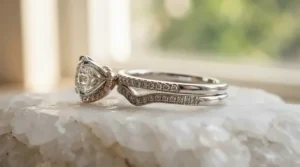
The Kobelli Open-C Diamond Band uses an open-C silhouette — essentially a curve with a gap cut into the top of the shank — specifically engineered to tuck under a low-set solitaire without the two rings colliding. If your engagement ring sits close to the finger rather than elevated on tall prongs, this construction solves a fit problem that a standard curved band sometimes can’t.
What the open design sacrifices in continuous sparkle across the top, it gains in function: the gap literally makes room for the engagement ring’s lowest point, something most buyers don’t realize matters until they’ve already returned a band that wouldn’t sit flat. Based on the spec comparison against the fully-curved options above, this is the pick specifically for cathedral or bezel settings with a low profile, not for high-set halos that don’t need the extra clearance.
Pros:
- ✅ Open-C gap solves fit issues for low-profile settings
- ✅ Solid 14K gold construction
- ✅ More affordable than fully-paved curved alternatives
Cons:
- ❌ Less continuous sparkle than a fully set curved band
- ❌ Overkill for high-set halo or solitaire settings
7. Gabriel NY Curved Band (AN15554) — best premium solid gold option
At the top of this lineup sits the Gabriel NY Curved Band (AN15554), a V-shaped design with five prong-set diamonds that curves beneath a center gemstone, available in 14K white gold, 14K yellow gold, or platinum. This is a band built for someone who’s done shopping around and wants a piece meant to be worn, resized if needed, and passed down.
The reasoning behind the premium price here isn’t marketing — it’s material. Solid 14K and 18K gold from an established bridal manufacturer holds prong tension and resists metal fatigue far better over 20+ years than gold-plated or lower-karat alternatives, which matters enormously for a ring worn every single day. Reviewers of Gabriel NY’s bridal lines consistently highlight the polish quality and prong security, with the main critique being that the brand’s pricing sits noticeably above marketplace-only sellers for comparable carat weight.
Pros:
- ✅ Solid gold or platinum built for decades of daily wear
- ✅ Established bridal brand with consistent craftsmanship
- ✅ Available in three metal options to match any engagement ring
Cons:
- ❌ Premium pricing compared to marketplace-only diamond bands
- ❌ V-shaped curve is specific to certain center-stone shapes
Curved Band Engagement Ring Pairing: A Practical Fitting Guide
Getting a curved band engagement ring pairing right is less about taste and more about geometry, so treat it like a measuring project before you treat it like a shopping trip. Start by identifying your engagement ring’s setting height — how far the center stone sits above the shank — since that height determines how deep a curve you actually need. A halo or cathedral setting sitting high off the finger typically needs a shallower curve than a low-set solitaire, which often needs a pronounced dip or an open-C gap to avoid crowding.
Next, bring both rings to a jeweler (or use a printable ring sizer at home) and physically test the pairing before buying online, especially for anything over $200. Slide the curved band up against the engagement ring exactly as you’d wear it, and check for three things: does it sit flush without a visible gap, does it wobble or rock when you move your hand, and does the combined width feel comfortable across the knuckle. If you’re buying two separate brands, order both in a returnable window, since even a half-size difference between them can throw off the fit.
Finally, decide your wear order early — most people wear the wedding band closer to the heart, meaning underneath the engagement ring, but curved bands specifically are often designed to sit on top so the curve visibly cradles the stone. Either way works; just buy accordingly, since some curve shapes only nest properly from one side.
Real-World Scenarios: Matching a Curved Band to Your Life
Picture a nurse who’s on her feet for twelve-hour shifts and washes her hands forty times a day — for her, a lower-profile pick like the Kobelli Open-C Diamond Band makes more sense than a tall guard ring that could snag on gloves or scrub against equipment. The open construction keeps things low and secure without sacrificing the diamond sparkle she still wants for date nights.
Now picture a bride on a tight budget who just got engaged with a modest pear-cut solitaire and needs a wedding band fast. The Mameloly V-Shaped Curved CZ Band solves the immediate fit problem for under $30, buying time to save for a diamond upgrade down the road without walking down the aisle with a gap between her rings.
And picture someone celebrating a milestone anniversary who’s ready to upgrade from a starter band to something built to last. The Gabriel NY Curved Band fits that moment: solid gold, a recognizable bridal brand, and a design substantial enough to be the last wedding band she ever needs to buy.
Common Fit Problems and Solutions With Curved Wedding Bands
Gap at the tip of a pointed stone: a shallow wave curve often can’t fully close the space beneath a pear or marquise center. Solution — choose a sharper chevron design like the Mameloly V-Shaped Curved CZ Band instead of a rounded wave.
Band rocks or spins when the rings are stacked: this usually signals the curve is too deep or too shallow for your specific setting height. Solution — size up in curve depth (a guard-style band like the Dazzlingrock Collection Curved Guard) or down (an open-C style) rather than assuming the ring itself is defective.
Rings scratch each other over time: two curved metals in constant contact will eventually show wear marks on the softer of the two. Solution — match metal hardness where possible, and have both rings professionally soldered together if you never plan to wear them separately, which eliminates movement entirely.
Budget doesn’t stretch to a diamond band yet: this is common right after an engagement when most of the budget went to the center stone. Solution — start with a cubic zirconia curved option like the EAMTI Sterling Silver Wave Band and treat the diamond version as an anniversary upgrade.
How to Choose a Curved Wedding Band: Shank Profile Types Explained
- Identify your engagement ring’s shank profile first. A flat shank, a knife-edge shank, and a comfort-fit rounded shank all sit differently against a curved band, so know which one you have before shopping.
- Measure setting height, not just stone size. A large stone on a low setting needs a different curve than a small stone on tall prongs — height drives the fit more than carat weight does.
- Decide between a shallow wave and a sharp chevron. Round and cushion stones generally pair better with gentle waves; pear, marquise, and oval stones usually need a defined V.
- Match metal color and karat, not just style. A curved band in a different white-gold alloy than your engagement ring can look subtly mismatched in direct light over time.
- Consider width relative to your engagement ring’s band. A curved band noticeably thinner or thicker than the engagement ring’s shank can make the pairing look unbalanced on the hand.
- Test for movement before finalizing. A band that shifts or spins once stacked will show wear faster and annoy you daily — prioritize a snug, stable pairing over a slightly better-looking gap closure.
- Confirm the return policy before buying online. Since fit varies by exact setting, a flexible return window matters more here than with almost any other ring purchase.
Notched Wedding Bands vs. Curved Wedding Bands
Notched wedding bands and curved wedding bands both solve the same core problem — an engagement ring that doesn’t sit flush against a straight band — but they do it differently. A notched wedding band stays essentially straight along most of its shank and has a small cut-out or notch carved specifically to accommodate the engagement ring’s prongs or setting, while a curved wedding band bends its entire profile into an arc or wave that follows the stone’s outline more broadly.
The practical difference shows up in customization and cost. Notched bands are typically made-to-order to match one specific engagement ring precisely, which means a tighter fit but a longer production time and a higher price for the custom work. Curved bands, by contrast, are usually sold as standard designs that fit a range of similar settings reasonably well without needing custom fabrication, which is why options like the Kobelli Open-C Diamond Band can ship quickly at a lower price than a bespoke notched piece.
For buyers on a deadline or a budget, a curved band is almost always the faster, cheaper route to a flush fit; for buyers with an unusually shaped or heirloom engagement ring where standard curves genuinely won’t work, a notched custom band becomes worth the extra time and cost.
Engagement Ring Shank Shapes and Which Curved Band Fits Best
Understanding engagement ring shank shapes takes the guesswork out of pairing. A cathedral shank, which arches the metal up to support the stone, generally plays well with a moderately curved band like the Dazzlingrock Collection Curved Guard, since both designs already work with elevation rather than against it. A split-shank ring, where the band divides into two strands near the setting, often pairs best with a slim, gently curved band that can slip into the V created by the split without adding visual bulk.
A plain solitaire on a simple round shank has the most flexibility and can wear nearly any curve style, from the sharp chevron of the Mameloly V-Shaped Curved CZ Band to the fuller wave of the Kobelli Diamond Wavy Stackable Set. Twisted or crossover shanks, on the other hand, tend to look best with a band that echoes some of that movement, like the KATARINA Diamond Twist Band, rather than a rigidly straight curve that fights the engagement ring’s existing motion.
The common thread across all of these is that a curved band works best when its shape either matches or deliberately contrasts with the engagement ring’s shank in a way that reads as intentional rather than accidental.
Custom-Fit Bridal Sets: When to Go Beyond Off-the-Shelf
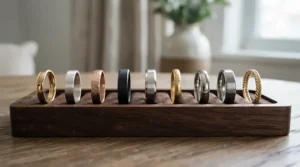
Most of the seven bands above are standard designs, which work for the majority of engagement rings on the market. But custom-fit bridal sets earn their higher price and longer wait time in a few specific situations: unusually shaped center stones (think trillion or kite cuts), heirloom rings with vintage settings that don’t match modern manufacturing standards, or an engagement ring with a very steep or very shallow setting angle that standard curves simply can’t match.
Going custom typically means sending your engagement ring — or precise measurements and photos of it — to a jeweler who casts a wedding band specifically molded to your ring’s exact contour. Expect a multi-week turnaround and a price premium over a standard curved band, but also expect a fit with zero visible gap, since the band is essentially built as a mirror image of your specific setting rather than a general approximation.
The honest trade-off: if a standard curved band from this list already sits flush in a trial fitting, custom work is an unnecessary expense. Save the custom route for engagement rings that genuinely don’t cooperate with anything off the shelf.
Common Mistakes When Buying a Curved Wedding Band
Buying based on the picture alone, without checking the specific curve depth listed, is the most common misstep — two bands can look nearly identical in a product photo and fit completely differently in person. Another frequent mistake is ordering the same ring size as the engagement ring without accounting for how a curved band’s shape changes where it sits on the finger, which can shift the effective fit by a quarter size or more.
Buyers also tend to skip verifying metal compatibility, pairing a nickel-containing white gold band with a nickel-free engagement ring and later wondering why one ring irritates their skin and the other doesn’t; the DermNet skin-reaction resource on jewelry allergy is worth a read if you’ve ever reacted to costume jewelry before. Finally, many shoppers assume a curved band will automatically look right stacked below the engagement ring without ever testing it stacked above — flipping the wear order can dramatically change how well two rings visually and physically nest together.
Long-Term Cost and Maintenance of Curved Wedding Bands
A cubic zirconia curved band like the EAMTI Sterling Silver Wave Band costs almost nothing upfront but typically needs replating or replacement within two to four years of daily wear, making its effective annual cost creep upward over time. A solid gold diamond band like the Gabriel NY Curved Band, by contrast, carries a much higher upfront price but needs only occasional professional cleaning and prong checks, stretching its cost-per-year dramatically lower over a decade or two of wear.
Budget for periodic maintenance regardless of which tier you choose: annual prong inspections (free at most jewelers who sold you the piece), occasional rhodium replating for white gold every one to three years, and resizing costs if your finger size changes, which happens to most people at least once over a marriage. Total cost of ownership almost always favors solid gold and platinum over gold-plated or costume pieces for anyone planning to wear the ring daily for more than five years — the math simply flips once replating and replacement cycles are factored in.
| Tier | Typical Price Range | Value Verdict |
|---|---|---|
| Budget (CZ/plated) | Under $30 | Best for short-term or trial pairings |
| Mid-range (real diamond, 10K–14K) | $350–$900 | Best balance of cost and daily durability |
| Premium (solid gold/platinum) | $1,400+ | Lowest cost-per-year over decades of wear |
The table above underscores a point worth repeating: cheap isn’t always cheaper. A $25 band replaced three times over ten years can cost more in total than a single $900 mid-range diamond band that simply lasts.
Safety, Metal Allergies, and Jewelry Regulations to Know
If you’ve ever developed itchy, red skin under a piece of costume jewelry, nickel is the likely culprit, and it shows up more often in white gold than most buyers realize — some white gold alloys use nickel specifically to achieve that bright white tone before rhodium plating is applied on top. Once the plating wears thin, which happens gradually with daily wear, the nickel underneath can trigger reactions in sensitive skin, so anyone with a known nickel allergy should ask sellers directly about alloy composition rather than assuming “white gold” means “nickel-free.”
On the regulatory side, U.S. jewelry marketers are required to follow the FTC’s jewelry buying guidance on how gold, platinum, and silver content must be disclosed and marked. A genuine 14K stamp must appear alongside the manufacturer’s registered trademark, and any deviation — an unmarked “gold” piece, or a vague “gold-tone” listing with no karat disclosure — is worth treating as a red flag rather than a bargain. For destination weddings or international purchases, also confirm hallmarking standards match U.S. expectations, since karat definitions and required markings can differ by country.
Frequently Asked Questions
❓ What is a curved wedding band called?
❓ How much does a curved wedding band cost?
❓ Should I wear the curved band above or below the engagement ring?
❓ Can any wedding band be curved to fit an engagement ring?
❓ Do curved wedding bands work with all engagement ring shanks?
Conclusion
Finding curved wedding bands for curved engagement rings really comes down to matching geometry, not just style — a band that closes the gap on your specific setting will always look and feel better than the prettiest ring that doesn’t actually fit. Whether you land on the budget-friendly EAMTI Sterling Silver Wave Band, a genuine diamond piece like the Dazzlingrock Collection Curved Guard or KATARINA Diamond Twist Band, or invest in a lasting solid gold option like the Gabriel NY Curved Band, the goal stays the same: two rings that sit together like they were always meant to.
Take the time to check your engagement ring’s setting height and shank shape before ordering, lean on a jeweler for a trial fitting if you’re spending real money, and don’t be afraid to start with an affordable placeholder while you save for the diamond version. A ring stack that fits properly isn’t a luxury — it’s the difference between loving your rings and quietly tolerating them for the next fifty years.
Recommended for You
- Thin Stackable Wedding Bands For Layering: 7 Best Picks 2026
- 7 Best Stackable Wedding Bands For Petite Fingers In 2026
- 7 Vintage Style Wedding Bands For Women That Feel Timeless (2026)
Disclaimer: This article contains affiliate links. As an Amazon Associate, I earn from qualifying purchases. If you purchase products through these links, we may earn a small commission at no additional cost to you.
✨ Found this helpful? Share it with your bride-to-be squad! 💬🤗
