In This Article
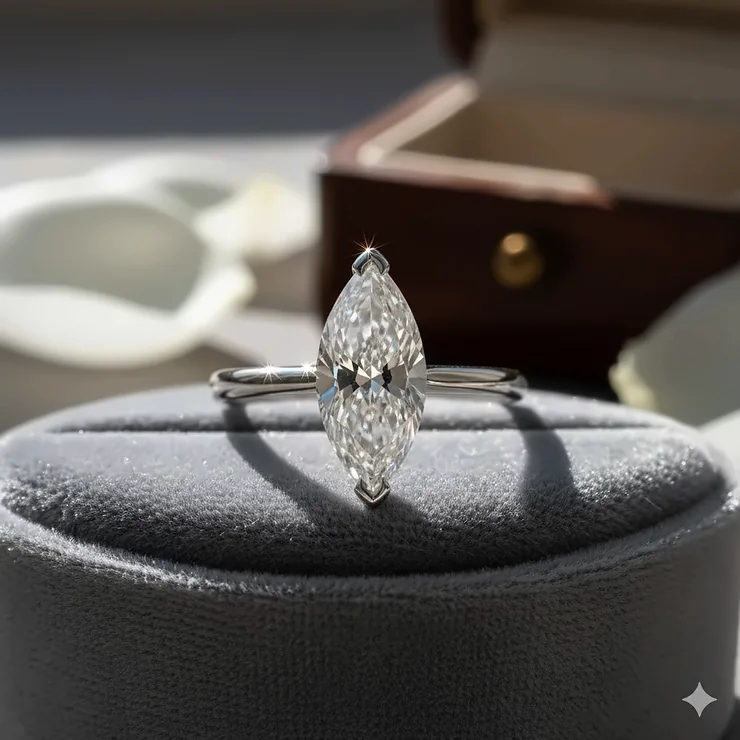
Some diamond shapes whisper. The marquise doesn’t. It arrives pointed at both ends, long and slightly dramatic, like a tiny gold-rimmed canoe drifting across your knuckle. After years of oval and cushion dominance, marquise engagement rings are back, and they’re back loudly. Searches spiked after Selena Gomez’s engagement, and designers have been building 2026 lines around the shape ever since.
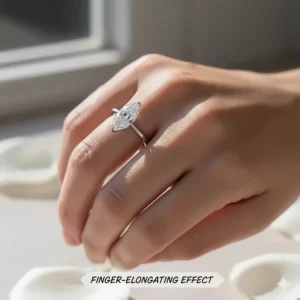
The appeal is partly arithmetic. An elongated stone covers more finger than a round stone of the same weight, so it looks bigger and makes fingers look longer. The appeal is also partly personality. Plenty of couples are tired of rings that look like everyone else’s, and a marquise diamond engagement ring is hard to confuse with anything else.
The shape has quirks, though. The points chip if you ignore them, a “bow-tie” shadow can sneak across the middle, and prices swing wildly depending on whether you buy natural diamond, lab-grown diamond, moissanite or cubic zirconia. So this guide covers seven real, researched options from budget to premium, with honest analysis of what each one means in practice. It also explains how to judge a marquise cut engagement ring by eye, which settings protect the stone, and what it will really cost you over the years.
Quick Comparison: Marquise Engagement Rings at a Glance
Here’s the shortlist before the deep dive. Prices are approximate ranges at the time of research and will vary by seller, metal and size, so always check the current listing.
| Ring | Center Stone | Metal | Approx. Price Range | Best For |
|---|---|---|---|---|
| PalmBeach Jewelry Marquise-Cut Cubic Zirconia Ring | Cubic zirconia, 2.48 ct. t.w. | Gold-plated sterling silver | Around $100 or less | PalmBeach CZ Ring suits trying the shape or a placeholder ring |
| AimiIee Marquise Moissanite Three-Stone Ring | Moissanite, 1.6 cttw | 925 sterling silver | Budget range (check current price) | AimiIee Three-Stone suits sparkle on a tight budget |
| Rosec Jewels 1 Ct Marquise Moissanite Solitaire | Moissanite, 1 ct | 925 sterling silver | Around $300 on one listing | Rosec Jewels Solitaire suits minimalists |
| Cora Jewellery 1.5CT Marquise Moissanite Ring | Moissanite, 1.5 ct | 10K–18K yellow gold | Roughly $600–$1,000 | Cora Jewellery Ring suits a “forever” gold band |
| Best Brilliance Samantha Marquise Diamond Ring | Natural diamond, 1.0 ctw | 14K white gold | Roughly $1,400–$2,700 | Best Brilliance Samantha suits natural-diamond purists |
| James Allen Marquise Lab-Grown Three-Stone Ring | Lab-grown diamond (center sold separately) | 14K–18K gold or platinum | Setting roughly $1,600–$1,850 | James Allen Three-Stone suits a custom-built stone |
| Rogers & Hollands Marquise Lab-Grown Three-Stone Ring | Lab-grown diamond, 2 3/8 ctw | 14K yellow gold | Around $5,000 | Rogers & Hollands Three-Stone suits a ready-to-ship statement ring |
Look at the table and one pattern stands out: the stone type, not the shape, drives the price. The PalmBeach CZ Ring and the Rogers & Hollands Three-Stone are both marquise engagement rings, yet they sit about fifty times apart in cost. If you want real durability without the diamond bill, the moissanite tier, represented by the Rosec Jewels Solitaire and Cora Jewellery Ring, is the sweet spot for most budgets. Anyone who wants a certified diamond should pay close attention to the James Allen Three-Stone, because the setting and the stone are priced separately.
💬 Just one click — help others make better buying decisions too!😊
What Are Marquise Engagement Rings?
Marquise engagement rings are rings whose center stone is an elongated, boat-shaped cut with two pointed ends and gently curved sides. The marquise cut belongs to the brilliant family, usually with 56 or 58 facets, and is prized because its length makes the stone look larger and the finger look longer than other shapes of the same carat weight.
The origin story is the stuff of royal gossip. Tradition says Louis XV of France asked a jeweler around 1745 to cut a diamond echoing the smile of his mistress, the Marquise de Pompadour. The International Gem Society recounts the legend, though whether the commission truly happened is debated. Either way, the name stuck, and so did the romance. You’ll also see the shape called a navette, which comes from the Latin word for boat, or simply a “football” diamond.
Two things define a good marquise: its length-to-width ratio and how evenly it handles light. A ratio near 2.0 looks classic, while stones near 1.75 look stubby and stones above 2.25 can look needle-thin and flash a dark band across the middle. We’ll unpack that band shortly.
Is the marquise right for you? If you want elegance with individuality, yes. If you routinely work with your hands in rough conditions, the points deserve extra thought, and the setting section later in this guide shows how to protect them.
Top 7 Marquise Engagement Rings: Expert Analysis
I’ve organized these from budget to premium. Each analysis is built on real specs and the review data I could verify, framed as reasoning, not as hands-on testing. Where detailed review text couldn’t be confirmed, I say so.
1. PalmBeach Jewelry Marquise-Cut Cubic Zirconia Ring — the lowest-risk way to try the shape
The PalmBeach CZ Ring wears a 2.48 ct. t.w. marquise-cut cubic zirconia in gold-plated sterling silver. That total weight includes accent stones, so don’t picture a 2.48-carat center. In practice, it’s a statement-sized look for a pocket-money price.
Here’s what the spec sheet won’t tell you plainly: cubic zirconia is a diamond simulant, not a diamond or moissanite. It scratches and clouds more readily than harder stones, and the gold plating wears down with years of daily friction. That makes this ring a smart “test drive” if you’re unsure marquise is your shape, or a stand-in while a custom ring is made.
Review sentiment is the strongest verifiable signal here. The ring carries about a 4.4 out of 5 average from several hundred reviews on one major retailer listing, which is a solid track record at this price. I could not verify the specific themes in those reviews, so treat the rating as a general indicator.
Pros:
- ✅ Very low cost for a large-looking marquise
- ✅ Hundreds of retailer reviews averaging about 4.4
- ✅ Good “trial” ring before committing to a stone
Cons:
- ❌ Cubic zirconia scratches and clouds with daily wear
- ❌ Gold plating thins over time
Price range: around $100 or less. Value verdict: excellent as a temporary or experimental ring, poor as a lifelong heirloom.
2. AimiIee Marquise Moissanite Three-Stone Ring — sparkle-per-dollar champion
The AimiIee Three-Stone is sold on Amazon as a 1.6 cttw marquise moissanite ring in 925 sterling silver, with seller-stated D color, VVS1 clarity and a certificate. Those color and clarity claims are seller specs, so read the certificate details when it arrives.
Moissanite is the clever middle road. It’s a different material from diamond, but it’s hard, fiery and far cheaper, which means a three-stone marquise composition suddenly becomes affordable. The three-stone layout also helps hide the bow-tie, since smaller stones show less dramatic shadows than one large one.
What should you weigh? Sterling silver is softer than gold or platinum, and it can tarnish. If this will be an everyday ring, plan on occasional polishing and prong checks. I couldn’t verify a star rating or review themes for this exact listing, so check the current listing’s reviews before buying.
Pros:
- ✅ Moissanite sparkle at a budget price
- ✅ Three-stone design hides bow-tie shadows
- ✅ Certificate included per the seller
Cons:
- ❌ Sterling silver tarnishes and scratches more easily
- ❌ Verified review data was limited at research time
Price range: budget tier, so check the current price. Value verdict: strong sparkle for the money, with a metal you’ll need to maintain.
3. Rosec Jewels 1 Ct Marquise Moissanite Solitaire — clean lines, minimal fuss
The Rosec Jewels Solitaire pairs a 1-carat marquise moissanite with a 925 sterling hallmark and a quality certificate, with sellers stating D color and VS1 clarity. One related listing describes a 5×10mm stone, which gives a ratio of exactly 2.0, the classic proportion.
That ratio is the quiet selling point. A 2:1 marquise is long enough to read as elegant, but not so narrow that the bow-tie dominates. For someone who loves minimalism, a plain solitaire lets the stone do all the talking, and it pairs easily with a curved wedding band.
Reviews are the weak link for verification. The listing I found had only a single five-star review, which is far too thin to draw conclusions. I’d call this a promising-on-paper pick that needs your own scrutiny of the stone’s photos and the return policy.
Pros:
- ✅ Classic 2:1 proportions on the 5×10mm listing
- ✅ Simple solitaire style that suits modern minimalism
- ✅ Certified moissanite per the seller
Cons:
- ❌ Very few verified reviews
- ❌ Sterling silver needs polishing and care
Price range: around $300 on one listing. Value verdict: fair for design and proportion, though less proven than the best-reviewed options.
4. Cora Jewellery 1.5CT Marquise Moissanite Ring — gold band, grown-up feel
The Cora Jewellery Ring steps up to real gold, with 10K yellow gold at the lower end and 18K at the higher end of the pricing. It carries a 1.5-carat marquise moissanite center.
Gold changes the ring’s character. It resists tarnish, can be repaired and resized by a jeweler, and takes V-shaped prongs that protect the tips. That’s the practical upgrade over sterling silver, and it’s why this tier suits couples who want something to wear for decades.
Retailer listings show roughly a 4.4 out of 5 rating across a small number of reviews (around fifteen). That’s encouraging but not definitive, since small samples swing easily. If you choose this one, compare the 10K and 18K options carefully: 18K is richer in color and softer, while 10K is tougher but paler.
Pros:
- ✅ Real gold band that can be maintained and resized
- ✅ Larger 1.5-carat marquise moissanite center
- ✅ Choice of 10K or 18K gold
Cons:
- ❌ Small review sample at about fifteen reviews
- ❌ Price climbs quickly with 18K gold
Price range: roughly $600–$1,000 depending on metal. Value verdict: the best “forever ring” balance of cost and durability for moissanite buyers.
5. Best Brilliance Samantha Marquise Diamond Ring — natural diamond, uncomplicated
The Best Brilliance Samantha is a 1.0 total-carat natural diamond marquise solitaire in 14K white gold. Listings show it at a discounted price against a much higher regular price, so treat the “sale” framing cautiously and compare it with similar stones elsewhere.
This is the pick for buyers who want mined diamond and a pure solitaire. Natural stones carry the traditional meaning and resale conversation, but the premium is real. For a marquise that size, clarity and color matter more than usual, because retailer guidance suggests VS2 clarity or better and G-H color or higher, as the pointed ends show off both flaws and warmth.
I couldn’t verify review data for this specific ring. So focus on the diamond’s certificate, its length-to-width ratio and, crucially, a video of it moving in light. A certificate won’t tell you about the bow-tie.
Pros:
- ✅ Natural diamond with traditional appeal
- ✅ Clean solitaire that suits stacking bands
- ✅ 14K white gold suits V-prong protection
Cons:
- ❌ Costs far more than moissanite for similar looks
- ❌ Review data was not verifiable
Price range: roughly $1,400–$2,700. Value verdict: worth it only if natural origin matters to you.
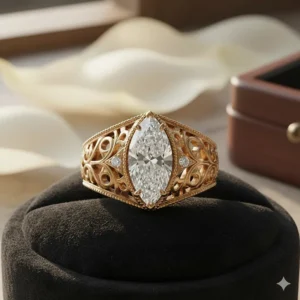
6. James Allen Marquise Lab-Grown Three-Stone Ring — build the stone you actually want
The James Allen Three-Stone is a setting you pair with a lab-grown diamond of your choosing. It’s listed on Blue Nile’s site in 14K rose gold, 14K or 18K yellow gold, 18K white gold and platinum, with marquise lab-grown side stones. Setting prices ran around $1,600–$1,850 in the listings I saw, before the center stone.
The important detail is that the center stone is separate. On Blue Nile, an IGI-graded 1.5-carat lab-grown marquise in D color and flawless clarity was listed around the mid-$2,000s, so a complete ring can land in the low-to-mid $4,000s, give or take. Because you choose the stone, you can reject any marquise with a heavy bow-tie, which is a genuine advantage over buying pre-set.
One practical consideration: IGI added cut grades to reports on loose fancy-shaped diamonds in 2022, according to one retailer guide, which gives you a little more information than GIA offers on fancy shapes.
Pros:
- ✅ You pick and inspect the center diamond
- ✅ Multiple gold and platinum options
- ✅ Three-stone design adds presence
Cons:
- ❌ Setting and stone priced separately
- ❌ Total cost is hard to judge from one listing
Price range: setting roughly $1,600–$1,850, with the full ring higher. Value verdict: the smartest premium route for shoppers who care about stone quality.
7. Rogers & Hollands Marquise Lab-Grown Three-Stone Ring — ready-to-ship statement piece
The Rogers & Hollands Three-Stone is a 2 3/8 ctw lab-grown marquise-cut diamond ring flanked by kite-shaped lab-grown accents, set in 14K yellow gold. The listing shows G color for the main stone and a rating around 4.8 out of 5.
That kite-shaped side-stone detail is the thoughtful part. It echoes the pointed geometry of the center stone, so the three stones read as one coordinated shape, not a random trio. On the finger, the effect is bold but cohesive.
The high rating is encouraging, although I couldn’t confirm how many reviews support it. So I’d treat it as a good sign, not a guarantee. At around $5,000, you’re paying for size and finish, and the ring comes ready to ship, which suits anyone who needs it soon.
Pros:
- ✅ Large total carat weight with a cohesive design
- ✅ Retailer rating around 4.8
- ✅ Ready-to-ship convenience
Cons:
- ❌ Premium price tag
- ❌ Review count not verified
Price range: around $5,000. Value verdict: fair for a big lab-grown statement ring, especially compared with natural equivalents.
How to Choose Marquise Engagement Rings: 7 Steps
Here’s the short answer: pick your stone type, check the ratio, inspect the bow-tie in motion, protect the points, then choose a band that fits the shape.
- Decide the stone type first. Natural diamond, lab-grown diamond, moissanite and cubic zirconia look similar in photos but differ in durability and cost. Your budget usually decides this before anything else.
- Target a ratio between 1.75 and 2.25. Many buyers prefer roughly 1.95–2.10. Below 1.75 reads stubby, and above 2.25 risks a visible bow-tie.
- Judge the bow-tie in motion. No major lab lists it on a report, so watch a video or view the stone in person. A soft, shifting shadow is normal.
- Prioritize clarity at the tips. Inclusions near the points are risky, since those are the weakest parts.
- Aim for warmer-looking color to be forgiving, cooler to be crisp. G-H or better keeps a diamond bright, though moissanite is often sold as colorless.
- Choose a protective setting. V-prongs or a bezel cover the points.
- Match the wedding band. Curved or chevron bands sit flush with the shape.
Notice how step three is the one most shoppers skip. A certificate can give you ratios and finish grades but nothing about how the stone behaves in light.
Features That Actually Matter (And Those That Don’t)
Marketing loves big words. Here’s the filter.
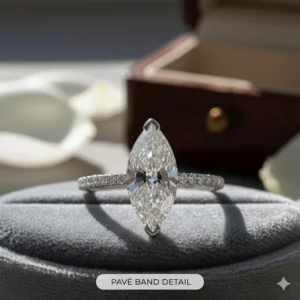
What matters most: the bow-tie and the ratio. The bow-tie is a dark, hourglass-shaped zone caused by light leaking through the long facets. GIA’s guidance on fancy shapes says it should be minimized as much as possible and that the points should be checked for inclusions. Notice that GIA doesn’t assign an overall cut grade to fancy shapes, so the burden of judging falls on you.
What matters moderately: symmetry. If the two points don’t line up or one side bulges, the stone looks off even before you can say why.
What barely matters: chasing the highest color grade. The pointed ends do reveal color, but past a certain point you’re paying for differences you can’t see on a hand. Retailer guidance suggests G-H or better, and that’s a sensible floor.
What doesn’t matter at all: the word “ideal” on a marquise listing. Because there’s no official overall cut grade for fancy shapes, that language can be a seller’s opinion. Be skeptical, ask for videos, and compare several stones side by side.
Best Settings for a Marquise Diamond Engagement Ring
A marquise is only as safe as its setting. The two points are the weak spots, since they can chip on a door frame or a hard knock.
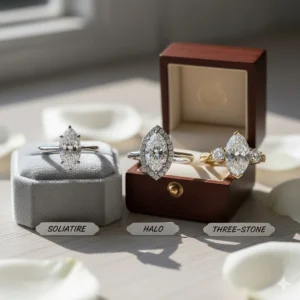
V-prongs. These cap each point and are the classic protection. They keep the outline visible while shielding the tips.
Bezel. A metal rim wraps the stone, offering the most protection. It also gives a clean, modern look, though it hides some of the diamond’s edge. The bezel also keeps metal near the stone’s edges, so check the bow-tie before committing.
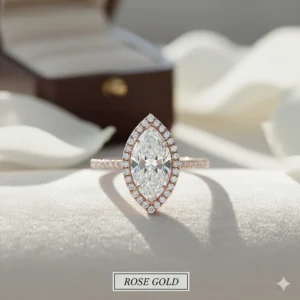
Hidden halo and halo. A halo adds sparkle and makes the center look bigger, while a hidden halo tucks sparkle under the stone.
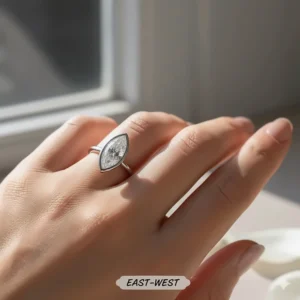
East-west. Turning the stone sideways makes a modern, wide statement and shows off the shape without the usual vertical drama.
One trade-off deserves a mention. Too much metal beneath the stone can deepen the bow-tie, so an open gallery often looks brighter than a closed one. Pair the setting with a curved or chevron band so the two rings sit flush instead of leaving an awkward gap.
Marquise Cut vs Oval, Round and Pear: What’s the Difference?
The marquise gets compared with other elongated cuts constantly, so here’s the head-to-head.
| Shape | Face-Up Size | Bow-Tie Likelihood | Edge Protection Need | Best For |
|---|---|---|---|---|
| Marquise | Largest for its weight | Very common | High (two points) | Bold, individual styles |
| Oval | Large | Common | Low | Safe, versatile style |
| Round | Smaller for its weight | None | Low | Maximum brilliance |
| Pear | Large | Common | Medium (one point) | Teardrop romantics |
Reading the table, the marquise wins on finger coverage but pays for it in maintenance. Rounds sidestep the bow-tie entirely, since it doesn’t occur there, and ovals give much of the elongated look with no points to protect. The marquise is the choice for people who want to be noticed.
Light behavior is the other story. One GIA report on split-facet cuts notes that the bow-tie is a long-standing issue in standard oval, marquise and pendeloque cuts. So it’s an inherent trait of the shape, not a sign of a bad stone, which is why judging severity matters more than demanding perfection.
Long-Term Cost & Maintenance: Natural vs Lab-Grown vs Moissanite
Buying the ring is only the first cost. Over a decade, upkeep, insurance and replacement matter too.
| Stone Type | Typical Upfront Cost | Durability | Upkeep | Best For |
|---|---|---|---|---|
| Cubic zirconia | Lowest | Lower; scratches and clouds | Replace or re-polish sooner | Trial or temporary rings |
| Moissanite | Low to moderate | High | Occasional cleaning and prong checks | Value-focused buyers |
| Lab-grown diamond | Moderate to high | Very high | Same as natural | Diamond look without natural premium |
| Natural diamond | Highest | Very high | Same as lab-grown | Tradition-minded buyers |
The cost story is more nuanced than “cheaper is better.” A cubic zirconia ring like the PalmBeach CZ Ring may need replacing, which erases its upfront saving. A Cora Jewellery Ring in gold costs more up front but is repairable. And for the diamond tier, a Best Brilliance Samantha and a lab-grown ring like the James Allen Three-Stone share the same hardness and care needs, so the difference is almost entirely price and origin.
Budget for insurance, a yearly jeweler inspection, and re-tipping prongs if they wear. On a marquise, prong wear around the points is the repair that most often comes up.
Practical Usage Guide: Care, Sizing and Your First 30 Days
Here’s what Amazon-style listings rarely cover.
Sizing. Fingers swell with heat and salt. Size the ring at the end of the day, not first thing in the morning. Some listings, like certain James Allen items, state that rings can’t be resized, so confirm before buying.
First-use tips. Check each prong with a fingertip for any snag. Gently tap the ring near your ear: a faint rattle can signal a loose stone.
Daily habits. Remove the ring for gym sessions, dishwashing, gardening and moving boxes. The points are the weakest area, so avoid pockets and tight gloves.
Cleaning schedule. Soak weekly in warm water with a few drops of mild dish soap, brush gently with a soft toothbrush, and rinse. Sterling silver pieces such as the AimiIee Three-Stone and Rosec Jewels Solitaire benefit from a polishing cloth.
Common first-30-day mistakes. Wearing it constantly without checking prongs, using harsh chemicals, and storing it loose with other jewelry.
Treat the first month as a settling-in period, and you’ll catch most problems early.
Real-World Scenarios: Which Marquise Engagement Ring Fits Which Person?
Stories beat spec sheets, so here are three buyer profiles.
The graduate on a tight budget. She wants the look without the debt. A PalmBeach CZ Ring works as a bridging ring, or an AimiIee Three-Stone gives her real moissanite sparkle for a modest outlay. She should plan on replacing or upgrading in a few years.
The nurse who washes her hands forty times a shift. Constant washing and gloves mean a low-profile setting matters. A bezel-style or V-prong Cora Jewellery Ring in gold gives durability, and she should remove it during procedures.
The couple saving for a statement ring. They want a 2-carat-plus look but not a six-figure bill. A Rogers & Hollands Three-Stone delivers size with lab-grown diamonds, while a James Allen Three-Stone lets them select the stone with the least visible bow-tie.
Each scenario ties budget, environment and frequency of use to a specific ring. Find the profile closest to yours, then adjust upward or downward from there.
Buyer’s Decision Framework: If This, Then That
Use this quick checklist.
- If your budget is under about $150, choose cubic zirconia like the PalmBeach CZ Ring only as a trial, or moissanite in sterling silver like the AimiIee Three-Stone, because moissanite resists wear better.
- If you want something to wear daily for years, choose gold with moissanite or lab-grown diamond, because gold can be repaired and resized.
- If tradition matters, choose a natural diamond such as the Best Brilliance Samantha, because origin is the whole point.
- If you’re picky about sparkle, choose a ring where you select the stone, like the James Allen Three-Stone, because you can reject heavy bow-ties.
- If you need it fast and want size, choose a ready-to-ship ring like the Rogers & Hollands Three-Stone, because there’s no custom wait.
Priority order, if you must rank: durability, bow-tie, ratio, then size.
💬 Just one click — help others make better buying decisions too!😊
Common Mistakes When Buying Marquise Engagement Rings
Buying by measurements alone. A stone can hit the right ratio and still show a heavy shadow. Always judge in light and motion.
Ignoring the tips. Inclusions at the points raise the risk of chipping. Check them closely.
Trusting “ideal cut” claims. GIA does not assign an overall cut grade to fancy shapes, so any such label is the seller’s opinion.
Skipping setting protection. An unprotected point on a marquise cut engagement ring is an invitation to a chip.
Choosing a straight band. A flat wedding band leaves a gap beside the pointed stone. Curved or chevron bands sit flush.
Forgetting insurance. Rings that cost real money deserve coverage, especially with thin prongs.
Overpaying for color. The pointed ends do show color, but you don’t need top-tier grades to get a bright, white-looking stone.
Avoid these seven, and you’ve dodged most buyer’s remorse before it starts.
Safety, Regulations and Disclosure: Buying Lab-Grown Diamonds Legally
If you’re considering lab-grown stones, it helps to know the rules protecting you. In 2018 the FTC revised its Jewelry Guides, and National Jeweler and JCK coverage of the revision explains that the update removed “natural” from the definition of a diamond. The Guides still require clear, prominent disclosure of lab-grown origin.
What does that mean for you? Sellers should clearly label a stone as laboratory-grown, laboratory-created or similar, rather than leaving “diamond” unqualified. Be cautious of listings that blur the line between a lab-grown diamond and a simulant such as cubic zirconia or moissanite. The FTC has previously warned sellers whose marketing could confuse shoppers on this exact point.
Practical protections: ask for a grading report from a recognized lab, confirm the stone type in writing, keep receipts, and check the return window. And if a seller leans on vague phrases like “eco-friendly,” ask what that claim is based on.
A well-disclosed lab-grown marquise diamond engagement ring is a perfectly legitimate purchase. It just needs the paperwork to match the sparkle.
Frequently Asked Questions
❓ How much do marquise engagement rings cost in 2026?
❓ Do marquise cut engagement rings snag on clothing?
❓ Which wedding band pairs best with a marquise diamond engagement ring?
❓ Are diamond marquise engagement rings harder to keep clean?
❓ Can I resize a ring from engagement rings marquise collections?
Conclusion
Marquise engagement rings reward the buyer who looks closely. The shape makes a stone look larger, makes fingers look longer and makes nearly any ring feel personal. In exchange, it asks for a protective setting, a sharp eye for the bow-tie and a little extra care.
Here’s the whole guide in one breath. Choose the stone type that matches your budget, aim for a ratio near 2.0, watch the stone move in light, and protect those points. If you want an inexpensive test of the shape, the PalmBeach CZ Ring does the job. If you want everyday durability at a friendly price, the Rosec Jewels Solitaire and Cora Jewellery Ring make sense. For certified diamonds, the James Allen Three-Stone lets you choose the stone, while the Rogers & Hollands Three-Stone gives you size on a ready-to-ship ring.
Whichever you choose, the right marquise diamond engagement ring is the one that feels like a good decision every time you look down at it.
Recommended for You
- 2 Carat Pear Shaped Diamond Ring: 7 Stunning Picks for 2026
- Pear Halo Engagement Ring: 7 Best Picks for 2026
- Pear Shaped Engagement Rings: 7 Stunning Picks for 2026
Disclaimer: This article contains affiliate links. As an Amazon Associate, I earn from qualifying purchases. If you purchase products through these links, we may earn a small commission at no additional cost to you.
✨ Found this helpful? Share it with your friends! 💬🤗
