In This Article
Here’s the secret jewelers have known for years: carat weight is a liar. Not a malicious one. It just measures weight, not how big a stone looks on your hand. Nowhere is that gap wider than with ovals.
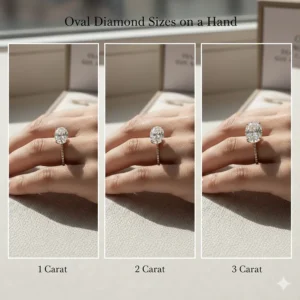
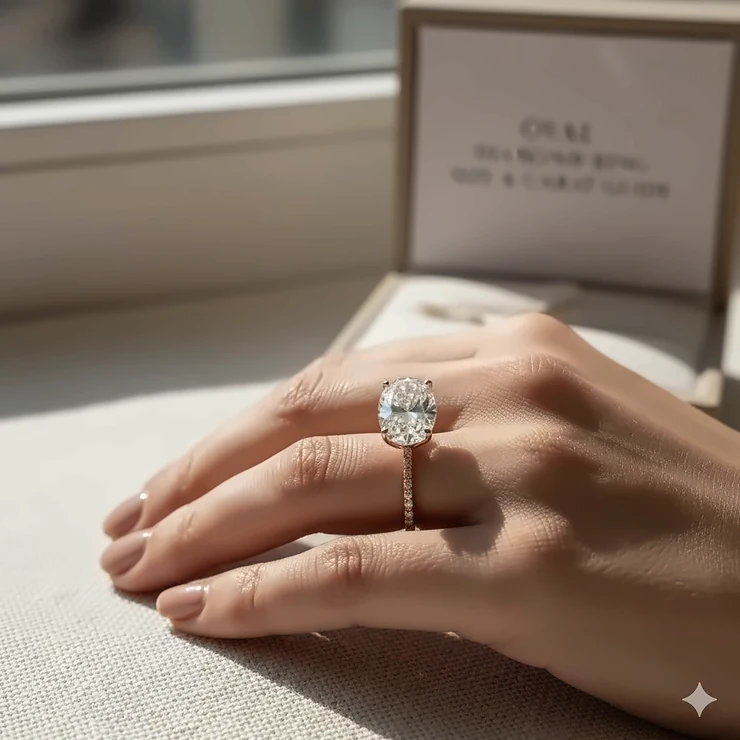
An oval spreads its weight across a long, flowing outline. It tends to look larger than a round of the same carat and makes fingers look longer, and it keeps the fire people love in a brilliant cut. That’s why this Oval Diamond Ring Size & Carat Guide starts with millimeters and ratios, not just carats.
I’ve organized everything around the questions buyers actually ask. How big is a 1 carat oval in real life? Which length-to-width ratio looks best? Will the dreaded bow-tie ruin the stone? And which rings are worth shortlisting in 2026?
You’ll find a size chart, seven real products analyzed against their specs, and practical guides for measuring, choosing, and caring for your ring. One honest note up front: every product here is analyzed from published specs and aggregated listing information. Nothing is claimed as hands-on tested, and where I couldn’t verify review data, I say so.
What Is an Oval Diamond Ring Size & Carat Guide?
An oval diamond ring size & carat guide is a reference that translates an oval stone’s carat weight into real millimeter dimensions, length-to-width ratio, and finger coverage, so you can predict how a ring will look before you buy. Because carat measures weight rather than width, two ovals of identical carat can look noticeably different.
Oval is a “fancy shape,” so GIA doesn’t assign it an overall cut grade the way it does for rounds. Its fancy-shape buying advice tells shoppers to look for even, well-rounded shoulders and to minimize the “bow-tie” as much as possible. GIA’s report still assesses polish and symmetry, but proportions are on you.
That’s the real value of a size guide. It turns a vague “2 carat” into a measurable footprint: something like 10 × 7 mm that you can compare against your finger, your style, and your budget.
Two more terms you’ll see throughout:
- Length-to-width (L/W) ratio: length divided by width. Lower is rounder, higher is slimmer.
- Diamond equivalent weight (DEW): how moissanite sellers translate a stone’s size into the carat weight a diamond of that size would have.
Quick Comparison: 7 Oval Diamond Rings at a Glance
Before the deep dive, here’s the shortlist. Prices are ranges only and change constantly, so check the live listing.
| Ring | Center Stone | Approx. Size | Metal | Price Range | Best For |
|---|---|---|---|---|---|
| Houston Diamond District Lab-Grown Oval Solitaire | Lab-grown diamond, IGI | 0.5–10 ct options | 14K gold | Mid-$1,000s+ at 1 ct; varies | Certified, size-flexible buyers |
| Houston Diamond District Vintage Lab-Grown Oval | Lab-grown diamond, D-E | 1–5 ct options | Gold | Varies by carat | Vintage-style lovers |
| Kobelli Annello Oval Halo | Moissanite (2 ct DEW) | 9 × 7 mm | 14K gold | Roughly $2,100–$3,300 | Halo fans wanting gold |
| Kobelli Orah | Moissanite (4 ct DEW) | 12 × 8 mm | 14K gold | Around the $2,000s | Statement size |
| Lispark 14K Oval Moissanite Halo | Moissanite (1.5 ct) | ~1.5 ct oval | 14K gold | Check current price | Gold on a modest budget |
| Newshe Oval CZ Bridal Set | Cubic zirconia | 9 × 7 mm | Sterling silver | Under $100 | Placeholder or travel ring |
| Ladylike S925 Oval Moissanite Hidden Halo | Moissanite (2 ct) | ~2 ct oval | Sterling silver | ~$100–$250 for comparable | Big look, small budget |
Looking at the table, the Houston Diamond District Lab-Grown Oval Solitaire is the only option here where a grading-lab report anchors the carat-to-millimeter question. If you want gold and a halo without crossing into diamond-budget territory, the Kobelli Annello Oval Halo sits in the middle. Budget buyers should note that the Newshe Oval CZ Bridal Set costs a sliver of the others because cubic zirconia is not a diamond or moissanite. That’s a perfectly honest trade-off as long as you buy it knowing that.
💬 Just one click — help others make better buying decisions too!😊
Top 7 Oval Diamond Rings: Expert Analysis
1. Houston Diamond District Lab-Grown Oval Solitaire (IGI Certified) — widest carat range, report-backed
The standout here is flexibility. The listing spans roughly 0.5 to 10 carats in a plain solitaire, so you can dial the size to your budget instead of settling for whatever the jeweler stocked.
The main variant lists E-F color and VS1-VS2 clarity, with a 14K yellow gold 1 carat version showing VS2-SI1 in one listing. Check which variant you’re ordering. In practice, E-F means colorless to the naked eye, while the clarity range means “eye-clean” depends on the individual stone, not the grade alone.
Based on the spec comparison, the IGI report is the real prize. It lists the stone’s actual millimeter measurements, which lets you verify the length-to-width ratio against this guide. A solitaire also shows the stone’s true size with no halo illusion, so what you read on the report is what you wear.
Review-wise, third-party roundups show buyer photos, but I couldn’t verify one stable rating across variants. Read the live reviews for the exact carat you want.
Pros:
- ✅ Certified lab-grown stone with verifiable measurements
- ✅ Huge carat range for any budget
- ✅ Colorless E-F grade on the main variant
Cons:
- ❌ Clarity grade differs between variants
- ❌ Plain solitaire offers no halo size boost
Lab-grown 1 carat ovals in 14K gold commonly list around the $1,100–$1,800 range across jewelers; check current price for this exact variant. Strong value if you care about stone quality over setting flash.
2. Houston Diamond District Vintage Lab-Grown Oval — top-tier D-E color with antique styling
This one swaps minimalism for personality. The listing offers 1 to 5 carat oval lab-grown diamonds in a vintage-style design with D-E color and VS1-VS2 clarity, so both the color and the clarity sit near the top of the practical range.
What does D-E color actually buy you? In a white metal, D-E is as colorless as diamond gets, a bonus mostly when you want the stone to look icy next to platinum or white gold. In yellow gold, the difference from F-G is much harder to spot, so you could redirect that budget toward carat.
Here’s what to weigh. Ornate vintage detailing adds visual interest, but it also adds crevices where lotion and dust collect, so expect to clean it more often than a plain solitaire. Confirm on the live page whether an independent certificate comes with the stone you pick, since the grading details are what make the carat-to-mm conversion trustworthy.
I couldn’t verify a consistent review set specific to this listing, so treat any star rating as something to check on the day you buy.
Pros:
- ✅ D-E color, the top colorless tier
- ✅ Vintage styling stands out from plain solitaires
- ✅ Carat options from 1 to 5
Cons:
- ❌ Detailed setting needs more frequent cleaning
- ❌ Ornate designs usually cost more than solitaires
Pricing varies with carat and metal, so check the current price. Good value for style-driven buyers who’d pay more for the look than for extra carats.
3. Kobelli Annello Oval Halo — gold, halo, and a colorless moissanite center
The standout is how much finger presence the setting manufactures. A 9 × 7 mm oval center (a 2 carat diamond-equivalent size) surrounded by 46 small round natural diamonds (about 1/4 carat total) is a classic halo recipe.
The center is Forever One moissanite, made in collaboration with Charles & Colvard, which Kobelli describes as colorless. Moissanite measures about 9.25 on the Mohs scale versus diamond’s 10, which means it handles daily wear well. It also throws more rainbow “fire” than diamond, which some people love and some find disco-like.
On paper, 9 × 7 mm lands in the neighborhood of a 1.75 to 2 carat diamond oval face-up. Add the halo, and retailers commonly claim an extra 0.25 to 0.50 carat of visual size. Treat that as marketing-adjacent but directionally plausible.
I couldn’t verify a reliable aggregate review set for this exact listing. Kobelli does include a certificate of authenticity and limited lifetime warranty card, which matters for future resizing and repair.
Pros:
- ✅ Solid 14K gold with a warranty card
- ✅ 9 × 7 mm center delivers about 2 ct of face-up size
- ✅ Halo amplifies perceived size
Cons:
- ❌ Pavé halo is harder to resize and clean
- ❌ Center is moissanite, not diamond
Listings show it from the low-$2,000s on sale up to the low-$3,000s at list, so check current price. Solid value if you want a gold-and-halo look without paying diamond prices.
4. Kobelli Orah — 12 × 8 mm statement oval with a hidden halo
Subtlety is not the point here. The listing describes a 12 × 8 mm moissanite oval (marketed as 4 carats DEW) with a hidden halo of lab-grown diamonds in a slim basket setting, in solid 14K gold.
Put that in context with our size chart: 12 × 8 mm exceeds the footprint of a typical 3 carat diamond oval. That’s a seriously big face-up presence, and with an L/W ratio of 1.5, it’s slim and dramatic rather than round and cozy.
The hidden halo is the clever bit. It adds a flash of sparkle visible from the side without the outline of a traditional halo, which suits people who love the look of ovals but dislike busy settings.
Who is it for? Someone with a decent finger length and no fear of attention. Who should pass? Anyone whose hands live in gloves, keyboards, or tight pockets. Spec-wise, a big stone sits higher and snags more.
Verified review data for this specific listing was thin, so confirm ratings live.
Pros:
- ✅ 12 × 8 mm footprint rivals a 3 ct+ diamond oval
- ✅ Hidden halo adds sparkle without clutter
- ✅ Solid 14K gold construction
Cons:
- ❌ Large stone catches on sleeves and gloves
- ❌ “4 carats” is diamond-equivalent, not true weight
One reseller listing showed it in the mid-$2,000s. Verify before you buy. Great value per millimeter if big presence is your goal.
5. Lispark 14K Oval Moissanite Halo — real gold on a moderate budget
The hook is the metal. This is a 1.5 carat oval moissanite in a halo design, offered in 14K yellow or white gold, which is rarer at this size than silver-plated alternatives.
If it follows the common 8 × 6 mm convention for a 1.5 ct DEW oval (Kobelli’s listings use exactly that pairing), expect a footprint slightly smaller than a 1.5 carat diamond oval. Always confirm the millimeters on the listing, because a “1.5 carat” label can hide a smaller stone.
Gold versus sterling is the practical difference. 14K gold won’t tarnish or wear through plating, and it can be resized by most jewelers. For a ring you’ll wear daily for years, that’s the decision that quietly matters most.
One third-party roundup flagged a limited review history because it’s a newer product. That isn’t a red flag by itself, but it does mean fewer long-term durability reports to lean on.
Pros:
- ✅ 14K gold in yellow or white
- ✅ Halo boosts perceived size
- ✅ Moissanite hardness suits daily wear
Cons:
- ❌ Short review history so far
- ❌ Exact millimeters need checking before ordering
Comparable 1.5 carat oval moissanite rings in solid gold elsewhere list in the mid-$500s. Check current price here. Good value if the metal quality holds up.
6. Newshe Oval CZ Bridal Set — the budget stand-in with a matching band
Let’s be refreshingly honest. This is a cubic zirconia set, not a diamond or moissanite ring. That’s not an insult, just a category.
The listing describes a 7 × 9 mm oval center (1.9 carats by the seller’s measure) in 925 sterling silver with a matching CZ wedding band. A footprint that size resembles a roughly 1.75 to 2 carat diamond oval at a tiny fraction of the cost.
Who is it for? People needing a placeholder before a real ring is chosen, a travel or gym ring, or a fashion piece. The listing itself warns that sterling silver oxidizes, so keep it away from lotions and cleaning chemicals.
Reviewer sentiment on the Walmart listing is positive: 4.6 stars across 32 ratings at the time of research, with buyers mostly praising the look and the pairing of ring and band. That’s a small sample, so treat it as encouraging, not conclusive.
Importantly, FTC guidance says sellers shouldn’t imply simulants are diamonds, and neither should you when gifting.
Pros:
- ✅ Two-piece set with matching band
- ✅ Big face-up footprint for the cost
- ✅ Sterling silver is nickel-free per the listing
Cons:
- ❌ CZ can scratch and cloud over time
- ❌ Silver tarnishes without care
Typically under $100, so check current price. Excellent value for what it is, if you treat it as a stand-in.
7. Ladylike S925 Oval Moissanite Hidden Halo — big look, small price
The hook is the combination: a roughly 2 carat oval moissanite with a hidden halo in S925 sterling silver. It aims for the Orah’s sparkle recipe at a fraction of the price.
A hidden halo, for the uninitiated, is a ring of small stones tucked beneath the center stone’s girdle. You get side-profile sparkle without the visible outline of a traditional halo, which many buyers find more modern.
Moissanite’s 9.25 Mohs hardness makes the stone itself durable. The weak link is the sterling silver band, which can tarnish or lose plating, a common trade-off across the silver-and-moissanite category. If you wear it daily, plan on polishing or replating down the road.
Reviewer data for this exact listing wasn’t verifiable in my research, so check the live page for sizing feedback in particular. Online buyers of silver rings commonly flag inconsistent sizing, so order carefully.
Pros:
- ✅ About 2 ct of face-up size
- ✅ Hidden halo adds side-profile sparkle
- ✅ Hard, durable center stone
Cons:
- ❌ Sterling band may need polishing or replating
- ❌ Limited verified review data
Comparable 2 carat sterling oval moissanite rings run roughly $100–$250, so check current price. Strong value for the look, assuming you accept silver’s maintenance.
✨ Don’t Miss These Exclusive Deals!
🔍 Take your oval ring search to the next level with these carefully selected options. Click on any highlighted product name to check current pricing and availability. These picks will help you find a ring that looks as good on your hand as it does on the screen!
Oval Diamond Carat Size Chart: What Each Carat Looks Like in Millimeters
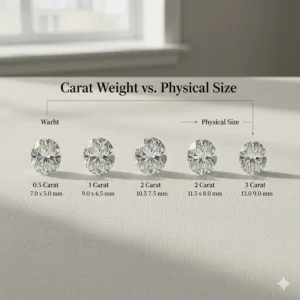
Here’s where the guide earns its keep. Retail charts disagree by a few tenths of a millimeter, so I’ve shown approximate ranges drawn from published oval charts, including the oval size table from Variation.
| Carat | Approx. Length × Width (mm) | What It Reads Like | Best For |
|---|---|---|---|
| 0.50 | ~6.0 × 4.0 | Delicate, minimalist | Stacking, subtle styles |
| 0.75 | ~7.0 × 5.0 | Everyday elegance | Daily wear |
| 1.00 | ~7.7–8.0 × 5.6–5.7 | The classic | Most engagement budgets |
| 1.50 | ~8.8–9.2 × 6.2–6.4 | Noticeable presence | Statement without excess |
| 2.00 | ~9.8–10.1 × 6.5–7.1 | Bold | Longer fingers |
| 3.00 | ~11.0–11.5 × 7.5–8.1 | Show-stopping | Maximalists |
Two lessons jump out. First, size scales slowly: a 2 carat oval is noticeably bigger than a 1 carat, but nowhere near double the width. Weight is a cube-ish measure, while what you see is surface area.
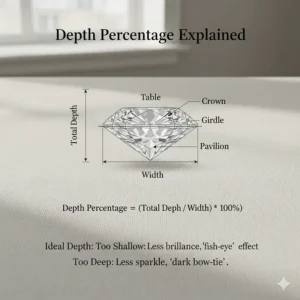
Second, the range at each carat exists because L/W ratio and cut depth change the footprint. A deep, heavy-bellied stone hides carats underneath where nobody sees them. Always compare millimeters, not just the weight on the tag.
If you’re shopping moissanite, remember the “carat” is DEW. By Kobelli’s listings, 8 × 6 mm ≈ 1.5 ct, 9 × 7 mm ≈ 2 ct, and 12 × 8 mm ≈ 4 ct. Compared with the chart above, those are slightly smaller than their diamond namesakes at the lower end, which is why millimeters are the honest currency.
Length-to-Width Ratio and the Bow-Tie Effect
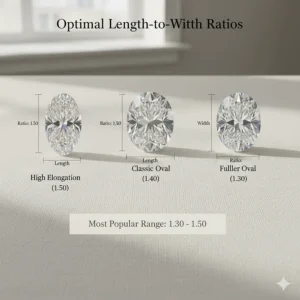
Ratio is the single spec that changes an oval’s personality most. Same carat, same color, same clarity: a 1.30 oval and a 1.55 oval look like different stones.
What the experts say:
- GIA’s earlier fancy-shape advice gives an optimal range of 1.33–1.66:1, noting personal taste decides.
- GIA’s oval diamond guide says many buyers prefer 1.30–1.50:1, with 1.30–1.40 for a rounder look.
- Higher ratios, roughly above 1.50, can show a stronger bow-tie.
The bow-tie, in plain words: a dark, bow-shaped shadow across the middle of the stone. GIA is blunt that every oval shows some, and that a well-cut stone keeps it minimal. It also says the effect appears when your own head and shoulders block light, so it looks stronger the closer your face gets.
Here’s the catch that surprises buyers: the bow-tie isn’t graded on a certificate. A report can’t tell you how visible it is, so ask for a video in daylight-style lighting. A faint bow-tie adds depth, while a heavy one makes a dead zone right in the stone’s center.
Practical rule: for a classic, forgiving oval, target 1.30–1.45. Go above 1.50 only if you’ve seen that exact stone in motion and love it.
How to Choose an Oval Diamond Ring Size & Carat
Follow these seven steps in order. Each one narrows the field.
- Set the budget first. Decide the total ring budget, then split it between stone and setting. A halo can add visual size cheaply, so you may not need extra carats.
- Start from your finger. Longer, slimmer fingers carry elongated ovals well. Shorter fingers often flatter a 1.30–1.40 ratio that doesn’t overwhelm the knuckle.
- Choose the ratio before the carat. Pick 1.30–1.45 for classic, 1.45–1.55 for modern and elongated.
- Convert carat to millimeters. Use the chart above and compare listed dimensions, not weights.
- Check the cut evidence. Look for even shoulders, good polish and symmetry, and a minimal bow-tie in video.
- Match stone type to lifestyle. Lab-grown diamond for diamond hardness and a true diamond label; moissanite for a bigger look at lower cost; CZ for stand-in use.
- Pick the setting last. Solitaire shows true size, halo adds apparent size, hidden halo adds side sparkle.
Do these in order and you’ll rarely overspend on carat when ratio and setting were the real levers.
Oval vs Round and Other Shapes: What You Actually Gain
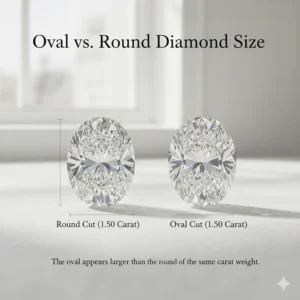
Retail education pages commonly claim an oval looks 10–15% larger face-up than a round of the same carat. The logic checks out: the stone spreads its weight over a longer surface. Here’s how the common elongated shapes compare.
| Shape | Face-Up Size vs Round (Same Carat) | Bow-Tie Risk | Finger Effect | Best For |
|---|---|---|---|---|
| Oval | Often described as 10–15% larger | Moderate; present in most | Lengthening | Size-seekers who like fire |
| Round | Baseline | Minimal | Neutral | Traditionalists |
| Marquise | Elongated, pointed | Noted by GIA | Very lengthening | Bold, vintage tastes |
| Pear | Elongated, one point | Noted by GIA | Lengthening | Distinctive styles |
The takeaway: oval gives you most of the size benefit of the pointed shapes without the vulnerable tips. Marquise and pear points chip more easily and need protective prongs. If you want brilliance, length, and practicality in one shape, oval is the quiet winner. Traditionalists who can’t stand any bow-tie should stay with round, since it’s the shape GIA doesn’t flag for it.
Solitaire, Halo, or Hidden Halo: Features That Actually Matter
Setting choice changes the look more than most buyers expect.
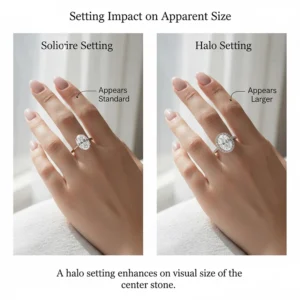
Solitaire. Shows the stone’s true size, no illusion. It’s the easiest to clean and resize, and the right choice when the stone is the hero.
Halo. Retailers commonly claim a halo adds 0.25–0.50 carat of visual size. Take it as a ballpark. It also frames the center and can disguise a slightly lower color grade, though it adds cleaning surface.
Hidden halo. Sparkle under the stone, no visible outline. Great side-on, and the setting trend behind both the Kobelli Orah and the Ladylike S925 Oval Moissanite Hidden Halo.
Marketing hype you can ignore: “AAAAA” cubic zirconia grades (not a recognized standard), “diamond-like fire” claims without specs, and carat labels with no millimeters. Features that matter: stone dimensions, metal purity (14K versus plated), prong style, and a certificate when the stone is a diamond.
One more thing the spec sheet won’t tell you: east-west settings (stone set sideways) can make a long oval read wider and more modern, an option Houston Diamond District and others offer in custom designs. If you’re torn on ratio, try it.
Lab-Grown vs Moissanite vs CZ: Value and Regulation
Three stones, three very different promises.
| Stone | Hardness (Mohs) | Typical Price Tier | Disclosure Note | Best For |
|---|---|---|---|---|
| Lab-grown diamond | 10 | Mid-$1,000s+ for 1 ct in 14K | Must be clearly labeled lab-grown | True-diamond buyers |
| Moissanite | ~9.25 | Hundreds to low-thousands | Not a diamond; sold by DEW | Bigger look, lower cost |
| Cubic zirconia | Lower than both | Under $100 | A simulant; can’t imply “diamond” | Stand-ins, travel |
Looking at the table, lab-grown diamond is the only option that’s chemically and optically a diamond, which is why it commands the highest price of the three. Moissanite gives you more millimeters per dollar but shows more rainbow flash. CZ is the cheapest, with the shortest lifespan before cloudiness and wear.
On regulation: the FTC’s Jewelry Guides, revised in 2018, removed “natural” from the definition of a diamond and allow lab-grown stones to be called diamonds as long as their origin is clearly disclosed. JCK’s coverage of the revised guides explains that the guides still require that disclosure be clear, prominent, and understandable. Sellers of simulants such as CZ were also told not to imply their stones are lab-grown or mined diamonds.
In practice: if a listing says “diamond” without “lab-grown” right next to it, be skeptical. If a seller calls a moissanite a “diamond alternative,” that’s honest. If it calls it a diamond, walk away.
Oval Diamond Rings for Different Hands and Finger Sizes
Ovals flatter almost everyone, but proportion still matters.
Short or wide fingers. An elongated oval draws the eye along the finger, creating a lengthening effect. Stay around a 1.35–1.50 ratio and avoid very wide, rounder ovals that can eat up the knuckle space. A stone around 1 to 1.5 carat usually sits well.
Long, slim fingers. You can carry 2 carats and up, and larger ovals like the Kobelli Orah‘s 12 × 8 mm footprint without it looking oversized.
Active hands. If you cook, climb, type all day, or wear gloves, choose a lower-profile setting (bezel or low-set prongs) and a stone under about 2 carats. Size is the least of your worries if the ring snags constantly.
Small ring sizes (4–5). Go slightly narrower in width, since a very wide stone can overhang. Check the “finger-to-top” height spec if listed; one 1 carat oval bezel listing I found measures about 4.3 mm from finger to top, a handy benchmark for low profiles.
Larger ring sizes (8+). The band and stone can be scaled together. A 2 to 3 carat oval won’t look out of balance.
The rule of thumb: match the stone’s width to the width of your finger, since oval length extends along it. If you can, print the millimeter footprint at 100% scale and hold it to your hand.
Practical Guide: How to Measure and Test Your Oval Ring Size at Home
Amazon listings give you a size dropdown, not a fitting. Here’s the setup and care routine that actually prevents returns.
Measuring your finger.
- Measure at the end of the day, when fingers are slightly larger.
- Use a printable ring sizer or a strip of paper, and measure the knuckle as well as the base.
- If your knuckle is bigger than the base, order the knuckle size and add a sizing bead later.
- Avoid measuring when cold, which shrinks fingers.
Previewing the stone.
- Cut a paper oval to the target millimeters (for example, 9 × 7 mm) and tape it to your finger. It’s a surprisingly honest preview.
- Check how far the stone extends toward the knuckle on both sides.
First 30 days checklist.
- Inspect prongs weekly; tiny gaps matter most on elongated stones, because the points of an oval take the most bumps.
- Store the ring flat and separate from other jewelry.
- Skip lotions and chlorine on silver or plated settings.
- Photograph the ring in daylight for your records.
Maintenance schedule.
- Weekly: soak in warm water with mild dish soap and use a soft brush.
- Every 6–12 months: have a jeweler check prongs and clean ultrasonically if the setting allows.
- Silver pieces: polish as needed, and keep them dry.
Common first-month mistakes: ignoring a slightly loose prong, sleeping in the ring, and buying a size “to grow into.” Sizing a ring down later works better than sizing up in many pavé and eternity designs.
Real-World Scenarios: Matching Carat to Lifestyle
Specs mean more in context. Here are three profiles and the reasoning behind each pick.
Scenario 1: The first-time proposer on a measured budget. A 1 carat class oval around 7.7–8.0 mm long is the sweet spot. The Houston Diamond District Lab-Grown Oval Solitaire fits because a certificate lets you verify millimeters and ratio. Keep the setting simple and put money into cut quality.
Scenario 2: The nurse or teacher who wears the ring through long shifts. Daily wear and frequent hand washing call for low-profile settings, durable stones, and real gold. The Lispark 14K Oval Moissanite Halo at 1.5 carat fits the metal and size logic, though confirm the profile height, since halos sit higher. A bezel alternative is worth a look.
Scenario 3: The maximalist with long fingers and a “go big” mandate. The Kobelli Orah‘s 12 × 8 mm footprint delivers statement size. Consider insurance, and plan for sleeve snags.
Bonus scenario: the placeholder. Planning to upgrade later, or just want a travel ring? The Newshe Oval CZ Bridal Set costs less than dinner for two, and nobody will weep if it goes missing on a trip.
Common Mistakes When Buying an Oval Diamond Ring
Plenty of buyers lose money on the same few errors.
Buying by carat alone. A deep stone can weigh 1 carat and look like 0.85. Compare millimeters, always.
Ignoring the ratio. A 1.65 oval surprises people who expected a classic shape. Check the listed ratio against the 1.30–1.50 range most buyers prefer.
Trusting a certificate for everything. It can’t capture the bow-tie, and for fancy shapes GIA doesn’t give an overall cut grade. Request video.
Skipping the lab-grown label check. The FTC requires clear disclosure of lab-grown origin, and JCK’s report on FTC warning letters shows regulators do enforce it. If the listing buries the origin, treat that as a warning sign.
Assuming moissanite carats equal diamond carats. They’re diamond-equivalent sizes, so verify the millimeters.
Forgetting the setting’s maintenance. Pavé and halos cost more to resize and keep clean.
Problem → solution, in one line each: stone looks too small? Add a halo or raise the L/W ratio slightly. Stone looks too long? Drop to 1.30–1.40. Heavy bow-tie? Ask for a different stone with a similar ratio, not a “fix.”
Long-Term Cost & Maintenance: What the Ring Really Costs
The sticker price is only chapter one.
Lab-grown diamond. Highest upfront cost of the three types, but the stone itself needs only cleaning. Be realistic about resale: lab-grown stones are not priced like rare natural ones, and marketing that implies otherwise is the kind of claim regulators police.
Moissanite. Lower purchase price, durable in daily wear. Gold settings add cost but last. Expect periodic prong checks and professional cleaning.
CZ and sterling silver. Cheapest upfront, shortest lifespan. Plan on polishing, replating, and eventually replacing, so the true cost over several years can approach a modest moissanite ring.
Cost-per-year view. A ring costing around $2,000 and worn 20 years works out to about $100 a year, while an under-$100 CZ set replaced every two years costs roughly $50 a year, with no heirloom value. Neither is “wrong.” They serve different purposes.
Maintenance line items. Annual prong inspection, occasional resizing, and insurance (many insurers want an appraisal for larger stones). Ask about the warranty before buying: the Kobelli Annello Oval Halo includes a warranty card, and the quality of that coverage matters more the longer you plan to wear the ring.
FAQ
❓ Is a 2 carat oval diamond ring too big for a size 5 finger?
❓ What is the best oval diamond ring setting for small hands?
❓ How much does an oval diamond ring cost in 2026?
❓ Can I resize an oval diamond ring after buying it?
❓ Should I choose a lab-grown oval diamond or a moissanite ring?
Conclusion
An oval diamond ring rewards the buyer who does the homework. This Oval Diamond Ring Size & Carat Guide boils down to a few moves: shop by millimeters, aim for a 1.30–1.45 ratio unless you’ve seen a longer stone and love it, and judge the bow-tie by video, not by certificate.
For picks, the Houston Diamond District Lab-Grown Oval Solitaire is the evidence-first choice. The Kobelli Annello Oval Halo is the balanced gold-and-halo option, and the Kobelli Orah is the dramatic one. The Lispark 14K Oval Moissanite Halo and Ladylike S925 Oval Moissanite Hidden Halo stretch a budget. The Newshe Oval CZ Bridal Set is a clearly labeled stand-in. Check live listings for current pricing, availability, and reviews before you buy.
✨ Ready to find your perfect oval?
💍 Compare the millimeters, check the ratio, and click any highlighted product above to see current pricing and availability. Your hand will thank you!
Recommended for You
- 1 Carat Oval Diamond Ring: 7 Best Picks That Sparkle in 2025
- 7 Best 2 Carat Oval Engagement Rings: 2025 Expert Guide
- 3 Carat Oval Diamond Ring: 7 Stunning Picks Under $10K (2025)
Disclaimer: This article contains affiliate links. As an Amazon Associate, I earn from qualifying purchases. If you purchase products through these links, we may earn a small commission at no additional cost to you.
✨ Found this helpful? Share it with your friends! 💬🤗
