
In This Article
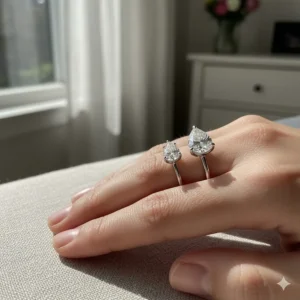
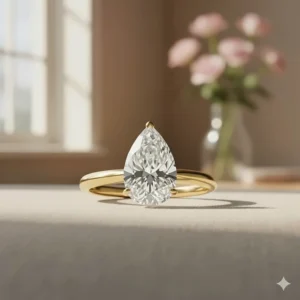
A 2 carat pear shaped diamond ring is a ring built around a teardrop-cut center stone of roughly two carats, round at one end and tapered to a point at the other. It borrows the fire of a round brilliant and the length of a marquise, so it looks bigger and longer on the hand than the weight on the certificate suggests.
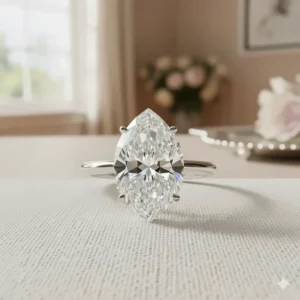
Here’s the part nobody mentions at the jewelry counter: carat is a measure of weight, not of how much stone you actually see. Elongated cuts spread that weight across more surface area, so a 2 carat diamond ring pear shape covers noticeably more finger than a round stone of the same weight. Think of it as getting a longer lens for the same amount of glass. 📸
It also helps that lab-grown stones have turned two carats from a lottery win into a realistic goal. In 2026, a 2 carat pear shaped diamond engagement ring can cost a few hundred dollars (moissanite) or the price of a decent used car (a fine natural stone). That gap is the whole story. It’s why the 2 carat pear shaped diamond ring price conversation needs a map, not a guess.
This guide is that map. You’ll get seven real rings across budget, mid-range, and premium tiers, spec breakdowns that explain what the numbers mean on an actual finger, and price ranges instead of fantasy figures. You’ll also get a few practical tricks, like how to dodge the dreaded bow-tie. For a pro-level companion read, GIA’s guide to buying fancy-shaped diamonds explains how the lab thinks about ratios and shadows. Ready? Let’s go. 💎
2 Carat Pear Shaped Diamond Ring Quick Comparison
Before the deep dive, here’s the whole lineup on one screen. Prices are ranges based on listings at the time of research, so check current price before you buy.
| Ring | Center Stone | Metal | Price Range | Best For |
|---|---|---|---|---|
| Rosec Jewels 2 Carat Pear Moissanite Solitaire | 2 ct moissanite, 7×10 mm | 925 silver, 14k gold plated | ~$190-$260 | Rosec Jewels suits first-ring or placeholder budgets |
| Beautlace 2 Carat Pear Moissanite Ring Set | 2 ct pear moissanite | 18K white gold over silver | Entry tier (check current price) | Beautlace suits shoppers who want a matching band included |
| EPI Jewelry 2 Carat Elegant Pear Moissanite Ring | 2 ct moissanite, 7×10 mm, E-F, VVS1 | 18K gold vermeil on silver | ~$300-$350 | EPI Jewelry suits pavé-band sparkle lovers |
| Barkev’s Modern 2 Carat Pear Moissanite Ring | ~2 ct moissanite plus natural diamond accents | 14k white gold | Low-$2,000s | Barkev’s suits gold-band buyers who want moissanite |
| Covaloro 14K Two-Tone Pear Solitaire | 2.00 ct lab diamond, IGI, E-F, VVS2 | 14K two-tone | ~$3,000-$3,250 | Covaloro suits certified-solitaire purists |
| Grown Brilliance Shyra Hidden Halo | 2 ct lab diamond, IGI, D, VVS | 14K yellow gold | Around $4,000 | Shyra suits halo fans who want it subtle |
| Grown Brilliance Blair French Pavé | 2 ct lab diamond, IGI, D, VVS | 14K white gold | Low-$4,000s | Blair suits classic, pavé-framed elegance |
Looking at the table, the real dividing line isn’t style, it’s stone type. The first three rings are moissanite in silver-based metals, Barkev’s moves to solid gold, and the last three are certified lab-grown diamonds. If a true diamond matters to you, Covaloro is the leanest route in this lineup, while Shyra and Blair add more finger-coverage drama through their accent stones.
💬 Just one click — help others make better buying decisions too!😊
Top 7 Picks for a 2 Carat Pear Shaped Diamond Ring: Expert Analysis
A quick note on method: I’m working from real listings, specs, and publicly visible review data, not from owning these rings. Where I couldn’t verify a consistent review base, I say so. Availability and sizing differ by retailer, so confirm details on the listing itself.
1. Rosec Jewels 2 Carat Pear Moissanite Solitaire — the budget teardrop with real face-up size
The standout is sheer spread for very little money: a 7×10 mm pear stone in a simple spaced-set solitaire.
The listing describes D color, VS1 clarity moissanite in 925 sterling silver finished with 14k gold plating. Moissanite is a different gemstone from diamond. It’s slightly softer (about 9.25 on the Mohs scale versus 10) and famously fiery, so expect more rainbow flash than a diamond throws. The 7×10 mm footprint works out to a length-to-width ratio near 1.43, a bit fuller than the 1.50-1.75 range GIA prefers for pears, which means a plumper, less tapered teardrop.
Based on those specs, this is the pick for anyone who wants the look of a 2 carat pear shaped diamond ring as a fashion piece, a placeholder, or a “propose now, upgrade later” plan. The catch is the metal: gold plating over silver thins with daily wear, so treat it as a style ring, not an heirloom.
On reviews, I couldn’t verify a steady star rating across variants. One related Rosec Jewels pear listing showed 255 reviews at the time of research while others showed none yet, so check the exact listing you’re eyeing.
Pros:
- ✅ Generous 7×10 mm face-up size
- ✅ Multiple ring sizes and metal variants
- ✅ Very low cost of entry
Cons:
- ❌ Plated silver wears with daily use
- ❌ Ratio runs slightly fuller than ideal
Price range: roughly $190-$260 at the time of research. Value verdict: excellent as a stylish stepping stone, less so as a forever ring.
2. Beautlace 2 Carat Pear Moissanite Ring Set — the matching-set bargain
The hook here is the bundle: an engagement ring plus a matching band, sold as one bridal set with a gift box.
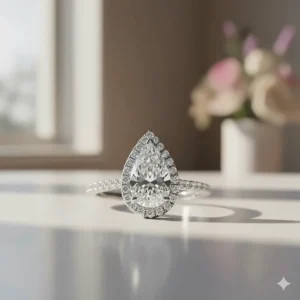
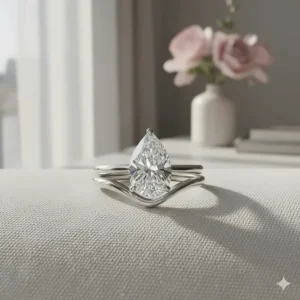
The listing pairs a 2-carat pear-cut moissanite with 18K white gold over silver. In practice, a bridal set solves a real problem, because pear solitaires can leave an awkward gap against a straight band, and a purpose-made companion piece avoids that. The tradeoff is the same one you’ll see in any plated silver ring: the surface finish is a coating, and coatings eventually fade at the points that rub, like the underside of the shank.
Here’s my analytical read. This is a smart pick for a proposal on a tight budget, a promise ring upgrade, or a gift where the recipient may swap the setting later. It’s not the one I’d choose for someone who plans to wear it nonstop through gardening, gyms, and dishes.
For reviews, I couldn’t verify a reliable aggregated rating for this exact listing, so I won’t characterize customer sentiment. Other Beautlace sets on the same retail page sat roughly in the $40-$70 range, which suggests an entry-tier price. Check current price before you commit.
Pros:
- ✅ Matching band included in the set
- ✅ Gift-ready packaging
- ✅ Entry-level cost for a 2 carat look
Cons:
- ❌ Plated finish needs gentle care
- ❌ Limited independent review data
Price range: entry tier, so check current price. Value verdict: strong for budget-first buyers who value the set.
3. EPI Jewelry 2 Carat Elegant Pear Moissanite Ring — the pavé-band sparkle upgrade
What sets it apart is the band: 36 small round moissanites that keep the sparkle going from the center stone all the way around.
The specs list a 7×10 mm pear moissanite, colorless, VVS1 clarity, E-F color, in a three-prong setting on 18K gold vermeil over S925 sterling silver. The shank is a slender 2.2 mm wide. That slimness makes the pear look larger by contrast, but it also means the ring needs gentle handling and won’t love a heavy-lifting lifestyle. Sizes run from 3 to 15, which is unusually inclusive.
What the spec sheet won’t tell you is how three prongs treat a pear. Standard guidance for pear solitaires calls for five prongs, including a V-prong to guard the tip. A three-prong head can look airier, but ask whether the pointed end is truly protected before you wear it daily.
I couldn’t verify a robust independent review base for this specific ring, so I’m not summarizing sentiment. The brand sells through its own site, so check return terms.
Pros:
- ✅ Pavé band adds all-around sparkle
- ✅ Wide size range from 3 to 15
- ✅ Colorless E-F, VVS1 stone grade listed
Cons:
- ❌ Thin 2.2 mm shank needs gentle wear
- ❌ Tip protection depends on the head design
Price range: around $300-$350. Value verdict: a polished budget option if you want more band detail than a plain solitaire offers.
4. Barkev’s Modern 2 Carat Pear Moissanite Ring — solid gold with natural diamond accents
The highlight is the metal: 14k white gold, with a roughly 2 carat pear moissanite flanked by smaller natural diamonds.
The listing shows approximately 0.09 ct of natural diamond accents, which is tiny, but it matters for the “diamond ring” feel. Moving from plated silver to solid 14k gold is the biggest durability jump in this lineup. You get resizing options, repairs, and a finish that won’t flake. It’s made to order, shipping in roughly two to four weeks, so it’s not a last-minute proposal solution.
From an analytical standpoint, this is the ring for someone who loves moissanite’s value but wants fine-jewelry bones. You’re paying for craftsmanship and metal here, not stone rarity. That’s a fair trade, as long as you’re clear-eyed that the center stone is moissanite rather than a diamond.
On reviews, I couldn’t confirm a verifiable aggregated rating for this exact ring, so I’m leaving sentiment out. Barkev’s markets its stones as responsibly sourced; treat that as the brand’s claim.
Pros:
- ✅ Solid 14k gold band
- ✅ Natural diamond accents beside the center
- ✅ Made-to-order craftsmanship
Cons:
- ❌ Two to four week lead time
- ❌ Center stone is moissanite, not diamond
Price range: low-$2,000s. Value verdict: reasonable if gold durability matters, pricey if you only want the look.
5. Covaloro 14K Two-Tone Pear Solitaire — the certified lab-diamond classic
The headline is certification: a 2.00 carat lab-grown diamond with an IGI report, graded E-F color and VVS2 clarity.
The two-tone design pairs a yellow-gold band with white-gold prongs, a thoughtful touch because white prongs keep a near-colorless diamond looking icy while the warm band adds contrast. A solitaire with a classic prong setting also lets light enter from every angle, which is exactly what a pear’s brilliant faceting wants. The listing’s ring size is 7, so confirm resizing before ordering another size.
What does “E-F, VVS2” mean in practice? Basically, you’re paying for grades your eye won’t separate from lower ones. VVS2 clarity is far beyond “eye-clean” territory, and E-F color is colorless. That’s fine if you want certainty, but if budget is tight, SI-range stones can look identical at arm’s length.
I couldn’t verify a steady review base for this exact ring, and the listing came from a retailer page rather than a marketplace with public ratings, so I’m not summarizing customer sentiment.
Pros:
- ✅ IGI-certified 2.00 ct lab diamond
- ✅ Colorless E-F color grade
- ✅ Clean two-tone solitaire design
Cons:
- ❌ Pricier than moissanite alternatives
- ❌ Specific ring size listed
Price range: around $3,000-$3,250. Value verdict: the leanest true-diamond option in this lineup.
6. Grown Brilliance Shyra Hidden Halo — the subtle sparkle upgrade
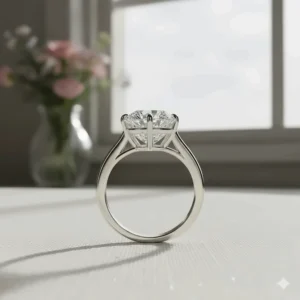
The distinctive feature is the hidden halo: 26 small round lab diamonds tucked beneath the center stone, visible mostly from the side.
The center is a 2 ct pear lab-grown diamond, IGI-certified, D color, VVS clarity, in 14K yellow gold, with total diamond weight listed at about 2.47 ct. The ring top measures roughly 11.5 mm across, which is chunky, and the hidden halo lifts the stone slightly off the finger. That elevation gives a pear more presence in profile, though it can also snag more easily on sleeves.
Here’s the practical takeaway. A hidden halo adds sparkle without the look of a full halo, which suits people who want the center stone to remain the star. D color is the top of the scale, but for most buyers, a notch or two lower looks identical once set in yellow gold, since the metal tints how the stone reads anyway.
I couldn’t confirm a verifiable rating base for this exact ring, so I’m not describing reviewer sentiment. The listing shows made-to-order shipping.
Pros:
- ✅ Hidden halo adds side-profile sparkle
- ✅ IGI-certified D-color center stone
- ✅ Substantial 14K yellow gold build
Cons:
- ❌ Raised profile may catch on fabric
- ❌ Made-to-order wait time
Price range: around $4,000. Value verdict: good for buyers who want drama without a visible halo.
7. Grown Brilliance Blair French Pavé — the classic framed pear
The standout here is the French pavé band, with small round diamonds that run along the shank and make the pear look like it’s floating.
The listing shows a 2 ct pear lab-grown diamond, IGI-certified, D color, VVS clarity, in 14K white gold with 12 small side stones (about 0.41 ct) for roughly 2.41 total carats. The top width is around 7.4 mm, which is noticeably narrower than the Shyra ring’s top, giving a leaner, more elegant look on the hand. White gold paired with a colorless stone keeps everything cool-toned and crisp.
My analytical take: this is the “classic engagement ring” answer in the lineup. If your partner wears mostly silver-toned jewelry, the white-gold look will blend easily. The pavé detail will need a jeweler’s eye every year or two to check for loose accent stones.
I couldn’t verify a robust public review base for this exact ring, so I’m not characterizing customer feedback.
Pros:
- ✅ Pavé band adds finishing detail
- ✅ Slimmer top width reads elegant
- ✅ IGI-certified D-color center stone
Cons:
- ❌ Pavé needs periodic prong checks
- ❌ Highest price in this lineup
Price range: low-$4,000s. Value verdict: worth it if you want a polished, traditional finish.
2 Carat Pear Shaped Diamond Ring Price: What the Market Says in 2026
Let’s talk money, because the 2 carat pear shaped diamond ring price is where most shoppers get whiplash. A stone’s cost depends on more than size, and the difference between a natural and a lab-grown diamond is enormous.
For natural stones, price-tracking data from July 2026 showed 2 carat pear diamonds ranging from roughly $1,000 to nearly $49,000, with a median in the mid-$15,000s. That’s the stone alone, before the setting. For lab-grown, general 2026 market figures put a well-cut 2 carat lab diamond in a very different bracket, often a few thousand dollars or less loose.
To put the lineup in context, here’s how the tiers stack up.
| Tier | Typical Stone | Approx. Ring Range | Best For |
|---|---|---|---|
| Moissanite in plated silver | 2 ct pear moissanite | ~$190-$350 | Rosec Jewels, Beautlace, and EPI Jewelry fit here |
| Moissanite in solid gold | Moissanite plus diamond accents | Low-$2,000s | Barkev’s fits here |
| Certified lab-grown diamond | 2 ct pear, IGI | ~$3,000-$4,300 | Covaloro, Shyra, and Blair fit here |
| Natural diamond | 2 ct pear, graded | Stone alone often mid-$15,000s median | Tradition-first buyers |
The analysis is straightforward. Roughly a tenfold jump separates silver-based moissanite from certified lab diamonds, and another large jump separates lab-grown from natural. If your goal is a big, beautiful pear that photographs well, the best-value zone is the certified lab-grown tier. If tradition or resale story matters, natural is a different budget conversation entirely.
How to Choose a 2 Carat Pear Shaped Diamond Engagement Ring
Shopping for a 2 carat pear shaped diamond engagement ring can feel like decoding a secret language. Here are seven steps, in the order I’d tackle them.
- Pick your stone type first. Natural, lab-grown, and moissanite are different products at different prices, so decide before you browse.
- Check the length-to-width ratio. GIA’s guidance puts the preferred range for pears at 1.50 to 1.75. Lower looks fuller, higher looks slimmer.
- Prioritize symmetry. Pears don’t get a formal cut grade, but symmetry matters because a lopsided teardrop is obvious in a ring.
- Look at the bow-tie. Request photos or video, since certificates can’t predict how strong the shadow is.
- Choose color with the metal in mind. Yellow gold warms a stone, white gold keeps it icy.
- Pick eye-clean over flawless. Clarity grades above VS often cost more than your eyes can notice.
- Insist on certification. A grading report from GIA or IGI is your proof of what you’re buying.
Following this order saves money because it pushes you to spend on what’s visible (shape, symmetry, shadow) and away from what isn’t (ultra-high clarity grades).
2 Carat Diamond Ring Pear Shape vs Round vs Oval: What Changes
Every shape trades something. A 2 carat diamond ring pear shape wins on finger coverage and personality, but it comes with a quirk or two the round brilliant doesn’t have.
| Shape | Face-Up Size at 2 ct | Bow-Tie Risk | Best For |
|---|---|---|---|
| Pear | Large, elongated | Common | Buyers who want length and a distinctive silhouette, like the Covaloro solitaire |
| Round | Smaller per carat | Rare | Traditionalists who want maximum sparkle, with no shadow to evaluate |
| Oval | Large, elongated | Common | Buyers who want length without a point, similar in style to Shyra settings |
Here’s the plain-English reading. If you want the biggest look per carat, pear and oval both deliver, but pear adds a pointed tip that demands protection and a slight asymmetry that feels romantic to some and fussy to others. Round diamonds are the safe, sparkly standard, and they don’t suffer from bow-tie shadows, but they cover less finger. If you love individuality, the pear is the better story.
Features That Actually Matter (And Those That Don’t)
Marketing loves a long spec sheet. Here’s what deserves your attention on a pear.
Ratio and symmetry matter most. The shape is defined by its proportions, and the evenness of the two “shoulders” and the centered tip show how well it was cut. For background on how cuts shape a diamond’s brilliance, Wikipedia’s overview of diamond cut covers the basics, including why poorly proportioned stones look dull.
The bow-tie is real, but manageable. Most pears show some dark band across the center. A subtle one adds contrast, while a heavy one steals sparkle. Some experts suggest depth percentages around the high-50s to mid-60s tend to reduce the effect, though none can eliminate it fully.
Overkill clarity and color don’t. Past a point, grades like VVS and D are insurance, not visible improvements. If you’d rather spend money on carat weight or setting quality, an eye-clean VS stone in a near-colorless grade will look nearly identical from a normal viewing distance.
Skip the “certified moissanite” buzzwords. Certification means different things from different sellers, so ask what exactly is certified.
Practical Usage Guide: Wearing and Caring for Your Pear Ring
Transformation time: here’s what the product pages don’t tell you about daily life with a teardrop.
Orientation. Most people wear a pear with the tip pointing toward the fingernail, which gives a lengthening effect. Flip it east-west if you want a bolder, modern look, but expect it to feel different on the hand.
Prongs. For a solitaire, the traditional approach is five prongs, with two on the rounded end, one on each side, and a V-prong over the tip. That V-prong is the pear’s seatbelt. If you’re comparing the EPI Jewelry three-prong head with the Covaloro solitaire, ask the seller how the tip is protected.
Maintenance schedule. Soak the ring in warm, mildly soapy water, brush gently, and rinse. Do this monthly. Have a jeweler check prongs every six to twelve months, and more often with pavé designs like Blair.
First 30 days. Notice where the tip catches: sweaters, hair, gloves. Most people adapt in a couple of weeks. If a ring snags constantly, ask about a lower setting.
Common mistakes. Wearing the ring while cleaning with bleach, lifting weights, or swimming in chlorinated pools can damage settings or plating. Take it off and store it in a soft pouch.
Real-World Scenarios: Which Ring Fits Which Buyer?
Specs are one thing. Real lives are another. Here are three buyer profiles and the rings I’d steer them toward, based on the spec comparison.
The first-job couple. Maya and Dev have a $400 ring budget and a wedding two years away. They want the look now and a nicer stone later. Rosec Jewels or EPI Jewelry gives them a 2 carat pear look today. They can upgrade to a certified stone after the wedding, and the starter ring becomes a fun everyday piece.
The practical planner. Priya wears her hands hard, since she’s a nurse with constant handwashing. She’d rather skip plated silver entirely. Covaloro offers a clean, solid-gold solitaire with a lab-grown diamond, a sturdy setting, and an IGI report, which fits a “buy once” mindset.
The statement shopper. Jordan wants a ring that photographs like a magazine spread. The side stones on Shyra and Blair add presence, and the pavé on Blair keeps the profile slender. At roughly $4,000, either costs a fraction of a comparable natural stone.
The lesson: match the ring to the life it’ll live, not the Pinterest board it came from.
Buyer’s Decision Framework: If This, Choose That
Still torn? Use this quick framework to land on a pick without spiraling.
- If your budget is under $400, choose a moissanite solitaire like Rosec Jewels because you get large face-up size and can upgrade later.
- If you want a matching band and gift-ready packaging, choose Beautlace because the set solves the band-gap problem up front.
- If you want pavé sparkle without a diamond price, choose EPI Jewelry because the band detail adds finish for a modest outlay.
- If you want solid gold but love moissanite, choose Barkev’s because the metal will hold up to daily wear.
- If a true diamond with a certificate is non-negotiable, choose Covaloro because it’s the leanest route to IGI paperwork.
- If you want subtle sparkle, choose Shyra because the hidden halo whispers instead of shouts.
- If you want a classic, polished look, choose Blair because the pavé frames the pear traditionally.
Priority checklist: stone type first, setting durability second, accent detail third, and brand last. Notice what’s missing from that list? Trendiness. Rings are forever, and the trend isn’t.
Common Mistakes When Buying a 2 Carat Pear Shaped Diamond Ring
I’ve seen the same few errors repeat in buyer conversations and review threads, and most are avoidable.
Chasing carat weight alone. Two carats of a lopsided, shadowy pear can look worse than 1.8 carats of a beautifully cut one. Look at the proportions and, if possible, a video.
Ignoring the ratio. A very long ratio can look like a sliver, while a very short one looks stubby. Aim near the sweet spot, then adjust for your preference.
Skipping the tip. The point is the most vulnerable spot. If the setting doesn’t protect it, you’ll be repairing chips sooner than you’d like.
Treating moissanite and diamond as the same thing. They’re different stones with different hardness and different sparkle. Both are lovely. Just don’t buy one thinking it’s the other.
Overpaying for clarity. Paying extra for flawless grades makes sense for investors, not for most engagement rings.
Forgetting resale reality. Lab-grown and moissanite prices tend to drop over time, so buy for love, not for returns.
Long-Term Cost and Maintenance of a 2 Carat Pear Shaped Diamond Ring
The sticker price is only the opening bid. A realistic ownership budget includes a few things.
Insurance. Expect to add a rider or separate policy. Premiums depend on appraised value, so cheaper rings cost less to cover, but they still deserve a rider if lost or stolen.
Setting upkeep. Pavé designs like Blair need prong checks, and plated rings like Rosec Jewels and Beautlace may need replating. Solid gold, as in Barkev’s and Covaloro, avoids that expense.
Resizing and repair. Solid gold can be resized by a jeweler. Plated silver can be trickier, since heat and polishing may affect the plating.
Cost per wear. Here’s a quick ROI frame. A ring in the $4,000 range worn daily for 20 years costs about 55 cents a day. A $250 plated ring replaced every two or three years may cost a bit more over time, though the upfront outlay is far lower.
The takeaway: cheaper upfront isn’t always cheaper over decades, but flexibility has real value too. If you may upgrade later, a budget ring is a perfectly rational choice.
Lab-Grown Labels, Moissanite, and the Rules: A Safety and Compliance Guide
Here’s the practical regulatory piece that protects your wallet. In the United States, the FTC’s Jewelry Guides govern how sellers describe gemstones. As trade outlet JCK explains in its coverage of the revised Jewelry Guides, lab-grown diamonds can be called diamonds, but their man-made origin must be clearly disclosed.
The FTC has also published business guidance noting that describing a lab-grown or simulated stone merely as a “diamond,” with no further qualifier, risks creating a false impression. Its business blog on sellers describing products accurately lists terms like laboratory-grown and laboratory-created as appropriate disclosures.
What does that mean for you?
- Look for the label. A legitimate listing should say lab-grown, laboratory-created, or moissanite right next to the stone description.
- Check the report. IGI and GIA reports for lab-grown stones identify them as lab-grown, and the certificate number can be verified with the lab.
- Be wary of vague terms. “Diamond-like” or “simulated diamond” signals a simulant, not a diamond.
- Question environmental claims. Phrases like “eco-friendly” are discouraged under separate FTC guidance, so treat them as marketing, not proof.
Disclosure rules protect you most when you know to look for them.
2 Carat Pear Shaped Diamond Ring for Specific Buyers
Different lives need different rings. Here’s tailored advice by buyer type.
Beginners. Start with a certified lab-grown solitaire like Covaloro. It keeps the decision simple: one stone, one report, one clean setting.
Budget-conscious shoppers. The moissanite trio of Rosec Jewels, Beautlace, and EPI Jewelry gives you the look without the cost. Just plan for plated-metal care.
Active wearers. Choose a lower profile and solid gold. Barkev’s and Covaloro are better matches than plated silver, and a more protective head can reduce snagging.
Detail lovers. The accent stones on Shyra and Blair reward close inspection. They also add a little more finger coverage, which fits a “bigger is better” mindset.
Vintage-minded buyers. Pears have been cut for centuries, and early versions date to the 1400s by most accounts, so a teardrop has real heritage. Pair one with a milgrain or yellow-gold setting for an antique feel.
Whatever your profile, the best ring is the one that matches the hand it’ll live on.
FAQ
❓ How big does a 2 carat pear shaped diamond ring look on the finger?
❓ What size in millimeters is a typical 2 carat pear diamond?
❓ Which way should I wear a pear shaped diamond ring?
❓ Do pear shaped rings snag on clothing?
❓ Is a lab-grown 2 carat pear diamond worth buying?
Conclusion
A 2 carat pear shaped diamond ring is one of the rare luxuries that rewards being a little nerdy. Learn the ratio, respect the tip, understand the bow-tie, and you can end up with a ring that looks like a lot more than it cost. 🔍
The seven picks above cover a wide field. Rosec Jewels, Beautlace, and EPI Jewelry are moissanite-in-silver options at budget prices. Barkev’s brings solid gold to the moissanite conversation. Covaloro delivers a certified lab-grown solitaire, and Shyra and Blair add accent-stone drama in the premium tier. Whatever you choose, ask for clear disclosure, check the ratio, and look for video of the actual stone.
If you’re starting today, my suggestion is simple: decide on stone type, set a ceiling, then pick the setting that matches how the ring will be worn day to day.
Recommended for You
- Pear Halo Engagement Ring: 7 Best Picks for 2026
- Pear Shaped Engagement Rings: 7 Stunning Picks for 2026
- 2 Carat Princess Cut Diamond Ring: 7 Stunning Picks (2026)
Disclaimer: This article contains affiliate links. As an Amazon Associate, I earn from qualifying purchases. If you purchase products through these links, we may earn a small commission at no additional cost to you.
✨ Found this helpful? Share it with your friends! 💬🤗
