In This Article
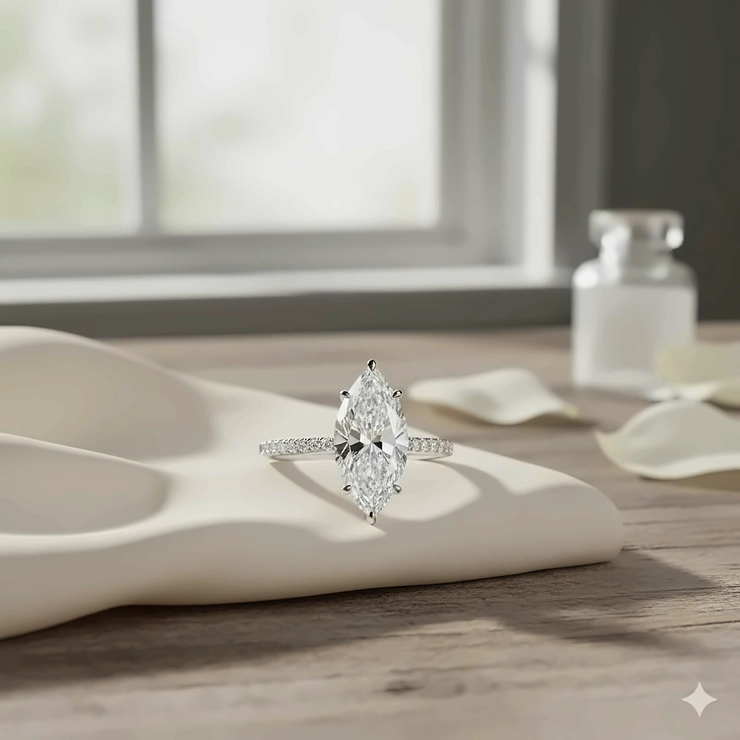
Some diamond shapes whisper. The marquise doesn’t. It has two pointed ends and a rounded belly, like a tiny boat sailing across your finger, and few shapes cover more visual ground per carat. That’s the pitch for a 1 to 3 carat marquise diamond ring. The stone looks bigger than its weight, lengthens the hand, and still feels a little rebellious next to the thousandth round solitaire.
Here’s the catch. The marquise punishes careless shopping. Those pointed tips can chip, a dark “bow-tie” can smear across the center, and the gap between a dazzling stone and a sleepy one comes down to proportions that never appear in a product headline. GIA’s marquise buying guide singles out the bow-tie as the thing to inspect face-up, which is a big part of why this guide exists.
So I pulled together seven real rings spanning budget to premium. They cover a 1 carat marquise diamond ring, a 1.5 carat marquise diamond ring, and a 3 carat marquise diamond ring. For each one I compared the specs and wrote down honest reasoning about who it suits. Where customer reviews could be verified, I summarize them. Where they couldn’t, I say so rather than inventing anything. Prices appear as ranges because they move constantly, so always check the current price and the exact seller before you buy.
Quick Comparison: 1 to 3 Carat Marquise Diamond Ring Picks at a Glance
| Ring | Center Size | Stone Type | Metal / Setting | Price Range | Best For |
|---|---|---|---|---|---|
| Shiree Odiz 1 Carat Natural Marquise Pavé Ring | 1 ct | Natural, F-G, SI1-SI2 | 14K white gold, pavé | Around $3,000 | Mined-diamond traditionalists |
| Diamondstuds 1.00 ct Marquise Solitaire | 1 ct | Natural, G-H, VS2 | 18K white gold, V-end prongs | Check current price | Protecting the tips |
| Quince 1.5ct Lab Grown Marquise Comfort Fit Ring | 1.5 ct | Lab-grown | White gold, comfort-fit band | Low $1,000s | Everyday value |
| Ivy & Rose 1.50ct East-West Marquise Ring | 1.5 ct | Lab-grown, certified | 14K gold, bezel | Mid-$1,000s | Active hands, modern style |
| Grown Brilliance Aimee 1 3/4 ctw Marquise Ring | 1.5 ct center | Lab-grown, IGI, E, VS1 | Platinum, side accents | Mid-$2,000s | A dressier look |
| Rosec Jewels 3 Carat Lab Grown Marquise Solitaire | 3 ct | Lab-grown, IGI, E, VS1 | Sterling silver, prong | Under $1,000 | Big size on a small budget |
| Grown Brilliance Rouge 3 ctw Marquise Solitaire | 3 ct | Lab-grown, IGI, E, VS1, excellent cut | 14K rose gold or platinum | $3,500-$4,500 range | A true statement ring |
Looking at the table, the real divide isn’t carat weight. It’s natural versus lab-grown and metal choice. The two lab-grown 1.5 carat options (Quince Comfort Fit and Ivy & Rose East-West) cost less than either natural 1 carat ring. If size matters most, Rosec Jewels 3 Carat delivers the most stone per dollar, though its sterling silver band is the trade-off. Shoppers wanting a 3 carat marquise diamond ring that is ready for daily wear should look at Grown Brilliance Rouge.
💬 Just one click — help others make better buying decisions too!😊
Top 7 1 to 3 Carat Marquise Diamond Ring Picks: Expert Analysis
1. Shiree Odiz 1 Carat Natural Marquise Pavé Ring — mined-diamond classic with pavé shimmer
This is the pick for anyone who wants a natural stone and a little extra glitter running down the band. The listing pairs a 1 carat natural marquise (F-G color, SI1-SI2 clarity per the seller) with pavé in 14K white gold.
F-G color sits in the colorless-to-near-colorless zone, so the stone should face up white against white metal. SI1-SI2 means inclusions exist under magnification. The seller calls the stone “eye clean,” which is the claim to confirm with a video before paying. Based on the spec comparison, that clarity is a sensible trade. Marquise facets are busy enough to mask small inclusions, so you aren’t paying for flawless grades nobody can see.
It suits someone who wants a 1 carat marquise diamond ring with built-in shimmer and would rather spend on size than perfection. Pavé does mean tiny stones along the shank, so schedule periodic checkups.
Review data is thin. The white-gold listing showed a single review, and a yellow-gold sibling showed six, with four at the top rating and the rest lower. That pool is too small to judge service claims, so treat them as unverified.
Pros:
- ✅ Natural stone in near-colorless range
- ✅ Pavé adds sparkle without extra carats
- ✅ Seller describes the center as eye clean
Cons:
- ❌ Pavé needs periodic prong checks
- ❌ Very small review pool
Around $3,000 is a fair mid-tier ask for natural. Confirm which lab grades the stone before you commit.
2. Diamondstuds 1.00 ct Marquise Solitaire — V-end prongs guard the tips
The brief for this ring is simple: protect the two most vulnerable parts of any marquise. It uses V-end prongs, which wrap each point in metal.
One listing carries a natural 1.00 ct stone graded G-H color and VS2 clarity with an excellent cut, set in 18K white gold and described as handcrafted in the USA. A cheaper sibling drops to H-I color and I1 clarity in 14K, and its listing warns the weight may vary by a tenth of a carat. So a “1 carat” there could be 0.9.
In practice, VS2 inclusions are hard to spot even at 10x, while I1 inclusions are often visible to the naked eye. In a marquise, whose long open table shows everything, that’s risky. I’d shop the G-H/VS2 version. The V-end prongs also address the tip-chipping problem that Ritani’s own guide flags for the shape.
This 1 carat marquise diamond ring suits buyers with active hands who want a clean solitaire and not a halo.
No verifiable customer reviews turned up at the time of research, so judge it on the spec sheet and the return policy.
Pros:
- ✅ V-end prongs shield the fragile points
- ✅ G-H/VS2 option balances color and clarity
- ✅ 18K gold option available
Cons:
- ❌ Solitaire shows less sparkle than pavé
- ❌ No verified reviews found
A firm figure wasn’t confirmed, so check the current price. Natural 1 carat marquise rings in this research ran from about $3,000 into the mid-$4,000s.
3. Quince 1.5ct Lab Grown Marquise Comfort Fit Ring — comfort-fit band at a friendly price
Comfort-fit means the inside of the band is gently domed so it slides over the knuckle and doesn’t dig in. That small detail matters more than most spec-sheet items after eight hours of typing.
The listing offers a 1.5 ct lab-grown marquise in a white gold option. A 1.5 carat marquise diamond ring is where the shape starts reading as unmistakably big. Depending on the ratio, expect roughly 12 mm of length. Lab-grown means the stone is a real diamond made above ground, and sellers are expected to disclose that clearly.
Based on the numbers, this is the value pick for the 1.5 size. The one catch is that the listing snippet didn’t spell out color and clarity, so ask for the grading report before you buy. It’s built for someone who wants a 1.5 carat marquise diamond ring to wear daily without a four-figure-plus price.
The listing showed 10 reviews. The themes weren’t verifiable in my research, so I won’t characterize them.
Pros:
- ✅ Comfort-fit interior eases daily wear
- ✅ Large 1.5 ct size at a low tier
- ✅ White gold option
Cons:
- ❌ Grading details not visible in the listing
- ❌ Small review pool
Around $1,300 sits in the low-$1,000s range, which is strong value if the paperwork checks out.
4. Ivy & Rose 1.50ct East-West Marquise Ring — sideways setting, bold on the hand
East-west means the stone lies sideways across the finger, and it changes the whole personality of the ring.
The spec sheet lists a 1.50 ct certified lab-grown marquise in a bezel setting with a knife-edge shank, in 14K gold. A platinum version also exists. The bezel wraps the stone’s edge in metal, which covers the tips and cuts the snag risk. The knife-edge band narrows to a blade, so the stone looks like it’s floating.
On paper, the east-west orientation makes a 1.5 carat marquise diamond ring look wider than a standard north-south one. That’s a trade-off. It reads fashion-forward, but it covers more of the finger’s width, so slender fingers should weigh the proportions. It’s best for people who want a modern, low-snag ring and don’t mind a bold silhouette.
I couldn’t verify reviews for this specific listing, so no sentiment is reported here.
Pros:
- ✅ Bezel protects both fragile points
- ✅ Knife-edge shank gives a floating look
- ✅ Certified lab-grown stone
Cons:
- ❌ Bezel hides a little of the stone’s edge sparkle
- ❌ No verifiable reviews found
Mid-$1,000s is a fair price for a certified stone in solid gold. It is a smart pick for hands that work.
5. Grown Brilliance Aimee 1 3/4 ctw Marquise Ring — platinum and an IGI paper trail
This one is for shoppers who want the paperwork and the metal to match the sparkle. The center is a 1.5 ct lab-grown marquise, IGI certified, graded E color and VS1 clarity. Small side accents add roughly a quarter carat in total, and the platinum band averages about 1.8 mm in width.
E color is colorless, and VS1 clarity is eye clean in almost any setting, so honestly this is more grade than the naked eye can verify. You’re partly paying for the certainty. Platinum is naturally white and dense, which suits prongs that grip pointed tips. The slim 1.8 mm band lets the center stone lead, while the accents tip the ring from minimalist toward dressy.
It suits anyone who wants a polished, evening-ready 1.5 carat marquise diamond ring and values documentation.
I couldn’t confirm a customer-review pool for this listing, so judge it by its IGI documentation.
Pros:
- ✅ IGI-certified E/VS1 center stone
- ✅ Platinum holds the tips securely
- ✅ Slim band keeps focus on the stone
Cons:
- ❌ Costs more than other 1.5 ct options
- ❌ Side accents mean extra stones to maintain
Mid-$2,000s is a fair premium for platinum plus certification.
6. Rosec Jewels 3 Carat Lab Grown Marquise Solitaire — three carats for under four figures
This is the cheapest route to seeing a 3 carat marquise diamond ring on your hand. It’s a 3 ct lab-grown stone, IGI certified, graded E color and VS1 clarity, in a prong setting on 92.5 sterling silver. Sister listings from the same seller quote roughly 15 × 7 mm for a 3 ct marquise.
A 15 mm stone is visible across a room. The compromise is the metal. Sterling silver is softer than gold or platinum and tarnishes, which makes it a poor fit for hard daily wear and limits how well it can be resized. The smart move is to treat the silver as a starter band. The lab stone is portable, and many buyers can re-set it in gold later.
It suits budget-conscious shoppers who want maximum size, or anyone trying the look before committing to a premium setting.
The listing I saw showed zero reviews, so there is no review sentiment to report.
Pros:
- ✅ Three carats at a very low price
- ✅ E/VS1 grades with IGI certification
- ✅ Stone can be moved to a better setting
Cons:
- ❌ Sterling silver tarnishes and scratches
- ❌ No customer reviews yet
Under $1,000 is the headline. Just budget separately for a sturdier band.
7. Grown Brilliance Rouge 3 ctw Marquise Solitaire — IGI-certified, excellent cut, true statement size
This is the ring to buy if you want a 3 carat marquise diamond ring built for real life. The center is a 3.00 ct lab-grown stone, graded E color and VS1 clarity, with an excellent cut grade and IGI certification. It comes in 14K rose gold or platinum. The rose gold version lists a 2.4 mm average band width and an 8.2 mm ring height, and a wide-shank 14K white gold variant lists a 4.1 mm band.
Ring height matters here. At 8.2 mm, the stone sits tall, so expect it to catch on sleeves and gloves. The wide-shank variant balances a 15 mm-class stone better and spreads weight across the finger. For reference, a sample IGI report for a 3.01 ct lab-grown marquise elsewhere lists 15.09 × 7.57 × 4.63 mm, a ratio near 2.0. Use that as a yardstick when you ask for measurements.
It’s for the buyer who wants a bold solitaire and will pay for documentation and metal quality.
No verifiable review sentiment was found, so lean on the report and the seller’s return terms.
Pros:
- ✅ Excellent cut grade with IGI report
- ✅ Choice of rose gold, white gold, or platinum
- ✅ Wide-shank variant suits a big stone
Cons:
- ❌ Tall setting can snag on fabric
- ❌ Highest price in this lineup
The $3,500-$4,500 range is steep, but fair for a certified, three-carat statement ring.
What Is a 1 to 3 Carat Marquise Diamond Ring?
A 1 to 3 carat marquise diamond ring is a ring with a marquise-cut center diamond, an elongated, boat-shaped brilliant with two pointed ends, weighing between one and three carats. Marquise stones tend to look larger than rounds of equal weight because they carry their size across length, which makes this range popular.
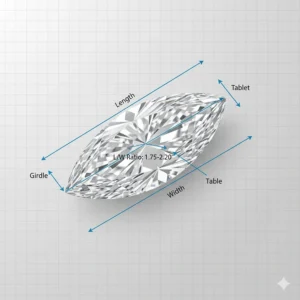
The shape is defined by its proportions. GIA’s marquise guide notes that a common length is about twice the width, a 2:1 ratio. It shows a 0.72 ct stone at 1.5:1 that reads “short” and a 1.75 ct stone at 2.7:1 that reads “long.”
Why the 1 to 3 window? A 1 carat stone is the classic entry point. At 1.5 carats the shape starts to dominate the hand. By 3 carats it’s a genuine statement. Below one carat the marquise can look slight, and above three the price climbs steeply and so does the weight on your finger. Each size gets its own section below.
How to Choose a 1 to 3 Carat Marquise Diamond Ring
- Pick your length-to-width ratio first. Divide length by width. Shapes between 1.7 and 2.3 are widely treated as the working range, and Brilliance’s marquise guide suggests staying below about 2.20 to limit bow-tie risk. Lower ratios look plump, higher ones look slim.
- Inspect the bow-tie face-up. The dark band across the center can’t be judged from a report. It needs a photo or video, so ask for HD media.
- Demand symmetry. Both points should line up and both sides should mirror. This shows quickly on a ring.
- Match clarity to the shape. SI1-SI2 can work if the stone is genuinely eye clean. In a marquise, I1 is a risky gamble.
- Protect the points. V-prongs or a bezel prevent the most common damage.
- Decide natural, lab-grown, or moissanite. This sets your price tier more than carat weight does. The comparison below walks through it.
- Confirm the certificate and return window. Insist on a named lab report and a clear return policy.
1 Carat Marquise Diamond Ring: What to Expect
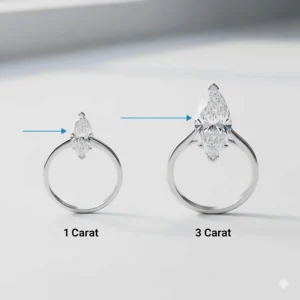
A 1 carat marquise diamond ring is the classic, and honestly the most forgiving. Expect a stone roughly 10 mm long and 5 mm wide at a 2:1 ratio, though cut and depth shift those numbers.
At this size, grade choices matter more because everything is visible up close. The Shiree Odiz 1 Carat Natural Marquise Pavé Ring leans on pavé for extra shine, while the Diamondstuds 1.00 ct Marquise Solitaire leans on a protective setting. A solitaire is also easier to clean.
Ritani’s own guide notes that a 1 carat marquise elongates the finger, and that a halo can make the stone appear larger. A halo also widens the footprint, so pick a slightly higher ratio if you add one. If you want a 1 carat marquise diamond ring to look bigger, choose the halo and a slimmer stone.
What buyers underestimate is that carat weight alone doesn’t tell you appearance. A stubby 1 carat marquise looks smaller than a longer one. Check measurements, not the headline.
1.5 Carat Marquise Diamond Ring: The Sweet Spot
For many buyers, a 1.5 carat marquise diamond ring is the best balance of presence and practicality. It reads as clearly large without the weight or price of three carats, and at roughly 12 mm long it fills the finger nicely.
This is also where lab-grown pricing becomes interesting. The Quince Comfort Fit and Ivy & Rose East-West rings both landed in the $1,000s in this research. The Grown Brilliance Aimee adds platinum, certified E/VS1 grades, and accents for the mid-$2,000s. The difference between them is mostly style and metal.
A useful rule: if your hands are active, pick bezel or V-prong protection. If you want an evening ring, the accents and platinum earn their place. A 1.5 carat marquise diamond ring also pairs easily with a slim wedding band, which is harder to say about bigger stones.
One more practical point. With a stone this size, east-west orientation changes the proportions noticeably. Try both orientations in photos before committing.
3 Carat Marquise Diamond Ring: A Real Statement
A 3 carat marquise diamond ring is a different animal. A sample IGI report for a 3.01 ct lab-grown marquise lists 15.09 × 7.57 × 4.63 mm, so you’re wearing roughly 15 mm of stone. That changes how the ring behaves. It snags, it shifts, and it demands a sturdier setting.
The two options here show the spread. The Rosec Jewels 3 Carat gets you the size for under $1,000 on sterling silver. The Grown Brilliance Rouge costs several times more but offers an excellent cut grade, gold or platinum, and a wide-shank variant that carries the weight better.
At this size, setting height matters more than at one carat. A taller setting gives more light but catches more. If you work with your hands, favor a lower, wider setting.
Per-carat prices climb fast above three carats in natural stones, so lab-grown is the practical way to reach this size. Check current prices, since they shift often.
✨ Don’t Miss These Exclusive Deals!
🔍 Take your search for the perfect marquise to the next level with these carefully selected rings. Click on any highlighted product to check current pricing and availability. These picks can help you find a stunning ring you’ll love wearing every day!
Natural vs Lab-Grown vs Moissanite: Benefits vs Traditional Alternatives
| Option | What It Is | Typical Pros | Typical Cons | Best For |
|---|---|---|---|---|
| Natural diamond | Mined diamond | Traditional appeal | Highest price per carat | Heirloom buyers |
| Lab-grown diamond | Real diamond made above ground | Larger size for less | Must be disclosed clearly | Size-focused shoppers |
| Moissanite | Different gemstone | Lowest cost | Not a diamond | Tight budgets |
Natural stones carry the tradition, which is why the Shiree Odiz 1 Carat Natural Marquise Pavé Ring and Diamondstuds 1.00 ct Marquise Solitaire stay at 1 carat in this lineup. Lab-grown stones are the reason a 3 carat marquise diamond ring is achievable at all for most budgets. Moissanite, such as the Cora Jewellery 1.5CT Marquise Moissanite Ring (10K white gold, listed around 12 × 6 mm with a 4.4-star average across 15 reviews), is a gemstone, not a diamond. Be clear-eyed about that if the goal is a diamond.
The practical takeaway is that lab-grown wins on size per dollar, natural wins on tradition, and moissanite wins on price but changes the category. The rules on naming matter here. According to JCK’s coverage of the FTC’s updated Jewelry Guides, lab-grown origin still requires clear, prominent disclosure. Any seller worth buying from will state it plainly.
Features That Actually Matter (And Those That Don’t)
What matters:
- Length-to-width ratio, because it decides the entire look.
- Symmetry of the two points.
- Face-up bow-tie visibility, judged by eye.
- Setting protection for the tips.
What matters less:
- Top-tier color grades. E versus G is hard to see once set in metal.
- Chasing VVS clarity. Marquise facets hide small inclusions well, so VS2 or better is plenty when the stone is eye clean.
Note that a certificate can’t settle the bow-tie question. Lumera’s glossary says its visibility can’t be established from a report or from measurements, only by looking. There is also no GIA cut grade for marquise, so “excellent” on a listing needs to be read alongside photos and proportions, not instead of them.
| Size | Approx. Length | Typical Ratio | Priority |
|---|---|---|---|
| 1 ct | About 10 mm | 1.8-2.1 | Tip protection |
| 1.5 ct | About 12 mm | 1.8-2.1 | Balance and comfort |
| 3 ct | About 15 mm | Near 2.0 | Setting height and weight |
Those figures are approximations, and real stones vary with depth and ratio. Use the table to sanity-check a listing, not to replace measurements. If the numbers fall outside it, ask why. A stone that is longer for its weight will look bigger and slimmer, while a shorter one will look plump and compact.
Setting, Safety and Disclosure Guide
A marquise is only as safe as its tips. The setting decides whether those points survive the first year.
- V-prongs (like on the Diamondstuds 1.00 ct Marquise Solitaire) cover each tip in metal.
- Bezels (like on the Ivy & Rose East-West) wrap the whole edge.
- Standard prongs show more stone but leave the tips more exposed.
Ritani’s guide notes that marquise stones are prone to chipping because of the pointed ends, so this isn’t a cosmetic concern.
Disclosure is the other safety issue. The FTC’s Jewelry Guides cover how lab-grown stones can be described. National Jeweler’s plain-English summary explains that sellers can use terms like “laboratory-grown” or “laboratory-created” and should avoid terms such as “green” or unqualified “grown.” In practice, you should see lab-grown spelled out in the title or description. If a listing is vague, move on.
Finally, ask for the certifying lab by name. IGI reports appear on several of the lab-grown rings above, and a named report is the only way to verify color, clarity, and measurements independently.
Long-Term Cost, Maintenance and Value Analysis
| Tier | Typical Range | Picks | Best For |
|---|---|---|---|
| Budget | Under $1,500 | Rosec Jewels 3 Carat, Quince Comfort Fit, Ivy & Rose East-West | Size and value |
| Mid-range | $1,500-$3,500 | Grown Brilliance Aimee, Shiree Odiz 1 Carat | Documentation, natural option |
| Premium | $3,500 and up | Grown Brilliance Rouge | Statement ring |
The budget tier is where size is cheapest, but you may need to upgrade the metal later, particularly with Rosec Jewels 3 Carat. The mid-range buys paperwork, platinum, or a mined stone. The premium tier buys a larger, well-documented solitaire with a better band.
Think about total cost of ownership. Over years, you’ll pay for periodic prong checks, possible re-tipping, and insurance. A pavé ring has more small parts to inspect. A bezel has fewer. A sturdier metal costs more upfront but often saves on repairs.
A simple cost-per-year view helps. A ring worn daily for decades makes a higher upfront price easier to justify, while a statement ring worn rarely is better bought at the budget tier.
Practical Usage Guide: Wearing and Caring for Your Marquise Ring
First week. Wear it around the house before wearing it out. Notice what it snags on: sweaters, gloves, hair. A tall setting like the Grown Brilliance Rouge needs the most adjustment.
Cleaning. Soak in warm water with mild dish soap, then brush gently with a soft toothbrush, especially around the points. Dry with a lint-free cloth.
Maintenance schedule.
- Every 6 months: have a jeweler check the prongs, especially at the tips.
- After any hard knock: inspect the points under light.
- Yearly: re-check insurance values.
Common first-30-day mistakes.
- Wearing it to the gym or while gardening.
- Storing it loose, where the points can scratch other jewelry.
- Skipping the sizing check. A marquise sits on the finger differently from a round.
Optimization tricks. Pair a 1 carat or 1.5 carat marquise with a slim contoured band so the points aren’t crowded. Keep stacking rings away from the tips. If you chose silver, such as the Rosec Jewels 3 Carat, wipe it after wear to slow tarnish.
Real-World Scenarios: Matching a Ring to Your Life
The nurse who washes her hands forty times a shift. Budget is moderate, and the ring must be snag-proof. A bezel or V-prong protects the tips, so the Ivy & Rose East-West or Diamondstuds 1.00 ct Marquise Solitaire fits. A lower setting reduces glove catches.
The designer who wants maximum drama on a limited budget. She wants a 3 carat marquise diamond ring and has less than a thousand dollars. The Rosec Jewels 3 Carat delivers the size, and she can re-set the stone into gold later when the budget grows.
The traditionalist proposing with a natural stone. He wants mined, certified, and classic. The Shiree Odiz 1 Carat Natural Marquise Pavé Ring or the G-H/VS2 version of the Diamondstuds Marquise Solitaire fits. He should ask for HD video to check the bow-tie.
Quick decision rules.
- If you work with your hands, choose protection first, then size.
- If you want the most stone per dollar, choose lab-grown.
- If you want an heirloom, choose natural and verify the lab report.
FAQ
❓ How much does a 3 carat marquise diamond ring cost?
❓ Is a 1.5 carat marquise diamond ring big enough?
❓ Do marquise diamond rings chip easily?
❓ Is a 1 carat marquise diamond ring worth it?
❓ Should I choose lab-grown or natural for a 1 to 3 carat marquise diamond ring?
Conclusion
The best 1 to 3 carat marquise diamond ring isn’t the biggest one. It’s the one whose proportions, setting, and paperwork match your life. A 1 carat marquise diamond ring is the classic, and the Diamondstuds 1.00 ct Marquise Solitaire shows how protection can matter as much as the stone. A 1.5 carat marquise diamond ring is the sweet spot, with the Quince Comfort Fit for value and the Ivy & Rose East-West for style. And a 3 carat marquise diamond ring is a statement, from the budget-friendly Rosec Jewels 3 Carat to the more substantial Grown Brilliance Rouge.
Remember the essentials: check the length-to-width ratio, judge the bow-tie by eye, protect the tips, and insist on a named lab report with clear lab-grown disclosure. Do that, and the pointed shape stops being a risk and becomes the whole point.
✨ Ready to Find Your Marquise?
🔍 Compare the picks above, check current pricing and availability, and choose the one that fits your hands and your budget. Your perfect ring is closer than you think!
Recommended for You
- Vintage Marquise Engagement Rings: 7 Stunning Picks for 2026
- Unique Marquise Engagement Rings: 7 Stunning Picks for 2026
- Marquise Engagement Rings: 7 Stunning Picks for 2026
Disclaimer: This article contains affiliate links. As an Amazon Associate, I earn from qualifying purchases. If you purchase products through these links, we may earn a small commission at no additional cost to you.
✨ Found this helpful? Share it with your friends! 💬🤗
