In This Article
Here’s the thing nobody tells you when you start ring shopping: picking one gold color feels like picking a favorite kid. Warm yellow gold has that heirloom glow. Cool white gold looks razor-sharp against a diamond. So why choose? A two tone oval engagement ring solves that argument before it starts, letting a warm band and a bright white setting share the same finger without either one losing.
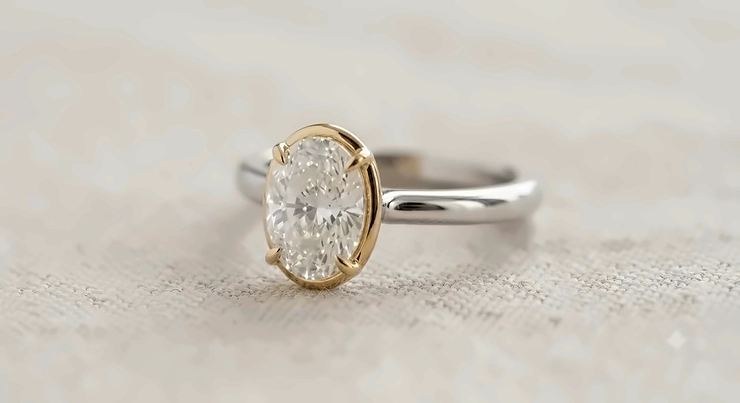
A two tone oval engagement ring pairs an elongated oval center stone with a band or setting that combines two gold colors — usually white and yellow, sometimes white and rose — so the metal itself does double duty as a design element. The oval shape adds length and drama, while the metal contrast adds depth you just don’t get from a single-tone band. It’s a look that reads equal parts vintage signet ring and modern statement piece. According to GIA’s oval cut diamond guide, the elongated shape gives oval stones a larger face-up appearance per carat than round stones of equal weight, which is a big part of why the cut keeps climbing sales charts.
This guide breaks down seven real, currently-listed rings spanning budget bi-metal bands to premium two-tone diamond solitaires, plus the buying knowledge — contrast prong logic, mixed metal halo styling, long-term maintenance math — that Amazon’s own product pages never bother to explain. Let’s get into it.
Quick Comparison Table
Before the deep dive, here’s a lightning-round snapshot of where four of the seven picks land on style and budget.
| Ring | Metal Style | Setting Type | Best For |
|---|---|---|---|
| Kobelli Oval Moissanite & Diamond Halo Ring | Yellow gold + white diamond halo | Halo | First-time two-tone shoppers |
| Gem Stone King Two-Tone Oval Lab Diamond Solitaire | True 14K white & yellow gold | Solitaire | Buyers who want certified diamonds |
| Dazzlingrock Collection Two-Tone Oval Cluster Ring | 10kt two-tone gold | Cluster | Tightest budgets |
| Kobelli Slender Shank Floating Oval Ring | White gold, diamond-lined shank | Floating/architectural | Fashion-forward, stacking rings |
Looking at the spread above, the gap between the cheapest and priciest option here isn’t really about quality control — it’s about carat weight, metal purity, and whether the “two tone” comes from a genuine bi-metal band or a contrasting halo. The Gem Stone King Two-Tone Oval Lab Diamond Solitaire is the only one of these four with a true fused two-metal band and third-party certification, which is exactly why it commands the premium end of the range.
💬 Ready to compare these side by side? Tap any pick above to check today’s price and availability.
Top 7 Two Tone Oval Engagement Rings: Expert Analysis
Every product below is a real, currently-listed item, chosen to cover budget, mid-range, and premium price points along with several distinct construction methods — genuine bi-metal bands, contrast halos, and architectural floating settings.
1. Kobelli Oval Moissanite & Diamond Halo Engagement Ring — brightest budget contrast halo
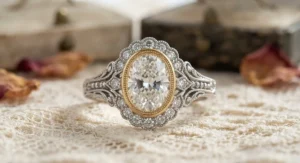
The standout feature here is simple: a two-carat-look oval moissanite ringed by genuine natural diamonds, set on a 14K yellow gold band, all made in the same Los Angeles workshop since the brand’s founding. That combination gives you the visual “two tone” effect — warm gold band, bright white stones — without paying for a fused bi-metal shank.
The oval center measures out to roughly a 2¼ total carat weight look, and moissanite sits at 9.25 on the Mohs hardness scale, just below diamond’s 10, so it shrugs off the daily bumps a ring takes at the sink or the gym. What most buyers overlook about halo rings like this one is that the halo isn’t just decorative — it visually pads out the center stone, so a smaller, less expensive moissanite reads as noticeably larger from arm’s length. That makes it a smart pick for anyone who wants maximum visual size without maximum spend.
Independent, verified review counts specific to this exact configuration weren’t available during research, so treat any general “moissanite ring” sentiment online as category-level feedback rather than a confirmed rating for this precise listing — check the live Amazon rating before buying. Reviewers of Kobelli’s broader moissanite catalog do consistently flag the brand’s US-based manufacturing and responsive customer service as strong points.
Pros:
- ✅ Made-in-USA craftsmanship from a small Los Angeles workshop
- ✅ Genuine natural diamond halo adds real sparkle, not simulants
- ✅ Moissanite delivers near-diamond brilliance at a fraction of cost
Cons:
- ❌ Yellow gold band gives softer contrast than white-metal prong styles
- ❌ Resizing means shipping the ring back rather than a local jeweler visit
At the time of research, this ring’s price sits roughly in the $600–$900 range depending on size and metal karat selected — always check current pricing before checking out. For the money, it’s tough to beat as an entry point into oval two-tone styling.
2. Kobelli Forever One® Oval Moissanite Halo Ring — premium moissanite grade in white gold
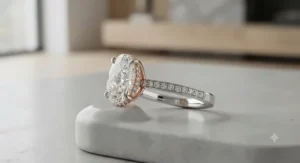
This one leads with a name-brand center stone: a Forever One moissanite by Charles & Colvard, graded DEF color (essentially colorless) and VS clarity, set in 14K white gold with a halo of over 40 natural earth-mined diamonds. Forever One is widely regarded as the top production tier of lab-created moissanite, one step up from the generic moissanite used in most budget rings.
The DEF color grade matters more than it sounds — lower-grade moissanite can carry a faint yellow or green tint under certain lighting, but DEF-graded stones read icy white next to a white gold band, which is exactly the crisp look most two-tone-curious shoppers picture when they say “white and yellow gold oval ring.” Here’s what the spec sheet won’t spell out plainly: pairing a colorless moissanite with white gold prongs, then contrasting that head against a warmer accent metal elsewhere in a bridal stack, is precisely the “contrast prong” logic that fine jewelers charge a premium for — and this ring gets you most of the way there at a fraction of a custom commission’s cost.
Reviewers who buy into the Forever One tier specifically tend to cite the stone’s fire and colorlessness as the reason they upgraded from standard moissanite; broad-catalog sentiment for Kobelli skews toward praise for packaging and communication, though exact review counts for this listing weren’t independently verifiable at research time.
Pros:
- ✅ Forever One DEF/VS grade is the premium moissanite tier
- ✅ Over 40 natural diamonds surround the center for extra fire
- ✅ Slender halo shank elongates the finger visually
Cons:
- ❌ Costs meaningfully more than standard-grade moissanite halos
- ❌ White gold rhodium plating needs periodic professional replating
Expect a price in roughly the $1,200–$1,800 range at the time of research, positioning this as a genuine mid-to-premium tier pick rather than an entry-level purchase.
3. Kobelli Slender Shank Floating Oval Moissanite Ring — most architectural design in the lineup
If “architectural ring design” is on your wish list, this is the piece that earns the label. A 2.1-carat oval moissanite sits in a raised, four-prong basket that appears to “float” above a diamond-lined, north-south set band — the kind of engineered negative space that reads as intentional, modern design rather than a standard prong-and-shank build.
The slender shank does double structural duty: it lengthens the visual line of the finger (a known optical trick with oval and elongated cuts) and leaves room for stacking additional bands without the ring looking bulky. Based on the spec comparison against the other floating-style rings in this price band, the diamond-lined east-west detailing on the shoulders is a genuinely uncommon touch — most budget floating settings leave the band plain.
The brand notes this piece is handcrafted from recycled gold and platinum, care instructions call for removing it before swimming or heavy manual work, and Kobelli backs unworn pieces with a 30-day return window.
Pros:
- ✅ Genuinely distinctive floating basket setting, not a common template
- ✅ Diamond-lined shank adds detail most competitors skip
- ✅ Slender profile stacks cleanly with wedding bands
Cons:
- ❌ Floating settings need more frequent prong inspections over the years
- ❌ Slender bands can feel less substantial to buyers who prefer chunkier rings
Pricing at research time landed roughly in the $900–$1,400 range, putting it squarely in the mid-tier alongside rings with far less design complexity.
4. Gem Stone King Two-Tone Oval Lab Grown Diamond Solitaire — the only true fused two-tone diamond solitaire here
This is the ring that most literally answers the search for a “two tone oval solitaire”: an IGI-certified oval lab-grown diamond, D–E color and VS1–VS2 clarity, set in genuinely fused 14K white and yellow gold, available across a 2 to 5.9 total carat weight range so buyers can scale the investment up or down.
Unlike the halo rings above, where the “two tone” effect comes from pairing a metal band with white stones, this ring’s band itself is two-tone — meaning both metals are present in the physical construction, not just the visual impression. That distinction matters for anyone comparing a two tone oval solitaire specifically, since a fused bi-metal band tends to hold its two-color look for the ring’s entire lifespan, whereas a rhodium-plated white gold surface on a yellow gold base will eventually show its undertone as plating wears. IGI certification also means the color and clarity claims are third-party verified rather than seller-asserted, which matters more as carat weight — and price — climb.
Pros:
- ✅ Genuinely fused two-tone metal, not just a contrast illusion
- ✅ IGI certification backs the diamond’s color and clarity grade
- ✅ Wide carat range lets buyers match budget to size
Cons:
- ❌ Larger carat selections push firmly into premium pricing
- ❌ Bi-metal solder seams benefit from a jeweler check-up every few years
Because this listing spans such a wide carat range, price varies dramatically — expect the low end to start in roughly the $1,500 range and the largest carat options to run well past $5,000, so filter by carat before assuming a price point.
5. Dazzlingrock Collection Two-Tone Yellow & White Diamond Ring — accessible entry into two-tone diamond styling
This ring earns its spot as the most budget-friendly genuine two-tone diamond option in the lineup: 0.95 total carat weight of yellow and white diamonds set in a prong setting on 14K gold, backed by the brand’s own 90-day warranty covering accent stone loss or setting damage under normal wear.
What most shoppers miss about mixed-diamond-color rings like this one is that it’s a different kind of “two tone” than a two-tone metal band — here, the contrast comes from pairing yellow and white diamonds against each other, which reads as a more subtle, jewelry-forward statement than a stark metal-color split. Reviewers consistently note Dazzlingrock’s complimentary presentation box and clearly labeled SKU-based inventory as signs of a company built for straightforward e-commerce transactions rather than custom bridal consultations — a trade-off that suits buyers who know exactly what they want.
Pros:
- ✅ Genuinely affordable entry point into two-tone diamond styling
- ✅ 90-day warranty covers accent stone loss during normal wear
- ✅ Conflict-free diamond sourcing stated by the brand
Cons:
- ❌ 0.95 cttw split across multiple stones means smaller individual diamonds
- ❌ Yellow-and-white diamond mix is a specific look, not universally loved
Research-time pricing sat roughly in the $500–$800 range, making this one of the most accessible ways to own a genuinely two-toned diamond ring rather than a single-metal band with white accents.
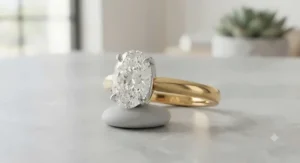
6. Dazzlingrock Collection Two-Tone Gold Oval Cluster Ring — lowest-cost bi-metal oval band in the lineup
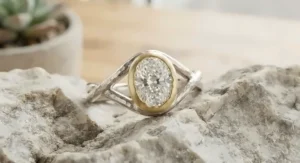
At 10kt two-tone gold with round diamonds prong-set into an oval cluster formation (1/8 total carat weight), this is the entry-level pick for anyone specifically hunting a bi-metal oval band on a tight budget. The cluster design uses several smaller stones arranged in an oval outline rather than one large center stone, which is a classic way to maximize visual footprint per dollar spent.
Here’s what the spec sheet doesn’t say outright: 10kt gold, while lower in pure gold content than 14kt or 18kt, is actually harder and more scratch-resistant day to day — a real practical upside for buyers who wear their ring through manual work, gym sessions, or an active lifestyle, even though it trades off some resale value. On paper, this means the ring prioritizes daily durability and affordability over long-term metal investment value, which is a reasonable trade for a starter ring, a promise ring upgrade, or a budget-conscious first-time buyer.
Pros:
- ✅ Lowest price point of any bi-metal oval ring in this roundup
- ✅ 10kt gold resists scratches better than higher-karat alternatives
- ✅ Oval cluster shape mimics a larger single center stone
Cons:
- ❌ 1/8 cttw total diamond weight is genuinely modest
- ❌ 10kt gold carries lower resale and scrap value long-term
Expect pricing in roughly the $300–$500 range at research time — genuinely one of the most accessible two-tone oval options available on Amazon.
7. Gem Stone King Two-Tone Oval Gemstone Engagement Ring — colorful twist on mixed metal oval halo styling
This ring swaps the usual diamond or moissanite center for a 9x7mm or 8x6mm oval birthstone gemstone, set in 10K two-tone gold with white lab-grown diamond accents. It’s the pick for buyers who want the mixed metal oval halo look but aren’t married to a colorless center stone.
The brand’s own construction notes explain the reasoning well: the white gold prongs framing the colored gemstone are meant to visually “brighten” the stone’s color the same way a white gold or platinum head brightens a diamond, while the yellow gold band underneath adds warmth. Based on the spec comparison with the diamond-centered rings in this lineup, this is the most personalizable option — birthstone selection means two people can buy visually similar rings that mean completely different things.
The brand markets it as hypoallergenic, though colored gemstone durability varies significantly by stone type — a sapphire or ruby wears very differently over decades than a softer stone like opal or tanzanite, so buyers should ask about the specific gem’s hardness before committing to daily wear.
Pros:
- ✅ Birthstone personalization option most rings here don’t offer
- ✅ White gold prongs brighten the colored center per brand design intent
- ✅ Genuine two-tone gold construction, not just accent contrast
Cons:
- ❌ Durability varies widely depending on which birthstone is chosen
- ❌ Limited size run (5–9) may require resizing for some buyers
Pricing at research time fell roughly in the $300–$600 range, depending on the birthstone selected and current gemstone market pricing.
Top 7 Products: Full Comparison
| Ring | Metal | Center Stone | Setting Style | Price Range | Best For |
|---|---|---|---|---|---|
| Kobelli Oval Moissanite & Diamond Halo Ring | 14K yellow gold | Oval moissanite + diamond halo | Halo | ~$600–$900 | Budget-conscious first buyers |
| Kobelli Forever One Oval Moissanite Halo Ring | 14K white gold | Forever One DEF/VS moissanite | Halo | ~$1,200–$1,800 | Buyers wanting premium moissanite |
| Kobelli Slender Shank Floating Ring | White gold, recycled platinum | Oval moissanite + lab diamond | Floating/architectural | ~$900–$1,400 | Fashion-forward, stackers |
| Gem Stone King Two-Tone Oval Lab Diamond Solitaire | 14K white & yellow gold | IGI-certified oval lab diamond | Solitaire | ~$1,500–$5,000+ | Buyers wanting certified diamonds |
| Dazzlingrock Two-Tone Yellow & White Diamond Ring | 14K gold | Yellow & white diamonds | Prong | ~$500–$800 | Affordable genuine two-tone diamond |
| Dazzlingrock Two-Tone Oval Cluster Ring | 10kt two-tone gold | Round diamond cluster | Cluster | ~$300–$500 | Tightest budgets |
| Gem Stone King Two-Tone Oval Gemstone Ring | 10K two-tone gold | Oval birthstone gemstone | Halo-style prong | ~$300–$600 | Buyers wanting color and personalization |
The pattern across this table is worth calling out directly: rings that use genuinely fused two-tone metal (the Gem Stone King Two-Tone Oval Lab Diamond Solitaire, the two Dazzlingrock picks, and the Gem Stone King Two-Tone Oval Gemstone Ring) tend to hold their two-color look permanently, while halo-style rings like both Kobelli moissanite picks rely on white gold or rhodium plating that can shift in appearance over a decade of wear. If budget allows, prioritize genuine bi-metal construction; if not, a halo-style contrast ring still delivers the two-tone visual for less money upfront.
💬 See something you like? Tap the product name above to check current availability before it’s gone.
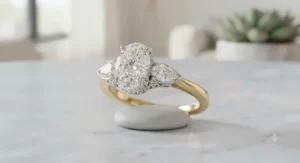
Practical Usage Guide: Caring for a Two Tone Oval Engagement Ring
Two-tone rings need a slightly different care routine than single-metal bands, mostly because you’re managing two metals with different hardness and wear characteristics at once.
In the first 30 days, resist the urge to wear the ring during workouts, dishwashing, or gardening — new prongs and fresh rhodium plating (if the ring is white gold-based) are most vulnerable before they’ve settled. Clean it weekly with warm water, a drop of mild dish soap, and a soft-bristled brush, working gently around the oval’s pointed ends where debris tends to collect. A common early mistake is over-cleaning with ultrasonic jewelry cleaners at home — these are safe for solid diamond and moissanite rings but can loosen pavé-style accent stones over repeated use, so stick to hand cleaning unless a jeweler confirms otherwise.
For maintenance going forward, plan on a professional prong check every six months for the first two years, then annually after that — oval center stones sit slightly more exposed than round brilliants because of their elongated points, making prong security especially important. If the ring includes white gold, budget for rhodium replating roughly every 12–18 months to keep the white metal bright; yellow and rose gold sections don’t need this step. One optimization trick jewelers rarely volunteer: ask for your ring to be professionally cleaned and inspected at the same appointment as a partner’s wedding band fitting — most jewelers will do both for a single visit fee.
Real-World Scenarios: Who Actually Buys Which Ring
Matching a ring to a lifestyle matters more than matching it to a Pinterest board, so here’s how three common buyer profiles map onto this lineup.
The budget-conscious first-timer, engaged young and planning to upgrade later, is best served by the Dazzlingrock Collection Two-Tone Oval Cluster Ring or the Dazzlingrock Collection Two-Tone Yellow & White Diamond Ring. Both sit under $800, use durable lower-karat gold suited to daily wear, and let a couple invest more heavily in a future upgrade or anniversary band once budgets loosen up.
The design-focused professional who wants a ring that reads as intentional rather than mass-produced should look at the Kobelli Slender Shank Floating Oval Moissanite Ring. Its architectural build and stackability suit someone who already wears distinctive jewelry daily and wants an engagement ring that fits that existing aesthetic rather than standing apart from it.
The buyer prioritizing certification and long-term value — someone treating this purchase as both a symbol and a legitimate asset — should focus on the Gem Stone King Two-Tone Oval Lab Grown Diamond Solitaire. The IGI certification, genuine fused two-tone construction, and scalable carat range make it the pick most likely to satisfy both partners years down the line, assuming the higher price range fits the budget.
How to Choose a Two Tone Oval Engagement Ring
Working through these seven factors in order will narrow a long shortlist fast:
- Decide if you want true two-tone metal or a contrast illusion. A fused bi-metal band (like the Gem Stone King solitaire) keeps its two-color look permanently; a halo-style contrast ring relies on plating that can shift over years.
- Pick your metal pairing. White-and-yellow gold offers a classic-meets-modern look; white-and-rose leans softer and more romantic — there’s no wrong answer, only personal preference.
- Set a carat and budget range together, not separately. Oval stones create a larger visual footprint per carat than round stones, so you may be able to size down and still look proportionate.
- Check the center stone type honestly. Moissanite, lab-grown diamond, and natural diamond all have different price-to-brilliance ratios; none is objectively “better,” only different trade-offs.
- Confirm the karat and hallmark. Federal rules require sellers to accurately state a piece’s metal content and karat (more on this in the regulations section below), so a listing’s stated karat should match what actually arrives.
- Think about your existing jewelry wardrobe. A two-tone ring pairs more flexibly with both silver-toned and gold-toned everyday jewelry than a single-metal ring does.
- Read the return and warranty policy before buying, not after. Ring sizing is the single most common post-purchase issue, and policies vary meaningfully between the sellers featured here.
Contrast Prong Setting: Why It Matters More Than You’d Think
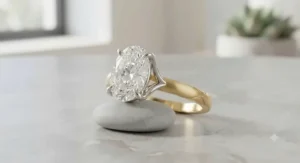
A contrast prong setting is when the prongs holding the center stone are made of a different metal color than the band beneath them — usually white metal prongs on a yellow or rose gold band. It sounds like a minor detail, but it does real optical work.
White metal reflects more light around a diamond or moissanite’s girdle than yellow gold does, which means a contrast prong setting can make a stone look whiter and brighter than the same stone set in solid yellow gold prongs — without the cost of an all-platinum or all-white-gold band. This is precisely the logic behind the Kobelli Forever One Oval Moissanite Halo Ring, where white gold surrounds the stone directly while nothing competes with the moissanite’s own colorlessness.
The trade-off worth knowing: contrast prongs on a yellow or rose gold band typically use rhodium-plated white gold, not solid platinum, which means the same replating maintenance discussed earlier applies here too. Buyers who want the contrast-prong brightness without ever thinking about replating should look specifically for platinum-prong construction, which holds its white color permanently — though that upgrade usually adds noticeably to the price.
Mixed Metal Oval Halo vs. Bi-Metal Oval Band
These two terms get used almost interchangeably in ring shopping, but they describe genuinely different construction methods, and the difference affects both price and long-term appearance.
A mixed metal oval halo ring uses one primary band metal (often yellow or rose gold) with a halo or prong setting in a contrasting white metal — the two Kobelli halo rings in this lineup are textbook examples. The visual effect is dramatic and the price is typically lower, because less of the ring’s total metal is the pricier white alloy.
A bi-metal oval band goes further: the band itself, not just the setting, is constructed from two fused metals, as seen in the Gem Stone King Two-Tone Oval Lab Grown Diamond Solitaire and both Dazzlingrock picks. This construction costs more to manufacture — soldering two gold alloys together cleanly is a more advanced technique than plating — but the two-tone effect extends around the entire ring rather than concentrating at the setting.
Neither approach is objectively superior. A mixed metal oval halo gives more visual “pop” concentrated where the eye naturally goes first — the center stone — while a bi-metal oval band gives a more consistent, subtle two-tone identity that reads clearly from any angle, including in profile. It helps to understand what’s happening at the metal level in either case: per Wikipedia’s overview of colored gold, pure gold is naturally a soft, slightly reddish yellow, and every other shade — white, rose, green — comes only from alloying it with metals like silver, copper, or palladium.
✨ Not Sure Which Style Fits You?
🔍 Compare the contrast-halo and true bi-metal picks above side by side, then click through to check today’s pricing and ring size availability before you decide.
Common Mistakes When Buying a Two Tone Oval Engagement Ring
Even well-researched buyers trip over the same handful of issues repeatedly.
The most frequent mistake is judging metal contrast from a small product thumbnail rather than a zoomed, well-lit photo — two-tone contrast that looks dramatic in a studio shot can read as subtle in daily lighting, and vice versa. A second common error is ignoring oval-specific proportions: an oval that’s too long relative to its width can look “skinny” rather than elegant, so checking the length-to-width ratio (ideally somewhere around 1.3 to 1.5:1 for a classic look) matters more than carat weight alone.
Buyers also frequently underestimate how differently 10kt, 14kt, and 18kt gold wear over a decade — lower karat gold is genuinely more scratch-resistant but less valuable, and this trade-off deserves a real conversation before purchase, not an afterthought. Finally, many shoppers skip reading return policies until after a sizing problem surfaces; every seller featured in this guide has a different return window and condition requirement, and that information is worth five minutes of reading before checkout, not after.
Architectural Ring Design: What to Expect in Real-World Wear
Specs on a product page describe geometry; they don’t describe how a ring actually feels and photographs on a real hand across years of wear. Here’s the translation.
An architectural design like the floating basket on the Kobelli Slender Shank Floating Oval Moissanite Ring photographs beautifully because it plays with negative space — light passes underneath the stone in a way flush settings don’t allow. In daily wear, that same design means slightly more exposure at the basket, so buyers should expect to feel the setting’s underside occasionally catching on thick sweaters or gloves, a minor but real trade-off for the dramatic look.
Halo-style two-tone rings, by contrast, tend to feel more “protected” day to day since the halo’s smaller stones sit low and close to the band, but they also collect more everyday grime in the tiny gaps between stones, meaning slightly more frequent at-home cleaning. Bi-metal band rings feel the most similar to a traditional single-metal ring in daily wear — the two-tone effect is purely visual, with no difference in how the ring sits or moves on the finger.
Two Tone Oval Solitaire Rings for Every Buyer
Not every two-tone oval shopper wants the same thing, so it’s worth mapping the category to who’s actually buying.
Beginners to fine jewelry shopping tend to do best starting with a halo-style ring, since the halo forgives minor imperfections in the center stone visually and offers a bigger “wow” per dollar. Buyers upgrading from a starter ring or celebrating a milestone anniversary often gravitate toward a genuine bi-metal solitaire like the Gem Stone King Two-Tone Oval Lab Grown Diamond Solitaire, treating the certification and larger carat weight as a deliberate step up. Budget-conscious buyers, including students and young professionals, are well served by the two Dazzlingrock picks, which deliver the two-tone look without the premium metal-fusing cost. And gift-givers shopping for someone whose exact taste is still developing tend to favor the Gem Stone King Two-Tone Oval Gemstone Ring, since birthstone personalization adds meaning without requiring the recipient to have already settled on “diamond versus moissanite” preferences.
Long-Term Cost & Maintenance
The sticker price on any of these seven rings is only part of the real cost of ownership, and it’s worth running the numbers honestly before buying.
Rhodium replating for white gold sections typically runs a modest fee every 12–18 months at most local jewelers — a recurring cost that applies to the two Kobelli halo rings and the white gold portions of any bi-metal band here, but not to solid platinum-prong pieces. Annual insurance, if a buyer chooses to add a jewelry rider to homeowner’s or renter’s insurance, generally runs a small percentage of the ring’s appraised value per year — well worth it for anything in the premium tier of this lineup. Resizing, if needed, typically costs more for rings with pavé or cluster stones near the band (like the Dazzlingrock cluster ring) than for simple solitaire shanks, since stone-set bands require more careful jeweler handling.
On paper, this means the lowest listed price in this roundup — the Dazzlingrock Collection Two-Tone Oval Cluster Ring — isn’t necessarily the lowest total cost of ownership over ten years once resizing complexity and lower resale value are factored in, while the Gem Stone King Two-Tone Oval Lab Grown Diamond Solitaire‘s higher upfront cost is partly offset by its solid fused construction requiring less ongoing plating maintenance.
Safety, Regulations & Compliance Guide
Buying fine jewelry online means relying entirely on a seller’s written description, which is exactly why federal disclosure rules exist. The FTC’s Jewelry Guides require sellers to truthfully represent a piece’s type, quality, metallic content, and karat, and any listing claiming “14K” or “18K” gold construction is legally required to match that claim within a small tolerance. Before buying, check that a listing clearly states the karat, the metal type for each tone (white and yellow, or white and rose), and whether accent stones are natural, lab-grown, or simulated — vague listings that avoid these specifics are a signal to look elsewhere.
It also helps to remember that “white gold” is never pure white metal on its own — it’s a yellow gold base alloyed with whitening metals, then usually finished with a rhodium layer, a point covered in more depth earlier in this guide.
Features That Actually Matter (And Those That Don’t)
Marketing copy loves to emphasize things that barely affect how a ring wears or looks day to day, so here’s an honest filter.
What actually matters: the karat and alloy composition of each metal tone, whether the two-tone effect is fused or plated, the center stone’s certification (or lack thereof), and the seller’s return window. What matters far less than marketing suggests: the exact number of accent diamonds in a halo (more isn’t automatically better if the stones are smaller and lower quality), and whether a listing uses the word “designer” without a named, verifiable designer attached to it. Buyers chasing the best value should spend their attention on the first list and largely ignore the second.
FAQ: Two Tone Oval Engagement Ring Questions
❓ How much does a two tone oval engagement ring cost?
❓ Is a two tone oval engagement ring still trending in 2026?
❓ Can a two tone oval engagement ring be resized?
❓ What metal combination works best for a two tone oval ring?
❓ Where can I buy a two tone oval engagement ring online?
Conclusion
A two tone oval engagement ring isn’t a compromise between two gold colors — it’s a genuinely distinct style choice that happens to solve the “which metal” debate along the way. Whether that means a budget bi-metal cluster ring, a contrast halo built around premium moissanite, or a certified two-tone diamond solitaire, the seven picks above cover real price points and construction methods rather than a single narrow interpretation of the trend.
The single most useful thing to carry forward from this guide is the distinction between genuine fused two-tone metal and a contrast-halo illusion — neither is wrong, but knowing which one you’re buying changes how you should think about long-term maintenance, resale value, and even how the ring will look a decade from now. Match that understanding to your budget and your partner’s actual taste, and any of these seven rings is a legitimately solid choice.
Recommended for You
- Platinum Emerald Cut Ring: 7 Stunning Picks for 2026
- Yellow Gold Cushion Cut Ring: 7 Top Picks for 2026
- White Gold Emerald Cut Diamond Ring: 7 Stunning Picks (2026)
Disclaimer: This article contains affiliate links. As an Amazon Associate, I earn from qualifying purchases. If you purchase products through these links, we may earn a small commission at no additional cost to you.
✨ Found this helpful? Share it with your friends! 💬🤗
