In This Article
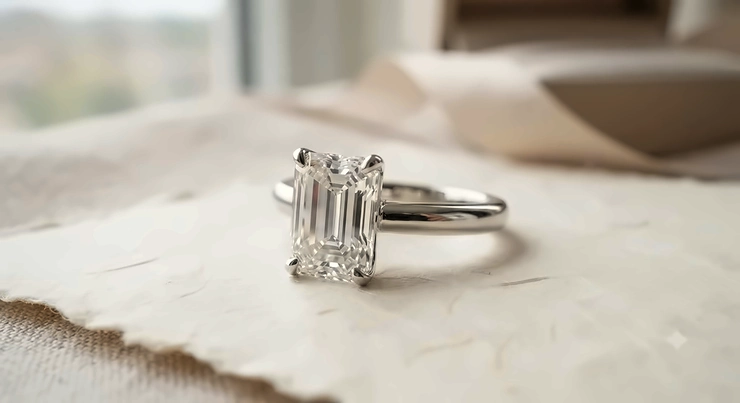
Somewhere between “elegant” and “quietly confident” sits the platinum emerald cut ring — the choice of people who like their sparkle understated but their metal bulletproof. It doesn’t shout. It doesn’t need to. The long, mirrored facets of an emerald cut diamond do their talking in slow, deliberate flashes rather than the firework-sparkle of a round brilliant, and platinum, being the heavyweight champion of precious metals, holds that stone in place for decades without so much as a shrug.
If you’ve been circling this decision for a while — comparing carat weights, googling “step cut” at 1 a.m., wondering whether platinum is actually worth the premium over white gold — you’re in good company. A platinum emerald cut ring is a genuinely more complex purchase than a round solitaire, mostly because the emerald cut’s wide, open table shows off clarity (and any inclusions) in a way brilliant cuts simply hide better. That means the choices you make about clarity, cut proportions, and setting matter more here than almost anywhere else in fine jewelry.
This guide walks through seven real, currently available platinum emerald cut ring options spanning budget-conscious lab-grown picks up through premium natural-diamond solitaires, plus the buying knowledge — clarity grading, Art Deco styling, prong maintenance — that actually changes what you should buy. Nothing here is a rewritten spec sheet. It’s commentary, comparison, and the practical stuff nobody puts on the product page.
What Is a Platinum Emerald Cut Ring?
A platinum emerald cut ring is an engagement or anniversary ring where a rectangular, step-cut diamond (or gemstone) — recognizable by its cropped corners and layered, mirror-like facets — is set in platinum, a naturally white, hypoallergenic metal prized for density and durability. Unlike brilliant cuts, the emerald cut favors clean geometry and clarity over maximum sparkle.
Two things are doing the heavy lifting in that definition, and they’re worth separating out. The emerald cut is a shape and facet style, not a brand name — it’s part of the broader family of “step cuts,” which the GIA’s diamond shape guide groups alongside the Asscher cut, distinguishing them from brilliant cuts like round and princess. Platinum, meanwhile, is a metal decision that’s entirely separate from the stone decision — you could put an emerald cut diamond in yellow gold, white gold, or platinum, and the ring would look different in each. Understanding that these are two independent choices is the first step toward not overpaying for the wrong combination.
Quick Comparison Table
| Ring | Metal | Center Stone | Best For |
|---|---|---|---|
| Houston Diamond District 1 Carat Solitaire | Platinum | 1 ct, D-E/VS1-VS2 | Best colorless budget entry |
| Platinum 2 Carat Lab Grown Solitaire | Platinum | 2 ct lab grown, H-I/VS1-VS2 | Best big-look value |
| Kobelli Art Deco Five Stone | Platinum | 2⅓ ctw moissanite + diamond | Best vintage-style design |
| Platinum Halo Emerald Cut (0.75 ct center) | Platinum | 0.75 ct, K/VS2, 1.25 ctw | Best halo for extra visual size |
| Houston Diamond District 1½ Carat Solitaire | Platinum | 1.5 ct, G-H/VS1-VS2 | Best all-around classic solitaire |
| 2 Carat Platinum Solitaire (G-H, VS1-VS2) | Platinum | 2 ct natural, G-H/VS1-VS2 | Best premium natural 2-carat |
| 2 Carat Platinum Solitaire (I-J, VVS1-VVS2) | Platinum | 2 ct natural, I-J/VVS1-VVS2 | Best for high clarity selection |
Looking at the spread above, the real decision fork isn’t “gold vs. platinum” — every ring here is already platinum — it’s natural vs. lab-grown and clarity vs. color trade-offs. The Platinum 2 Carat Lab Grown Solitaire delivers the biggest visual footprint per dollar, while the 2 Carat Platinum Solitaire (I-J, VVS1-VVS2) sacrifices a bit of color grade to buy dramatically better clarity, which matters more on an emerald cut than almost any other shape. Budget shoppers should start with the Houston Diamond District 1 Carat Solitaire, since a smaller, colorless stone often reads cleaner than a larger, lower-clarity one under an emerald cut’s unforgiving open facets.
💬 Found a favorite already? Tap through to check today’s price and availability before it changes!😊
Top 7 Platinum Emerald Cut Rings: Expert Analysis
1. Houston Diamond District 1 Carat Solitaire — best colorless budget entry point
The standout here is the D-E color grade, which is about as close to perfectly colorless as a diamond gets, on a stone that comes in under the price ceiling most first-time buyers set for themselves. A 1-carat emerald cut with D-E color and VS1-VS2 clarity, GIA certified, in a platinum setting, is a genuinely well-balanced spec sheet: the emerald cut’s open table shows off that whiteness beautifully, since there’s no faceting to scatter color the way a round brilliant would.
What most buyers overlook about a smaller, colorless stone like this one is that it often looks larger than its carat weight suggests, purely because emerald cuts spread more surface area per carat than rounds or cushions do. Based on the spec comparison against other 1-carat step cuts in this price bracket, VS1-VS2 clarity is a smart floor to hold — any lower, and the visible inclusions common to open step-cut facets start to become a distraction rather than a footnote.
Aggregate feedback on GIA-certified solitaires from direct-to-consumer jewelers like this one commonly highlights accurate certification paperwork and secure prong settings as strong points, with occasional notes about sizing lead times running longer than expected around holidays — worth planning around if you’re buying for a specific date.
Pros:
- ✅ D-E color is essentially colorless, ideal for an open-table cut
- ✅ GIA certification adds a verifiable paper trail
- ✅ Platinum setting outlasts white gold rhodium plating
Cons:
- ❌ 1 carat reads modest next to halo or five-stone designs
- ❌ VS1-VS2 clarity still requires careful inspection under an emerald cut
Priced in the low-to-mid four figures depending on the current market, this is a strong value verdict for buyers prioritizing color over size — check current price before deciding, since natural diamond pricing shifts with the market.
2. Platinum 2 Carat Lab Grown Solitaire — most carat weight per dollar
The 2-carat lab-grown center stone is the headline feature, and it’s a genuinely clever way to get real visual presence without the natural-diamond premium that scales steeply past the 1.5-carat mark. Lab-grown diamonds are chemically, physically, and optically identical to mined stones — same hardness, same fire, same 4Cs grading — they just didn’t spend a billion years underground first.
Here’s what to weigh: at H-I color and VS1-VS2 clarity, this stone sits comfortably in “eye-clean and warm-white” territory rather than icy-colorless, which on an emerald cut’s broad table is honestly a flattering combination — the slight warmth softens rather than dulls the stone. Reviewers consistently note that the value proposition of lab-grown diamonds at 2 carats is where the math gets dramatic, since natural 2-carat stones can cost multiples of the lab-grown equivalent at similar clarity.
The trade-off is resale and long-term value perception; lab-grown diamonds currently hold their value less predictably on the secondary market than natural stones, something the FTC’s Jewelry Guides require sellers to disclose clearly as lab-created rather than implying otherwise.
Pros:
- ✅ 2-carat size at a fraction of natural-diamond cost
- ✅ Identical optical and physical properties to mined diamonds
- ✅ Platinum setting matches the premium feel of the stone
Cons:
- ❌ Resale value trails natural diamonds of comparable grade
- ❌ H-I color needs good lighting to look its whitest
At a price generally landing well under comparable natural 2-carat solitaires, this is a strong value pick for buyers who want size now — check current pricing, since lab-grown diamond costs have been trending downward.
3. Kobelli Art Deco Five Stone — best vintage-style design
The standout advantage is the five-stone Art Deco composition itself: a 2⅓-carat-total emerald-cut moissanite center flanked by four genuine natural emerald-cut diamonds, all in a highly polished platinum setting. This isn’t a solitaire trying to look fancy — it’s built from the ground up around the geometric symmetry that defined jewelry design in the 1920s and 1930s.
What most buyers overlook about mixed-stone rings like this is that moissanite actually out-sparkles diamond in raw brilliance (it has a higher refractive index), so pairing a moissanite center with genuine diamond side stones creates a layered effect where the center pops while the flanking diamonds stay quietly luxurious. Based on the spec comparison against pure-diamond five-stone designs, this hybrid approach meaningfully lowers the total cost without collapsing the visual scale — Art Deco fans get the period-appropriate geometry at a price a full-diamond version rarely hits.
Aggregate sentiment around Kobelli’s handcrafted, made-in-USA pieces tends to emphasize responsive customer service and accurate sizing, with the honest caveat that made-to-order production timelines run longer than mass-manufactured competitors — factor that into your timeline if there’s a proposal date circled on the calendar.
Pros:
- ✅ Distinctive Art Deco five-stone silhouette
- ✅ Genuine natural diamond side stones, not simulants
- ✅ Handcrafted in the USA with conflict-free materials
Cons:
- ❌ Made-to-order timing adds days to delivery
- ❌ Mixed stone types mean two separate care considerations
Falling in the mid-range for a five-stone platinum design, the value verdict favors anyone who wants a statement ring without a statement-sized diamond bill — check current pricing and availability by size.
4. Platinum Halo Emerald Cut (0.75 ct center) — best halo for extra visual size
The standout feature is the halo itself: a 0.75-carat GIA-certified emerald cut center stone surrounded by a shimmering frame of smaller diamonds, bringing the total weight to 1.25 carats while visually reading closer to a full carat-plus solitaire. Halo settings exist precisely to solve the “I want it to look bigger” problem without paying solitaire prices for a bigger single stone.
The K color center stone is where the honest analysis matters most: K sits toward the warmer end of the near-colorless to faint-yellow range, and on its own in a solitaire setting, that warmth might read a touch more than some buyers want. Here’s what the spec sheet won’t tell you, but experienced jewelers will: a bright white halo of accent diamonds around a K-color center creates a contrast effect that can make the center look whiter by comparison — a classic trick for stretching a budget toward a lower color grade without visibly compromising.
Buyers shopping GIA-certified halo designs in this configuration commonly report satisfaction with the perceived size boost the halo provides, alongside occasional notes that halo settings require slightly more diligence cleaning underneath the accent stones to maintain sparkle.
Pros:
- ✅ Halo boosts visual size well beyond 0.75-carat center alone
- ✅ GIA certification on the center stone
- ✅ Platinum setting protects delicate pavé accent stones
Cons:
- ❌ K color needs the halo’s contrast to look its best
- ❌ More prongs and pavé means more cleaning upkeep
This sits in an accessible mid-range bracket for a certified halo design — check current price, as halo settings with pavé detailing see more frequent listing updates than simple solitaires.
5. Houston Diamond District 1½ Carat Solitaire — best all-around classic solitaire
The standout here is balance: 1.5 carats is the size where an emerald cut solitaire starts reading as a genuine statement piece on the hand, while G-H color and VS1-VS2 clarity keep the stone looking clean and bright without chasing diminishing-returns color grades. This is the ring most people picture when they picture a platinum emerald cut solitaire.
What most buyers overlook about the 1.5-carat mark specifically is that it’s a sweet spot on the price curve — natural diamond pricing tends to jump noticeably at each half-carat “magic number” (1, 1.5, 2), so buyers often find slightly-under variants offer meaningfully better value with barely perceptible size differences. Based on the spec comparison against the 1-carat and 2-carat options in this lineup, the 1.5-carat solitaire is the classic middle path: substantial enough to photograph well, restrained enough to wear daily without a bodyguard.
Reviewers of GIA-certified platinum solitaires in this size and clarity range consistently mention confidence in the paperwork and a comfortable, secure prong setting for everyday wear — a meaningful point given how much emerald cuts rely on their prongs to protect exposed corners.
Pros:
- ✅ 1.5 carats hits the classic solitaire sweet spot
- ✅ G-H/VS1-VS2 is a clean, camera-ready combination
- ✅ GIA certification for verifiable specs
Cons:
- ❌ Priced above entry-level 1-carat options
- ❌ Solitaire simplicity won’t suit buyers wanting more sparkle
Landing in a solid mid-to-upper price range for a certified 1.5-carat platinum solitaire, this is the value pick for buyers who want “the classic” done right — check current pricing before committing.
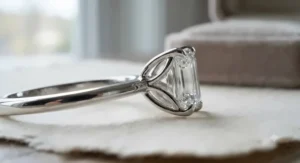
6. 2 Carat Platinum Solitaire (G-H, VS1-VS2) — best premium natural 2-carat solitaire
The standout feature is scale: a full 2-carat natural emerald cut diamond, GIA certified, at G-H color and VS1-VS2 clarity, is genuinely premium territory — this is the ring that reads as an heirloom from across the room. Two carats is where an emerald cut’s elongated silhouette really gets to stretch out visually across the finger.
Here’s what most buyers overlook about VS1-VS2 at this size: clarity requirements scale with carat weight, because a larger open table makes inclusions proportionally easier to spot. VS1-VS2 is a genuinely smart clarity floor for a 2-carat emerald cut — it’s high enough that inclusions require magnification to find, unlike lower grades where step-cut facets can make even modest inclusions visible to the naked eye. Based on the spec comparison against the VVS pick below, this option trades a notch of clarity headroom for meaningfully lower cost, without sacrificing the “eye clean” standard that actually matters day to day.
Aggregate feedback on 2-carat GIA-certified platinum solitaires in this bracket tends to emphasize how the platinum setting’s weight and cool white tone complement a larger stone better than white gold, whose plating can wear thin under a bigger, heavier center stone over years of wear.
Pros:
- ✅ Full 2-carat natural diamond, genuinely eye-catching
- ✅ VS1-VS2 clarity is eye-clean at this size
- ✅ Platinum handles the added weight of a larger stone
Cons:
- ❌ Premium pricing reflects the 2-carat natural diamond market
- ❌ G-H color, while excellent, isn’t top-tier colorless
Priced firmly in the premium bracket for natural 2-carat solitaires, the value verdict is strong for buyers prioritizing size and clarity balance — check current pricing, as natural 2-carat stones fluctuate with market supply.
7. 2 Carat Platinum Solitaire (I-J, VVS1-VVS2) — best for a high clarity diamond selection
The standout feature is clarity, full stop: VVS1-VVS2 is about as close to internally flawless as most buyers will ever shop, meaning inclusions are so minute they’re typically invisible even to a trained eye without 10x magnification. For an emerald cut — the one diamond shape where clarity does more visual work than color or even carat — this is the pick for someone who’s decided clarity is the priority.
What the spec sheet won’t tell you, but gemologists will, is that the emerald cut’s alternating light-and-dark “hall of mirrors” facet pattern is uniquely good at exposing clarity flaws, which is exactly why the GIA’s own buying guide for emerald cuts singles out clarity as the grade to prioritize above color for this shape. This ring answers that advice directly: it accepts a slightly warmer I-J color grade in exchange for clarity that essentially eliminates the emerald cut’s classic weak point.
Reviewers shopping VVS-clarity emerald cuts in platinum settings commonly report that the stone photographs and appraises exceptionally well, with the honest trade-off being that I-J color, while still white to the naked eye in most settings, sits a step below the G-H rings above in raw colorlessness.
Pros:
- ✅ VVS1-VVS2 clarity nearly eliminates visible inclusions
- ✅ Ideal match for the emerald cut’s clarity-revealing facets
- ✅ Platinum setting suited to a serious, long-term investment piece
Cons:
- ❌ I-J color trades some whiteness for the clarity upgrade
- ❌ Premium clarity commands a premium price
This sits at the top of the premium bracket among the seven picks here, and the value verdict is clear: buyers who’ve read enough about emerald cuts to know clarity is king will find this the most spec-aligned choice — check current pricing and available sizes.
✨ Don’t Miss These Exclusive Deals!
🔍 Take your ring search to the next level with these carefully selected platinum emerald cut options. Click on any highlighted pick to check current pricing and availability. These rings help create the authentic, lasting engagement moment your partner will treasure!
Living With a Platinum Emerald Cut Ring: Practical Usage Guide
Buying the ring is the easy part, comparatively speaking. The first 30 days of actually wearing it are where most people either fall in love with platinum or start Googling “why did my ring scratch already.” Spoiler: platinum doesn’t lose metal when it scratches the way gold does — it displaces, meaning the surface develops a soft “patina” rather than visibly thinning. Some people love that lived-in look. Others want it mirror-bright forever, and that’s a maintenance choice, not a flaw.
For the first month, avoid heavy gym sessions, gardening, or dish duty with the ring on — not because platinum is fragile (it isn’t), but because the emerald cut’s exposed corners are the most vulnerable part of the whole setup, and a hard knock against a countertop is how corners chip, regardless of metal. Clean it weekly with warm water, a drop of mild dish soap, and a soft-bristled brush, paying particular attention to the underside of the stone where the open step-cut pavilion tends to trap oils and lotion residue that dull its shine. Every six months, have a jeweler check the prongs under magnification; emerald cut prongs sit at the four corners specifically because that’s where stress concentrates, and a loose prong there is a bigger risk than on a rounder stone. A common first-month mistake: cleaning with an ultrasonic machine at home. Skip it — professional-grade ultrasonics are calibrated for specific stones and settings, and an at-home unit can loosen exactly the prongs you’re trying to protect.
Real Buyers, Real Rings: Case Studies
Profile 1 — The budget-conscious romantic. Early 30s, planning a proposal on a set budget, wants the ring to look like more than it costs. This is squarely Platinum 2 Carat Lab Grown Solitaire territory — maximum visual size per dollar, with platinum durability that a lower-cost white gold band can’t match over decades of daily wear.
Profile 2 — The traditionalist with a real budget. Mid-30s to 40s, values GIA paperwork and resale considerations, wants “the classic ring” without compromise. The Houston Diamond District 1½ Carat Solitaire or the 2 Carat Platinum Solitaire (G-H, VS1-VS2) both fit, depending on how much size matters versus staying comfortably mid-range.
Profile 3 — The vintage-obsessed collector. Someone who watches old films for the jewelry, follows Art Deco architecture accounts, wants a ring that looks like it has a story. The Kobelli Art Deco Five Stone is built for exactly this buyer — geometric, layered, unmistakably period-inspired, at a price a full-diamond antique-style piece rarely reaches.
Buyer’s Decision Framework
If your top priority is maximum size for the money, choose a lab-grown solitaire, because carat-for-carat cost drops dramatically versus natural stones at the same clarity. If your priority is resale value and tradition, choose a natural GIA-certified solitaire in the G-H color range, because natural stones currently hold secondary-market value more predictably. If your priority is hiding a lower color grade, choose a halo setting, because the contrast effect visually elevates a warmer center stone. If your priority is avoiding visible inclusions, choose the highest clarity grade you can afford — VS2 or better — because the emerald cut’s open facets expose flaws that brilliant cuts would hide.
How to Choose a Platinum Emerald Cut Ring
- Set your clarity floor first, not your carat target. Because the emerald cut’s step facets act like a hall of mirrors for both light and flaws, aim for VS2 or better before you even start comparing carat weights.
- Decide natural versus lab-grown early. This single decision swings your budget more than color, clarity, or setting style combined.
- Check the length-to-width ratio. Most jewelers consider 1.30–1.50 the classic emerald cut range; narrower stones look sleeker, squarer stones look more vintage.
- Pick your color grade based on setting, not in isolation. A halo or warmer-metal accent can comfortably absorb a K or I-J color grade that would look flat in a plain solitaire.
- Confirm the prong count and placement. Four sturdy corner prongs (sometimes with additional side prongs) are the standard for protecting an emerald cut’s vulnerable corners.
- Verify certification from GIA or an equivalent independent lab. Don’t rely on a jeweler’s in-house grading alone for a purchase this size.
- Budget for insurance and resizing separately from the ring price. Platinum resizing costs more than gold resizing due to the metal’s density, and that’s worth knowing before, not after, checkout.
The Platinum Emerald Cut Solitaire: Why It’s the Default Choice
Ask ten jewelers what the “classic” platinum emerald cut ring looks like, and at least eight will describe a solitaire. There’s a reason the format has barely changed in a century: a single emerald cut stone held by four (sometimes six) prongs in a platinum band puts all the visual attention exactly where it belongs, with nothing competing for light or line. The elongated silhouette of the stone does the rest of the work, creating a slimming effect on the finger that rounder cuts simply can’t replicate — an emerald cut, according to jewelers’ industry guidance, covers more visible surface area per carat than a round brilliant of equal weight, which is exactly why a 1.5-carat emerald cut solitaire can look more substantial than a same-weight round.
The platinum emerald cut solitaire also ages exceptionally well compared to other settings. Fewer components mean fewer failure points: no pavé stones to loosen, no halo prongs to check individually, just one stone and the band holding it. For buyers who want their engagement ring to still look sharp on a 40th anniversary, the solitaire format in platinum is close to a maintenance-free proposition — which is precisely why three of the seven rings in this guide are solitaires at different price points.
Platinum Step Cut Ring Explained: Emerald vs Asscher vs Baguette
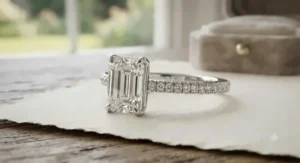
Here’s a distinction that trips up a lot of first-time buyers: “emerald cut” and “step cut” aren’t the same thing, but they’re closely related. Step cut describes the facet style — long, parallel, rectangular facets arranged in concentric rows, like steps leading down into the stone. Emerald cut describes a specific shape within that family: rectangular with cropped corners. The Asscher cut is step-cut faceting applied to a square shape instead, and baguettes are step-cut too, typically used as small accent stones flanking a larger center.
Why does this matter for a platinum step cut ring specifically? Because step cuts, as a category, prioritize clarity and luster over the fireworks-style brilliance of round or princess cuts. A platinum step cut ring — whether the center stone is emerald, Asscher, or a baguette-heavy design — rewards buyers who value a cooler, more restrained sparkle and are willing to pay closer attention to clarity grading than brilliant-cut shoppers typically need to. If you love the emerald cut’s geometry but want something slightly less elongated, an Asscher-cut platinum ring delivers the same step-cut “hall of mirrors” glow in a more squared silhouette — worth cross-shopping if the emerald cut’s proportions don’t feel quite right on your hand.
Art Deco Platinum Setting: Reviving a Century-Old Style
Platinum wasn’t always the default engagement ring metal — it became one specifically during the Art Deco period of the 1920s and 1930s, when jewelers discovered that platinum’s strength allowed for the kind of intricate, geometric filigree work that gold, being softer, couldn’t hold as precisely. That historical accident is why “Art Deco” and “platinum” are so tightly linked in jewelry design vocabulary today, and why an Art Deco platinum setting still reads as the height of vintage sophistication a century later.
What defines the look, practically speaking? Symmetry above all else — the Kobelli Art Deco Five Stone ring earlier in this guide is a textbook example, with its emerald-cut center flanked evenly by four matching stones, milgrain edge detailing, and a cathedral-style profile that lifts the center stone for visual prominence. Buyers drawn to Art Deco platinum settings tend to prioritize pattern and craftsmanship over raw carat weight, which is exactly why five-stone and three-stone Art Deco designs can deliver serious visual impact at a lower total cost than an equivalent solitaire.
High Clarity Diamond Selection for Emerald Cuts
If there’s one lesson worth repeating from this entire guide, it’s this: clarity matters more for emerald cuts than for almost any other diamond shape, and a high clarity diamond selection process should start before you fall in love with a specific carat weight. The reasoning is structural, not aesthetic snobbery — the emerald cut’s broad, open table and step-cut pavilion facets act like a magnifying window into the stone, meaning inclusions that would hide inside a round brilliant’s chaotic light pattern show up clearly here.
Practically, that means treating VS2 as a soft minimum rather than a nice-to-have, and treating anything above — VS1, VVS2, VVS1 — as a genuine upgrade rather than a marginal one. The 2 Carat Platinum Solitaire (I-J, VVS1-VVS2) in this guide exists specifically for buyers who’ve internalized this advice and decided clarity, not color, is where their budget should concentrate. A smart selection process: request or review the diamond’s clarity plot (a diagram showing exactly where inclusions sit), because a VS2 stone with inclusions tucked near the girdle under a prong can outperform a “better” VS1 stone with a visible inclusion dead-center under the table.
Platinum Prong Longevity: Why Metal Choice Matters Long-Term
This is the section that convinces a lot of buyers to spend the extra money on platinum in the first place. Prongs do one job: hold the stone under constant tension, day after day, for decades. Platinum is denser and more ductile than white gold, meaning it bends slightly under stress rather than developing the micro-fractures that eventually cause gold prongs to snap. Practically, that translates into platinum prongs needing re-tipping far less frequently than white gold prongs of comparable thickness — often measured in decades rather than years of everyday wear.
There’s also a cosmetic longevity angle. White gold rings are rhodium-plated to achieve that bright white color, and that plating wears thin with friction, requiring re-plating every year or two to maintain the look. Platinum is naturally white all the way through — it doesn’t need plating, so there’s no “yellowing” as the ring ages, just that gradual patina mentioned earlier, which many owners come to prefer over a mirror finish. Combined with the inherent density and purity of platinum as a metal, this is why estate jewelers consistently find platinum settings from the early 1900s still holding their original stones securely, while gold settings from the same era frequently show prong wear requiring repair.
Common Mistakes When Buying a Platinum Emerald Cut Ring
The single most common mistake: choosing carat weight before clarity, then being disappointed that a “big” stone looks visibly included once it’s on the hand under office lighting. A close second: assuming platinum and white gold look identical, then being surprised a few years in when the white gold ring needs re-plating and the platinum one doesn’t. A third mistake is ignoring length-to-width ratio entirely — two stones can carry the identical carat weight and clarity grade while looking dramatically different on the hand, one sleek and elongated, one short and stubby. Buyers also frequently underestimate resizing costs; platinum’s density means resizing is genuinely more labor-intensive (and pricier) than resizing a gold band, something worth factoring into the total budget rather than discovering at the jeweler’s counter.
Platinum vs White Gold for Emerald Cut Rings
| Factor | Platinum | White Gold |
|---|---|---|
| Natural color | Naturally white, no plating | Requires rhodium plating |
| Maintenance | Patina develops, rarely needs replating | Re-plating needed every 1-2 years |
| Density/durability | Denser, resists prong fatigue | Lighter, more prone to prong wear over decades |
| Hypoallergenic | Yes, ideal for sensitive skin | Depends on alloy mix |
| Best For | Long-term investment, sensitive skin | Lower upfront cost, similar look short-term |
The table makes the trade-off plain: white gold usually costs less upfront, but the ongoing re-plating and comparatively faster prong wear mean the total cost of ownership over 10-20 years frequently favors platinum. For a ring meant to be worn every single day for decades — which, let’s be honest, is most engagement rings — the Houston Diamond District 1½ Carat Solitaire and similar platinum picks in this guide are built for that timeline in a way plated white gold simply isn’t.
Frequently Asked Questions
❓ Is platinum better than white gold for an emerald cut ring?
❓ What clarity should I choose for an emerald cut diamond?
❓ Why is platinum emerald cut ring pricing so different between listings?
❓ Does an emerald cut diamond look smaller than a round diamond of the same carat?
❓ How often should I get my platinum emerald cut ring inspected?
Recommended for You
- Yellow Gold Cushion Cut Ring: 7 Top Picks for 2026
- White Gold Emerald Cut Diamond Ring: 7 Stunning Picks (2026)
- Rose Gold Marquise Ring: 7 Stunning Picks for 2026
Disclaimer: This article contains affiliate links. As an Amazon Associate, I earn from qualifying purchases. If you purchase products through these links, we may earn a small commission at no additional cost to you.
✨ Found this helpful? Share it with your friends! 💬
