
In This Article
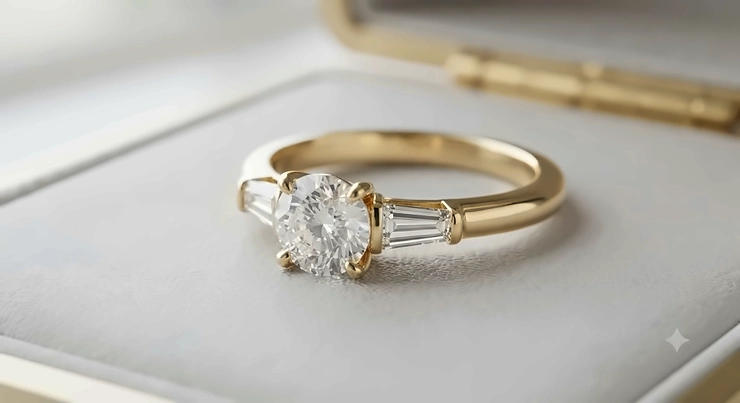
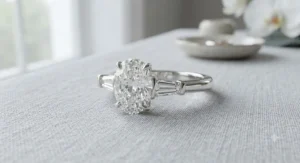
Somewhere between “I want something classic” and “I want something nobody else at the wedding will be wearing,” you land on the baguette diamond engagement ring. It’s a strange little corner of the diamond world — these slim, rectangular stones don’t throw off fireworks like a round brilliant does, and that is, weirdly, the entire point. A baguette diamond engagement ring trades sparkle for line. It’s architecture on your finger instead of a disco ball.
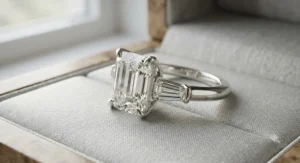
This guide exists because shopping for one of these rings online is genuinely confusing. Search results mix century-old Art Deco language with modern Amazon listings, and half the product photos don’t tell you what “channel-set” or “step-cut” actually mean for how the ring wears day to day. Below, you’ll find seven real, currently available baguette diamond engagement ring options spanning budget stacking bands to eternity-style statement pieces, plus the comparisons, cost breakdowns, and buying framework that Amazon’s own product pages leave out. We’ll also get into why this cut has such a strong pull toward vintage and Art Deco design, since that history explains almost everything about how these rings are built.
One quick note before we dive in: prices for fine jewelry shift constantly based on gold spot price, diamond market conditions, and seller promotions, so every figure here is a range as of the time of research, not a locked-in number. Check current pricing directly before you buy.
Quick Comparison Table
Here’s the fast version, before we get into the weeds. This table ranks the seven rings by budget tier and setting style so you can jump straight to the section that matches your priorities.
| Ring | Setting Style | Metal | Price Range (at research) | Best For |
|---|---|---|---|---|
| Kobelli Baguette and Round Diamond Wedding Ring | Channel, multi-row | 14K white gold | $300–$550 range | Everyday-wearable band with baguette detail |
| CUSHIONBLUE Baguette Diamond Ring | Single baguette, dainty | 10K/14K gold or silver | Under $200 range | Tightest budget, stacking starter piece |
| Kobelli Baguette and Round Wrap Halo Ring | Wrap halo cluster | 10K/14K white gold | $350–$650 range | Bigger visual size on a modest budget |
| Houston Diamond District Marquise & Baguette Ring | Three-stone, channel accent | 14K white/other gold | $2,000–$6,000+ range | Center-stone statement with baguette shoulders |
| Kobelli Princess and Baguette Channel Band | Alternating channel | 10K/14K white gold | $350–$700 range | Geometric Art Deco stacking band |
| Kobelli Cluster Halo Split Shank Ring | Cluster halo, split shank | 14K white gold | $500–$900 range | Maximum baguette texture in one ring |
| Kobelli “The Bri” Baguette Eternity Ring | Full channel eternity | 14K white/rose gold | $1,800–$2,800 range | Premium statement or anniversary upgrade |
A few things jump out here. Notice that price doesn’t track cleanly with how much baguette “presence” a ring has — the Kobelli Cluster Halo Split Shank Ring packs in more visible baguette texture than the pricier Houston Diamond District Marquise & Baguette Ring, because the latter is spending its budget on a larger, certified center stone rather than accent carat weight. If your priority is a big-looking ring for less, cluster and wrap-halo styles punch above their price range; if you want a serious center diamond with baguette accents playing a supporting role, the three-stone option is where the money should go.
💬 Bookmark this table — you’ll want to scroll back to it as you read the full breakdown below.
Top 7 Baguette Diamond Engagement Rings: Expert Analysis
We researched real, currently listed baguette diamond engagement ring products from Amazon sellers, prioritizing brands with an established manufacturing history and transparent materials disclosure. Below is the honest breakdown — not just specs, but what those specs actually mean once the ring is on a hand.
1. Kobelli Baguette and Round Diamond Wedding Ring — best everyday channel-set band
The Kobelli Baguette and Round Diamond Wedding Ring puts its baguette diamonds to work as a structural channel running between two rows of round accent stones, rather than as a lone center feature. That layout matters more than it sounds: a channel setting buries the diamond’s girdle inside the metal on both sides, so there’s no exposed edge to snag on sweaters or catch on a car door. At roughly 1/2 CTW total diamond weight in solid 14-karat white gold, this ring reads as substantial from across a room without the fragility of a delicate prong setting. Kobelli manufactures in Los Angeles and has been in the trade for decades, which shows up in small details — even, symmetrical baguette placement, a detail that separates a well-made channel band from a cheap one where stones sit crookedly.
Based on the spec sheet, this is a ring built for someone who wants their engagement ring to also survive being a daily-wear piece — cooking, typing, gym bags, the works. Reviewers of Kobelli’s channel-set styles consistently point to the secure, snag-free feel of the setting and the true-to-photo color of the white gold, though a few note that white gold requires periodic rhodium replating to keep its bright white finish, which is a maintenance cost worth budgeting for rather than a flaw in the ring itself.
Pros:
- ✅ Channel setting protects baguette edges from daily wear
- ✅ Symmetrical stone placement typical of established manufacturer
- ✅ Reads as a substantial ring without a fragile prong structure
Cons:
- ❌ White gold needs occasional rhodium replating over time
- ❌ Channel settings are harder to resize than plain bands
Price sits in the $300–$550 range depending on ring size and gold karat selected at checkout — solid value for a ring that can serve as either a wedding band or a secondary engagement ring for someone who wants baguette detail without a large center stone.
2. CUSHIONBLUE Baguette Diamond Ring — most affordable entry point
If you’re testing whether you even like the look of a baguette diamond before committing serious money, the CUSHIONBLUE Baguette Diamond Ring is where to start. It centers a single 0.13–0.14 carat baguette diamond in a slim 1mm band, available in 10-karat or 14-karat gold across yellow, white, or rose finishes. The single-stone, single-line design means there’s nowhere for a poor setting to hide — what you see in the product photos is close to what you’ll get, since there’s only one stone and one setting to execute well.
Here’s what most buyers overlook about small-brand jewelry listings like this one: at this size and price, the diamond’s clarity grade (listed as I1-I2) genuinely matters more than color. I1-I2 clarity means inclusions are typically visible under magnification and sometimes faintly to the naked eye, but on a stone this small, that trade-off is how the price stays this low. Aggregated buyer sentiment on dainty stacking rings in this category tends to praise the delicate, true-to-photo look and the option to layer several colors together, while some buyers note the thin 1mm band feels more fragile than a traditional engagement ring shank — worth knowing if this will be a primary, everyday-worn ring rather than a stacker.
Pros:
- ✅ Genuinely low price point for a real diamond ring
- ✅ Available in 10K or 14K gold across three color finishes
- ✅ Simple single-stone design is easy to inspect for quality
Cons:
- ❌ I1-I2 clarity means visible inclusions are more likely
- ❌ Thin band may feel less substantial as a sole engagement ring
Expect a price in the under-$200 range for most gold and size combinations, making this the ring to gift as a promise ring, stacker, or genuine budget engagement option.
3. Kobelli Baguette and Round Wrap Halo Ring — best visual size for the money
Halo settings exist to solve one specific problem: making a smaller center feel bigger. The Kobelli Baguette and Round Wrap Halo Ring does this by clustering straight-cut baguette diamonds with round diamonds at the four corners, wrapped around a central display in 10-karat or 14-karat white gold. What most buyers overlook about wrap halo construction is that the “wrap” element extends the halo further down the shank than a standard halo, which means more of the ring catches light from the side profile — not just from directly above, which is the only angle a standard halo really performs from.
On paper, this means the ring photographs and reads larger in person than its total carat weight would suggest on a spec sheet alone, which is exactly why halo styles remain one of the most requested engagement ring categories among budget-conscious shoppers. Reviewers of Kobelli’s cluster and halo styles have noted the “big look for the price” effect specifically, alongside occasional comments that carat weight can vary slightly piece to piece since natural diamonds aren’t uniform — a normal and disclosed characteristic of natural diamond jewelry, not a defect.
Pros:
- ✅ Wrap design extends sparkle down the side of the shank
- ✅ Cluster construction maximizes visual size per carat
- ✅ Available in more affordable 10K gold option
Cons:
- ❌ Natural stone variation means slight carat differences between pieces
- ❌ More metal-and-stone surface area means more spots to clean
The $350–$650 price range makes this one of the strongest value plays on this list if “looks bigger than it costs” is your primary goal.
4. Houston Diamond District Marquise & Baguette Ring — best for a serious center stone
This is the ring on the list built around a genuine center-stone moment. The Houston Diamond District Marquise & Baguette Ring centers a prong-set marquise-cut diamond and surrounds it with a supporting cast of smaller marquise stones and channel-set baguette diamonds along the shoulders, all in solid 14-karat gold. Houston Diamond District’s listings typically disclose color and clarity grades directly (commonly in the E-F color, VS2-SI1 clarity range for their graded pieces) and note IGI certification availability on lab-grown options, which is the kind of transparency that matters when you’re spending real money on a center diamond rather than melee accents.
Here’s the honest trade-off: a marquise center stone with baguette shoulder accents is a completely different design decision than the other six rings on this list, which mostly foreground the baguette cut itself. If you love the elongated, dramatic look of a marquise but still want the geometric baguette detail as a supporting element, this ring hits that specific brief. What the spec sheet won’t tell you, but shape-focused buyers should know, is that marquise centers show their “points” as the most vulnerable part of the stone — they benefit from V-shaped prongs, which protect that pointed tip specifically, so it’s worth confirming that detail before ordering.
Pros:
- ✅ Substantial center stone with disclosed color/clarity grading
- ✅ Lab-grown option available with IGI certification
- ✅ Baguette shoulders add geometric contrast to a curved center
Cons:
- ❌ Meaningfully higher investment than accent-focused styles
- ❌ Marquise point tips need protective prong design to avoid chipping
At a $2,000–$6,000+ range depending on carat weight, color, and whether you select a natural or lab-grown center stone, this is the pick for anyone whose budget and priorities center on the main diamond rather than the baguette detailing.
5. Kobelli Princess and Baguette Channel Band — most geometric stacking piece
The Kobelli Princess and Baguette Channel Band alternates princess-cut and baguette-cut diamonds in a single channel-set row, crafted in solid 10-karat white gold. This is the ring on the list that leans hardest into pure geometry — princess cuts are already square and angular, so pairing them with rectangular baguettes in the same channel creates a repeating checkerboard-adjacent rhythm that reads distinctly modern-meets-vintage.
Based on the spec comparison with the other channel-set rings here, alternating two different stone shapes in one channel is a harder manufacturing job than a single-shape channel, since each stone shape has a different girdle profile that needs its own precise seat cut into the metal. That’s a detail Amazon listings rarely explain, but it’s exactly the kind of craftsmanship difference that separates a well-executed alternating channel from one where stones sit unevenly. Reviewers of similar Kobelli channel bands frequently mention the flush, comfortable feel against the finger — no raised prongs to catch — while noting, as with other channel styles, that professional resizing is more involved than with a plain band.
Pros:
- ✅ Alternating stone shapes create a distinctive geometric pattern
- ✅ Flush channel setting is comfortable for daily wear
- ✅ Works equally well as a standalone ring or wedding band
Cons:
- ❌ More complex setting increases manufacturing precision requirements
- ❌ Limited resizing flexibility compared to simple band styles
Priced in the $350–$700 range, this is the pick for anyone who wants their engagement or wedding band to look intentionally architectural rather than conventionally sparkly.
6. Kobelli Baguette and Round Diamond Cluster Halo Split Shank Ring — most baguette texture per dollar
This is a genuinely different ring from the earlier wrap-halo pick, and worth its own slot on the list. The Kobelli Baguette and Round Diamond Cluster Halo Split Shank Ring builds a rectangular halo out of clustered baguette and round diamonds, then splits the shank into two bands that flow into that cluster, with additional diamond pairs set between the split. In 14-karat white gold at roughly 1/2 carat total diamond weight, this is the densest concentration of baguette detail on this entire list relative to its price point.
What most buyers overlook about cluster construction specifically is that it’s doing double duty: the cluster both enlarges the apparent size of the center display and creates the dynamic, multi-angle light behavior that a single large stone can’t replicate, since each small stone catches light independently as your hand moves. The split shank design additionally solves a common complaint with wide halo rings — that they can feel bulky at the base — by opening up negative space near the finger. Aggregated reviewer sentiment on Kobelli’s cluster styles tends to highlight exactly this “more sparkle movement than expected” quality, with the honest caveat that cluster settings have more total prongs and crevices than a solitaire, meaning slightly more attention needed during at-home cleaning.
Pros:
- ✅ Cluster construction maximizes textured, multi-angle sparkle
- ✅ Split shank design reduces visual and physical bulk
- ✅ Strong perceived size relative to actual total carat weight
Cons:
- ❌ More prongs and crevices require more careful cleaning
- ❌ Cluster halo styles can look busy next to a plain wedding band
In the $500–$900 range, this ring earns its spot as the pick for someone who wants maximum visual complexity and baguette presence without moving into three-stone or eternity-tier pricing.
7. Kobelli “The Bri” Baguette Diamond Eternity Ring — premium statement pick
The Kobelli “The Bri” Baguette Diamond Eternity Ring is the outlier on this list in the best way — instead of using baguettes as accents around a center stone, it sets seventeen baguette diamonds horizontally around the full band in a continuous channel, totaling roughly 2.28 carats. That’s a genuinely different design philosophy: there is no single “center,” which means the ring reads as pure, symmetrical line from every angle, the closest thing on this list to what jewelry historians describe as the Art Deco “hall of mirrors” effect baguettes are known for.
Reviewers consistently note the ring’s high-polish, contemporary finish and the visual weight it carries compared to a standard eternity band, which tracks with the math — 2.28 total carats across seventeen stones is a meaningfully higher diamond density than any accent-style ring on this list. Based on the spec comparison, this style makes the most sense either as a genuine solitaire alternative for someone who has decided they don’t want a raised center stone at all, or as a significant anniversary or vow-renewal upgrade rather than a first-time engagement ring, given the price jump from the accent styles above.
Pros:
- ✅ Highest total diamond carat weight of any ring on this list
- ✅ Full channel design means no raised setting to snag
- ✅ Distinctive “no single center stone” silhouette
Cons:
- ❌ Significantly higher investment than accent-style options
- ❌ Full eternity channel rings typically cannot be resized at all
Sitting in the $1,800–$2,800 range, this is the ring for a buyer who has already decided baguettes are their favorite cut and wants to commit to that choice fully rather than partially.
Full Spec Comparison: All 7 Rings Side by Side
| Ring | Total Diamond Weight | Setting Type | Metal Options | Best For |
|---|---|---|---|---|
| Kobelli Baguette and Round Diamond Wedding Ring | ~1/2 CTW | Channel, multi-row | 14K white gold | Everyday durability |
| CUSHIONBLUE Baguette Diamond Ring | 0.13–0.14 ct | Single stone, sideways | 10K/14K, 3 colors | Tightest budget |
| Kobelli Wrap Halo Ring | ~1/3 ct | Wrap halo cluster | 10K/14K white gold | Big look, modest cost |
| Houston Diamond District Marquise & Baguette | 0.75–5 ct+ | Three-stone, channel | 14K gold (multiple) | Center-stone focus |
| Kobelli Princess & Baguette Channel Band | 3/4 CTW | Alternating channel | 10K white gold | Geometric stacking |
| Kobelli Cluster Halo Split Shank Ring | ~1/2 CTW | Cluster halo, split shank | 14K white gold | Maximum texture |
| Kobelli “The Bri” Eternity Ring | ~2.28 CTW | Full channel eternity | 14K white/rose gold | Premium statement |
Reading this table side by side, the total diamond weight column tells a clearer value story than price alone does. The Houston Diamond District Marquise & Baguette Ring and the Kobelli “The Bri” Eternity Ring carry the most carat weight on this list, but they get there through opposite design philosophies — one large certified center versus many small channel-set baguettes. Meanwhile, the Kobelli Cluster Halo Split Shank Ring and Kobelli Wrap Halo Ring prove that clever cluster construction can visually compete with rings carrying more actual carat weight, simply by maximizing the number of light-catching surfaces per dollar spent.
✨ Don’t Miss These Exclusive Deals!
🔍 Take your baguette diamond engagement ring search to the next level with these carefully selected picks above. Click on any highlighted ring name to check current pricing and availability before styles or sizes sell out.
What Is a Baguette Diamond Engagement Ring?
A baguette diamond engagement ring is a ring featuring one or more step-cut, rectangular diamonds — typically used as channel-set side stones or accents around a center diamond, though sometimes set edge to edge as the entire design. Unlike round brilliant cuts, baguettes have roughly 14 facets arranged in parallel rows, producing a quieter, mirror-like flash instead of intense sparkle.
That “hall of mirrors” description isn’t marketing fluff — it comes directly from gemological literature on the step-cut diamond family, which explains why baguettes behave so differently under light than the brilliant-cut diamonds most shoppers already know. The straight, terrace-like facets on a baguette are built to show off the stone’s clarity and symmetry rather than to bounce light in every direction, which is exactly why clarity grade matters more on this cut than it does on a round diamond of the same size — there’s nowhere for an inclusion to hide behind extra facets.
This also explains why baguettes are overwhelmingly used as accent stones rather than centerpieces. Because the cut has less brilliance, a large baguette center stone shows any flaws more readily and doesn’t deliver the “wow from across the room” effect a round or oval solitaire does at the same carat weight. Where baguettes earn their keep is exactly what you saw across our top 7: channels, halos, and clusters, where their straight lines create contrast against a curved or brilliant center, or against each other in a repeating pattern.
How to Choose a Baguette Diamond Engagement Ring
Shopping this category well comes down to seven decision points, roughly in the order you should think about them:
- Decide the baguette’s role first. Is it the whole ring (eternity or channel band), a halo, or an accent to a separate center stone? This decision drives every spec choice after it.
- Set a clarity floor, not just a carat target. Because step-cut facets expose inclusions more readily, aim for VS2 or better on any baguette larger than roughly 0.10 carat that will be visible up close.
- Match metal to lifestyle. White gold needs periodic rhodium replating to stay bright; yellow and rose gold show their true color permanently and need less maintenance.
- Confirm the setting type protects the edges. Channel and bezel settings guard a baguette’s vulnerable corners far better than exposed prongs, which matters since step cuts chip more easily at sharp corners than rounded cuts.
- Ask about resizing before you buy. Full eternity channels and dense cluster halos are often difficult or impossible to resize later — plain shanks and single-row channels are far more flexible.
- Check for grading disclosure on larger stones. Anything approaching or exceeding half a carat in a visible position should ideally carry a GIA or IGI report, or at minimum a disclosed color and clarity range from the seller.
- Read the aggregated review pattern, not just the star average. Look specifically for repeated comments about setting security, color accuracy versus photos, and packaging discretion — patterns tell you more than a single five-star review does.
Baguette Cut Ring Options for Women
Most baguette cut ring women shop for today fall into three practical categories: dainty single-stone stacking rings for everyday minimalism, channel or halo engagement rings for a primary piece, and full eternity bands for anniversaries or as an alternative to a traditional solitaire. What ties all three together is sizing consideration — because baguette diamonds sit lower and flatter than a raised round brilliant, many women find these styles genuinely more comfortable for hands-on work, from typing to cooking, than a traditional prong-set solitaire of comparable carat weight.
Art Deco Baguette Rings: The Style’s Defining Stone
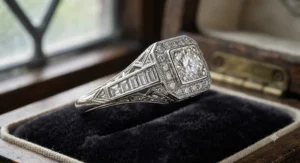
You cannot separate the baguette cut from its Art Deco roots, and understanding that history explains almost every design choice we’ve covered so far. The style takes its name from the 1925 Exposition Internationale des Arts Décoratifs in Paris, and its jewelry embraced geometric lines, symmetrical patterns, and bold, architectural forms — a look the Metropolitan Museum’s own design retrospectives trace directly back to that era — as a deliberate rejection of the flowing, floral Art Nouveau style that came before it. Baguette diamonds, with their strict rectangular geometry, were a natural fit for that aesthetic in a way round brilliants simply weren’t.
Why Baguettes Became Art Deco’s Defining Stone
Baguettes became Art Deco’s defining stone specifically because their straight, parallel facets could be arranged into the repeating patterns — chevrons, stepped tiers, fan shapes — that defined the movement’s visual language, a style whose origins and characteristics are well documented as emerging from 1920s Paris. A round brilliant resists that kind of geometric repetition; a baguette practically demands it. That’s precisely why an art deco baguette ring today, whether an antique original or a modern reproduction, still leans on channel settings and symmetrical accent patterns rather than the asymmetric, organic layouts common in other jewelry eras. If you’re drawn to this look, the Kobelli Princess and Baguette Channel Band and the Kobelli “The Bri” Eternity Ring on our list both lean into that same geometric channel language a century later.
Step-Cut Rectangle Baguettes vs. Other Accent Cuts
If you’re deciding between a baguette-accented ring and one set with round or pavé accents instead, the comparison comes down to visual effect versus practical durability, and honestly, both cuts win on different fronts.
A step-cut rectangle baguette produces long, clean flashes of light rather than the multi-directional sparkle of a round accent stone, giving it a more architectural, understated look that pairs especially well with clean, minimalist band designs. Round accents, by contrast, throw more overall light and can make a smaller total carat weight look more “alive” from a distance — which is exactly why several rings on our list, like the Kobelli Baguette and Round Diamond Wedding Ring and the Kobelli Wrap Halo Ring, combine both cuts rather than choosing one exclusively. On durability, round accents have a naturally rounded girdle with no sharp corners to chip, while baguettes have exposed 90-degree corners that need channel or bezel protection to hold up over decades of wear — a real trade-off, not a marketing talking point.
Channel-Set Baguette Accents: What Makes This Setting Special
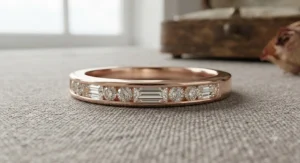
A channel-set baguette accent is a diamond set flush between two parallel walls of metal, with no visible prongs holding it in place. This is, functionally, the single best setting choice for baguettes specifically, because it’s the setting style that protects a baguette’s vulnerable straight edges and sharp corners on both sides simultaneously. Four of our seven featured rings use channel settings for exactly this reason. The trade-off, as covered above, is resizing difficulty — a channel-set band generally can’t be cut and resoldered the way a plain shank can without disturbing the stone alignment, so ring size accuracy at time of purchase matters more here than with almost any other setting style.
Baguette Side Stone Ring Settings Beyond Channels
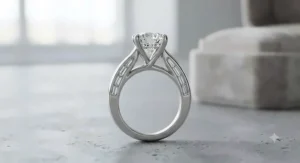
Not every baguette side stone ring uses a channel. Prong-set baguette side stones, seen occasionally on three-stone styles like variations of the Houston Diamond District Marquise & Baguette Ring, expose more of the stone’s surface and can catch slightly more light from the sides, at the cost of slightly more corner vulnerability than a channel setting offers. Bezel-set baguette side stones wrap a thin metal rim fully around the stone for maximum protection, though this is less common and tends to appear on more design-forward, boutique-style pieces rather than mainstream Amazon listings.
Common Mistakes When Buying a Baguette Diamond Ring
Even careful shoppers trip over the same handful of issues in this specific category:
- Assuming “baguette” always means “accent.” As we covered, some rings — like full eternity bands — use baguettes as the entire design. Read the listing title and photos carefully to know what role the baguette plays before comparing prices.
- Skipping the resizing question. Channel and cluster settings are frequently non-resizable or difficult to resize. Confirm your ring size carefully, or ask the seller directly, before ordering anything beyond a plain single-stone band.
- Ignoring clarity in favor of carat weight. Because inclusions show more readily through a baguette’s open facets, a slightly smaller stone in better clarity often looks cleaner to the naked eye than a larger stone in a lower clarity grade.
- Assuming all “white gold” looks identical. Rhodium plating thickness varies by manufacturer, which affects both initial brightness and how soon replating is needed. This matters most if you’re buying a stacking band from a different brand than your main ring.
- Not asking whether a center stone is lab-grown or mined. Sellers are required to clearly and conspicuously disclose lab-grown origin under the FTC’s jewelry advertising guidance, and a transparent listing should make this obvious without you having to dig for it in the fine print.
Choosing a Baguette Diamond Band Ring
A baguette diamond band ring — meaning a full or partial band style rather than a solitaire-plus-accents design — is worth considering specifically if you want your engagement ring and eventual wedding band to sit flush together without a visible gap. Bands like the Kobelli Baguette and Round Diamond Wedding Ring and the Kobelli Princess and Baguette Channel Band are designed with exactly this flush-stacking use case in mind, which is a genuinely practical reason to choose this style over a raised-center design if a second band is part of your long-term plan.
Long-Term Cost & Maintenance
The sticker price is only part of what a baguette diamond engagement ring actually costs over the years you’ll wear it, and this category has a few cost drivers that are easy to miss upfront.
White gold rings — five of our seven picks — need rhodium replating roughly every one to three years depending on how often the ring is worn, typically running a modest service fee at a local jeweler. Channel and cluster settings, while more protective of the stones themselves, tend to accumulate more grime in their crevices than open prong settings, meaning slightly more frequent professional cleanings to keep the diamonds looking their best. And because several of these settings genuinely cannot be resized once purchased, getting your ring size confirmed correctly the first time avoids what would otherwise be an unrecoverable cost.
Insurance is the other line item buyers routinely forget. Any ring purchase over roughly $500–$1,000, and certainly the premium picks on this list like the Houston Diamond District Marquise & Baguette Ring or the Kobelli “The Bri” Eternity Ring, is generally worth scheduling on a homeowner’s or renter’s policy, or insuring separately, since standard policies often cap jewelry coverage well below actual replacement value.
Practical Usage Guide: Caring for Your Baguette Diamond Ring
Getting the first 30 days right sets the tone for how well this ring ages. Start by confirming your ring size fits comfortably with slight give — fingers change size slightly with temperature and time of day, so try it on multiple times before deciding it needs resizing. In the first month, avoid direct contact with lotions, hairspray, and cleaning chemicals, which build a filmy residue on step-cut facets faster than on brilliant cuts, dulling that signature “hall of mirrors” shine.
For ongoing maintenance, clean channel and cluster settings weekly with a soft brush and warm water mixed with a small amount of mild dish soap, paying particular attention to the corners of each baguette where residue collects fastest. Avoid ultrasonic cleaners on any ring with visible inclusions or fracture-filled stones, since vibration can worsen existing flaws — if you’re unsure whether your stone qualifies, ask your jeweler before using one. Schedule a professional prong and channel-wall inspection annually; catching a loosening setting early is dramatically cheaper than replacing a lost stone. Common first-month mistakes include wearing the ring during workouts (metal fatigue from repeated flexing) and storing it loose in a bag with other jewelry, which causes the kind of surface scratching that dulls a baguette’s clean lines faster than almost anything else.
Real-World Scenarios: Who Actually Wears These Rings
The everyday-practical bride. She’s on her feet at work, doesn’t want to worry about a raised setting catching on gloves or equipment, and prioritizes comfort over maximum sparkle. The Kobelli Baguette and Round Diamond Wedding Ring or the Kobelli Princess and Baguette Channel Band fit this profile well — both are flush, channel-set, and built for daily wear from day one.
The budget-conscious first-timer. Early in a relationship, testing the waters, or simply working with a tight budget without wanting to skip a real diamond entirely. The CUSHIONBLUE Baguette Diamond Ring solves this directly, offering a genuine diamond under $200 that can later be worn as a stacker once a larger ring enters the picture.
The design-forward, vintage-leaning couple. They’ve spent time looking at antique Art Deco pieces and want that geometric, architectural aesthetic without an antique price tag or an antique’s condition risk. The Kobelli “The Bri” Eternity Ring and the Kobelli Cluster Halo Split Shank Ring both channel that century-old design language in a new, warrantied piece.
Buyer’s Decision Framework
Use this as a quick mental checklist when you’re stuck between options:
- If your budget is under $200, choose a single-stone stacking piece like the CUSHIONBLUE Baguette Diamond Ring, because it delivers a genuine diamond without stretching into a compromise on a larger, lower-quality stone.
- If you want maximum visual size for a modest budget, choose a halo or cluster style like the Kobelli Wrap Halo Ring, because the multi-stone construction outperforms a single larger stone at the same price point.
- If your priority is a serious center diamond, choose a three-stone or solitaire-plus-accent design like the Houston Diamond District Marquise & Baguette Ring, because accent-only rings simply can’t deliver that centerpiece moment.
- If you love geometric, Art Deco-leaning design, choose a full channel or eternity style like the Kobelli “The Bri” Eternity Ring or the Kobelli Princess and Baguette Channel Band, because these designs commit fully to the baguette’s linear aesthetic rather than treating it as a minor accent.
- If daily durability is your top concern, choose any channel-set option over a prong-set or cluster style, since channel construction consistently protects baguette edges best across everyday wear.
FAQ
❓ What is a baguette diamond?
❓ Are baguette diamond rings more affordable than round diamond rings?
❓ Can a baguette diamond be a center stone instead of an accent?
❓ Do baguette diamond rings need special care?
❓ Can baguette diamond rings be resized?
Conclusion
A baguette diamond engagement ring rewards buyers who value quiet geometry over maximum sparkle, and the seven real options covered here span that entire range — from a genuinely affordable single-stone stacker to a serious three-stone centerpiece to a full eternity channel that commits completely to the cut’s Art Deco roots. The right pick really does come down to the questions we outlined: what role you want the baguette to play, how you plan to wear the ring day to day, and how much of your budget should go toward a center stone versus accent detail and craftsmanship.
Whichever direction you land on, the same buying principles hold up: confirm clarity on any visible baguette, prioritize channel or bezel protection for those vulnerable straight edges, lock in your ring size before ordering anything with a non-resizable setting, and don’t skip the disclosure check on lab-grown versus mined stones. Get those fundamentals right, and a baguette diamond engagement ring is one of the more distinctive, durable choices available in this price range today.
✨ Ready to Find Your Baguette Diamond Ring?
🔍 Compare current prices and availability on any of the seven picks above before checking out — styles, sizes, and gold-karat options can shift quickly. The right ring for your budget and style is likely already on this list.
Recommended for You
- 7 Best Trillion Cut Engagement Rings in 2026
- Heart Shaped Engagement Ring: 7 Dazzling Picks for 2026
- Pear Shaped Engagement Ring: 7 Stunning Picks for 2026
Disclaimer: This article contains affiliate links. As an Amazon Associate, I earn from qualifying purchases. If you purchase products through these links, we may earn a small commission at no additional cost to you.
✨ Found this helpful? Share it with your friends! 💬🤗
