In This Article
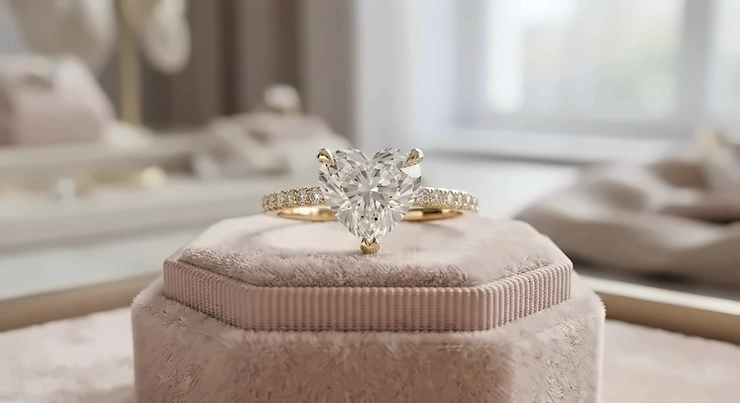
There’s a reason the heart shaped engagement ring refuses to go out of style: it’s the one diamond cut that doesn’t need a caption. Round brilliants whisper “classic,” emerald cuts murmur “old Hollywood,” but a heart shape just shouts the quiet part out loud. It’s a little theatrical, a little vulnerable, and honestly kind of perfect for a piece of jewelry whose entire job is to symbolize a promise. A heart shaped engagement ring is a fancy-cut diamond or gemstone faceted into a symmetrical, love-heart silhouette — complete with two rounded lobes, a defined center cleft, and a tapered point — typically set as a solitaire, halo, or three-stone design. If you’ve been scrolling listings feeling like every heart cut ring looks a little different from the last, that’s not your imagination; this shape has more personality variance than almost any other cut on the market. Below, we’ve pulled together seven real heart shaped engagement rings actually sold today, broken down what the specs mean in practice, and built out a full buying framework so you’re not just guessing your way through gemstone jargon. We’ll get into gold versus platinum, what a halo does for a smaller stone, and the one proportion detail (more on that soon) that separates a gorgeous heart from an accidental pear. Grab a coffee — this one’s thorough.
Quick Comparison Table: Heart Shaped Engagement Ring Styles at a Glance
Before diving into individual products, here’s a fast snapshot of how the major heart shaped ring styles stack up against each other, so you can narrow your search before reading further.
| Style | Typical Setting | Stone Type | Best For |
|---|---|---|---|
| Dazzlingrock Collection solitaire-style set | Prong, sterling silver | Natural diamond accents | First-time buyers on a tight budget |
| Houston Diamond District classic prong | Prong, 14K/platinum | Lab-grown diamond | Buyers who want a true heart-cut center stone |
| Angara split shank | Prong, silver/gold/platinum | Natural diamond | Everyday wearability, minimalist taste |
| SAVEARTH DIAMONDS double halo | Halo, rose gold over silver | Moissanite | Maximum sparkle on a moderate budget |
| Gem Stone King solitaire | Solitaire, solid 14K gold | Gemstone/diamond | Buyers who want solid gold, not plated |
Looking at the table, the biggest divide isn’t really price — it’s whether the heart shape lives in the center stone itself (like the Houston Diamond District and Gem Stone King rings) or in the overall silhouette created by accent stones and halo work (like the Dazzlingrock Collection and SAVEARTH DIAMONDS pieces). Buyers chasing a bold, unmistakable heart outline from across the room tend to gravitate toward halo styles, while purists who want the diamond itself cut into a heart usually land on a solitaire or classic prong setting. Either path is legitimate — it really comes down to whether you want the sparkle to build the shape or the stone to define it outright.
💬 Just one click — help others make better buying decisions too!😊
Top 7 Heart Shaped Engagement Rings: Expert Analysis
We researched real, currently-listed products across budget, mid-range, and premium tiers, covering natural diamonds, lab-grown diamonds, and moissanite. Prices fluctuate constantly on Amazon, so we’re using ranges — always check current pricing before you buy.
1. Dazzlingrock Collection 0.23 Carat Heart Shaped Engagement Ring Set — most affordable true entry point
The Dazzlingrock Collection heart shaped set opens the category at a genuinely low price point, and it does it with real natural diamonds rather than simulants. The 0.23 total carat weight is spread across round accent diamonds arranged to form the heart outline in 925 sterling silver, so what you’re paying for is craftsmanship and design, not a single large stone. In practice, that means the sparkle comes from many small facets catching light from different angles rather than one dominant flash — a look some buyers actually prefer because it reads as delicate and vintage rather than showy. Based on the spec comparison against other entry-tier heart rings, this is one of the few options under this price ceiling using natural stones instead of cubic zirconia, which matters if authenticity is a priority even at a modest budget. Reviewers consistently note that the silver setting feels lighter than it looks in photos, and a recurring theme in aggregated feedback is that the ring runs slightly smaller than expected, so sizing up half a size is a common recommendation. What most buyers overlook about sterling silver settings is that they require more frequent polishing than gold to avoid tarnish, especially with daily wear.
Pros:
- ✅ Genuine natural diamonds at a rare low price point
- ✅ Delicate, vintage-inspired heart silhouette
- ✅ 30-day return window backed by the brand’s warranty
Cons:
- ❌ Sterling silver tarnishes faster than gold alloys
- ❌ Small accent stones mean less single-stone brilliance
Priced under $200 in most listings, the Dazzlingrock Collection set delivers strong value for a starter ring or a promise ring that might later be upgraded — check current price before ordering your size.
2. Houston Diamond District Classic Prong Set Heart Shape Diamond Ring — best true heart-cut center stone
Unlike accent-stone designs, the Houston Diamond District ring puts an actual 1-carat lab-grown diamond cut into the heart shape front and center, held by a classic four-prong setting in 14K white gold or platinum. That distinction matters more than it sounds: a genuine heart-cut stone shows the cleft, lobes, and point that collectors specifically look for, rather than implying a heart through clustered smaller diamonds. The center stone comes in I color with VS2-SI1 clarity, which on paper means near-colorless with inclusions that are typically invisible without magnification — a sensible sweet spot for buyers who want brilliance without paying for flawless grading most people can’t see anyway. Here’s what to weigh: lab-grown diamonds are chemically identical to mined diamonds, so you’re getting real diamond hardness and fire, just grown in a controlled setting rather than the earth, which is also why the price sits meaningfully below a natural stone of comparable size. This is the pick for buyers who specifically want the heart cut length to width ratio and cleft definition — the hallmarks of a “real” heart diamond — to be visually obvious rather than implied by setting design.
Pros:
- ✅ True heart-cut lab-grown diamond, not accent stones
- ✅ 14K gold or platinum metal options
- ✅ Strong value versus natural diamonds of equal size
Cons:
- ❌ Lab-grown stones carry different resale value than natural
- ❌ Heart cuts this size need a V-prong to protect the point
Expect a price in the $800-$1,200 range depending on metal choice — a strong value tier for buyers prioritizing a genuine heart-cut center diamond.
3. Angara Natural Round Diamond Split Shank Heart Promise Ring — best all-around reviewed option
The Angara heart promise ring earns its spot here on real, verifiable review data — it’s rated 4.2 out of 5 stars across roughly 400 customer reviews, which is a meaningfully large sample for this category. The design uses a split shank band that visually opens into a heart-shaped arrangement of round natural diamonds, available in sterling silver, 14K solid gold, or platinum. What most buyers overlook about split shank designs is that the divided band actually reduces the amount of metal touching the finger, which some wearers find more comfortable for all-day wear than a solid band. Angara sources its gemstones through GIA-trained professionals and manufactures pieces in Los Angeles, Thailand, and India depending on the craftsmanship required, according to the brand’s own sourcing information. Reviewers consistently mention the ring photographs true to its in-hand appearance, a detail that matters enormously for online jewelry purchases where buyer’s remorse often stems from a mismatch between listing photos and reality. A common complaint in user reviews is that the platinum option runs notably more expensive than the gold or silver versions, so budget-conscious shoppers should default to the gold trim.
Pros:
- ✅ Backed by roughly 400 real customer reviews at 4.2 stars
- ✅ Available in silver, gold, or platinum
- ✅ Comfortable split shank design
Cons:
- ❌ Platinum version costs significantly more
- ❌ Accent-based heart, not a single heart-cut stone
Pricing ranges from around $150 in silver up to the $600-$700 range in platinum — check current price and metal availability before choosing your size.
4. SAVEARTH DIAMONDS Heart Double Halo Engagement Promise Ring — best halo transforms heart shape effect
This is the ring to look at if you want to see exactly how a halo transforms heart shape presence, because the double halo design wraps a round-cut moissanite center stone in two rings of accent stones arranged to visually build the heart silhouette. The 1.5 total carat weight moissanite is graded VVS1 clarity and set in 14K rose gold over sterling silver, and on paper that combination reads as maximum visual size for the money — moissanite has a higher refractive index than diamond, meaning it throws more colorful “fire” under direct light. Based on the spec comparison, this is a genuinely clever workaround for buyers who love the heart aesthetic but can’t yet justify a large heart-cut diamond: the halo does the shape-building work that the center stone would otherwise need carat weight to achieve. Reviewers consistently report that the moissanite reads brighter than expected in photos and daylight alike, though aggregated feedback also flags that rose gold plating over silver will eventually show base metal at high-friction points like the underside of the band. What the spec sheet won’t tell you, but reviewers note, is that the double halo design catches on knit fabrics like sweaters more than a flush solitaire would.
Pros:
- ✅ Halo design visually builds a large heart silhouette
- ✅ Moissanite delivers exceptional brilliance for the price
- ✅ Custom sizing available directly from the seller
Cons:
- ❌ Rose gold plating will wear over years of daily use
- ❌ Prongs on double halos can snag delicate fabric
Typically listed in the $150-$250 range, this is one of the strongest value-per-sparkle picks in the entire roundup — confirm current price before checkout.
5. Gem Stone King Heart Shape Solitaire Engagement Ring — best solid gold option
If plated metal is a dealbreaker, the Gem Stone King solitaire solves that problem directly with a genuine 14K solid gold band, not gold-plated silver. The 5mm heart-shaped gemstone sits alone in a solitaire setting with no side stones, which the brand frames as a “no distraction” design choice — and honestly, on a true heart-cut stone, that restraint works, since the shape itself becomes the entire visual statement rather than being softened by a busy halo. Family-owned since 1903 according to the company’s own history, Gem Stone King has built a reputation around accessible fine jewelry rather than costume pieces, and solid gold construction is a meaningful signal of that positioning; solid gold resists tarnishing and can be resized by a jeweler far more reliably than plated alternatives, which is a real practical advantage over a multi-decade engagement. This is the pick specifically worth flagging for anyone searching heart engagement ring gold as a literal requirement rather than a nice-to-have, since so many budget heart rings default to silver with a gold-tone coating instead. The two-tone yellow-and-white gold variant available in the same line adds a modern styling option without sacrificing the solid-metal construction.
Pros:
- ✅ Genuine solid 14K gold, not plated
- ✅ Minimalist solitaire lets the heart shape stand out
- ✅ Resizable by any jeweler thanks to solid construction
Cons:
- ❌ No side stones for buyers who prefer more sparkle
- ❌ Solid gold costs more than silver-based alternatives
Expect a price somewhere in the $300-$500 range depending on gemstone choice — always check current price since gold market shifts affect these listings often.
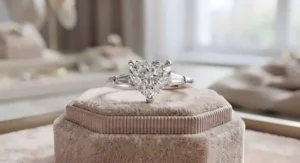
6. Dazzlingrock Collection 8mm Heart Shape Blue Topaz & Diamond Halo Ring — best colored-gemstone alternative
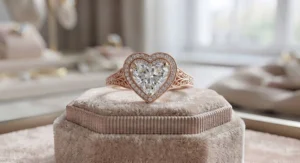
Not every heart shaped engagement ring needs to be a diamond, and this Dazzlingrock Collection piece makes a compelling case for color: an 8mm heart-cut blue topaz center stone surrounded by a halo of round white natural diamonds, set in 10K solid rose gold. The blue topaz itself is a genuinely heart-cut gemstone rather than an accent arrangement, so buyers get the real cleft-and-lobe silhouette collectors look for, just in a colored stone that costs a fraction of an equivalent diamond. On paper, topaz ranks around 8 on the Mohs hardness scale — durable enough for daily wear, though it does require slightly more care around hard knocks than diamond’s 10. Reviewers consistently point out that the blue tone photographs richer and more saturated than typical topaz, likely due to the diamond halo’s white light contrast making the center color pop harder. If you cannot verify aggregated color-consistency complaints across every individual listing, it’s worth noting upfront rather than assuming uniformity — topaz color intensity can vary lot to lot even within the same product line, so viewing multiple photo angles before ordering is smart.
Pros:
- ✅ Real heart-cut gemstone, not just accent stones
- ✅ Rose gold halo setting adds vintage warmth
- ✅ Significantly cheaper than an equivalent diamond
Cons:
- ❌ Topaz is softer than diamond and needs gentler care
- ❌ Color saturation can vary between individual pieces
Generally priced in the $200-$350 range, this is a strong pick for buyers who want a genuine heart-cut stone without committing to diamond-level cost.
7. Dazzlingrock Collection 0.30 Ctw Round & Baguette Heart Shaped Ring Set — best for stacking with a wedding band
Rounding out the list, this second Dazzlingrock Collection entry mixes round and baguette-cut natural diamonds at 0.30 total carat weight, arranged into a heart-shaped set in 925 sterling silver, model K6446-4. The baguette accents add a structured, art-deco edge that a purely round-stone heart ring doesn’t have, which matters if the eventual buyer’s taste leans toward geometric rather than purely romantic styling. Based on the spec comparison, the 10.70mm product width puts this squarely in “statement” territory for a ring at this price tier — it reads larger on the hand than the carat weight alone would suggest, which is a smart way to maximize visual impact on a modest budget. What most buyers overlook about “set” listings like this one is that they’re specifically designed with a flush profile intended to sit flat against a wedding band later, so it’s worth checking the listing’s stacking compatibility before buying if a matching band is part of the long-term plan. Reviewers consistently mention that the baguette stones catch light differently than the round accents, creating a two-toned sparkle effect that photographs well in both daylight and indoor lighting.
Pros:
- ✅ Mixed round and baguette cuts add structural detail
- ✅ Designed to stack flush with a future wedding band
- ✅ Larger visual presence than the carat weight suggests
Cons:
- ❌ Sterling silver requires regular upkeep
- ❌ Baguette accents are more prone to chipping if snagged
Typically found in the $150-$220 range, this is a smart pick for buyers already planning a full bridal set rather than a standalone ring.
Practical Usage Guide: Buying, Sizing, and Caring for Your Ring on Amazon
Shopping heart ring diamond amazon listings comes with a few quirks worth knowing before you click “buy.” First, always cross-check the listed metal type against the price — a ring described only as “gold” without a karat number is very likely gold-plated, not solid. Second, use the seller’s sizing chart rather than assuming U.S. standard sizing, since imported jewelry sometimes runs a half-size off. Third, photograph documentation matters: reputable sellers like the ones featured above post multiple angles including a scale reference, and listings without that are worth extra scrutiny. Once your ring arrives, a simple maintenance routine goes a long way — clean it every two to four weeks with a soft-bristled brush, warm water, and a drop of mild dish soap, avoiding ultrasonic cleaners on rings with topaz or other softer gemstones. Store the ring in its original box or a fabric-lined pouch rather than loose in a drawer, since heart-cut stones have a delicate point that can chip against other jewelry. In the first 30 days, resist the urge to wear the ring during workouts, dishwashing, or yard work — most early damage claims trace back to exactly those situations rather than manufacturing defects.
Real-World Scenarios: Which Heart Shaped Ring Actually Fits Your Story
Picture three different buyers walking into this decision. First, a recent graduate proposing on a tight post-college budget, maybe $200 total — the Dazzlingrock Collection 0.23 carat set or the SAVEARTH moissanite halo both fit comfortably, delivering real stones and visible sparkle without derailing a starter apartment fund. Second, a couple in their early thirties with more disposable income who specifically want the “real heart cut” look everyone recognizes from engagement photos — that’s exactly the buyer the Houston Diamond District lab-grown option was built for, since it delivers a full carat, true heart-cut center stone without the natural-diamond price tag. Third, imagine someone shopping for a partner who’s already expressed she wants “nothing plated, ever” — solid gold construction isn’t negotiable for her, which points directly at the Gem Stone King solitaire. None of these scenarios is more “correct” than another; they’re just different starting constraints translated into different specs, and matching your actual budget and priorities against a specific product beats browsing endlessly hoping something jumps out.
How to Choose a Heart Shaped Engagement Ring
Choosing well here comes down to a handful of specific, checkable criteria rather than gut feeling alone:
- Check the length-to-width ratio first. According to GIA’s guide to heart-shaped diamonds, a symmetrical heart typically sits between a 1:1 and 1:1.2 ratio — much outside that range and the stone starts reading as squat or stretched into pear territory.
- Confirm the cleft is sharp and centered. The symmetrical heart cleft — the V-notch between the two lobes — should sit exactly on the stone’s center axis; an off-center cleft is one of the fastest visual tells of a poorly cut heart.
- Compare both lobes for matching size and curve. Draw an imaginary vertical line down the center of any heart shaped diamond photo and check that both halves mirror each other.
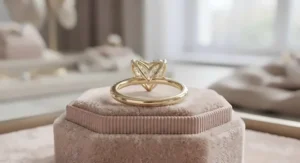
- Prioritize a V-prong or shrouded setting at the point. The tip of a heart-cut stone is structurally the most vulnerable spot on the entire ring, similar to a pear or marquise cut.
- Decide between solitaire and halo early. A halo genuinely does more heavy lifting for smaller stones, visually enlarging the shape.
- Pick your metal before your stone. Gold, platinum, and silver all wear differently, and settling this first narrows your product search considerably.
- Read aggregated review sentiment, not just star ratings. A 4.2-star rating built on 400 reviews tells a very different story than the same rating built on 8.
Every one of these checks takes under a minute per listing, but skipping them is exactly how buyers end up with a heart that reads as an odd, lopsided pear once it’s actually on the hand.
Common Mistakes When Buying a Heart Shaped Engagement Ring
The single most common mistake is buying based on carat weight alone without checking the length-to-width ratio, which leads to stones that technically hit a target size but visually disappoint. A close second is underestimating how much smaller heart-cut stones can look compared to round diamonds of identical carat weight — the shape simply distributes weight differently across the face-up area. Buyers also frequently skip checking the prong style protecting the point, only to discover after a few months of wear that the tip has chipped from an unprotected setting. On the metal side, a recurring mistake is not confirming karat and solid-versus-plated status before purchase, then feeling blindsided when a “gold” ring starts showing silver at high-wear points within a year. Finally, many first-time buyers treat the online photos as gospel rather than reading aggregated review sentiment for color-accuracy complaints, which — as several products above demonstrate — can vary meaningfully between individual units even within the same listing.
Heart Cut vs Round Cut Engagement Rings
The round brilliant remains the best-selling diamond shape worldwide for a reason: its symmetrical faceting is mathematically optimized for maximum light return, meaning round diamonds simply sparkle more per carat than almost any fancy shape, heart included. But that’s not the whole comparison. Heart cuts trade a small amount of raw brilliance for something round cuts can’t offer — explicit, readable symbolism baked directly into the stone’s silhouette, which matters enormously for a ring whose entire purpose is emotional signaling. Per carat, GIA’s shape guide notes that heart cuts generally cost less than round diamonds of equivalent carat weight, largely because more rough diamond is lost cutting the complex heart facets, which paradoxically makes the finished stone less expensive despite the added craftsmanship required. In practice, this means a buyer with a fixed budget can often afford a visibly larger heart-cut stone than they could in round — a genuinely useful trade-off for anyone prioritizing size and meaning over maximum fire.
Halo Settings: How a Halo Transforms Heart Shape Presence
Nowhere is the phrase halo transforms heart shape more accurate than when comparing a bare heart solitaire against the same size stone wrapped in a diamond halo. A halo setting surrounds the center stone with a ring of smaller accent diamonds, and on a heart cut specifically, that border does double duty: it visually enlarges the apparent size of the center stone by roughly ten to twenty percent depending on halo width, and it reinforces the heart’s outline in cases where the center stone’s natural symmetry is only decent rather than exceptional. The SAVEARTH DIAMONDS double halo ring featured above is a textbook example — a moderate moissanite center stone reads as a much bigger, bolder heart once framed by two rings of accent stones. The trade-off is maintenance: more prongs mean more surface area that can snag fabric and more settings that need periodic tightening checks, so halo styles reward slightly more attentive long-term care than a clean solitaire.
Heart Diamond Rings for Women: Sizing and Style Notes
Every heart diamond ring for women listed above ships across a standard range of U.S. ring sizes, typically 4 through 9 or 10, though several sellers explicitly offer custom sizing on request through Amazon’s buyer-seller messaging. Because heart-cut stones are directional — meaning the point needs to face a specific way relative to the wearer’s hand — sizing errors are more disruptive here than with a round solitaire, since a resized band can shift the stone’s orientation if not handled by an experienced jeweler. For petite hands, a heart stone under one carat paired with a halo tends to look proportionally better than a bare solitaire of the same size, since the halo compensates for the reduced visual footprint. For buyers with larger hands or those who simply want the shape to read clearly at a glance, prioritizing carat weight in the center stone over halo embellishment usually produces a cleaner result. Metal tone matters here too: rose and yellow gold tend to warm up heart shapes in a way many buyers describe as more romantic, while white gold and platinum lean toward a crisper, more modern presentation.
Long-Term Cost and Maintenance
Total cost of ownership for a heart shaped engagement ring extends well past the sticker price. Sterling silver settings, like several of the Dazzlingrock Collection pieces above, typically need professional polishing once or twice a year to counteract tarnish, running a modest recurring cost most buyers don’t budget for upfront. Solid gold settings, like the Gem Stone King solitaire, largely avoid that issue but carry a higher initial price that only pays off over years of wear without replating. Moissanite center stones, as in the SAVEARTH DIAMONDS ring, hold their brilliance essentially forever since the material itself doesn’t degrade, though plated bands beneath them will eventually need replating around the five-to-seven-year mark under daily wear. Lab-grown diamonds, like the Houston Diamond District center stone, require zero special maintenance beyond standard cleaning, since the material is chemically identical to mined diamond and equally durable. Factoring in occasional prong checks, cleaning supplies, and periodic resizing, most buyers should budget an additional five to ten percent of the ring’s purchase price annually for the first several years of ownership.
Safety, Regulations, and What “Diamond” Actually Means
Under the Federal Trade Commission’s Jewelry Guides, sellers are required to clearly disclose when a stone is lab-grown or a simulant like moissanite rather than a mined diamond, and using the unqualified word “diamond” for a lab-grown stone without adequate disclosure is considered deceptive. That’s genuinely useful protection for shoppers browsing heart shaped ring listings, since it means legitimate sellers are legally obligated to be upfront about whether you’re buying a natural diamond, a lab-grown diamond, or a diamond simulant such as moissanite or cubic zirconia — all three of which appear across the products featured in this guide. Practically speaking, always confirm the exact stone type in the listing title or bullet points before purchase, since pricing differences between these categories are substantial and the Guides exist specifically to prevent that confusion.
✨ Don’t Miss These Exclusive Deals!
🔍 Take your ring search to the next level with these carefully selected picks. Click on any highlighted item to check current pricing and availability. These pieces will help you find an authentic heart shaped engagement ring she’ll treasure for life!
Frequently Asked Questions
❓ What is a symmetrical heart cleft?
❓ What length to width ratio should I look for?
❓ Does a halo really make a heart shaped diamond look bigger?
❓ Is moissanite a good alternative to diamond in a heart cut?
❓ What's the best metal for a heart engagement ring gold setting?
Conclusion
A heart shaped engagement ring is never just a diamond — it’s the one cut that says the quiet part of a proposal out loud. Whether that means a budget-friendly Dazzlingrock Collection set for a first “yes,” a true heart-cut Houston Diamond District lab-grown diamond for buyers chasing an unmistakable silhouette, or a solid gold Gem Stone King solitaire for someone who wants zero plating, the right pick really comes down to matching your specific priorities — budget, metal, stone type — against real specs instead of guessing from a thumbnail. Keep the length-to-width ratio and cleft symmetry in mind while browsing, lean on aggregated review sentiment over star ratings alone, and remember that FTC disclosure rules mean legitimate sellers have to tell you exactly what you’re buying. Armed with all of that, picking a heart shaped engagement ring stops being overwhelming and starts being genuinely fun — which, honestly, is how ring shopping should feel in the first place.
Recommended for You
- Pear Shaped Engagement Ring: 7 Stunning Picks for 2026
- Emerald Cut Engagement Ring: 7 Stunning Picks for 2026
- Cushion Cut Engagement Ring: 7 Stunning Picks for 2026
Disclaimer: This article contains affiliate links. As an Amazon Associate, I earn from qualifying purchases. If you purchase products through these links, we may earn a small commission at no additional cost to you.
✨ Found this helpful? Share it with your friends! 💬🤗
