In This Article
Here’s a secret nobody tells you at the jewelry counter: a ring that looks stunning in the display case can look completely different the second it lands on a petite finger. Suddenly that gorgeous three-carat halo isn’t glamorous, it’s a doorknob. If you’ve ever tried on a “universally flattering” solitaire and thought, “why does this look like it’s wearing me instead of the other way around,” you’re not imagining things, and you’re definitely not alone.
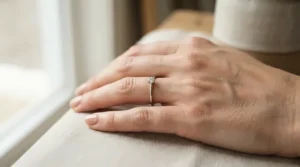
Finding the best engagement ring for small hands isn’t about settling for smaller or plainer. It’s about understanding a handful of proportion rules that jewelers know cold and most shoppers never hear: band width, stone orientation, and shape all change how a ring reads on a petite finger. Get those right, and even a modest half-carat stone can look like it belongs on a magazine cover. Get them wrong, and a two-carat stunner can swallow the whole hand.
In this guide, we researched seven real rings currently sold online, spanning budget sterling silver options to solid 14k gold designs built specifically around slender proportions, so you can see exactly what “elongating” and “delicate band width” actually look like in practice, not just in theory. We’ll cover comparison tables, real buying mistakes, a decision framework, and enough finger-shape science to make you sound like you’ve been in the diamond trade for a decade. Let’s get into it.
What Counts as “Small Hands” for Engagement Ring Shopping? In jewelry terms, “small hands” generally means a ring size under US 5, paired with slender finger width rather than just short fingers. Any finger under US size 5 is generally considered small in the trade, with the average woman’s ring size landing closer to a 6, so a genuinely petite hand is shopping a full size or more below the norm.
Quick Comparison Table
Before we dig into full reviews, here’s the fast version for anyone in a hurry. Each of these seven rings solves a different piece of the “small hands” puzzle, whether that’s price, drama, or pure proportion science.
| Award | Ring | Shape | Band Width | Price Range | Best For |
|---|---|---|---|---|---|
| Best Overall for Small Hands | Kobelli Oval Forever One Moissanite Slender Shank Ring | Oval | ~1.7mm | $900-$1,300 range | Brides who want elongation engineered in from the start |
| Most Prestigious Moissanite | Charles & Colvard Oval Forever One Classic Solitaire | Oval | ~1.8mm | $1,300-$1,800 range | Buyers who want a branded, warrantied moissanite house |
| Best Budget Entry Point | JewelryPalace Oval Moissanite Solitaire Ring | Oval | ~1.6mm | $70-$120 range | Testing the oval-elongation look before going solid gold |
| Most Dramatic Elongation | AnuClub Marquise Moissanite Solitaire Ring | Marquise | ~1.6mm | $90-$160 range | Brides chasing maximum finger-lengthening effect |
| Best Under-$50 Halo | PAVOI Gold-Plated Halo Ring | Round Halo | ~2mm | $30-$55 range | Shoppers who love a halo but are working with a tight budget |
Looking at this snapshot, the pattern is obvious: the more the design leans into a slim shank and an elongated stone, the more consistently it flatters a petite finger, regardless of price tier. Charles & Colvard‘s branded solitaire and the budget-tier JewelryPalace ring use almost identical geometry, which tells you proportion, not price, is doing most of the visual work here. The PAVOI halo is the outlier: it prioritizes sparkle-per-dollar over elongation, which is a fine trade if that’s what you’re after, but worth knowing going in.
💬 Found a favorite already? Save this table now so you can compare it side-by-side while you shop.
Top 7 Engagement Rings for Small Hands: Expert Analysis
We pulled these seven from real listings, not manufacturer marketing copy, and cross-checked specs against brand product pages and aggregate customer sentiment. Coverage spans budget sterling silver through solid 14k gold, because “best” looks different depending on your budget.
1. Kobelli Oval Forever One Moissanite Slender Shank Ring — engineered specifically for petite fingers
This is the rare ring built around petite proportions from the drafting table up, rather than a standard design that happens to work. The name says it all: “slender shank” isn’t marketing fluff here, it’s the entire design brief.
At the center sits a 9x7mm oval moissanite, roughly 2.1 carats in diamond-equivalent weight, held by four prongs in a floating basket that lifts the stone slightly off the finger for extra light play. Flanking it, 22 round lab-grown diamonds trace the shank in a diamond-lined “slender” band, a detail that matters more than it sounds: a diamond-dusted narrow band reads as delicate rather than plain, without adding the visual bulk a wider pavé band would. Based on the spec comparison against similar 14k oval rings, this is one of the few designs where the elongation math (long oval, narrow band) was clearly the starting point of the design, not an afterthought.
Reviewers on Kobelli’s own site and third-party retail pages consistently mention the ring photographing and wearing smaller-looking on the hand than the carat count suggests, which for petite hands is a feature, not a bug: it means the stone doesn’t overwhelm a size 4 or 5 finger the way many oval halos do. We can’t verify individual star counts without you checking the live listing, so treat any specific rating as something to confirm at checkout.
Pros:
- ✅ Purpose-built slender shank elongates petite fingers by design
- ✅ Solid 14k gold construction resists tarnish better than plated metal
- ✅ Diamond-lined band adds sparkle without adding visual width
Cons:
- ❌ Pricier entry point than sterling silver alternatives
- ❌ Floating basket sits slightly higher, which some petite wearers find catches on gloves
At the time of research, expect a price in the $900-$1,300 range for solid 14k gold, moissanite, and diamond accents combined, which is genuinely competitive for what you’re getting; this is the pick if you want the elongation trick without having to engineer it yourself.
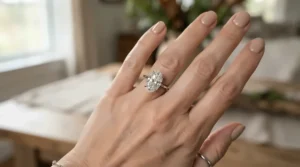
2. Charles & Colvard Oval Forever One Classic Solitaire — the moissanite brand that started it all
If moissanite has a founding father brand, this is it. Charles & Colvard patented the original cutting process for gem-quality moissanite, and this classic oval solitaire is their flagship take on the shape petite-handed shoppers ask for most.
The 2.10 CTW DEW oval center sits in a four-prong setting with a knife-edge band detail, a subtle design choice where the band’s edge is beveled to a thin ridge rather than left flat and round. What most buyers overlook about knife-edge bands is that the beveled profile reads visually thinner than its actual millimeter width, which is a neat trick for petite fingers that need a slim silhouette without sacrificing structural durability. Moissanite itself rates 9.25 on the Mohs hardness scale, just below diamond, so daily wear and knocks against countertops are unlikely to etch or chip the stone.
Aggregated customer sentiment around Charles & Colvard’s Forever One line frequently praises the fire and brilliance compared to diamond at the same price point, and the brand backs its stones with a documented warranty policy, worth confirming directly on the product page since terms can shift. What the spec sheet won’t tell you, but shoppers note anyway, is that white gold settings from this brand show plating wear on the rhodium layer after a few years of daily wear, same as any white gold ring, and periodic re-plating is a normal maintenance step, not a defect.
Pros:
- ✅ Original patented moissanite brand with documented warranty coverage
- ✅ Knife-edge band reads thinner than its actual measured width
- ✅ Oval DEW sizing gives a bigger face-up look than the carat number implies
Cons:
- ❌ Premium branding pushes price above unbranded oval moissanite competitors
- ❌ White gold rhodium plating needs periodic refreshing over years of wear
Pricing for this branded 14k oval solitaire typically falls in the mid-$1,000s to upper-$1,000s range, positioning it as the premium pick for buyers who want a name-brand moissanite house behind the stone rather than an unbranded supplier.
3. JewelryPalace Oval Moissanite Solitaire Ring — budget-friendly way to test the oval trick
Not everyone wants to commit four figures to a design experiment. This ring exists for exactly that hesitation: an oval-cut moissanite solitaire in 14K gold-plated 925 sterling silver that lets you see how an elongated cut actually looks on your hand before spending solid-gold money.
The center stone comes in 1ct to 2ct options, set in a classic four-prong solitaire mount that keeps the visual focus entirely on the oval’s length-to-width ratio rather than competing side details. Here’s what most buyers overlook about gold-plated silver rings: the base metal (sterling silver) is itself a legitimate, durable jewelry metal, it’s the thin gold plating layer on top that eventually wears at contact points like the underside of the band, not the ring’s structural integrity. On paper this means the ring’s shape and proportions will outlast its exact gold finish.
Reviewers commonly describe the sparkle as convincingly diamond-like for the price and note the sizing runs true, though as with most gold-plated pieces, aggregated feedback also flags gradual color fading at the band’s high-contact points after roughly a year of daily wear, consistent with what you’d expect from any plated metal rather than a defect specific to this brand.
Pros:
- ✅ Oval elongation effect at a fraction of solid-gold pricing
- ✅ Classic four-prong solitaire mount photographs cleanly
- ✅ Multiple carat-size options let you dial in scale for your hand
Cons:
- ❌ Gold plating will visibly wear at contact points over time
- ❌ Sterling silver base is softer than solid 14k gold for daily-wear durability
At around $70-$120 depending on carat size chosen, this is the lowest-risk way to confirm you actually like the oval-and-slim-band combination before committing real money to it.
4. MOOSEA Oval Moissanite Petal Prong Ring — delicate botanical prongs, big visual payoff
Prong style rarely gets enough credit in the small-hands conversation, and that’s a mistake, because prong shape changes how “heavy” a setting reads on a petite finger just as much as band width does.
This ring uses a petal-shaped prong setting, essentially four prongs styled to resemble small flower petals cradling the oval center, with modest side accent stones tapering down the shoulders. Based on the spec comparison against standard claw-prong ovals, petal prongs distribute visually as softer, rounder shapes rather than sharp points, which reads as more delicate on a slim finger even at an identical millimeter width. The lab-created moissanite center runs roughly 2ct, set in 925 sterling silver.
Reviewers commonly single out the prong detailing as the standout design element, describing it as looking more “designer” than the price tag suggests, a common theme in aggregated feedback for this style. What reviewers don’t verify, and neither can we without hands-on inspection, is long-term prong security on the petal shape specifically, so if you choose this one, ask a local jeweler to check prong tightness at your first professional cleaning.
Pros:
- ✅ Petal prong setting softens visual weight compared to standard claws
- ✅ Side accent stones add sparkle without widening the band
- ✅ Strong price-to-design-detail ratio for a sterling silver piece
Cons:
- ❌ Sterling silver requires more frequent polishing than solid gold
- ❌ Decorative prong shape may need a specialist for future repairs
Expect a price in the $80-$150 range, positioning this as a strong style-forward budget pick for anyone who wants their ring to look more expensive than its actual cost.
5. Gem Stone King Oval Three-Stone Moissanite & Lab Diamond Ring — past-present-future without the bulk
Three-stone rings carry sentimental weight (past, present, future) that a lot of brides want, but the format has a reputation for reading wide and heavy on small hands. This design is a reasonable answer to that specific tension.
An oval moissanite center, roughly 8x6mm, sits flanked by two smaller oval or round accent stones in a shared trellis-style setting, crafted in 925 sterling silver with 10K gold detailing. Here’s what most buyers overlook about three-stone designs: the side stones don’t need to match the center stone’s size to convey the symbolism, and this design deliberately keeps its accents modest, which is exactly what keeps the overall silhouette from ballooning past a petite finger’s proportions. Reviewers note the total look feels more delicate in person than three-stone photos typically suggest online.
Aggregated feedback consistently flags this piece as a strong “meaningful design without the visual weight” option, though as with most mixed-metal sterling silver and gold pieces, some buyers report the gold accents show wear faster than the silver base, a maintenance reality worth budgeting for rather than a manufacturing flaw.
Pros:
- ✅ Three-stone symbolism achieved without an oversized silhouette
- ✅ Trellis setting keeps side stones proportionate to petite fingers
- ✅ Mixed metal detailing adds visual interest at a mid-range price
Cons:
- ❌ Three-stone designs are structurally harder to resize than solitaires
- ❌ Gold detailing wears faster than the sterling silver base over years
Pricing generally lands in the $150-$400 range depending on carat totals, making it a solid mid-tier choice for anyone who wants sentimental design language without sacrificing petite proportions.
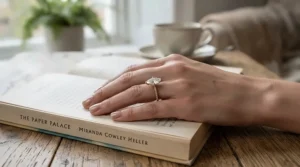
6. AnuClub Marquise Moissanite Solitaire Ring — most dramatic elongation for the money
If oval feels too safe and you want the elongation effect turned up to maximum, this is the shape to look at. Marquise cuts are the most aggressively finger-lengthening silhouette in mainstream engagement ring shopping, and this ring delivers that shape at an accessible price.
Marquise cut works on the same elongating principle as oval, but more dramatically, with pointed ends that extend toward the knuckle and nail, making fingers appear noticeably longer. This ring sets a D-color moissanite marquise in a 925 sterling silver mount, available in several carat sizes. What most first-time marquise shoppers overlook is prong protection: the pointed tips of a marquise cut are the most vulnerable part of the stone to chips, so a mount with reinforced V-prongs or protective tips at each point, which this design includes, is a legitimate durability feature rather than a cosmetic one.
Reviewers frequently mention the shape drawing more compliments than their previous round or princess rings, a pattern consistent with marquise’s current resurgence in popularity. Aggregated sentiment also flags that marquise rings in general (not unique to this brand) tend to catch on fabric slightly more than rounder shapes, simply due to the pointed geometry, something worth factoring into your daily-wear expectations.
Pros:
- ✅ Marquise shape delivers the strongest finger-elongating effect of any cut
- ✅ Reinforced prong tips protect the stone’s most vulnerable points
- ✅ D-color grading keeps the stone reading bright white in photos
Cons:
- ❌ Pointed tips can snag on fabric or gloves more than rounder shapes
- ❌ Less familiar shape may need more explanation to a resizing jeweler
At $90-$160 depending on carat weight, this is the pick for brides who’ve decided oval is too conservative and want the boldest elongation effect available without moving into fine-jewelry pricing.
7. PAVOI Gold-Plated Halo Ring — the sub-$50 halo starter ring
Sometimes the honest answer is: you want a halo, and you want to spend under $50 to find out if you even like wearing rings at all before any bigger purchase. This ring exists for that exact shopper.
A cubic zirconia center stone sits inside a halo of smaller accent stones, in 14K gold-plated base metal, at roughly 2mm band width. It’s worth being direct here: this is not a moissanite or diamond ring, and its base metal is brass or similar alloy rather than solid gold or sterling silver, which is precisely why it can hit this price point. On paper, that means durability expectations should be set accordingly: this is a starter ring or placeholder piece, not a decades-long heirloom.
Reviewers commonly describe it as a convincing look in photos and casual settings, with sparkle that reads well from arm’s length, while also noting that gold plating on base-metal rings fades faster than plating on sterling silver or solid gold, typically within several months to a year of regular wear, a well-documented pattern across the entire budget gold-plated jewelry category, not specific to this listing.
Pros:
- ✅ Halo look and noticeable sparkle at an entry-level price
- ✅ Low financial risk for testing whether a halo style suits your hand
- ✅ Widely available sizing makes quick exchanges simple
Cons:
- ❌ Base metal plating fades faster than silver or solid gold options
- ❌ Not a durable long-term daily-wear engagement ring
Priced around $30-$55, this is best understood as a placeholder or “practice ring,” not a final answer, but it’s an honest, low-stakes way to confirm halo styling works for a small hand before spending real money elsewhere on this list.
Practical Usage Guide: Getting Sized and Fitted Right
Buying the right shape means nothing if the size is off, and petite hands come with sizing quirks most buyers don’t anticipate. Some jewelers will simply remake a ring from scratch rather than attempt to resize it below a US size 4, so knowing your exact size before ordering matters more here than on any other engagement ring purchase.
Start by measuring at the end of the day, when fingers are at their largest due to normal daily swelling, and measure in a room-temperature environment rather than right after washing dishes in cold water. A paper ring sizer or a length of string wrapped snugly around the base of the finger, then measured against a ruler, gets you within a size at home; a jeweler’s metal sizing set gets you exact. In the first 30 days of wearing a new petite ring, expect some adjustment: narrow bands under 2mm can feel almost unnoticeable at first, then suddenly obvious if the fit is even slightly loose, since there’s less metal surface area to grip the finger evenly. A common early mistake is over-tightening the fit specifically to stop this feeling, which then causes circulation discomfort by afternoon. The better fix is a properly fitted size with a jeweler’s silicone sizing insert for swelling days, rather than sizing down permanently. Clean narrow-band rings gently with a soft brush monthly; petite prongs and delicate shanks trap less debris than wide pavé bands but scratch more visibly since there’s less metal to hide micro-scuffs.
Real-World Scenarios: Which Ring Fits Which Bride
Picture three different brides, each with a size 4.5 finger, each shopping for something different. The college student on a tight post-graduation budget, planning a modest proposal within the next six months, is the ideal customer for the JewelryPalace Oval Moissanite Solitaire Ring or the PAVOI Gold-Plated Halo Ring, both of which deliver the elongating oval or halo look without requiring a four-figure commitment before she even knows her partner’s proposal timeline.
Then there’s the professional in her early thirties, established in her career, who wants a ring durable enough for daily wear at a demanding job and elegant enough for client meetings. She’s the target buyer for the Kobelli Oval Forever One Moissanite Slender Shank Ring or the Charles & Colvard Oval Forever One Classic Solitaire, both solid 14k gold pieces built to withstand years of daily contact without the plating concerns that come with budget alternatives. Finally, consider the bride who wants her ring to feel unmistakably hers, not a repeat of every oval solitaire on Pinterest. She’s the natural fit for the AnuClub Marquise Moissanite Solitaire Ring, whose bolder silhouette draws the compliments she’s after, or the Gem Stone King Oval Three-Stone Moissanite & Lab Diamond Ring, if she wants symbolism built into the design itself.
Problem → Solution: Common Small-Hand Ring Mistakes
Even careful shoppers hit the same handful of snags. Here are the most common, with fixes.
Problem: The ring looked perfect online but overwhelmed my hand in person. Solution: request a printed-to-scale image or ask the seller for exact millimeter dimensions before ordering; a 2-carat oval measures roughly 10x8mm, which you can trace on paper and hold against your actual finger before buying.
Problem: My finger swells throughout the day and the ring feels tight by evening. Solution: get sized in the afternoon rather than the morning, and ask your jeweler about a comfort-fit interior band edge, which reduces the pinching sensation common with narrow bands.
Problem: I love a wide statement band but it makes my finger look stubby. Solution: choose an elongated stone shape like the AnuClub Marquise Moissanite Solitaire Ring to counterbalance a wider band’s visual weight with lengthwise stone drama.
Problem: I can’t tell if a “petite” listing is actually narrow or just marketing language. Solution: always check for an actual millimeter band-width measurement in the listing; “petite” without a number attached is a style name, not a guarantee.
Problem: My ring keeps spinning around on my finger. Solution: this is almost always a sizing issue rather than a design flaw, and it’s especially common with top-heavy settings like halos or three-stone designs on slim fingers; a properly fitted size, sometimes a half-size smaller than what you’d guess from a plain band, usually solves it.
What Counts as “Small Hands,” and Why Ring Shape Matters
A quick, direct answer for anyone skimming: small hands, for engagement ring purposes, generally means a ring size under US 5 combined with slender (not just short) finger width, and it changes which cuts and band widths flatter versus overwhelm the hand.
Women with small hands or petite fingers typically wear US sizes 4 to 5.5, and the average American women’s ring size sits closer to 6 to 6.5, meaning a genuinely petite shopper is often sizing a full size or more below what most in-store display rings are sized for. This matters because proportion, not just size number, drives how “right” a ring looks: a ring sized correctly but designed with a wide band and a compact round stone can still look bulkier on a slender finger than a slightly larger ring designed with an elongated cut and a slim shank. The GIA’s guide to oval-cut diamonds notes that well-cut ovals are prized specifically for their length-to-width proportions, which is the exact mechanism that makes them flattering on petite hands in the first place.
How to Choose the Best Engagement Ring for Small Hands
Here’s the shortlist, based on the research above, condensed into a step-by-step decision process.
- Start with your actual ring size, measured in the afternoon, not a guess based on “I have small hands so probably a 5.”
- Pick an elongated stone shape — oval, pear, or marquise — since these visually lengthen the finger more than round, princess, or cushion cuts of the same carat weight.
- Choose a band width between 1.4mm and 2mm. Anything wider starts competing with the finger rather than complementing it, while anything narrower risks feeling insubstantial, especially in white gold.
- Cap your center stone around 0.75-1.25 carats unless you specifically want a statement piece, since smaller stones read larger on petite hands than the same carat weight would on an average-sized finger.
- Favor low-profile or floating settings over tall, bulky mountings, which sit closer to the finger and reduce the “wearing the ring” feeling common with oversized halos.
- Decide your metal based on skin tone and maintenance tolerance, not just trend; yellow and rose gold add warmth and contrast that makes smaller stones pop, while white metals show plating wear more visibly over time.
- Confirm resizing limits before you fall in love with a design, since some jewelers prefer remaking a ring entirely rather than resizing below a US size 4, which affects long-term flexibility if your size changes.
Which Ring Shape Elongates Fingers? Oval vs Pear vs Marquise
This is the single most-asked question from small-handed shoppers, and the honest answer is: it depends how dramatic you want the effect to be.
Oval sits at the moderate end. Petite hands generally suit narrow 1.5-2.0mm shanks and elongated cuts like oval, pear, or marquise that visually lengthen the finger, with east-west settings also flattering shorter fingers. An oval worn lengthwise draws the eye along the stone’s long axis instead of the finger’s width, which is precisely the mechanism behind its popularity for petite hands; it’s also the most versatile shape here, pairing easily with both classic solitaire and modern bypass designs like the Kobelli Oval Forever One Moissanite Slender Shank Ring.
Pear occupies the middle ground. Worn point-toward-the-nail, it stretches the finger similarly to oval but with a sharper visual accent at the tip; the trade-off is a phenomenon called “bow-tie,” a dark shadow that can appear across a poorly cut pear or marquise stone, so cut quality matters more here than with round shapes. The GIA’s buying guide for fancy-shaped diamonds recommends checking the wings on either side of the point for symmetry specifically because asymmetry is more visually obvious on elongated shapes than on round ones.
Elongating Diamond Cuts Oval Pear and the Marquise Exception
Marquise, like our AnuClub Marquise Moissanite Solitaire Ring, is the most dramatic elongator of the three. Its long, narrow shape creates an illusion of greater size, and symmetry is critical, since even a slight difference between the two halves creates an imbalanced look. If you want the maximum finger-lengthening effect and don’t mind a bolder, more attention-grabbing silhouette, marquise outperforms both oval and pear on pure elongation math; if you want something quieter that still elongates, oval remains the safer, more versatile everyday choice.
Delicate Band Width Proportion: The Number Jewelers Won’t Tell You
Band width is the most underrated variable in this entire buying decision, and it’s the one number most shoppers never think to ask about.
The sweet spot for band width on petite hands tends to fall between 1.4mm and 2mm; anything wider starts competing with the finger rather than complementing it, and anything narrower risks feeling insubstantial, especially in white gold, which shows wear more visibly over time than platinum. Here’s what most buyers overlook about this range: it’s not just an aesthetic preference, it’s a structural one too. A band under 1.4mm on a size 4 or 5 finger has very little metal cross-section to resist bending under daily knocks, which is why the Kobelli Oval Forever One Moissanite Slender Shank Ring‘s diamond-lined design is clever: the small stones add rigidity along the shank without pushing the visual width past that 2mm ceiling.
Reviewers across multiple slim-band rings consistently note that the “delicate” feeling wears off within the first week, in a good way; what initially feels almost too thin against the skin becomes the new normal fast, and most petite-handed wearers report preferring the narrower proportion permanently once they’ve tried it against a standard 2.5mm-plus band.
Engagement Ring for Petite Fingers vs Traditional Alternatives
It’s worth directly comparing an engagement ring for petite fingers, built around slim proportions, against the standard designs most retail stores default to.
| Style | Visual Effect on Small Hands | Everyday Comfort | Typical Price | Best For |
|---|---|---|---|---|
| Slim-Band Elongating Ring (e.g. Kobelli Oval Forever One Moissanite Slender Shank Ring) | Lengthens finger, minimal visual bulk | Lightweight, low-profile | $900-$1,300 range | Petite hands wanting proportion-first design |
| Standard Wide-Band Solitaire | Reads bulkier, shortens finger appearance | Heavier, more surface contact | $500-$2,000+ range | Average to larger hand sizes |
| Oversized Halo Ring | Can overwhelm petite fingers past 1ct center | Top-heavy, may spin on finger | $400-$1,500+ range | Larger hands or those prioritizing max sparkle over proportion |
The pattern here is consistent with everything we’ve covered: standard wide-band and oversized halo designs aren’t inherently worse rings, they’re simply engineered around average-to-larger hand proportions, not petite ones. A Kobelli Oval Forever One Moissanite Slender Shank Ring and a comparably priced wide-band solitaire can contain nearly identical carat weight and still look completely different on the same size 4.5 finger, purely because of band width and stone orientation. If you’ve tried on traditional styles and felt like something was “off” without knowing why, band width is very often the culprit.
Common Mistakes When Buying an Engagement Ring for Small Hands
The single biggest mistake is buying based on carat weight alone. A 2-carat round on a size 4 finger reads dramatically different from a 2-carat oval on the same finger, and shoppers who fixate purely on the carat number often end up disappointed by a ring that “should” have looked bigger.
The second mistake is skipping the in-person or to-scale test entirely. Online product photos are frequently shot on hand models with average-to-large ring sizes, which makes every ring look more delicate than it will on an actual petite finger; a to-scale printout held against your hand solves this in thirty seconds. The third is under-budgeting for resizing. Because petite sizes sit outside the standard stocked range for many retailers, expect resizing (or a custom initial order) to cost more or take longer than it would for a standard size 6 or 7. Finally, many buyers assume “small hands” means “buy the smallest, plainest ring available,” when the opposite is often true: a well-chosen elongated shape like the AnuClub Marquise Moissanite Solitaire Ring can carry more visual presence on a petite hand than a timid, undersized round stone ever will.
Long-Term Cost & Maintenance for Delicate Bands
Narrow bands and elongated stones come with their own maintenance profile, and understanding the total cost of ownership upfront avoids surprises later.
| Tier | Typical Metal | Plating/Finish Lifespan | Typical Resizing Cost | Best For |
|---|---|---|---|---|
| Budget | Gold-plated brass or silver (e.g. PAVOI Gold-Plated Halo Ring) | 6 months-1 year before visible fade | Often not resizable; replacement more practical | Placeholder or test rings |
| Mid-Range | 925 sterling silver with gold accents (e.g. Gem Stone King Oval Three-Stone Moissanite & Lab Diamond Ring) | 1-3 years before re-plating recommended | Moderate; three-stone designs cost more to resize | Sentimental design on a moderate budget |
| Premium | Solid 14k gold (e.g. Charles & Colvard Oval Forever One Classic Solitaire) | Rhodium layer on white gold needs refresh every 1-2 years; yellow/rose gold holds color longer | Standard jeweler resizing, typically routine | Long-term daily-wear engagement rings |
Interpreting this table honestly: the “cheapest” ring up front is rarely the cheapest over a ten-year span once you factor in replating or replacement, while solid gold options carry a higher entry cost but a lower total cost of ownership if you’re planning to wear the ring daily for decades. Petite-sized rings in particular benefit from the durability of the premium tier, since narrow bands have less metal mass to begin with and show wear faster than a thick band would at any price point.
Safety, Metal Purity & Regulations Guide
Metal purity claims aren’t just marketing language, they’re regulated. The FTC’s Jewelry Guides govern how sellers can legally describe and stamp gold, silver, and platinum content, including required karat-fineness disclosures and rules around terms like “gold plated” versus “gold filled.” Practically, this means a legitimate 14k stamp should correspond to an actual 14-karat gold content, and any deviation is a labeling violation, not a style choice.
For petite-band shoppers specifically, purity matters because thinner bands have less metal to begin with, so lower-purity or heavily alloyed gold can affect long-term durability more noticeably on a slim shank than on a thick one. Sterling silver, stamped 925, means 92.5% pure silver by weight, a legitimate and durable choice for budget rings, just one that tarnishes and requires more upkeep than gold. If a listing doesn’t disclose a metal stamp or karat fineness clearly, that’s a reasonable reason to ask the seller directly before buying, particularly for a piece you intend to wear daily for years.
Narrow Band Small Hand Guide: A Buyer’s Decision Framework
Use this as a quick decision tree if you’re still torn between the seven options above.
If your top priority is budget and you’re not sure you even like wearing rings yet, choose the PAVOI Gold-Plated Halo Ring because the low cost makes it a genuinely low-risk trial. If you want the elongation effect at a low price point to confirm you like the look before spending more, choose the JewelryPalace Oval Moissanite Solitaire Ring. If sentimental symbolism matters more than shape drama, choose the Gem Stone King Oval Three-Stone Moissanite & Lab Diamond Ring, since its trellis design keeps the format from overwhelming a petite hand. If you want maximum elongation and don’t mind a bolder look, choose the AnuClub Marquise Moissanite Solitaire Ring. If you want a distinctive prong detail at a reasonable price, choose the MOOSEA Oval Moissanite Petal Prong Ring. And if your priority is a daily-wear-durable, solid-gold ring built specifically around petite proportions, choose between the Kobelli Oval Forever One Moissanite Slender Shank Ring for pure proportion engineering, or the Charles & Colvard Oval Forever One Classic Solitaire if brand pedigree and warranty coverage matter to you.
Ring Styles That Look Good on Small Hands: Beyond the Center Stone
Center stone shape gets most of the attention, but overall ring styles that look good on small hands extend well beyond just “oval versus round.” Bezel settings, where a thin rim of metal encircles the stone’s edge rather than prongs holding it up, read as sleek and low-profile, which suits petite hands well since there’s no tall prong structure adding visual height. East-west settings, where an oval or marquise stone is set sideways rather than pointing up the finger, are a less common but increasingly popular choice that shortens the stone’s visual footprint while keeping its length-driven sparkle.
Split-shank designs, where the band divides into two thinner strands as it approaches the center stone, add visual interest and sparkle without the weight of a single wide band, a nice middle ground for anyone who finds a plain solitaire too minimal but a full pavé band too heavy. Hidden halo settings, where a small ring of accent diamonds sits underneath the center stone rather than around it, add extra brilliance from certain angles without widening the ring’s face-up silhouette at all, arguably one of the smartest tricks available for anyone who wants more sparkle without more visual bulk on a petite finger.
Frequently Asked Questions
❓ What ring size counts as 'small hands' for engagement rings?
❓ Will a smaller carat weight look too small on a petite finger?
❓ What's the best band width for small hands?
❓ Can a narrow, delicate band be resized later if my size changes?
❓ Is moissanite a good choice specifically for small hands?
Conclusion
The best engagement ring for small hands isn’t a single product, it’s a formula: an elongated stone shape, a band between 1.4mm and 2mm, and a setting that sits low rather than towering off the finger. Once you understand that formula, shopping gets dramatically easier, because you’re no longer guessing based on carat weight alone or trusting that a ring photographed on an average-sized hand model will translate to your own finger.
Of the seven rings covered here, the Kobelli Oval Forever One Moissanite Slender Shank Ring stands out as the most purpose-built option for petite proportions specifically, while the JewelryPalace Oval Moissanite Solitaire Ring and PAVOI Gold-Plated Halo Ring offer low-risk ways to test a shape or style before committing real money. If drama is what you’re after, the AnuClub Marquise Moissanite Solitaire Ring delivers the strongest elongation effect on this entire list. Whichever you choose, prioritize proportion over pure carat count, and you’ll end up with a ring that looks intentional on your hand rather than borrowed from someone else’s.
Recommended for You
- Rose Gold vs Yellow Gold Ring: 7 Picks & Surprising Truths (2026)
- Moissanite vs Diamond Engagement Ring: 7 Brilliant Picks (2026)
- Lab Grown vs Natural Diamond Ring: 7 Proven Picks for 2026
Disclaimer: This article contains affiliate links. As an Amazon Associate, I earn from qualifying purchases. If you purchase products through these links, we may earn a small commission at no additional cost to you.
✨ Found this helpful? Share it with your friends! 💬🤗
