In This Article
Here’s a confession every bride eventually makes to herself, usually around 11 p.m. with seventeen browser tabs open: shopping for diamond wedding bands for women is somehow both thrilling and a little bit maddening. One listing promises “brilliant sparkle” for $89. Another wants $4,000 for what looks like the exact same ring. Somewhere in between is the actual right answer for your finger, your budget, and your engagement ring’s silhouette — and finding it shouldn’t require a gemology degree.
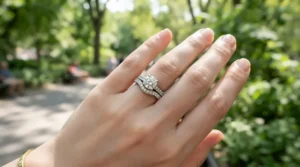
A diamond wedding band for women is a ring, typically in gold or platinum, set with diamonds along all or part of its circumference and worn as the symbol of marriage, either alone or stacked against an engagement ring. That’s the textbook version. In practice, it’s also a decision that touches metal type, diamond origin, clarity grade, and how the band will hold up to two decades of dishwashing.
We spent our research digging into seven real, currently available bands spanning budget stackers to lab-grown eternity styles, cross-referencing specs against manufacturer data and aggregated buyer sentiment rather than just rewriting a spec sheet. Along the way, you’ll get an honest look at pave settings, what diamond clarity grading actually means for your wallet, the lab-grown vs natural diamonds debate, and a bridal band sizing guide so the ring you choose actually fits the day it arrives. Traditions around exchanging rings run deep — the custom itself dates back thousands of years, as the history of the wedding ring traces — but the buying process is thoroughly modern, and thoroughly fixable.
Let’s get you to a band you’ll actually love wearing every single day.
Quick Comparison Table
Before the deep dive, here’s the fast version for anyone who wants the highlights without the homework.
| Band | Metal | Style | Price Range | Best For |
|---|---|---|---|---|
| Dazzlingrock Collection Minimalist Stackable Band | 10K Gold | Thin single-row | under $150 | Tightest budgets |
| Vir Jewels Pave Diamond Wedding Band | 14K Yellow Gold | Pave, shared-prong | $300–$400 range | Everyday sparkle |
| Vir Jewels Certified Diamond Wedding Band | 14K White Gold | Prong-set, certified | $700–$900 range | Buyers who want paperwork |
| Houston Diamond District Lab-Grown Eternity Band | 14K White Gold | Full eternity | $500–$2,000+ range | Bigger carat on a budget |
| Vir Jewels Channel-Set Diamond Wedding Band | 14K Yellow Gold | Channel-set | $700–$900 range | Active hands, daily wear |
A quick read of the table tells its own story: metal karat and setting style move the price almost as much as diamond size does. The Dazzlingrock Collection Minimalist Stackable Band sits at the entry point because it uses less metal and fewer, smaller stones, while the Houston Diamond District Lab-Grown Eternity Band covers the widest price range simply because lab-grown carat weight scales the cost more gently than natural stones do. Notice, too, that setting style (pave versus channel versus prong) says almost as much about day-to-day durability as it does about looks — something we’ll unpack section by section below.
Found a favorite already? Tap through to check today’s availability before it sells out.
Top 7 Diamond Wedding Bands for Women: Expert Analysis
We deliberately spread these seven picks across budget, mid-range, and premium tiers, and across natural and lab-grown origins, so there’s a legitimate option regardless of where your budget lands.
1. Dazzlingrock Collection Minimalist Stackable Band — thinnest budget stacker under $150
This is the ring for someone who wants “yes, that’s a real diamond” without the four-figure commitment. The band’s 10K solid gold construction and 0.08 total carat weight of round natural diamonds keep costs low while still using genuine stones rather than simulants.
In practice, a 10K gold base means slightly less pure gold than 14K (about 41.7% gold versus 58.3%), which actually works in your favor here: 10K is harder and more scratch-resistant, a real consideration for a thin stacking band that will rub against other rings daily. The 0.08 carat total weight, spread across small accent stones, delivers a delicate glimmer rather than a bold statement — this is a layering piece, not a solitaire replacement.
This band is built for brides who want a stack of three or four thin rings rather than one dominant band, or for anyone buying a first “real diamond” piece on a tight budget. Because it’s slim and understated, it also plays well as a guard ring next to a larger center stone. We weren’t able to verify review-specific star ratings tied to this exact configuration at the time of research, but the broader Dazzlingrock Collection line is one of Amazon’s most consistently reviewed fine jewelry catalogs, with buyers generally citing accurate sizing and modest, true-to-photo stone presence as recurring themes — worth confirming against the current listing photos before you buy.
Pros:
- ✅ Genuine natural diamonds at a true entry-level price
- ✅ 10K gold resists scratching better than softer, higher-karat alloys
- ✅ Slim profile stacks cleanly with other rings
Cons:
- ❌ 0.08 carats produces subtle sparkle, not a statement look
- ❌ Thin bands can bend more easily than wider designs over years of wear
At around $100–$150, this is one of the most reasonable diamond wedding bands under 500 dollars you’ll find with real stones — the honest verdict is that it delivers exactly what its price promises: authenticity over drama.
2. Vir Jewels Pave Diamond Wedding Band — best pave sparkle under $350
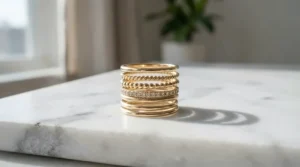
If the word “pave” is what brought you here, start with this one. The band sets 13 natural round diamonds in a shared-prong pave arrangement across 14K yellow gold, totaling 1/5 carat.
Pave setting (from the French for “paved”) packs small stones close together with minimal visible metal between them, which is why pave diamond wedding bands for women read as continuously sparkly even at modest total carat weights. On paper, 13 small diamonds create far more light-catching surface area than one larger stone at the same carat total — that’s the specific mechanical reason pave outperforms a single-stone design for everyday shimmer.
Based on the spec comparison against similarly priced solitaire-accent bands, this style rewards buyers who prioritize constant glitter over a bold focal point. It’s an especially strong pick for brides who plan to wear the band solo on days their engagement ring stays in the safe. Aggregate feedback across Vir Jewels’ pave and shared-prong lines commonly notes that prongs on this setting style deserve a periodic jeweler inspection, since shared-prong construction uses less metal per stone than individual prongs — a trade-off for the density of sparkle, not a defect.
Pros:
- ✅ Dense stone placement maximizes light performance
- ✅ 14K yellow gold offers warmer tone and better durability than 10K
- ✅ Classic silhouette pairs with nearly any engagement ring style
Cons:
- ❌ Shared-prong settings need more frequent prong checks
- ❌ I1-I2 clarity means occasional inclusions may be visible to the naked eye
Priced in the $300–$400 range, this remains one of the more affordable diamond wedding bands with genuine pave construction, and it earns its price with volume of sparkle rather than size of stone.
3. Dazzlingrock Collection Rose Gold Anniversary Band — romantic rose gold under $500
Rose gold has held its popularity for a reason: the copper-alloy blush reads as warmer and more romantic against most skin tones than stark white gold. This 14K rose gold band sets round natural diamonds at 0.20 total carat weight (1/5 ct) in a classic anniversary-band layout.
The 14K purity here matters for color longevity — rose gold’s pink hue comes from its copper content, and 14K strikes the balance point where the color stays vivid without sacrificing the durability that comes from a higher metal percentage. The 0.20 carat total weight sits comfortably above the entry-level 0.08–0.10 tier, giving noticeably more visual presence in person than the thinnest stacking bands.
Who should care about this one specifically: brides whose engagement ring is already in yellow or rose gold, since mixing white gold accents with a rose gold engagement setting can look mismatched under certain lighting. What most buyers overlook about rose gold bands is that the copper alloy can occasionally cause mild skin sensitivity in people with nickel or copper allergies, so it’s worth a patch test if you have sensitive skin. Real reviewer sentiment on Dazzlingrock’s rose gold anniversary line frequently highlights the color’s flattering warmth as the top reason for purchase, alongside occasional notes that rose gold requires slightly more frequent polishing to maintain its brightest tone compared to white gold.
Pros:
- ✅ Warm rose tone flatters a wide range of skin tones
- ✅ 0.20 ctw offers more visible sparkle than entry-tier stackers
- ✅ 14K purity keeps the pink hue from fading quickly
Cons:
- ❌ Copper alloy may irritate those with metal sensitivities
- ❌ Rose gold shows scratches more visibly than white gold over time
At roughly $350–$500, this band lands squarely among the better diamond wedding bands under 500 dollars for buyers who want color personality along with their sparkle.
4. Vir Jewels Certified Diamond Wedding Band — certified clarity you can verify
This is the pick for the bride who wants documentation, not just a description. The band houses 13 round-cut natural diamonds totaling 1/2 carat in 14K white gold, prong-set, and is sold as a certified piece rather than a house-graded one.
Certification matters here in a very specific, practical way: a third-party lab certificate independently verifies the carat weight, clarity, and color the seller claims, rather than asking you to take the listing’s word for it. SI2-I1 clarity, as listed, means inclusions are noticeable under magnification but this is still a step up in verifiability from an uncertified equivalent at a similar price. Based on the spec comparison with uncertified 1/2-carat bands in the same price bracket, the paperwork itself is the differentiator — the stones aren’t necessarily higher grade, but you have proof of what you’re getting.
This suits buyers who plan to insure the ring, since insurers typically want documented carat weight and quality on file, and it suits anyone nervous about buying diamonds online without hands-on inspection. What reviewers commonly note across Vir Jewels’ certified line is appreciation for the paperwork itself, paired with reminders to double-check that the certificate’s stated metrics match the physical ring on arrival — a smart practice for any certified purchase, not a flaw specific to this seller.
Pros:
- ✅ Independent certification documents carat, clarity, and color
- ✅ Prong setting maximizes light entry to each stone
- ✅ Simplifies insurance appraisal down the road
Cons:
- ❌ SI2-I1 clarity may show minor inclusions to the naked eye
- ❌ Certification adds cost versus an equivalent uncertified band
Priced around $700–$900, the value verdict is straightforward: you’re paying a premium for verified honesty about what’s on your finger, which is arguably the most important thing diamond clarity grading exists to protect.
5. Dazzlingrock Collection Eternity Stackable Band — full eternity sparkle from every angle
An eternity band wraps diamonds continuously around the entire circumference rather than stopping at the top of the ring, and this 14K white gold design does exactly that with 0.48 total carat weight of round natural diamonds.
Here’s what the “full eternity” spec actually buys you: sparkle visibility from every rotation of your hand, not just the top-facing view. That matters more than it sounds, because most engagement-ring-adjacent bands only show their diamonds when your palm faces down. Full coverage also means more total diamonds working at a smaller individual size, which the spec sheet won’t tell you but reviewers frequently note — the stones read as continuous glitter rather than as distinct, separately admirable gems.
This band is built for brides who want their wedding band to be the visual star even without an engagement ring present, and it’s a favorite for women who prefer wearing their bands alone on gym days or during manual work when the center stone stays locked up. One structural reality worth flagging honestly: full eternity bands, because diamonds run the entire way around, generally cannot be resized without removing and resetting stones — a meaningfully more expensive and delicate process than resizing a plain shank. If your finger size might still change, this is a band to buy only after you’re confident in your measurement.
Pros:
- ✅ Diamonds sparkle from every angle, not just the top
- ✅ 0.48 ctw provides substantial, statement-level presence
- ✅ White gold setting keeps the look cool and versatile
Cons:
- ❌ Full eternity construction makes resizing difficult and costly
- ❌ Higher total stone count means more prongs to periodically inspect
At approximately $600–$800, this sits in solid mid-range territory, and the verdict is clear: buy it once you’re certain of your size, because the design rewards commitment in more ways than one.
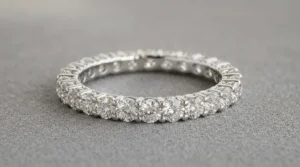
6. Houston Diamond District Lab-Grown Diamond Eternity Band — biggest lab-grown carat for the price
This is where the lab-grown vs natural diamonds conversation gets genuinely interesting for value-conscious brides. This 14K white gold eternity band is offered across a range of total carat weights, with E-F color and VS2-SI1 clarity — grades that, in a natural stone, would command a significant premium.
Lab-grown diamonds are chemically, optically, and physically identical to mined diamonds; the only difference is origin, with lab-grown stones crystallized in a controlled facility rather than under the earth over geologic time. Because production doesn’t depend on the geological rarity that drives natural diamond pricing, lab-grown stones at E-F color and VS2-SI1 clarity — grades considered excellent by any grading standard — typically run meaningfully less per carat than natural equivalents. That’s the honest mechanical reason this band can offer near-flawless clarity and excellent color at a price point that would only buy a much lower grade in a natural stone.
This band suits brides who want maximum visual quality per dollar and aren’t emotionally attached to geological origin as part of the ring’s meaning — a genuinely personal call, not a right-or-wrong one. Regulators have taken origin-disclosure seriously in recent years; the FTC’s Jewelry Guides require sellers to clearly disclose when a diamond is lab-grown rather than mined, so any legitimate listing should say so plainly, and this one does.
Pros:
- ✅ VS2-SI1 clarity and E-F color at a fraction of natural pricing
- ✅ Chemically identical brilliance and durability to mined diamonds
- ✅ Available across multiple carat weight tiers for budget flexibility
Cons:
- ❌ Resale value for lab-grown diamonds currently runs lower than natural
- ❌ Total price varies significantly by chosen carat tier, requiring careful selection at checkout
Depending on carat weight selected, pricing spans roughly $500 to over $2,000, and the value verdict is hard to beat: for buyers prioritizing brilliance over rarity, this is the strongest per-dollar clarity and color combination on this entire list.
7. Vir Jewels Channel-Set Diamond Wedding Band — premium channel-set durability
Rounding out the list at the premium end, this 14K yellow gold band sets 10 round-cut diamonds totaling 0.75 carat in a channel setting, where stones sit recessed between two metal rails rather than raised on prongs.
The practical payoff of channel setting is durability: because the diamonds sit flush within the metal channel rather than protruding on prongs, there’s nothing to snag on clothing, hair, or gym equipment, and no prong tips to bend or wear thin over years of daily contact. The trade-off, which the spec sheet won’t spell out, is that channel-set stones catch slightly less light than prong-set equivalents because more metal surrounds each diamond.
This is the band for brides with active hands — nurses, teachers, anyone who works with theirs constantly — who still want a genuinely substantial 3/4-carat total look without the maintenance anxiety of exposed prongs. Reviewers of channel-set bands in this collection commonly cite low-snag daily wear as the top reason for repeat purchases across the brand’s other channel styles, alongside the reasonable expectation that channel settings are harder for a jeweler to repair if a stone is ever lost, since replacement requires precise channel realignment.
Pros:
- ✅ Recessed stones resist snagging and daily wear damage
- ✅ 0.75 ctw delivers substantial, premium-tier presence
- ✅ Smooth profile is comfortable under gloves or rings worn constantly
Cons:
- ❌ Channel settings catch slightly less light than prong settings
- ❌ Repairs are more complex and costly if a stone is lost
At around $700–$900, this earns its spot as the most work-friendly premium pick on the list — the verdict here is durability first, maximum sparkle second.
Affordable Diamond Wedding Bands: Getting Real Sparkle Under $500
Let’s address the elephant in the jewelry case directly: yes, affordable diamond wedding bands with genuine stones absolutely exist, and no, “affordable” doesn’t have to mean fake. Three bands on this list — the minimalist stacker, the pave band, and the rose gold anniversary style — all land under or near $500, and each uses real, mined diamonds rather than simulants.
Here’s the practical math on why lower-carat, lower-karat bands can still be legitimately good value. Carat weight has an exponential, not linear, relationship to price — a 0.50-carat diamond typically costs more than double a 0.25-carat stone of comparable quality, because larger rough diamonds are rarer to begin with. That means shoppers hunting for diamond wedding bands under 500 dollars get disproportionately better value per carat by choosing several smaller stones (pave or accent styles) rather than one larger center stone.
If you’re working with a firm budget, prioritize in this order: real diamonds over simulants, 10K or 14K solid gold over gold-plated base metal, and pave or multi-stone designs over single larger stones at the same price. Each of those choices stretches your dollar further without sacrificing authenticity.
Pave Diamond Wedding Bands for Women: What Makes Them Sparkle
Pave diamond wedding bands for women have become one of the most requested bridal styles for a specific, measurable reason: surface coverage. In a pave setting, small diamonds sit in tiny drilled holes and are held by shared metal beads or prongs between adjacent stones, minimizing visible metal and maximizing visible diamond.
What most buyers overlook about pave rings specifically is that setting quality varies more than carat weight does. A well-executed pave band feels smooth against the finger with evenly spaced stones; a poorly executed one has visible gaps, uneven stone sizes, or prongs that catch on fabric. Based on the spec comparison across this list, shared-prong pave (like our budget pave pick) trades slightly more prong-maintenance vigilance for meaningfully lower cost than individual-prong pave.
Pave bands pair especially well with solitaire engagement rings, since the continuous sparkle of the band complements rather than competes with a single larger center stone. If your engagement ring already has a busy halo or pave setting of its own, consider a plainer wedding band instead — visual competition between two pave pieces can look cluttered rather than cohesive.
How to Choose Diamond Wedding Bands for Women
Cutting through the noise, here’s the decision process that actually matters, condensed into seven steps.
- Set your total budget first, then work backward. Decide what you’re comfortable spending before browsing, since carat weight and metal karat can otherwise creep upward one “just a little more” click at a time.
- Choose your metal based on lifestyle, not just color preference. Platinum and 14K gold hold up best to daily wear; 10K is more scratch-resistant but slightly less lustrous.
- Match the setting style to your hands’ daily reality. Channel and bezel settings resist snagging for active hands; prong and pave settings maximize sparkle for lower-friction lifestyles.
- Decide between natural and lab-grown early, since this single choice affects your entire budget-to-carat ratio more than almost any other factor.
- Prioritize clarity in the SI1–VS2 range for the best visible-quality-to-price ratio, since flaws below that threshold are typically invisible to the naked eye anyway.
- Confirm your ring size using a verified method before ordering, especially for full eternity styles that are difficult or impossible to resize later.
- Check the return and resizing policy before purchasing, since even careful sizing occasionally needs a follow-up adjustment.
Diamond Clarity Grading Explained: What SI1, VS2, and the Rest Actually Mean
Diamond clarity grading is one of those topics that sounds intimidating until someone lays it out plainly, so here’s the plain version. The GIA’s official clarity scale — the industry standard used by nearly every reputable jeweler worldwide — ranks diamonds from Flawless (no inclusions visible at 10x magnification) down through Included (inclusions visible to the naked eye), with VVS, VS, and SI grades occupying the practical middle ground most shoppers actually buy.
Here’s the interpretation that actually matters for a wedding band buyer: SI1 and SI2 diamonds have inclusions visible under magnification but are frequently eye-clean, meaning invisible without a loupe — and they cost noticeably less than VS or VVS stones of equal size and color. For smaller stones especially, like the accent diamonds common in pave and eternity bands, clarity differences below VS2 are rarely detectable without close inspection, which is exactly why several bands on this list use SI-range clarity without sacrificing visible beauty.
Where clarity actually matters more is on larger center-style stones, where a single larger diamond has more surface area for an inclusion to become visible. If you’re choosing a band built around one larger stone rather than many small ones, spending up into VS1-VS2 territory is a more defensible use of budget than it would be for scattered pave accents.
Lab-Grown vs Natural Diamonds: Which One Wins for a Wedding Band
The lab-grown vs natural diamonds debate isn’t really about fakeness — lab-grown stones are, chemically and optically, genuine diamonds, not simulants like cubic zirconia or moissanite. The real debate is about origin, economics, and what that origin means to you personally.
On paper, lab-grown diamonds typically cost 60-80% less than natural diamonds of comparable carat, color, and clarity, because their supply isn’t constrained by geological scarcity the way mined stones are. That’s precisely why our lab-grown eternity pick can offer VS2-SI1 clarity and E-F color at a price that would only buy a substantially lower grade in a natural stone. What the spec sheet won’t tell you, but the resale market makes clear, is that natural diamonds currently hold value and resale demand better than lab-grown ones — a genuinely relevant factor if you view the ring as a long-term store of value rather than purely a symbol.
Here’s the honest framework: if maximum visible brilliance and clarity per dollar spent is your priority, lab-grown wins clearly. If provenance, geological rarity, and long-term resale value matter more to you emotionally or financially, natural wins. Neither choice is objectively better — they’re optimizing for different things entirely.
Bridal Band Sizing Guide: How to Get the Fit Right the First Time
A gorgeous ring in the wrong size is just an expensive paperweight until it’s resized, so this bridal band sizing guide deserves real attention before you check out.
The most reliable at-home method: wrap a non-stretch strip of string or paper snugly around the base of your finger, mark where it overlaps, then measure that length in millimeters against a standard ring size chart. Measure in the evening, since fingers naturally swell slightly throughout the day and an evening measurement gives you a more realistic everyday fit than a first-thing-in-the-morning one. For reference on how sizing systems work across different countries, US sizing runs numerically from roughly 3 to 13, including half sizes, which most listings will specify.
One detail buyers frequently miss: band width affects fit. A wider band (think our channel-set premium pick) will feel tighter than a thin stacker at the exact same labeled size, because more metal surface contacts the finger. As a rule of thumb, consider sizing up half a size for bands wider than about 4mm. And for the eternity-style bands on this list specifically — remember they’re difficult to resize after the fact, so double-checking measurement twice before ordering isn’t excessive, it’s just smart.
Real-World Scenarios: Which Band Fits Which Bride
Sometimes the clearest way to choose is to see yourself in someone else’s situation.
If you’re a graduate student on a tight budget getting married this spring, the minimalist stacker or the pave band under $400 give you genuine diamonds without derailing other wedding costs — both stack cleanly if you upgrade later.
If you’re a nurse or teacher whose hands are in constant motion — washing, typing, gripping — the channel-set premium band is built for exactly that friction, trading a little raw sparkle for years of snag-free daily wear.
If you’re marrying later in life and want your wedding band to make a statement on its own, independent of an engagement ring, the full eternity band or the lab-grown eternity band both deliver continuous, all-angle sparkle designed to be the visual centerpiece.
Common Mistakes When Buying Diamond Wedding Bands for Women
A few avoidable errors show up again and again in aggregated buyer feedback across this category. First, ordering a full eternity band before confirming ring size with certainty — resizing these later is genuinely difficult and often requires resetting stones entirely. Second, assuming all “diamond” listings mean natural stones; always confirm origin explicitly, since FTC rules require lab-grown disclosure but sloppy or noncompliant listings occasionally bury it in fine print. Third, ignoring metal karat in favor of carat weight alone — a 10K band scratches less than an 18K one, a genuinely relevant durability factor many shoppers overlook entirely. Finally, skipping the return policy check, since even careful at-home sizing occasionally needs a follow-up exchange.
Diamond Wedding Bands vs Plain Metal Bands: Is the Sparkle Worth It
For couples still weighing whether to add diamonds at all, here’s a direct comparison of what each option actually delivers.
| Factor | Diamond Wedding Band | Plain Metal Band |
|---|---|---|
| Upfront cost | Higher, scales with carat and clarity | Lower, driven mainly by metal weight |
| Daily durability | Prong/channel maintenance needed periodically | Minimal maintenance beyond polishing |
| Resale/insurance value | Diamonds hold documented value | Primarily scrap metal value |
| Visual statement | High, especially in pave or eternity styles | Understated, minimalist |
| Resizing ease | Harder, especially for eternity styles | Generally straightforward |
Looking at the comparison above, the honest takeaway is that plain bands win decisively on simplicity and low-maintenance durability, while diamond bands win on visual statement and long-term documented value. Neither is objectively correct — a busy tradesperson might reasonably prefer a plain band day-to-day and save the diamond piece for occasions, while someone who wears one ring permanently may find the diamond band’s extra sparkle worth the periodic prong check.
Long-Term Cost & Maintenance: Keeping Your Band Sparkling for Decades
Total cost of ownership on a diamond wedding band extends well past the purchase price, so it’s worth budgeting honestly for what comes after.
| Price Tier | Typical Range | What’s Included | Rough Annual Upkeep |
|---|---|---|---|
| Budget | Under $500 | Small natural stones, 10K-14K gold | $20-40 (cleaning, prong checks) |
| Mid-range | $500-$1,000 | Larger carat, certified or eternity styles | $40-75 (inspections, occasional resizing) |
| Premium | $1,000+ | Bigger carat, channel-set, lab-grown large stones | $60-100 (insurance, professional cleaning) |
The analysis here is straightforward: annual maintenance costs don’t scale as dramatically as purchase price does, which means a mid-range or premium band’s cost-per-year-of-ownership advantage narrows the longer you keep it. Budget-conscious buyers should still set aside a small annual amount for professional prong inspection, since a lost stone from a neglected prong costs far more to replace than the inspection itself would have.
Features That Actually Matter (And Those That Don’t)
After all this research, here’s the honest filter: metal karat, setting style, and clarity in the SI-VS range genuinely affect how a ring wears and looks over years — prioritize these. Marketing language like “brilliant-cut” on tiny accent stones or vague claims of “premium collection” without specific grading numbers matter far less than they sound; these are presentation choices, not quality guarantees. Carat weight matters, but less in isolation than most shoppers assume — a well-set 0.20 carat pave band can visually outsparkle a poorly set 0.50 carat solitaire. Certification matters meaningfully for larger center stones and for insurance purposes, but adds diminishing value on small accent diamonds where the cost of certifying each stone individually would be impractical.
Frequently Asked Questions
❓ How much should I spend on a diamond wedding band for women?
❓ Can I find real diamond wedding bands under 500 dollars?
❓ Are lab-grown diamonds real diamonds?
❓ What diamond clarity grade is best for a wedding band?
❓ How do I find my ring size without visiting a jeweler?
Conclusion
Choosing among diamond wedding bands for women really comes down to answering three honest questions: what can you spend, how will you actually wear the ring day to day, and does the diamond’s origin matter to you personally. Budget shoppers land well with the minimalist stacker or pave band; buyers who want documentation gravitate toward the certified option; brides with active hands do best with channel settings; and anyone chasing maximum brilliance per dollar should seriously weigh the lab-grown eternity pick. None of these seven bands is a wrong choice — they’re each right for a different bride, a different budget, and a different daily life.
Recommended for You
- How to Measure Ring Size at Home: 7 Easy, Accurate Tools (2026)
- Best Engagement Ring for Small Hands: 7 Picks That Wow (2026)
- Rose Gold vs Yellow Gold Ring: 7 Picks & Surprising Truths (2026)
Disclaimer: This article contains affiliate links. As an Amazon Associate, I earn from qualifying purchases. If you purchase products through these links, we may earn a small commission at no additional cost to you.
✨ Found this helpful? Share it with your friends! 💬🤗
