
In This Article
There’s a particular kind of jewelry math that only makes sense once you’ve actually tried it: one ring, worn alone, can look a little lonely on a hand that used to hold a whole engagement-and-wedding set. Two or three thin bands, stacked and slightly mismatched, suddenly look intentional. That’s the entire appeal behind thin stackable wedding bands for layering — they let you build a bridal look piece by piece instead of committing to one fixed design forever.
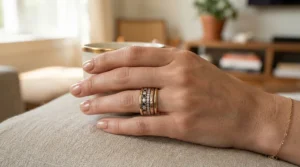
What is a thin stackable wedding band? It’s a low-profile ring, typically 1mm to 2.5mm wide, designed to sit flush against an engagement ring or other bands without adding bulk. Unlike a traditional single wedding band, a stacking band is built to be worn in combination — with mixed metals, mixed textures, or added over the years to mark anniversaries.
This guide breaks down seven real, currently available options spanning budget stainless steel sets to a genuine solid-gold diamond band, plus the comparison data, care tips, and buying framework you actually need before you check out. We’ll also get into mixed metal stacking rings, dainty stackable wedding bands, and the stacking trends worth knowing about before you swipe your card.
Quick Comparison Table
Before the deep dive, here’s the fast version — useful if you’re comparing on your phone in a jewelry store parking lot, which, let’s be honest, is exactly how most stacking decisions get made.
| Ring | Metal / Material | Width | Best For |
|---|---|---|---|
| PAVOI Dainty Layering Set | Waterproof stainless steel, 14K plate | 1mm | Budget starter stack |
| MILACOLATO Thin Stackable Set | 14K gold plated, non-tarnish | 1.3mm | Ultra-slim minimalist look |
| Poxtex Couples Stackable Set | 14K gold plated | 1mm–5mm | His-and-hers matching |
| EAMTI 2mm CZ Band | 925 sterling silver | 2mm | Budget sparkle |
| PAVOI Rose Gold CZ Band | Sterling silver, 14K rose gold plate | 1.8mm | Everyday shimmer |
| PAVOI Interlocked Rings | 14K gold plated, mixed tones | Varies | Mixed metal statement |
| Dazzlingrock Diamond Band | 10K/14K solid gold, real diamond | ~1.5mm | Premium, real diamond |
Looking at the spread, the split is really about metal authenticity versus experimentation cost: the plated stainless and gold-over-silver picks let you test a stacking habit for the price of a nice dinner out, while the Dazzlingrock Collection band is the one entry here made of solid gold with an actual mined diamond — meaning it’s the piece you’d wear as a permanent anchor rather than a rotating accent. If your goal is trying five different stack combinations before committing, start with the plated sets; if you already know your metal color and just want the “real” version, skip straight to solid gold.
💬 Found a combination you like already? Save this page and come back before you check out — a few extra minutes of comparison usually saves buyer’s remorse later.
Top 7 Thin Stackable Wedding Bands for Layering: Expert Analysis
| # | Product | Price Range | Ideal Buyer |
|---|---|---|---|
| 1 | PAVOI Dainty Layering Stackable Ring Set | Under $20 | First-time stackers |
| 2 | MILACOLATO 1.3mm Thin Stackable Rings | $15-$25 range | Minimalists |
| 3 | Poxtex Couples Stackable Ring Set | $15-$30 range | Couples, mixed widths |
| 4 | EAMTI 2mm Sterling Silver CZ Band | $20-$35 range | Budget sparkle seekers |
| 5 | PAVOI Rose Gold Sterling Silver CZ Band | $30-$50 range | Rose gold lovers |
| 6 | PAVOI Interlocked Mixed Metal Rings | $40-$65 range | Statement stackers |
| 7 | Dazzlingrock Collection Diamond Solid Gold Band | Low-to-mid $200s range | Investing in a permanent piece |
A pattern worth noticing: price climbs almost in lockstep with material honesty. The under-$35 tier is entirely plated metal over base metal or silver, which is fine for rotating fashion pieces but not something you’d want touching water and lotion for forty years straight. Once you cross into the PAVOI Interlocked and Dazzlingrock territory, you’re paying for base metals that won’t wear through — a distinction that matters more than most shoppers realize until year three of daily wear.
1. PAVOI Dainty Layering Stackable Ring Set — waterproof stainless steel starter stack
If you’re not sure whether you’ll actually like the stacked look, this is the low-risk way to find out. The set uses a stainless-steel core with a gold plate, which is the reason it can survive showers and dish duty without the finish flaking within a week — plated brass, by comparison, usually can’t make that claim.
At 1mm wide and roughly 2mm thick per band, these are genuinely thin — thin enough that four of them together still feel lighter than one standard 4mm wedding band. The steel core also means they’re nickel-free and hypoallergenic, which matters if past rings have ever left your finger red or itchy. Based on the spec sheet, this is squarely a beginner’s set: it’s built for daily wear and swimming, not for looking identical to fine gold jewelry up close.
Because it’s a multi-pack rather than a single ring, honest expectations matter here — you’re buying a stacking starter kit, not a wedding-day heirloom. Feedback trends for waterproof stainless stacking sets in this category tend to center on how well the plating survives regular hand-washing and workouts, which is exactly the use case this style is built for; the trade-off buyers in this category consistently note is a slightly less luxurious hand-feel than solid gold.
Pros:
- ✅ Waterproof stainless steel resists tarnish and fading
- ✅ Genuinely thin 1mm profile stacks without bulk
- ✅ Nickel-free build suits sensitive skin
Cons:
- ❌ Plated finish will eventually wear thinner than solid metal
- ❌ Feels lighter/less substantial than fine jewelry
Priced under $20 for a multi-piece set, this is the easiest entry point on the list — the value verdict is simple: if you’re testing the stacking habit before spending real money, start here.
2. MILACOLATO 1.3mm Thin Stackable Rings — thinnest profile for subtle daily wear
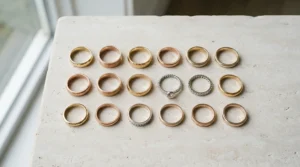
Some stacking rings are thin in name only. This one earns the label — at 1.3mm wide, it’s built to disappear next to a chunkier engagement ring rather than compete with it, which is precisely the effect most people chasing a “minimalist stack” are after.
The 14K gold plating sits over a base designed to resist tarnishing, and the half-cubic-zirconia detailing adds a bit of sparkle without turning the ring into a full eternity band. What this spec sheet actually means in practice: you get shine at certain angles and a clean line at others, which reads as more expensive than the price tag suggests. It’s a smart pick for someone who wants texture in their stack without every single band screaming for attention.
Where this style tends to shine — and where non-tarnish plated gold rings in general tend to draw complaints — is longevity under heavy water exposure; non-tarnish coatings hold their color noticeably longer than standard gold plating, but they’re still a coating, not solid metal, so they aren’t meant to survive a lifetime of daily wear the way karat gold does.
Pros:
- ✅ Ultra-thin 1.3mm width layers invisibly
- ✅ Non-tarnish coating outlasts basic gold plating
- ✅ Half-CZ detail adds subtle sparkle
Cons:
- ❌ Coating will eventually need replacing over years
- ❌ Sizing runs small on some fingers
In the $15-$25 range, this is a smart middle pick for anyone building a five-ring stack without spending five-ring money.
3. Poxtex Couples Stackable Ring Set — best for his-and-hers matching sets
Most stacking guides focus entirely on women’s rings, which ignores a growing trend: couples buying matching thin bands in different widths (1mm, 3mm, 5mm) so both partners wear the “same” ring scaled to their hand. That’s exactly what this set is built for.
The gold plating here covers a base metal designed for daily wear, and the appeal isn’t just the coordinated look — it’s flexibility. A partner who wants a slim, understated band can wear the 1mm; someone who wants more visual weight can go with the 3mm or 5mm from the same collection, so the couple’s rings coordinate in tone without being identical.
What most buyers overlook about matched-width sets like this is that they solve a real styling problem: mismatched metal tones between partners’ rings can look accidental rather than intentional, and buying from one coordinated line avoids that entirely.
Pros:
- ✅ Multiple widths let couples coordinate, not match
- ✅ Non-tarnish plating suited to daily wear
- ✅ Unisex sizing range covers most hands
Cons:
- ❌ Base metal plating, not solid gold
- ❌ Thicker widths run heavier than typical stacking bands
In the $15-$30 range depending on set size, this is the pick for couples who want a coordinated look without buying two separate ring lines.
4. EAMTI 2mm Sterling Silver CZ Wedding Band — sparkle-forward eternity band on a budget
This is where the list shifts from purely plated pieces to something with a real precious-metal base: 925 sterling silver, set with a full ring of cubic zirconia stones. At 2mm wide, it’s slightly thicker than the ultra-thin picks above, but that width is exactly what gives the CZ setting enough room to actually catch light.
Sterling silver being the base metal (rather than base-metal-plus-plating) means the tarnish resistance and hand-feel are genuinely better than the sub-$20 sets, even if it’s not gold. Based on the spec comparison, this is the pick for someone who wants an eternity-band look — that continuous sparkle around the whole ring — without an eternity-band price, since lab-created CZ costs a fraction of natural diamonds by weight while producing a comparable amount of visual brilliance.
A common thread in feedback on CZ eternity-style stacking bands generally is that the stone security holds up well under normal wear, but heavy-impact activities (weightlifting, manual labor) can loosen prong-set stones over time — a risk that applies to any prong-set ring, silver or gold.
Pros:
- ✅ Real sterling silver base, not just plated
- ✅ Full CZ eternity look at a fraction of diamond cost
- ✅ 2mm width balances thinness with sparkle
Cons:
- ❌ Silver will need occasional polishing
- ❌ Prong-set stones need gentler handling than bezel-set ones
At $20-$35, this is arguably the best value-per-sparkle on the entire list.
5. PAVOI Rose Gold Plated Sterling Silver CZ Band — rose gold romance with a real silver base
Rose gold has held its place as one of the most requested stacking tones for a reason: it reads warmer than yellow gold and softer than white gold, which makes it an easy metal to layer against almost anything. This band pairs that tone with a sterling silver base rather than a cheaper alloy, at a slim 1.8mm width designed specifically to sit next to engagement rings without crowding them.
The AAAAA-grade cubic zirconia used here is graded specifically for clarity and cut precision, which is the practical reason it reads as sparklier than lower-grade CZ at the same price point — cut quality affects how stones scatter light more than most shoppers assume, a principle diamond graders take seriously enough that the GIA has built entire courses around measuring it precisely.
Reviewers of rose gold plated silver rings in this category consistently mention how the plating’s warmth holds up better than expected with normal wear, though — as with any plated finish — direct contact with lotions, perfume, and chlorine will shorten the coating’s lifespan.
Pros:
- ✅ Warm rose tone pairs easily with mixed stacks
- ✅ Sterling silver base outperforms cheap alloys
- ✅ Higher-grade CZ reads sparklier at this price
Cons:
- ❌ Rose gold plating fades faster than yellow or white
- ❌ Avoid lotion/perfume contact to extend finish life
In the $30-$50 range, this is the pick for anyone who’s decided rose gold is their signature tone.
6. PAVOI Interlocked Stackable Rings — best for mixed-metal statement stacking
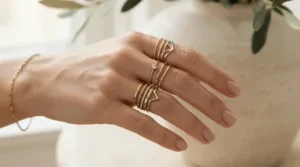
Mixed metal stacking rings have become one of the defining looks in modern bridal jewelry, and this is a purpose-built example rather than an accidental one — the bands are physically interlocked, connecting yellow, white, and rose gold-plated tones into a single piece that reads as an intentional multi-metal statement instead of three separate rings that happen to be worn together.
The advantage of an interlocked design over loose individual bands is practical: the rings can’t slide out of alignment throughout the day, which is a common complaint with freely stacked sets that shift as you move your hands. From a styling standpoint, this piece essentially does the mixed-metal-pairing work for you — a useful shortcut if you like the aesthetic but don’t want to spend time experimenting with which individual tones to combine.
What the spec sheet won’t tell you, but the category’s general feedback suggests, is that interlocked designs trade some flexibility for that stability — you can’t swap out one band for a different one later without disrupting the whole piece, so it works best as a finished statement rather than a stack you plan to keep adding to.
Pros:
- ✅ Interlocked build prevents bands sliding out of place
- ✅ Delivers full mixed-metal look in one purchase
- ✅ Cubic zirconia accents add dimension
Cons:
- ❌ Can’t easily add or remove individual bands later
- ❌ Plated finish, not solid tri-color gold
At $40-$65, this is the shortcut pick for the mixed-metal look without the trial and error.
7. Dazzlingrock Collection Minimalist Diamond Stackable Ring — the one real diamond, solid gold pick
Every other ring on this list is plated metal over a base or silver core. This one isn’t — it’s built in solid 10K or 14K gold, set with a genuine natural diamond at roughly 0.08 total carat weight. That distinction matters more than it might sound: solid gold doesn’t wear through the way plating eventually does, which is why this is the piece most suited to being a permanent, decades-long member of your stack rather than a rotating accent.
At roughly 1.5mm to 2mm wide depending on size, it stays genuinely thin despite being real gold and a real stone — a testament to how far minimalist bridal jewelry has come from the days when “diamond band” automatically meant thick and heavy. As the GIA explains in its carat-weight education, carat weight measures a diamond’s weight rather than its visual size, which is exactly why a small-carat stone set close to the finger can still catch noticeable light without looking oversized against a delicate band.
Because it’s fine jewelry rather than costume jewelry, the honest trade-off is price and ongoing care — natural diamonds should be checked periodically by a jeweler to make sure prongs haven’t loosened, the same maintenance any diamond ring needs regardless of brand.
Pros:
- ✅ Solid 10K/14K gold, not plated
- ✅ Genuine natural diamond, not simulated CZ
- ✅ Slim enough to layer despite being fine jewelry
Cons:
- ❌ Highest price point on this list
- ❌ Needs periodic prong inspection like any diamond ring
In the low-to-mid $200s range depending on gold color and size, this is the anchor piece — the one you buy once you know exactly what your stack is missing.
How to Build (and Care For) Your Ring Stack: A Practical Guide
Buying the rings is the easy part. Making them actually work together — and keeping them looking good — is where most first-time stackers stumble.
Start with your engagement ring or primary band as the anchor and add one thin band at a time rather than buying a five-piece set on day one; it’s much easier to see whether a combination works when you’re not staring at five new rings simultaneously. In the first 30 days, wear your stack through your normal routine — showering, gym, typing all day — before deciding whether plated pieces are holding up. This is also when sizing issues show up: a ring that felt fine in the box can feel snug once your finger swells slightly from heat or salt intake.
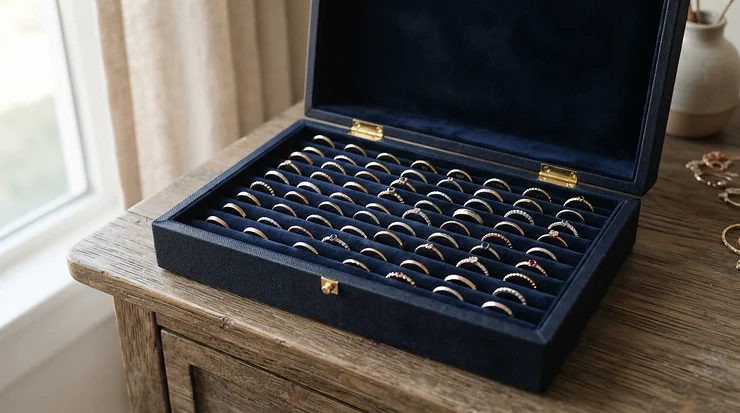
For maintenance, clean plated pieces with a soft cloth only — avoid ultrasonic cleaners and harsh jewelry dips, which strip plating fast. Solid gold and sterling silver pieces can handle gentle jewelry cleaner and an occasional soft-bristle brush. Store rings separately in a soft-lined box rather than tossed in a drawer together; bands rubbing against each other in storage is one of the fastest ways to scratch a soft gold-plated finish. The single most common first-month mistake is wearing a stack in the pool or ocean and assuming “waterproof” plating means “chlorine-proof” — check the specific material claims before assuming.
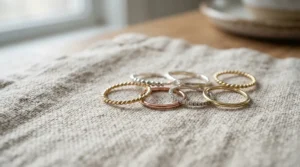
Layered Ring Stack Ideas: 3 Real Brides, 3 Real Scenarios
Seeing how these pieces work for actual lifestyles makes the abstract advice concrete.
The budget-conscious newlywed, six months in. She wants to add to her stack without a big spend, wears gloves for half her workday, and isn’t ready to commit to solid gold yet. The PAVOI Dainty Layering Set paired with the MILACOLATO thin band gives her four to five rings’ worth of stacking options for well under $50 combined — low financial risk while she figures out her long-term style.
The bride who already knows she loves mixed metals. Rather than buying three separate bands in three tones and hoping they photograph well together, she goes straight for the PAVOI Interlocked Rings, which deliver the finished mixed-metal look in a single purchase — ideal for someone who wants the aesthetic without months of experimentation.
The five-year anniversary upgrade. She’s worn a plated starter stack since her wedding and it’s finally time to add one piece that will actually last. The Dazzlingrock Collection solid gold diamond band becomes her permanent anchor — thin enough to sit beside her original engagement ring, but built from materials that won’t fade the way her early plated pieces did.
How to Choose Thin Stackable Wedding Bands for Layering
- Decide your metal base first. Solid gold and sterling silver outlast any plated option; plated pieces are for experimentation, not permanence.
- Measure your engagement ring’s width. Your stacking bands should generally be equal to or thinner than your anchor ring so they don’t overpower it.
- Pick one dominant tone, then accent. A stack of five different colors competing for attention usually looks busier than intended — one dominant metal with one or two accent tones tends to read as more deliberate.
- Consider your hands-on lifestyle. Nurses, gym-goers, and manual laborers should lean toward waterproof stainless steel or solid metal over delicate plated pieces that scratch easily.
- Check comfort-fit versus flat-band design. Comfort-fit interiors round slightly for easier on/off but can feel different when stacked flush against a flat-band neighbor.
- Budget for the whole stack, not one ring. A five-band stack at $30 each adds up fast — decide your total spend before falling for individual pieces one at a time.
- Save the real-metal upgrade for later. It’s genuinely fine to start with plated pieces and add one solid gold or diamond piece once you’ve confirmed your preferred tone and width.
Mixed Metal Stacking Rings vs. Matching Metal Stacks
The debate between mixed metal stacking rings and single-tone matching stacks comes down to a simple trade-off: cohesion versus personality.
A matching metal stack — all yellow gold, or all white gold — photographs more predictably and pairs cleanly with other jewelry you already own, since you’re not introducing multiple undertones into one look. It’s the safer, more traditional route, and it’s genuinely easier for a first-time stacker to get right without any styling knowledge.
Mixed metal pairing, by contrast, rewards intentional contrast: a warm rose gold band next to a cool white gold one draws the eye specifically because it isn’t uniform. The PAVOI Interlocked Rings essentially pre-solve this by physically fusing the tones together, while pieces like the EAMTI or Dazzlingrock bands work well as standalone accents you deliberately introduce into an otherwise single-tone stack. The honest downside of mixing metals loosely is that it can look unintentional if the tones clash rather than complement — which is exactly why pre-mixed pieces have become popular shortcuts for people who like the aesthetic but not the guesswork.
Minimalist Bridal Jewelry & Stacking Trends to Know
Dainty Stackable Wedding Bands: The Minimalist Case
Dainty stackable wedding bands have grown from a niche alternative into one of the dominant bridal jewelry categories, largely because they solve a practical problem: a single thick wedding band can feel heavy or clunky against smaller hands, while several thin bands distribute that same visual weight more gently. The MILACOLATO and PAVOI Dainty Layering Set picks above are both built around this exact principle — thinness as a design feature, not a compromise.
Stacking Ring Trends for 2026
Current stacking trends lean toward asymmetry over matched sets — brides mixing widths, textures, and even finish (polished next to matte) rather than buying a uniform three-ring bundle. Interlocked and connected designs, like the PAVOI Interlocked Rings, have also grown in popularity as a way to get a curated mixed-metal look without assembling it band by band.
Mixed Metal Pairing 101
If you’re pairing metals yourself rather than buying a pre-connected set, a simple rule helps: pick one metal to dominate (worn closest to your knuckle or as the widest band) and let the second and third tones play supporting roles as thinner accent pieces.
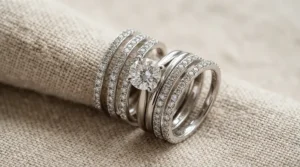
Common Mistakes When Buying Thin Stackable Wedding Bands
Buying purely by photo is the most frequent misstep — a ring that photographs beautifully flat-laid on a marble counter can feel completely different stacked on an actual hand under real light. Skipping the sizing chart is another: because these bands are thin, even a half-size error is more noticeable than it would be on a wider, chunkier ring. Shoppers also commonly underestimate cumulative cost, buying rings one at a time without a running total, only to realize a “budget” stacking habit added up to a meaningful sum. Finally, ignoring material claims — assuming “gold” automatically means solid gold rather than gold-plated — leads to disappointment when a coating wears thin faster than expected; this is precisely the kind of confusion that federal disclosure rules exist to prevent, since the FTC’s jewelry marketing guidelines require sellers to clearly disclose karat fineness and plating on any product described using the word “gold.”
What to Expect: Real-World Performance
Specs on a product page only tell part of the story — here’s how these categories actually behave day to day. Plated stainless and gold-over-silver pieces typically hold their finish well for the first several months of normal wear, with visible thinning usually showing up first at points of friction: the underside of the band, where it contacts other rings, and any spot that regularly brushes against a keyboard or steering wheel. Sterling silver pieces will tarnish faster than gold in humid climates but respond well to a quick polish. Solid gold pieces, like the Dazzlingrock band, show essentially no color change over years of wear — the main real-world consideration becomes stone security rather than metal finish, since prongs holding any diamond, natural or simulated, benefit from a jeweler’s inspection every year or two.
| Consideration | Plated Metal (Stainless/Base) | Sterling Silver | Solid Gold |
|---|---|---|---|
| Tarnish resistance | Moderate, coating-dependent | Needs regular polish | Excellent |
| Best For | Rotating fashion pieces | Budget sparkle | Permanent daily wear |
| Water/Chlorine Safe | Varies by coating | Avoid chlorine | Generally safe |
The takeaway from this comparison is straightforward: match the metal to the role that ring plays in your stack. Pieces you plan to swap seasonally can absolutely be plated; the one ring you never want to take off is where solid gold earns its higher price tag.
Long-Term Cost & Maintenance of Your Ring Stack
Thinking in total cost of ownership changes the math on “budget” pieces. A $20 plated set that needs replacing every 12-18 months due to finish wear can cost more over five years than a single $200 solid gold band that never needs replacing — the plated route just spreads that cost out in smaller, less noticeable purchases. That doesn’t make plated pieces a bad choice; it just means they’re better suited to rings you expect to rotate or replace anyway, rather than the permanent anchor of your stack.
Maintenance costs also differ: solid gold and sterling silver can be professionally cleaned and re-polished by any local jeweler for a modest fee, while plated pieces generally can’t be re-plated cost-effectively once the coating wears through — at that point, replacement is usually cheaper than restoration. Budgeting roughly one jeweler visit per year for prong-set pieces, like the Dazzlingrock band or the EAMTI CZ ring, is a reasonable rule of thumb to catch loosening stones before they’re lost entirely.
Safety, Skin Sensitivity & Compliance Guide
Nickel sensitivity is far more common than most jewelry shoppers realize — the American Academy of Dermatology notes that nickel allergy is one of the most prevalent causes of allergic contact dermatitis, affecting a substantial share of the population, disproportionately women, largely due to jewelry exposure. If you’ve ever had a ring leave your finger red, itchy, or irritated, look specifically for nickel-free labeling — every ring featured in this guide is described as nickel-free or hypoallergenic by its manufacturer, but sensitive-skin buyers should still patch-test a new piece for the first few days rather than assuming.
On the labeling side, U.S. sellers describing a product as “gold” or “silver” are required to disclose the actual karat fineness or silver purity conspicuously — a rule spelled out under the FTC’s jewelry industry guidelines. Practically, that’s why reputable listings specify “14K gold plated” rather than just “gold,” and it’s worth checking that disclosure before buying from any seller that’s vague about it.
FAQ
❓ How many rings can you stack on one finger?
❓ Can you wear stackable wedding bands every day?
❓ Do stackable wedding bands need to match your engagement ring's metal?
❓ Are thin stackable rings durable enough for a wedding band?
❓ What's the difference between stackable and eternity bands?
Conclusion
The best thin stackable wedding bands for layering aren’t necessarily the most expensive ones — they’re the ones matched honestly to how you’ll actually wear them. Start with a plated set like the PAVOI Dainty Layering Set if you’re still finding your style, lean into a pre-mixed piece like the PAVOI Interlocked Rings if you already know you love the mixed-metal look, and save the Dazzlingrock Collection solid gold diamond band for the moment you’re ready to add something permanent. As the FTC’s jewelry attorney has explained regarding the industry’s updated disclosure rules, consumers generally understand karat disclosures once they’re clearly labeled — so the smartest move you can make as a buyer is simply reading those specs before you add anything to your cart. Whatever combination you land on, building a stack gradually tends to age better than buying five rings in one sitting and hoping they all work.
Recommended for You
- 7 Best Stackable Wedding Bands For Petite Fingers In 2026
- 7 Vintage Style Wedding Bands For Women That Feel Timeless (2026)
- 7 Full Eternity Bands For Anniversary Gifts That Wow In 2026
Disclaimer: This article contains affiliate links. As an Amazon Associate, I earn from qualifying purchases. If you purchase products through these links, we may earn a small commission at no additional cost to you.
✨ Found this helpful? Share it with your friends! 💬🤗
