In This Article
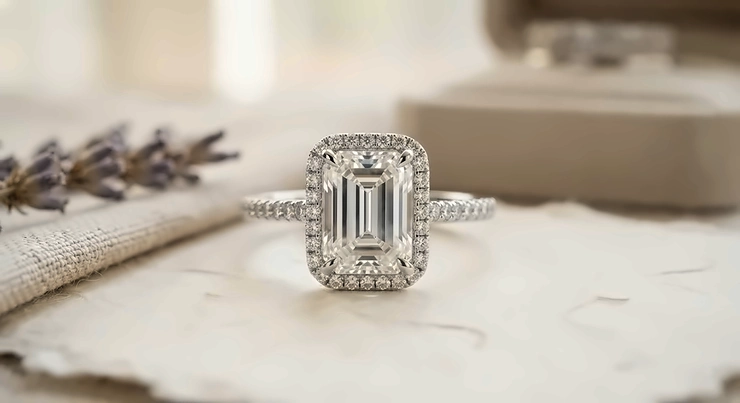
Here’s the thing nobody tells you before you start shopping for an emerald cut engagement ring: it doesn’t sparkle the way you think a diamond ring should. There’s no confetti-burst of fire when it catches the light. Instead, you get something quieter and, honestly, more confident — long glassy flashes that sweep across the stone like light moving through a skyscraper’s windows. An emerald cut engagement ring features a rectangular, step-cut faceted stone with trimmed corners, prized for a clean, architectural “hall of mirrors” look rather than the scattershot sparkle of a round brilliant. It’s the cut favored by people who’d rather stand out for restraint than for razzle-dazzle — think Amal Clooney, Beyoncé, and roughly a century of Art Deco design before them.
That architectural quality is exactly why this cut has surged back into style, and also why shopping for one is trickier than picking a round diamond off a shelf. Because the stone’s big open facets act like windows into its interior, an emerald cut diamond ring hides nothing — inclusions, tints, and cutting mistakes all show up in a way they simply don’t on a busier brilliant cut. That means the “best” emerald cut solitaire ring for your budget isn’t necessarily the biggest carat weight you can find; it’s the one where clarity, proportions, and setting all pull in the same direction.
Below, I’ve pulled together seven real, currently available options spanning budget sterling silver through platinum lab-grown diamond, plus the buying knowledge — clarity minimums, finger-shape considerations, the actual meaning of “hall of mirrors” — that most product listings leave out entirely. Whether you’re hunting for an elongated finger type flattering shape, a halo gold setting for extra sparkle, or a straightforward solitaire, there’s a real product match ahead.
Quick Comparison Table
| Ring | Stone Type | Metal | Price Range | Best For |
|---|---|---|---|---|
| Kobelli Emerald Cut Diamond Three Stone Ring | Lab-grown diamond | 14K white gold | $1,600–$2,400 range | Buyers who want three real diamonds, not accents |
| Houston Diamond District Platinum Solitaire | Lab-grown diamond | Platinum | $2,800–$4,200 range | Premium shoppers prioritizing durability and pavé sparkle |
| Kobelli 1.75ct Emerald Halo Ring | Moissanite + lab diamond | 14K gold (3 tones) | $900–$1,300 range | Anyone chasing a bigger look on a mid-tier budget |
| Kobelli Emerald-Cut Moissanite Solitaire | Moissanite | 14K yellow gold | $700–$1,000 range | A clean, classic solitaire without diamond pricing |
| Gem Stone King 10K Emerald Cut Ring | Diamond accents + gemstone | 10K white gold | Under $400 range | First-time buyers wanting real gold, real diamonds |
| Effinny Elongated Emerald Cut Ring | Simulated diamond | 925 sterling silver | Under $60 range | Testing the elongated silhouette before investing more |
| EAMTI 3CT Three-Stone CZ Ring | Cubic zirconia | 925 sterling silver | Under $40 range | Promise rings, placeholders, or ultra-tight budgets |
Looking at the spread above, the gap between the EAMTI 3CT Three-Stone CZ Ring and the Houston Diamond District Platinum Solitaire isn’t just price — it’s what the ring is actually for. The sterling silver options work as placeholders or low-stakes promise rings while you save, whereas the Kobelli Emerald Cut Diamond Three Stone Ring and the Houston Diamond District piece are built as decades-long daily-wear jewelry with real diamond content. If you’re anywhere in the middle, the moissanite options from Kobelli hit a sweet spot: solid gold, a stone with real hardness and fire, and a price that doesn’t require financing.
💬 Already have a favorite from the table above? Scroll down to see it up close.
Top 7 Emerald Cut Engagement Rings: Expert Analysis
1. Kobelli Emerald Cut Diamond Three Stone Engagement Ring — three real lab-grown diamonds, not accents
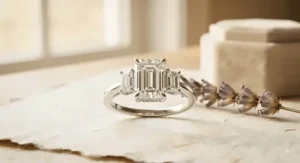
The headline feature here is right there in the name: this isn’t a single center stone with tiny side chips, it’s three genuine lab-grown diamonds totaling roughly 1¾ carats, set in solid 14K white gold and designed and made in Kobelli’s Los Angeles workshop. The emerald cut center stone is flanked by two smaller diamonds cut to echo its rectangular lines, which is a detail a lot of three-stone rings fumble by mixing shapes that don’t visually agree.
Because every stone here is a certified lab-grown diamond rather than a diamond simulant, you’re getting genuine diamond hardness (a 10 on the Mohs scale) and genuine diamond fire, just without the mined-diamond markup — lab-grown diamonds typically run 60-85% less than mined stones of comparable size and grade. Based on the spec comparison with other three-stone rings in this bracket, the fact that all three stones are diamond (not diamond-plus-CZ, which is common at this price point) is what actually justifies the cost.
This is a ring for someone who wants “diamond ring” to be a literal, checkable fact — not a marketing description. It suits buyers who plan to wear it daily for life and who value the symbolism of three stones (often read as past, present, future) over a single dramatic solitaire. Reviewers of Kobelli’s lab-grown diamond line consistently flag the brand’s US-based manufacturing and responsive customer service as differentiators versus overseas drop-shippers, though buyers should expect the standard resize wait times that come with made-to-order fine jewelry rather than mass-stocked pieces.
Pros:
- ✅ All three stones are genuine lab-grown diamonds, not simulants
- ✅ Made in the USA with traceable, conflict-free sourcing
- ✅ Matching wedding band available for a cohesive bridal set
Cons:
- ❌ Made-to-order turnaround is slower than in-stock silver pieces
- ❌ White gold requires occasional rhodium replating over time
At around $1,600–$2,400 depending on carat total and gold karat, the Kobelli Emerald Cut Diamond Three Stone Engagement Ring lands as one of the strongest value plays in the “actual diamond” category, especially against mined-diamond three-stone rings that routinely start above $4,000 for similar total carat weight.
2. Houston Diamond District Emerald Cut Lab-Grown Diamond Platinum Ring — platinum solitaire built for daily-wear durability
If the Kobelli three-stone ring is about visible stone count, this piece is about material integrity: it’s a solitaire emerald cut lab-grown diamond, graded D-E color and VS1-VS2 clarity, set in platinum rather than gold, with pavé diamond side stones lining the shank. Platinum matters more than people assume — it’s denser and more scratch-resistant than white gold, and it never needs replating because the metal itself is naturally white, not gold plated to look white.
The D-E color and VS1-VS2 clarity combination is worth pausing on. Because emerald cuts have that big open table, they’re notoriously unforgiving of color tint and visible inclusions — a corner-cutting VS2 or worse can look noticeably duller here than the identical grade would in a round brilliant. Landing in the VS1-VS2 range gives real margin for an eye-clean look at typical viewing distance, which lines up with GIA’s own guidance on diamond clarity: inclusions read as more visible in emerald cuts than in round brilliants because of the shape’s larger, more open facets.
This is the ring for someone who has decided platinum is worth the premium — people with metal sensitivities, people who hate the idea of replating a ring every few years, or people who simply want the densest, most “serious” version of fine jewelry available. What most buyers overlook about platinum solitaires in this price tier is that the metal cost itself, not just the diamond, is driving a meaningful chunk of the total price.
Pros:
- ✅ Platinum setting resists tarnish and never needs replating
- ✅ D-E color, VS1-VS2 clarity is a strong eye-clean combination for this cut
- ✅ Pavé side stones add sparkle the solitaire shape alone can’t provide
Cons:
- ❌ Platinum’s density makes resizing more labor-intensive (and pricier)
- ❌ Highest price point of the seven rings featured here
Priced in the $2,800–$4,200 range depending on center carat weight, this is squarely a premium pick, but it’s still a fraction of what an equivalent mined-diamond platinum solitaire would run — often $8,000 and up for matching specs.
3. Kobelli 1.75ct Emerald Moissanite & Lab Diamond Halo Ring — halo gold setting that visually stretches the center stone
This is the emerald cut halo ring gold shoppers specifically search for: a 9x7mm emerald-cut moissanite center stone wrapped in a hidden halo of pavé lab-grown diamonds, all on a slender 1.5mm diamond-lined band, available in yellow, white, or rose 14K gold. The “hidden” part of the halo matters — instead of a visible ring of extra stones around the center, the diamonds tuck beneath the crown, so from the top the eye reads mostly diamond and moissanite with no obvious seam.
Pairing a moissanite center with genuine lab-grown diamond accents is a smart hybrid: moissanite brings more raw fire than a diamond (it actually has a higher refractive index), while the diamond halo and band keep the accent stones at true diamond hardness where they take the most wear from daily bumps. Here’s what the spec sheet won’t tell you but the design logic implies: a halo doesn’t just add sparkle, it optically enlarges the center stone by 20-30% at a glance, which is a real trick for maximizing visual size on a mid-range budget.
This ring suits buyers who want their ring to read as “bigger” and more elaborate than its actual carat weight, and who are comfortable with moissanite’s slightly different fire (more rainbow flash, less pure white sparkle) in exchange for real cost savings versus an all-diamond halo of the same visual size.
Pros:
- ✅ Hidden halo design adds visual size without a chunky silhouette
- ✅ Choice of yellow, white, or rose 14K gold
- ✅ Diamond-lined band adds sparkle along the shoulders
Cons:
- ❌ Moissanite’s fire differs noticeably from diamond up close
- ❌ Halo settings collect more dust and need more frequent cleaning
Expect a price in the $900–$1,300 range, positioning this as one of the better “looks expensive, isn’t” plays among emerald cut solitaire ring and halo alternatives.
4. Kobelli Emerald-Cut Moissanite Engagement Ring, 14K Yellow Gold — the clean, all-moissanite solitaire
Strip away the halo and side stones, and this is what’s left: a single 9x7mm emerald-cut moissanite, nearly 3 carats total weight, set simply in solid 14K yellow gold. No side stones, no pavé — just the cut doing the talking, which is arguably the most honest way to showcase what an emerald cut actually looks like.
Moissanite at 9.25 on the Mohs hardness scale is durable enough for genuine daily wear (only diamond and a handful of rare gems rank higher), and its refractive index means it throws noticeably more colorful flash than a diamond of the same size — some buyers love this, others find it reads as slightly less “white.” Because there’s no halo or pavé to distract, the emerald cut’s step facets and hall-of-mirrors effect are more visible here than on the more decorated pieces in this lineup, which honestly makes it a better showcase of what this specific cut is about.
This is the pick for someone who’s already decided on moissanite and just wants the purest, least-fussy version of an emerald cut solitaire ring — a minimalist counterpoint to the halo option above.
Pros:
- ✅ Nearly 3-carat look at a fraction of diamond pricing
- ✅ Solid 14K gold, not gold plating
- ✅ Unobstructed view of the step-cut facet pattern
Cons:
- ❌ No side stones means less overall sparkle than the halo version
- ❌ Yellow gold shows more visible warmth if you prefer a colorless stone look
At roughly $700–$1,000, this solitaire sits as the mid-range anchor of the lineup — more substantial than the silver pieces below, considerably cheaper than anything with a genuine diamond center.
5. Gem Stone King 10K White Gold Emerald Cut Ring with Diamond Accents — real gold, real diamonds, budget entry point
Gem Stone King has been cutting and setting stones since 1903, and this piece reflects that old-school jewelry-house approach applied to a modern budget: an 8x6mm emerald-cut center stone (available across several gemstone options) set in genuine 10K white gold, with small genuine diamond accents worked into the setting rather than simulants throughout.
The 10K gold designation matters more than shoppers usually realize — it’s the minimum karat legally sellable as “gold” in the US, meaning roughly 41.7% pure gold alloyed with harder metals for durability. That’s a meaningful trade-off: less gold content than 14K, but a more scratch-resistant everyday ring as a result, which is arguably the right call for a budget piece that still needs to survive daily wear. Based on the spec comparison with other sub-$400 rings, having any genuine diamond content at all (rather than 100% simulant) is the differentiator that makes this one worth a look over the many CZ-only alternatives crowding this price tier.
This is the pick for someone who wants to say “there are real diamonds in my ring” without the price tag of a diamond center stone — a first ring, a promise ring with upgrade intentions, or simply a tight-budget engagement ring that doesn’t feel like a placeholder.
Pros:
- ✅ Genuine 10K gold, not plated base metal
- ✅ Real diamond accents, not all-simulant construction
- ✅ Backed by a century-plus jewelry manufacturer
Cons:
- ❌ Center stone is a gemstone/simulant option, not diamond or moissanite
- ❌ 10K gold has a slightly more yellow-muted white-gold tone than 14K
Priced under $400 in most configurations, this is a legitimate budget pick precisely because it doesn’t cut every corner at once.
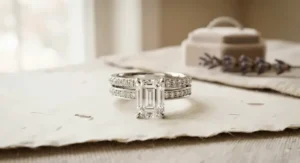
6. Effinny 3.5ct Solitaire Elongated Emerald Cut Engagement Ring — the long emerald cut ring built for an elongated finger type
This is the ring to search for if “elongated” is the word doing the heavy lifting in your search bar. Effinny’s design stretches the length-to-width ratio further than a standard emerald cut, creating a noticeably slimmer, longer silhouette set in 925 sterling silver with a simulated diamond center stone.
That elongated proportion isn’t just an aesthetic preference — it’s a genuine finger-shape tool. A more elongated stone visually lengthens whatever finger it sits on, which is why jewelers commonly recommend elongated emerald, oval, or marquise cuts to shoppers who want a slimming effect. Here’s what most listings don’t explain: the “ideal” emerald cut length-to-width ratio most jewelers cite sits around 1.3 to 1.5, and pieces marketed as “elongated” typically push toward or past the top of that range for a more dramatic, finger-lengthening line.
This ring makes the most sense as either a low-stakes way to test whether you personally like the elongated look before committing to a diamond version, or as a standalone budget choice for someone who’s already sold on the silhouette and doesn’t need diamond content to be happy with the ring.
Pros:
- ✅ Noticeably more elongated silhouette than standard emerald cuts
- ✅ Sterling silver keeps cost accessible
- ✅ A genuinely useful way to trial the elongated look before upgrading
Cons:
- ❌ Simulated center stone won’t hold up to diamond-level daily wear
- ❌ Sterling silver tarnishes faster than gold or platinum
Priced under $60, this is squarely a testing-ground or budget-first purchase rather than a forever piece — and it’s honest about that trade-off.
7. EAMTI 3CT Three-Stone Emerald Cut CZ Engagement Ring, 925 Sterling Silver — the lowest-cost entry point
Rounding out the lineup is the most budget-forward option here: a three-stone design with an emerald-cut cubic zirconia center flanked by smaller CZ side stones, set in 925 sterling silver, available across a wide size run from 3 to 11.
Cubic zirconia is a diamond simulant, not a diamond alternative in the moissanite sense — it’s softer (around 8-8.5 on the Mohs scale versus moissanite’s 9.25) and typically loses some brilliance over months of daily wear as micro-scratches accumulate. That’s not a knock so much as a category fact: at this price, you’re buying the emerald cut look — the three-stone silhouette, the step-cut facets, the hall-of-mirrors flash — without the durability expectations of a diamond or moissanite piece.
This ring earns its spot on a budget-conscious buyer’s list, not because it competes with the diamond or moissanite options above, but because it fills a real need: an affordable stand-in ring for a surprise proposal before a couple shops together for the “real” one, a placeholder while saving, or simply a ring for someone who wants the aesthetic without the investment.
Pros:
- ✅ Extremely accessible price point
- ✅ Full size range from 3 to 11 covers nearly everyone
- ✅ Three-stone emerald cut silhouette at a fraction of diamond pricing
Cons:
- ❌ CZ softness means visible wear develops faster than diamond or moissanite
- ❌ Not intended as a long-term daily-wear investment piece
At under $40, this is less a competitor to the rest of the lineup and more a category of its own — and for the right buyer, that’s exactly the point.
How to Care for and Set Up Your New Emerald Cut Engagement Ring
Getting the ring is only step one — keeping that hall-of-mirrors effect looking sharp takes a little maintenance most retailers never mention. Because the open step facets hide nothing, dust, lotion residue, and soap film show up here faster and more obviously than on a busy brilliant cut, where dozens of tiny facets camouflage the same buildup.
In the first 30 days, resist the urge to wear the ring while applying lotion, sunscreen, or hairspray — these products build an invisible film across the open table that dulls the “mirror” flash almost immediately. A soft-bristled toothbrush and warm water with a drop of mild dish soap, used weekly, keeps the facets clear without risking the metal or stone. For moissanite and diamond center stones specifically, a monthly soak in the same solution followed by a gentle brush restores most of the sparkle that daily wear steals.
Sizing deserves its own note: because emerald cut rings sit lower and wider on the finger than round solitaires, a ring that measures “correctly” in a jewelry store can still feel snug once the stone’s weight settles against your knuckle throughout the day. Size in the afternoon, when fingers are naturally slightly larger, and expect prong checks every 12-18 months regardless of metal type — the corners of an emerald cut are more vulnerable to chipping than a round stone’s continuous edge, so loose prongs are a bigger risk here than on other shapes.
✨ Ready to protect your investment? Most jewelers offer free prong tightening with any purchase — ask before you buy.
Real-World Scenarios: Which Emerald Cut Ring Fits Your Life?
The Budget-Conscious Planner: If you’re proposing within the next six weeks on a tight timeline and tighter budget, the EAMTI 3CT Three-Stone CZ Ring or Effinny 3.5ct Solitaire Elongated Emerald Cut Ring solve the immediate need — both ship quickly, cost under $60, and let you propose now while shopping together for an upgrade later, which is increasingly common practice rather than a compromise.
The Sustainability-Minded Couple: If lab-grown sourcing and traceable materials matter to your values, the Kobelli Emerald Cut Diamond Three Stone Ring or the Houston Diamond District Platinum Solitaire deliver genuine diamond content with a dramatically lower environmental and ethical footprint than mined stones, since lab-grown diamonds skip the mining process entirely.
The Maximum-Impact-Per-Dollar Shopper: If your priority is a ring that photographs big and reads as elaborate without a five-figure budget, the Kobelli 1.75ct Emerald Moissanite & Lab Diamond Halo Ring does the most visual work per dollar spent, thanks to that size-amplifying hidden halo design.
The Slender-Finger Optimizer: If finger-flattering proportions are the deciding factor over stone type, start with the Effinny 3.5ct Solitaire Elongated Emerald Cut Ring as a low-cost way to confirm you love the elongated look before investing in a diamond or moissanite version of the same silhouette.
Solving Common Emerald Cut Ring Problems
Problem: The stone looks dull in photos despite being “high clarity.” This is almost always a cleaning issue, not a grading one — reference the care routine above and clean the piece immediately before any photo occasion.
Problem: Visible inclusions weren’t obvious in the listing photos. Emerald cuts reveal inclusions more readily than brilliant cuts do, which is exactly why clarity grade matters more here than on other shapes; when shopping diamond or lab-diamond options, treat VS2 as a floor, not a target, and ask for close-up video before buying loose stones specifically.
Problem: The ring feels loose after a few weeks. As covered above, emerald cuts sit differently on the finger than round stones and often need a follow-up sizing adjustment — this is normal and not a sign of a defective ring.
Problem: Deciding between moissanite and lab-grown diamond feels impossible. If fire and color-flash appeal to you and budget is the priority, moissanite wins; if the driving factor is owning an actual diamond (lab-grown or otherwise) regardless of price difference, that preference should settle the decision on its own.
Problem: Uncertainty about which of the seven rings above actually fits your budget band. Revisit the Quick Comparison Table near the top of this article — it’s organized by price range specifically to make this decision faster.
How to Choose an Emerald Cut Engagement Ring
- Set your clarity floor first, not last. Because of the open table, aim for VS2 as an absolute minimum on diamond or lab-diamond center stones, and VS1 if the stone is over 1.5 carats — the larger the open facets, the more an inclusion gets visually amplified.
- Pick your length-to-width ratio deliberately. A ratio around 1.3–1.5 reads as a “classic” emerald cut proportion; anything higher leans into the elongated, finger-lengthening look.
- Decide on stone type before setting style. Diamond, lab-grown diamond, moissanite, and CZ all behave differently under the step-cut facet pattern — moissanite throws more color flash, diamond stays whiter, CZ dulls faster.
- Match the setting to how the ring will actually be worn. Halo settings add visual size but collect more debris; solitaires are lower-maintenance but show off the cut’s proportions more honestly.
- Choose metal based on lifestyle, not just looks. Platinum resists tarnish and never needs replating but costs more upfront and resizes less easily; 14K gold balances durability and price; 10K and sterling silver suit budget-first buyers.
- Confirm the return and resize policy before buying. Made-to-order fine jewelry (like the Kobelli and Houston Diamond District pieces here) typically has different return windows than in-stock silver pieces — read this before, not after, ordering.
- Budget for maintenance, not just the purchase price. Prong checks, professional cleanings, and eventual replating (for white gold) are recurring costs worth factoring into your total spend over the ring’s lifetime.
Emerald Cut vs Round Cut Engagement Rings — Which Wins for You?
The round brilliant cut remains the best-selling diamond shape in the US, largely because its 58-facet pattern is mathematically engineered to maximize light return and sparkle from nearly any angle. An emerald cut engagement ring trades that all-angle sparkle for a completely different visual proposition: fewer, larger flashes of light concentrated in the stone’s step facets, an effect that reads as more sophisticated and less “loud” in person.
Practically speaking, round cuts hide clarity flaws far more effectively, meaning you can often drop to SI1 clarity on a round stone and still get an eye-clean look — try that on an emerald cut and inclusions become obvious. Round cuts also tend to cost more per carat than emerald cuts of equal color and clarity, because more of the rough diamond crystal is wasted in cutting a round shape versus a rectangular one. That efficiency gap is why an emerald cut diamond ring of a given carat weight often costs meaningfully less than an equivalent round — assuming you’ve budgeted correctly for the higher clarity grade the shape demands.
The honest takeaway: choose round if maximum sparkle and flaw-forgiveness matter most to you; choose emerald cut if you want a distinctive silhouette, a finger-flattering elongated option, and you’re willing to pay slightly more attention (and budget) to clarity grade to get the eye-clean result.
Common Mistakes When Buying an Emerald Cut Diamond Ring
The single most common mistake is buying on carat weight and color alone while treating clarity as an afterthought — exactly backwards for this cut. A close second is skipping video or in-person viewing entirely; because windowing (dead, light-leaking zones) and uneven facet symmetry aren’t always obvious from listing photos, they’re the kind of flaw that only shows up once the ring arrives.
Buyers also frequently underestimate how differently an emerald cut sits on the hand compared to a round stone of the same carat weight — its low profile and rectangular footprint can read as either more subtle or more substantial depending on finger length, so trying a similar shape on in person (even a costume piece) before committing to an online purchase is worth the extra step. Finally, shoppers sometimes assume every “emerald cut” listing follows the same proportions; length-to-width ratios genuinely vary by manufacturer, so always check the actual millimeter dimensions rather than relying on carat weight alone to estimate size.
Emerald Cut Engagement Rings for Different Finger Types
An elongated finger type — meaning long, slender fingers — actually looks proportionally balanced with almost any emerald cut, since the stone’s rectangular shape echoes the finger’s existing lines rather than fighting them; a classic 1.3–1.5 ratio solitaire, like the Kobelli Emerald-Cut Moissanite Engagement Ring, tends to look especially natural here.
Shorter or wider fingers generally benefit most from a more elongated ratio (1.5 and up), since the stretched silhouette creates a slimming visual effect — this is precisely the appeal of the Effinny 3.5ct Solitaire Elongated Emerald Cut Engagement Ring, and it’s worth deliberately seeking out that longer proportion rather than a standard-ratio stone if finger-lengthening is a priority. For petite hands overall, a smaller emerald cut in a low-profile solitaire setting typically reads as more proportional than a large halo, which can visually overwhelm a smaller hand regardless of finger length. For wider palms or larger hands, a halo setting like the Kobelli 1.75ct Emerald Moissanite & Lab Diamond Halo Ring can actually look more balanced, since the added width of the halo keeps the ring from appearing too small against a bigger hand.
Long-Term Cost & Maintenance
The purchase price is only the entry cost. White gold settings need rhodium replating roughly every 1-2 years of regular wear to maintain their bright white color, typically running $50-80 per service at a local jeweler — a cost platinum pieces like the Houston Diamond District ring simply avoid, which partially offsets platinum’s higher upfront price over a decade-plus of ownership. Sterling silver pieces tarnish faster and can’t be replated the same way, meaning budget rings like the EAMTI and Effinny options are genuinely disposable-tier investments rather than heirloom pieces — a fact worth accepting going in rather than discovering later.
Insurance is the other line item people forget. Most homeowner’s or renter’s policies cap jewelry claims well below typical engagement ring values, so a standalone jewelry insurance rider — often just 1-2% of the ring’s appraised value annually — is worth budgeting for anything above roughly $1,000, which covers everything from the Kobelli moissanite solitaire up through the platinum piece in this lineup. Factor prong checks, cleanings, potential replating, and insurance into your real total cost of ownership, and the gap between the cheapest and most expensive rings here narrows more than the sticker prices suggest.
Features That Actually Matter (And Those That Don’t): VS2 Clarity, Color, and the Step-Cut Hall of Mirrors Effect
Marketing copy loves to lead with carat weight, but for this specific cut, clarity grade does more visual heavy lifting than size. Inclusions are simply easier to spot in an emerald cut than in a round brilliant because of the shape’s large, open facets — which is the entire reason VS2 functions as the realistic minimum clarity grade for this cut rather than a nice-to-have upgrade. Below VS2, expect visible inclusions at normal viewing distance on most stones over half a carat.
The step-cut hall of mirrors effect itself — those broad, alternating light-and-dark flashes running down the stone’s length — is a direct result of the parallel facet arrangement, and it’s a feature, not a flaw, even though it means less all-around sparkle than a round brilliant. What doesn’t matter nearly as much here: cut grade in the way it’s certified for round brilliants. Unlike round diamonds, there’s no standardized lab-issued cut grade for emerald cuts, so “ideal cut” claims on an emerald cut listing are a retailer’s own assessment, not an independent certification — worth knowing so you’re not paying a premium for a grading claim that hasn’t been independently verified.
Color grade matters more on emerald cuts too, for the same open-facet reason clarity does — a G-H color diamond that looks perfectly white in a round brilliant can show a faint warm tint here that’s simply more visible against the stone’s broad, flat facets.
Safety, Regulations & Compliance Guide
Shopping for diamonds and diamond simulants online means navigating marketing language that isn’t always as straightforward as it should be. The FTC’s Jewelry Guides require marketers to truthfully represent the type, grade, quality, cut, and treatment of the gemstone products they sell, which is why reputable listings clearly distinguish natural diamond from lab-grown diamond from moissanite or cubic zirconia rather than using ambiguous language. When comparing listings, look specifically for that clarity — a product genuinely calling itself “lab-grown diamond” is legally required to be an actual diamond, chemically and physically, just grown rather than mined; “diamond simulant” or “cubic zirconia” is a different category entirely and should be labeled as such.
It’s also worth verifying grading claims independently where possible. Center stones over roughly 1 carat in diamond or lab-grown diamond pieces often ship with an independent grading report (GIA or IGI being the two most recognized labs), and that documentation is worth requesting before purchase on any higher-value piece, since it’s the only way to confirm color and clarity claims beyond the seller’s own listing description.
Frequently Asked Questions
❓ What makes an emerald cut engagement ring different from other diamond shapes?
❓ Is an emerald cut engagement ring more or less expensive than a round diamond?
❓ What is the minimum clarity grade recommended for an emerald cut diamond?
❓ Does an emerald cut ring make fingers look longer?
❓ Can moissanite or cubic zirconia be used in an emerald cut engagement ring?
Conclusion
An emerald cut engagement ring rewards a little extra homework in exchange for a look that genuinely stands apart from the round-and-princess-cut crowd most people default to. The seven rings above cover real ground — from the EAMTI and Effinny pieces under $60 for testing the silhouette risk-free, through the moissanite and halo options from Kobelli in the middle, up to the lab-grown diamond three-stone and platinum solitaire pieces built for decades of daily wear.
If there’s one rule to carry forward from everything above, it’s this: prioritize clarity grade over carat weight for this specific cut, because the hall-of-mirrors effect that makes emerald cuts beautiful is the same effect that makes flaws impossible to hide. Get that right, match the proportions to your finger and your setting preference, and budget honestly for the maintenance that keeps any ring looking as good in year five as it did on day one — and any of the seven options above can genuinely serve as the ring behind a lifelong “yes.”
Recommended for You
- Cushion Cut Engagement Ring: 7 Stunning Picks for 2026
- 7 Best Princess Cut Engagement Rings in 2026
- Oval Diamond Engagement Ring: 7 Stunning Picks for 2026
Disclaimer: This article contains affiliate links. As an Amazon Associate, I earn from qualifying purchases. If you purchase products through these links, we may earn a small commission at no additional cost to you.
✨ Found this helpful? Share it with your friends! 💬🤗
