In This Article
Mixed material wedding bands combine two or more metals or materials in one ring, such as tungsten with rose gold plating, titanium with a gold inlay, or sterling silver with 10K gold. They give you contrast and personality, and they usually cost far less than a band cast entirely in precious metal.

Here is the problem with the traditional route. Brilliant Earth’s wedding ring cost guide puts the typical band at roughly $1,300 to $1,800, and that’s before engraving, resizing, or a single diamond. That’s a lot of money for something you’ll bash against doorframes, gym bars, and steering wheels. Meanwhile, alternative-metal rings routinely land between $25 and $400, according to the 2026 price guides we reviewed.
The mixed-material look isn’t just a budget workaround, either. Jewelers have flagged mixed metals as one of the defining wedding ring trends of 2026, partly because soaring gold prices are pushing couples toward slimmer, smarter designs. A ring that pairs a tough core with a warm accent hits the sweet spot between style and survival.
This guide covers seven real options, from a bargain-bin tungsten workhorse to a premium titanium-and-14K splurge. You’ll also get the math behind wedding band cost factors, an honest look at plating wear, and a decision framework so you don’t buy twice. Where a spec matters, I explain what it means on your actual finger. Prices below are ranges, and they shift constantly, so always check the current listing.
Quick Comparison: 7 Mixed Material Wedding Bands at a Glance
| Ring | Materials | Typical Price Range | Best For |
|---|---|---|---|
| King Will 8mm Two-Tone Tungsten | Tungsten carbide, rose gold-tone accents | $25-$40 range | Scratch-proof budget buyers |
| TIGRADE Black and Blue Two-Tone Titanium Band | Titanium, colored finish | Under $50 | Lightweight, sensitive skin |
| Bling Jewelry Men’s Two-Tone Titanium Band | Titanium/carbide, gold-plated stripe | Under $35 | Cheapest gold-look stripe |
| Luxe Jewelry Designs 3-Piece Two-Tone Stainless Set | Stainless steel, rose gold ion plating, CZ | Under $40 | Sparkle on a tiny budget |
| Fine Color Jewels Sterling Silver and 10K Gold Infinity Ring | 925 silver, 10K gold | Around $150-$175 | Real gold content |
| Jared Two-Tone Tungsten 8mm | Ion-plated tungsten | Around $250 | Retail-store backing |
| Debebians Titanium and 14K Gold Band | Titanium, 14K yellow gold | High-$600s | Genuine gold inlay |
Look at the pattern: the price jumps are driven by real gold content, not by looks. The King Will 8mm Two-Tone Tungsten and the Bling Jewelry Men’s Two-Tone Titanium Band deliver a similar visual punch for the cost of a fast-food dinner, while the Debebians Titanium and 14K Gold Band costs roughly twenty times as much because actual 14K gold is in the mix. If you’re shopping for two-tone wedding bands under 250, the middle of this table is where the value lives.
💬 Just one click — help others make better buying decisions too!😊
Top 7 Mixed Material Wedding Bands: Expert Analysis
A note before the rankings: the analysis below is built from published specs and aggregated review sentiment, not hands-on ownership. Listings, sellers, and availability change, so confirm details on the current product page.
1. King Will 8mm Two-Tone Tungsten — scratch resistance at a rock-bottom price
King Will is the brand people keep landing on when they want tungsten without the jeweler’s markup. The two-tone version pairs a brushed silver-tone center with rose gold-tone stepped edges on a comfort-fit, 8mm tungsten carbide base.
On paper, tungsten carbide scores around 9 on the Mohs scale, so daily knocks that would scar gold barely register. In practice, you’ll notice the heft immediately. Roundup editors single out this ring’s weight as a pleasant surprise, and its subtle contrast earns praise for avoiding a gimmicky look. Keep in mind that tungsten can’t be resized.
Aggregated review sentiment for the brand skews strongly positive, with a very large review base on its matte line. A common complaint across tungsten bands in general is that sizing runs slightly loose or tight, so measure before you order.
Pros:
- ✅ Extremely scratch-resistant carbide core
- ✅ Weighty, substantial feel on the finger
- ✅ Very low cost for a two-tone design
Cons:
- ❌ Cannot be resized if your finger changes
- ❌ Accent plating can still wear at the edges
Price: roughly $25-$40, which makes it the value benchmark of this list.
2. TIGRADE Black and Blue Two-Tone Titanium Band — featherweight comfort for all-day wear
If tungsten is the heavyweight, titanium is the swimmer. The TIGRADE Black and Blue Two-Tone Titanium Band gives you a lightweight titanium body with a bold contrasting color, which suits buyers who find heavier bands tiresome.
Titanium’s big selling point is comfort. It’s roughly half the density of tungsten and is naturally nickel-free, so it’s a go-to for sensitive skin. The tradeoff is that titanium scratches more readily than tungsten, though a brushed finish hides that well. And like tungsten, it generally can’t be resized.
TIGRADE’s plain polished dome band carries more than 14,000 Amazon reviews at roughly 4.4 stars, which is solid brand-level evidence of consistent quality control. I couldn’t verify review counts for this specific two-tone color, so treat the brand signal as directional, not definitive.
Pros:
- ✅ Lightweight and comfortable for long wear
- ✅ Hypoallergenic, nickel-free base metal
- ✅ Strong brand-level review track record
Cons:
- ❌ Scratches faster than tungsten carbide
- ❌ Colored finish may wear at edges over years
Price: well under $50, an easy yes for anyone prioritizing comfort.
3. Bling Jewelry Men’s Two-Tone Titanium Band — gold-plated stripe for pocket change
The Bling Jewelry Men’s Two-Tone Titanium Band is the cheapest way here to get a gold-look accent. It’s an 8mm band listed at roughly 12-16 grams, with a 14K gold-plated center stripe against a titanium-and-carbide body.
Because that stripe is plated rather than solid gold, it’s the part most likely to show wear. The weight is reassuring, though; it feels more like a real ring than a costume-jewelry piece.
Here’s the honest data problem: the listing shows only a handful of product ratings, averaging around 3 stars, though the seller’s overall rating across nearly 2,000 reviews sits near 4.3. One buyer says they were very pleased with the quality. With a sample this small, I’d treat it as a promising budget gamble, not a proven winner. Buy it with a return window in mind.
Pros:
- ✅ One of the lowest prices for a gold-look accent
- ✅ Substantial 8mm width and weight
- ✅ Comfort-fit, hypoallergenic claims
Cons:
- ❌ Very few product reviews to rely on
- ❌ Plated stripe will eventually wear
Price: under $35. Cheap enough to experiment, not cheap enough to skip the return policy.
4. Luxe Jewelry Designs 3-Piece Two-Tone Stainless Set — sparkle without the sticker shock
This is the bridal-set option. The Luxe Jewelry Designs 3-Piece Two-Tone Stainless Set combines a rose gold ion-plated stainless steel band with round, prong-set cubic zirconia stones, at roughly 5.5 grams total.
Stainless steel is tough and corrosion-resistant, and ion plating generally outlasts old-fashioned electroplating. What the spec sheet won’t tell you is that stone settings on budget sets are the usual failure point. The prongs, not the steel, determine how long the ring looks sharp.
I couldn’t find product-level reviews, though the seller carries a mid-3-star rating across thousands of reviews. That points to inconsistent customer experiences, so I’d treat this as a short-term or backup ring. Sizing is also listed per item, so check you’re ordering the right size.
Pros:
- ✅ Three-piece set for a very low price
- ✅ Durable stainless steel base
- ✅ Rose gold tone flatters most skin tones
Cons:
- ❌ Mixed seller ratings signal uneven quality
- ❌ CZ prongs can loosen over time
Price: under $40, ideal as a placeholder or travel set.
5. Fine Color Jewels Sterling Silver and 10K Gold Infinity Ring — real gold, still affordable
Here is where a mixed-material ring starts containing actual precious metal. The Fine Color Jewels Sterling Silver and 10K Gold Infinity Ring blends 925 sterling silver with 10K gold in a two-tone infinity design with diamond accents.
Honest analysis: 10K is the lowest common gold purity in the U.S., but it’s harder and less pricey than 14K, which is precisely why it suits a daily wearer on a budget. Sterling silver tarnishes, so keep a polishing cloth handy.
Review data is thin. The seller shows a high rating, but only a handful of reviews back it up, and I couldn’t verify product-level feedback. The ring is more fashion-forward than traditional, so it suits someone wanting an infinity motif over a plain band.
Pros:
- ✅ Includes genuine 10K gold content
- ✅ Elegant infinity motif with diamond accents
- ✅ Can be maintained or resized by a jeweler
Cons:
- ❌ Sterling silver needs periodic polishing
- ❌ Limited verified customer feedback
Price: around $150-$175, a fair price for a ring with true precious-metal content.
6. Jared Two-Tone Tungsten 8mm — the retail-backed middle ground
This is the “I want a store behind me” pick. The Jared Two-Tone Tungsten 8mm pairs a brushed grey tungsten center with rose-tone ion-plated borders and a polished grey interior, at 8mm wide and about 2.4mm thick.
The product page itself is refreshingly honest. Ion-plated tungsten resists scratches better than gold or silver, but plating can still be damaged by abrasive surfaces and chemicals. Read that as a feature: you’re paying for transparent care instructions and a physical return desk.
It’s listed at roughly the top of the budget range, which also means it’s a nice test of whether retailer markup buys you anything. It buys convenience, not better tungsten.
Pros:
- ✅ Honest care guidance from the retailer
- ✅ Polished interior reduces friction
- ✅ Comfort and bold 8mm profile
Cons:
- ❌ Costs several times the budget tungsten options
- ❌ Plating can still wear under abrasion
Price: around $250, which sits right at the edge of the under-$250 line.
7. Debebians Titanium and 14K Gold Band — the splurge with a real gold inlay
At the top of the ladder, the Debebians Titanium and 14K Gold Band uses a titanium body with 14K yellow gold polished edges around a brushed center, in an 8mm comfort-fit build offered in sizes 8.5 to 13.
Because the gold here is solid, it won’t wear off like plating; it will only scratch and patina. That’s the real analytical difference between this ring and everything priced beneath it. You’re buying durability and permanence, not just color.
It’s made to order with a processing time of a few days, and it’s hypoallergenic. I couldn’t find verified customer reviews, so judge this on materials and the maker’s warranty terms.
Pros:
- ✅ Genuine 14K gold, not plating
- ✅ Lightweight titanium comfort
- ✅ Sensible 8mm width with brushed finish
Cons:
- ❌ Far outside a budget-ring range
- ❌ Limited size range and no verified reviews
Price: in the high-$600s. It’s the benchmark that shows why the cheaper rings cost what they do.
How to Choose Mixed Material Wedding Bands: 6 Steps
Choosing mixed material wedding bands comes down to six decisions, made in this order:
- Set your ceiling first. Decide the most you’ll spend per ring, then eliminate everything above it. Budget discipline saves more money than any coupon.
- Pick your base metal for your lifestyle. Tungsten resists scratches, titanium is lightest, stainless steel is forgiving and cheap, sterling silver is soft but warm.
- Decide how the second color is applied. Solid inlay lasts the longest, ion or PVD plating lasts years, and simple electroplating lasts the shortest.
- Check resizing. Tungsten and titanium usually can’t be resized, so measure twice, and consider a ring sizer.
- Match width to your hands. Wider bands use more material and cost more, so 4mm to 6mm is the sweet spot for most hands.
- Read the return policy. Online sizing is guesswork. Free returns turn a risky purchase into a safe one.
If you remember one thing, make it step three. The accent method matters more than the base metal for how the ring will look in three years.
Wedding Band Cost Factors: What Actually Drives the Price
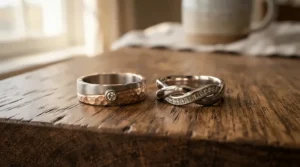
The wedding band cost factors that matter most are metal type, band width, accent materials, finish complexity, and brand. Metal choice is the heavyweight: simple metal bands run roughly $150 to $700, while alternative metals like tungsten, titanium, and stainless steel commonly run $25 to $400.
Width compounds the metal cost. One 2026 price guide notes that a 6mm band costs about 50% more than a 4mm band in the same metal. That’s why men’s bands, which tend to be wider, often cost more in precious metals but barely move the needle in tungsten.
Stones are the next multiplier. For small accent stones, lab-grown diamonds typically run 50 to 70 percent below natural diamonds of comparable size. Finishes like hammered, brushed, or milgrain add labor, and brand markup adds a quiet premium on top. Gold prices also matter: jewelers are shifting toward 9K and 10K gold, slimmer profiles, and lab-grown stones to keep costs down.
Looking at that stack, the cheapest lever is almost always the base metal. Swapping solid gold for a tungsten or titanium core with a gold-tone accent removes the largest cost driver while keeping most of the look.
Metal Combination Pricing: What Each Pairing Typically Costs
Metal combination pricing follows a simple rule: the more real precious metal in the pairing, the higher the tag.
| Combination | Typical Price Range | Gold Content | Best For |
|---|---|---|---|
| Tungsten + plated accent (King Will 8mm Two-Tone Tungsten) | $25-$40 range | None | Tight budgets, active hands |
| Titanium + plated stripe (Bling Jewelry Men’s Two-Tone Titanium Band) | Under $35 | Plated only | Lightweight, low-risk trial |
| Ion-plated tungsten (Jared Two-Tone Tungsten 8mm) | Around $250 | None | Retail-backed purchase |
| Sterling + 10K gold (Fine Color Jewels Sterling Silver and 10K Gold Infinity Ring) | $150-$175 range | 10K | Real gold, modest cost |
| Titanium + 14K gold (Debebians Titanium and 14K Gold Band) | High-$600s | 14K | Heirloom-leaning buyers |
The table shows a cliff, not a slope. Everything without real gold sits under about $250, and the moment solid gold enters, costs climb steeply. If you want a gold look but not a gold bill, plated accents on a hard base metal are the efficient route, provided you accept eventual touch-ups. Buyers who want zero maintenance should budget for the inlay.
✨ Don’t Miss These Exclusive Deals!
🔍 Take your search for mixed material wedding bands to the next level with these carefully selected options. Click any highlighted ring to check current pricing and availability. These picks will help you find a ring you’ll actually enjoy wearing every day!
Two-Tone Wedding Bands Under 250: Where the Value Sits
Two-tone wedding bands under 250 are the sweet spot of this category, and four of the seven rings above live there. The King Will 8mm Two-Tone Tungsten, TIGRADE Black and Blue Two-Tone Titanium Band, Bling Jewelry Men’s Two-Tone Titanium Band, and Luxe Jewelry Designs 3-Piece Two-Tone Stainless Set all cost less than a nice dinner. The Jared Two-Tone Tungsten 8mm hits the ceiling.
What does that budget actually buy? Mostly durable base metals with decorative surface color. That’s fine, as long as you understand the trade. You get scratch resistance and comfort, but you don’t get gold, and you don’t get resizing on most hard metals.
The smart approach is to buy a ring for how it’ll wear, not how it photographs. If you work with your hands, tungsten is the logical base. If you hate feeling a ring, titanium wins. If you want a stone-set look for a small spend, stainless steel is the practical canvas.
Affordable Mixed Metal Rings vs. Traditional Solid Bands
Affordable mixed metal rings win on price and personality, and traditional bands win on repairability and symbolism. Here’s how they compare.
| Feature | Affordable Mixed Metal Rings | Traditional Solid Gold or Platinum |
|---|---|---|
| Typical cost | $25-$250 range | $400-$1,800+ |
| Scratch resistance | High (tungsten), moderate (titanium) | Low to moderate |
| Resizing | Often not possible | Usually easy |
| Accent longevity | Years (plating) or lifetime (inlay) | Lifetime |
| Best for | Active lifestyles, tight budgets | Heirlooms, long-term investment |
Reading across that table, the biggest practical difference is repairability. A gold band can be resized, polished, and reshaped for decades, while a tungsten ring is effectively a replaceable item. That’s not a flaw, it’s a different philosophy. If you’d rather spend a few hundred dollars saved on the honeymoon and replace the ring in twenty years, affordable mixed metal rings make a lot of sense.
Budget Multi-Material Wedding Bands: Features That Actually Matter
Budget multi-material wedding bands live or die on three features, and the rest is marketing.
The accent method. Plating, ion plating, and PVD sit on a spectrum. Retailer guidance on ion-plated tungsten and titanium suggests edge wear commonly appears after roughly two to ten years of daily use, and independent coating sources commonly cite two to five years for consumer-grade finishes. Treat any “lifetime” claim for plating skeptically.
The fit. Comfort-fit interiors have a domed inside surface, which makes a ring slide over the knuckle more easily. They also tend to measure about a half size smaller, so order accordingly.
The base metal’s failure mode. Tungsten is brittle under a hard impact, titanium dents and scratches more easily, and stainless steel is forgiving but less luxurious.
What doesn’t matter much? Weight claims, inflated hardness comparisons, and “lifetime guarantee” banners on products from unknown sellers. For budget multi-material wedding bands, return policies beat slogans every time.
Entry-Level Unique Bands: Getting Personality Without the Price
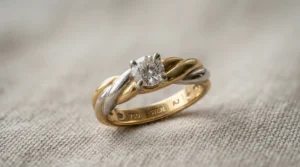
Entry-level unique bands are how you get a ring that doesn’t look like everybody else’s. Hammered textures, brushed centers, stepped edges, and color-blocked finishes all add character without adding cost, since the metal itself is still tungsten, titanium, or steel.
A simple way to think about it is that “unique” lives in the finish, not the metal. A hammered rose-gold-tone tungsten ring looks bespoke, though it’s mass-produced. The King Will 8mm Two-Tone Tungsten does this well with its stepped edges.
If you want something more distinctive still, consider mismatching: a wider matte band for one partner and a slim polished band for the other. Retailers report that two-tone and satin-center designs sell especially well because they hide daily scratches, and sets that share a finish but differ in width tend to look like a pair without looking like uniforms. For entry-level unique bands, that mix-and-match approach is the cheapest trick in the book.
Practical Guide: Caring for Mixed Material Wedding Bands
Mixed material wedding bands need slightly more care than solid ones, because the two materials age at different rates. Treat the first 30 days as the setup period.
First-week habits:
- Wear it daily so you learn its fit, especially if you ordered comfort fit.
- Remove it before heavy gripping, like weightlifting or tool work.
- Check the edges for early wear, since that’s where plating fails first.
Ongoing maintenance:
- Clean with mild soap, warm water, and a soft cloth. Skip abrasive pastes and harsh chemicals.
- Remove it before swimming in chlorinated pools or the ocean, and before using strong cleaners or hand sanitizer.
- Store it separately from harder objects that could scratch the surface.
- If it’s sterling silver, polish occasionally with a silver cloth.
Common first-month mistakes: wearing it in the shower daily, scrubbing the plating, and ignoring a loose fit. A ring that spins or slides around wears unevenly. If a plated accent does fade, check the retailer’s finish warranty, since some brands cover it.
Real-World Scenarios: Matching Rings to Real Budgets
Scenario 1: The college student on a $100 budget. She wants a stone-set look and will probably upgrade later. The Luxe Jewelry Designs 3-Piece Two-Tone Stainless Set fits the budget, and she should plan on it being a starter ring. Free returns matter more than anything else here.
Scenario 2: The electrician who works with his hands daily. He needs scratch resistance and wants a quick rinse routine. The King Will 8mm Two-Tone Tungsten is the logical pick. The tradeoff is that if his hand ever swells in an injury, a tungsten ring may need to be cracked off by emergency staff, so he should keep a sensible fit.
Scenario 3: The office worker with sensitive skin. He barely wants to feel a ring. The TIGRADE Black and Blue Two-Tone Titanium Band is light and nickel-free, so it’s a comfortable choice.
Scenario 4: The couple with $700 to spend on two rings. They want a real gold element. One option is pairing the Fine Color Jewels Sterling Silver and 10K Gold Infinity Ring with a plain tungsten band for the other partner, which spends the budget where it shows most.
Safety and Allergy Guide: Nickel, Plating, and Emergency Removal
Two safety issues are worth knowing before you buy a mixed-material ring.
Nickel. Nickel is among the most common contact allergens, and nickel allergy typically causes an itchy rash where skin meets a nickel-releasing metal. Titanium is nickel-free, which is why it’s recommended for sensitive skin, and many tungsten carbide bands are made cobalt-free or nickel-free. One caution: a plated surface isn’t a guaranteed barrier, because plating can wear through. If you have a known allergy, buy from a seller that clearly states the base metal and return policy.
Emergency removal. Hard metals behave differently in an emergency. Tungsten carbide is brittle and tends to shatter under pressure rather than bend, and published case reports describe emergency departments removing a tungsten carbide ring from a swollen finger by shattering it with locking pliers. Standard ring cutters struggle with it. That’s no reason to avoid tungsten, but it is a reason not to wear any ring too tight. If your finger swells from an injury, don’t wait to seek help.

Frequently Asked Questions
❓ Are mixed material wedding bands durable enough for daily wear?
❓ Can you resize a tungsten or titanium two-tone ring?
❓ How much should I spend on a two-tone wedding band?
❓ Will the colored accent on a budget ring turn my finger green?
❓ Are mixed material wedding bands acceptable for a formal wedding?
Conclusion
Mixed material wedding bands let you trade a bit of tradition for a lot of value, and that’s a smart trade for most couples. The rule is simple: let the base metal handle durability and let the accent handle personality.
If you want one quick takeaway, here it is. Choose the King Will 8mm Two-Tone Tungsten for maximum toughness on a tiny budget, the TIGRADE Black and Blue Two-Tone Titanium Band for comfort, and the Fine Color Jewels Sterling Silver and 10K Gold Infinity Ring if you want real gold without the premium price. Save the Debebians Titanium and 14K Gold Band for when you want solid gold that won’t need replacing, and treat the Jared Two-Tone Tungsten 8mm as the retail-backed middle option.
Whatever you pick, measure your finger carefully, read the return policy, and expect plated accents to age. A wedding band isn’t a one-day purchase, but it doesn’t have to be a financial wound either.
✨ Ready to find your perfect ring?
🔍 Click any highlighted pick above to check current pricing and availability, then pick the one that fits your hands, your habits, and your budget. 💍
Recommended for You
- Mixed Material Wedding Bands For Outdoor Lifestyles: 7 Best (2026)
- Meteorite Wedding Bands: 7 Stunning Picks Worth Buying (2026)
- Carbon Fiber Wedding Bands For Active Men: 7 Top Picks 2026
Disclaimer: This article contains affiliate links. As an Amazon Associate, I earn from qualifying purchases. If you purchase products through these links, we may earn a small commission at no additional cost to you.
✨ Found this helpful? Share it with your friends! 💬🤗
