

In This Article
Carbon fiber wedding bands vs tungsten wedding bands is a face-off between two modern, non-precious materials. Carbon fiber is a lightweight woven composite. Tungsten carbide is a dense, ultra-hard compound of tungsten and carbon. Carbon fiber wins on featherweight comfort. Tungsten wins on scratch resistance and a substantial, weighty feel.

Here’s the thing nobody mentions at the jewelry counter: you will wear this ring roughly 25,000 hours a year. It will meet door handles, barbell collars, steering wheels, dish water and the occasional granite countertop. A gold band takes that abuse and slowly turns into a map of your life. These two materials take a different route, and the difference matters.
Tungsten is the heavyweight champion of scratch resistance. On the Mohs scale of mineral hardness, tungsten carbide lands in the high 8s to 9.5 depending on the source. Carbon fiber plays a different game. It’s featherlight, visually dramatic, and tied to a very contemporary idea of what a groom’s ring can be.
I researched current product listings, published buying guides and aggregated reviews to build this guide. You’ll get seven real rings, honest trade-offs, and the practical know-how that a product page won’t give you. By the end, you’ll know which side of the debate your hand belongs on.
Quick Comparison: Carbon Fiber vs Tungsten at a Glance
| Feature | Carbon Fiber Bands | Tungsten Carbide Bands |
|---|---|---|
| Weight | Very light; barely noticeable | Heavy, substantial, “jewelry-store” heft |
| Scratch resistance | Moderate; depends on the resin or clear coat | Excellent; among the best of mainstream ring metals |
| Break-resistance | Flexes slightly; can chip or crack at inlay edges | Won’t bend; can crack or shatter on hard impact |
| Resizable? | Generally no | No |
| Emergency removal | Typically cut with standard tools | Cracked off with locking pliers |
| Look | Woven, techy, matte or twill | Polished, brushed, black, gunmetal or white |
| Typical price range | Roughly $25–$150 depending on build | Roughly $15–$60 for most Amazon-style bands |
| Best For | Core Carbon Rings Carbon Fiber Twill for lightness | King Will Tungsten Matte Beveled for durability |
Read that table as a trade, not a scoreboard. Tungsten gives you a ring that shrugs off keys, concrete and daily friction, but it asks you to accept brittleness under a sharp blow. Carbon fiber gives you comfort and a distinctive look, but asks you to accept a softer surface. If your hands work hard, the King Willow-style heft of tungsten usually makes more sense. If you forget you’re wearing a ring until someone compliments it, carbon fiber is your lane.
💬 Just one click — help others make better buying decisions too!😊
Top 7 Carbon Fiber and Tungsten Wedding Bands: Expert Analysis
I picked these seven to cover the whole spectrum: pure tungsten, tungsten-carbon fiber hybrids, ceramic, titanium and 100% carbon fiber. All are real products. Prices are ranges only, so check current pricing before you buy.
1. King Will Tungsten Matte Beveled — the battle-tested everyday workhorse
The brushed matte surface with a polished beveled edge is the star here. Matte finishes hide the micro-scuffs that a mirror polish would advertise.
This is tungsten carbide with a comfort-fit interior, offered in widths from about 6mm to 10mm and in black, silver or gunmetal finishes. Comfort fit means the inside is gently domed, so an 8mm band doesn’t pinch around the knuckle. Expect real weight on the hand, far more than a titanium or carbon fiber band.
Based on the spec sheet, this is the “set it and forget it” ring for a groom with a stable ring size and a job that involves tools. The 6mm width also lines up with the slimmer-band trend. One 2026 roundup noted more than 19,700 reviews at roughly 4.7 stars at the time of research. Reviewers commonly praise scratch resistance and fit, while sizing remains the usual tungsten frustration.
Pros:
- ✅ Excellent scratch resistance for daily wear
- ✅ Comfort-fit interior suits wider widths
- ✅ Huge review base and wide size range
Cons:
- ❌ Cannot be resized if your finger changes
- ❌ Can crack under a hard, direct impact
Price: typically in the $20–$50 range. Verdict: the strongest value in the category.
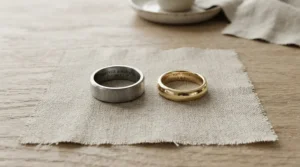
2. King Will Carbon Fiber Plaid Tungsten — plaid inlay on a tungsten backbone
The standout is the plaid-woven carbon fiber inlay set into a tungsten shell. It looks like something from a racing garage, in a good way.
This hybrid puts the tough material on the edges, where scratches happen, and the carbon fiber in the center channel, where it’s recessed and protected. The tungsten edges take the knocks while the inlay does the visual talking. That’s smart design: you get the look of carbon fiber without exposing it to the full beating of daily life.
For a groom who wants both identities in one ring, this is the cleanest compromise on the list. The trade-off is that the inlay’s clear finish is still softer than the tungsten rails. Published roundups list this as a “unique design” pick and a value choice, though I couldn’t verify a deep review pool for this exact variant, so treat sentiment as limited.
Pros:
- ✅ Tungsten rails protect the inlay
- ✅ Striking plaid pattern stands out
- ✅ Hybrid heft without full tungsten weight
Cons:
- ❌ Inlay can dull over years of abrasion
- ❌ Not resizable
Price: usually in the $25–$60 range. Verdict: the best pick for the undecided.
3. Core Carbon Rings Carbon Fiber Twill — all carbon fiber, almost no weight
The standout is a band marketed as 100% aerospace carbon fiber with a visible twill weave. That’s the retailer’s claim, so verify the build details on the listing.
This is the opposite pole from tungsten. A solid carbon fiber ring typically weighs only a few grams, so light that you may check your hand to see if it’s still there. That’s why carbon fiber ring weight is the headline here, and why this is the choice for anyone who hates feeling jewelry.
The honest take: low weight and a woven pattern are the benefit, and a softer surface is the cost. It won’t match tungsten’s scratch resistance, and prolonged exposure to heat or harsh solvents isn’t kind to resin-based composites. Published roundups feature it as a top carbon fiber pick, but review volume looks smaller than for mass-market tungsten bands.
Pros:
- ✅ Nearly weightless on the hand
- ✅ Distinctive woven twill look
- ✅ Great for sensitive or active wearers
Cons:
- ❌ Softer surface than tungsten
- ❌ Poor fit for heat or harsh chemicals
Price: likely in the $60–$150 range. Verdict: worth it if weight is your priority.
4. MJ Metals Black Ceramic Carbon Fiber — sleek black ceramic with a carbon inlay
The standout is a black ceramic shell with a carbon fiber center, a stealthy, minimal look.
Ceramic is very hard and resists scratching well, so the black finish stays uniform. The inlay adds texture without the loud pattern of a plaid. Ceramic rings run lighter than tungsten but heavier than pure carbon fiber.
Here’s what the spec sheet won’t tell you: ceramic’s strength is hardness, and its weakness is brittleness. A sharp knock against a hard edge can chip it, similar in spirit to tungsten’s break risk. Published roundups list it among the carbon fiber inlay picks, with limited verifiable review depth.
Pros:
- ✅ Black ceramic resists everyday scratches
- ✅ Light, comfortable feel on the hand
- ✅ Clean, understated modern aesthetic
Cons:
- ❌ Ceramic can chip on hard impact
- ❌ Not resizable
Price: roughly $30–$80. Verdict: a strong fit for style-first grooms.
5. TUTISS 6mm White Tungsten — slim, bright and polished
The standout is the 6mm domed polished white tungsten finish, which gives you the silvery look of white gold or platinum at a fraction of the cost.
At 6mm it lines up with the slimmer-band shift that several 2026 buying guides describe. The domed profile sits a little taller on the finger than flat bands. White tungsten keeps its polish far longer than precious metals, as tungsten resists the micro-scratching that dulls platinum.
For a groom who wants a classic silver look without the maintenance, this is the straightforward choice. The caveat is the same as every tungsten band: pick your size carefully. Roundups feature it as an everyday-wear pick.
Pros:
- ✅ Bright white look without precious-metal cost
- ✅ Slim 6mm suits smaller hands
- ✅ Polish holds up to daily wear
Cons:
- ❌ Cannot be resized
- ❌ Brittle under sharp impact
Price: often in the $15–$40 range. Verdict: great budget-friendly classic.
6. CROWNAL Tungsten Couple Bands — matching sets for two
The standout is the couple-set approach: 4mm, 6mm and 8mm widths in black, silver, gunmetal or gold tones, with sizes spanning 4 to 17.
Matching bands are a real trend, and this listing lets two people choose different widths in the same finish. Center engraving (“I Love You,” per the listing) adds a sentimental note without custom-order delays. Tungsten means both of you get the same scratch-resistant durability.
The honest drawback is that sets share a quality tier, so if one partner wants carbon fiber and the other tungsten, you’ll need to mix and match. Roundups describe it as a strong value for couples.
Pros:
- ✅ Matching set solves two rings at once
- ✅ Wide size range, 4 through 17
- ✅ Multiple widths and finishes available
Cons:
- ❌ Shared quality tier for both rings
- ❌ Sizing mistakes can’t be fixed by resizing
Price: typically in the $20–$60 range. Verdict: the smartest couples pick.
7. Thorsten Carbon Fiber Titanium Band — titanium shell, carbon fiber inlay
The standout is a titanium shell with a carbon fiber inlay, which pairs light weight with a refined look.
Titanium sits around 6 on the Mohs scale, softer than tungsten but still tough and very light. The carbon fiber inlay brings the techy aesthetic. One 2026 roundup named it a premium pick with roughly a 4.8-star rating and a lifetime warranty. Confirm the warranty terms on the current listing, since affiliate roundups don’t always stay accurate.
If you want light weight with a less fragile feel than ceramic, this is a smart middle road. The trade-off is that titanium scratches more readily than tungsten, so expect a lived-in patina.
Pros:
- ✅ Light titanium comfort all day
- ✅ Polished carbon fiber inlay
- ✅ Warranty reportedly offered (verify)
Cons:
- ❌ Titanium scratches more than tungsten
- ❌ Smaller review pool than mass-market rings
Price: usually $40–$120. Verdict: balanced and elegant.
Side-by-Side Recap of the Seven Rings
| Product | Material | Weight Feel | Approx. Price Range | Best For |
|---|---|---|---|---|
| King Will Tungsten Matte Beveled | Tungsten carbide | Heavy | $20–$50 | Everyday durability |
| King Will Carbon Fiber Plaid Tungsten | Tungsten + carbon fiber | Medium-heavy | $25–$60 | Hybrid style |
| Core Carbon Rings Carbon Fiber Twill | Full carbon fiber | Very light | $60–$150 | Weight-sensitive wearers |
| MJ Metals Black Ceramic Carbon Fiber | Ceramic + carbon fiber | Light-medium | $30–$80 | Stealthy modern looks |
| TUTISS 6mm White Tungsten | Tungsten carbide | Heavy | $15–$40 | Slim classic silver look |
| CROWNAL Tungsten Couple Bands | Tungsten carbide | Heavy | $20–$60 | Matching couples |
| Thorsten Carbon Fiber Titanium Band | Titanium + carbon fiber | Light | $40–$120 | Light, premium feel |
The table makes one pattern obvious: tungsten dominates the budget end, while carbon fiber pushes you into the pricier, lighter end. If you want maximum durability per dollar, King Will Tungsten Matte Beveled and TUTISS 6mm White Tungsten are hard to beat. If you want the lightest possible ring, Core Carbon Rings Carbon Fiber Twill is the answer. The hybrids, King Will Carbon Fiber Plaid Tungsten and MJ Metals Black Ceramic Carbon Fiber, split the difference.
✨ Don’t Miss These Exclusive Deals!
🔍 Take your ring shopping to the next level with these carefully selected bands. Click on any highlighted product name to check current pricing and availability. The right ring will feel like part of you from day one!
Tungsten Ring Pros and Cons: The Honest Ledger
Let’s settle the tungsten ring pros and cons without the marketing gloss. Jewelry-grade “tungsten” is almost always tungsten carbide, a compound of tungsten and carbon usually sintered with a nickel or cobalt binder. Pure tungsten alone would be too brittle for rings.
The pros are real. Tungsten is extremely scratch-resistant, holds its finish for years, doesn’t tarnish, and is typically priced well below gold or platinum. Quality nickel-binder versions are generally described as hypoallergenic. The weighty feel is a genuine draw: many men say it makes the ring feel “real.”
The cons matter just as much. Tungsten cannot be resized, because the sintering process makes it too hard to alter. Many sellers offer size exchanges instead, so check the policy before buying. It’s also brittle. It doesn’t bend like gold, so a sharp, hard blow can crack it.
What about emergencies? The scary myth says tungsten can’t be removed. In practice, emergency staff typically crack it with locking pliers. In some ways that’s easier than cutting metal.
My take: tungsten is the best choice for a stable ring size and a no-fuss lifestyle. It’s a weaker choice if your hands swell often, or if you work in a job with heavy impact risk.
Carbon Fiber Ring Weight: How Light Is Light?
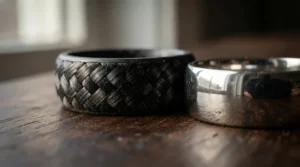
Carbon fiber ring weight is the single biggest reason people choose the material. The numbers explain why. Tungsten carbide has a density of roughly 15 g/cm³. Carbon fiber composites sit near 1.6 g/cm³, so the raw material is about ten times lighter.
In practice, a full carbon fiber band can weigh only a few grams, while a comparable 8mm tungsten band often lands in the mid-teens of grams. Exact numbers vary by width, size and inlay design. Hybrids like King Will Carbon Fiber Plaid Tungsten fall in between because their shell is still tungsten.
What does that mean on your hand? A lighter ring is easier to forget. If you’ve ever tugged at a heavy ring while typing, you know the appeal. Light rings also tend to spin less on the finger and put less pull on the knuckle during long days.
But light has a price. Some grooms interpret weight as meaning, and a featherweight band can feel strangely absent. If you love substance, pick tungsten. If you love invisibility, pick Core Carbon Rings Carbon Fiber Twill or the titanium-based Thorsten Carbon Fiber Titanium Band. Neither is wrong. They’re different personalities.
Scratch Resistant Ring Materials: What Actually Holds Up
Scratch resistant ring materials sound like a simple category, but the details matter. Scratch resistance isn’t the same as damage resistance. A ring can resist scratching and still chip.
Here’s the practical ranking for everyday wear. Tungsten carbide sits at the top. Ceramic follows, with excellent scratch resistance but brittleness at the edges. Titanium is tough but shows a patina over time. Carbon fiber depends heavily on its clear coat or resin, which is much softer than tungsten. Gold and platinum scratch easily and develop a soft, worn look.
For hybrid rings, the design logic is simple: put the tough material where the world touches the ring and the fancy material where it’s recessed. That’s why King Will Carbon Fiber Plaid Tungsten makes more engineering sense than a fully exposed carbon fiber surface for hard-working hands.
Does a scratched ring matter? Some people love a worn-in look as a record of marriage years. Others want a ring that still looks new at the twentieth anniversary. Be honest about which camp you’re in before you pick a material.
Mohs Hardness Scale: What the Numbers Really Tell You
The Mohs hardness scale ranks materials by what can scratch what, from talc at 1 to diamond at 10. Friedrich Mohs introduced it in 1812. As Compound Interest explains, it’s a relative ranking, not an even ladder, which means the gaps between numbers aren’t equal.
Here’s how ring materials stack up, using the commonly cited figures. Tungsten carbide lands around 8.5 to 9.5, depending on the source. Titanium sits near 6. Gold is around 2.5 to 3. Diamond is 10.
This is why tungsten rarely scratches in daily life. Almost nothing you touch is harder, except diamond, certain abrasives and other tungsten. Steel keys, around 5.5, usually won’t mark it.
The catch: Mohs measures scratch resistance only. It tells you nothing about toughness, which is how well a material survives impact. Tungsten is hard but brittle. Gold is soft but forgiving. Carbon fiber doesn’t fit neatly on the scale at all, since it’s a composite rather than a mineral. Use Mohs as one input, not the whole decision.
Ring Break-Resistance: Shatter, Chip or Bend?
Ring break-resistance is where the tungsten debate gets emotional. Tungsten is hard but doesn’t bend. Under a sharp, sudden impact, such as a hammer strike or a hard drop onto stone, it can crack. That brittleness is the price of its hardness.
Carbon fiber behaves differently. Woven fibers distribute stress, so a full carbon fiber ring tends to flex slightly rather than snap. Its weak spots are the resin surface and the edges of inlays, which can chip or lift under abuse. Ceramic, as in MJ Metals Black Ceramic Carbon Fiber, shares tungsten’s brittleness.
There’s also a safety angle. A ring that cracks under a crushing injury can be removed. A ring that bends can trap a finger. Many emergency staff prefer tungsten for exactly that reason, and carbon fiber can typically be cut with standard tools.
Practical rule: if you do heavy manual work, take the ring off for the risky moments or choose a silicone backup. If your daily risks are mostly keyboard and steering wheel, either material will serve you well.
Modern Groom Ring Trends in 2026
Modern groom ring trends in 2026 lean toward personality without fuss. Several jewelers’ guides describe minimalist profiles, textured finishes, mixed metals and personalized details as the main directions. Rustic & Main’s 2026 guide and other retailer roundups point the same way.
Slimmer is back. One 2026 buying guide reports that 4 to 6mm bands have overtaken 7 to 8mm as the most purchased widths. That favors rings like TUTISS 6mm White Tungsten.
Texture is winning. Brushed, hammered and woven finishes beat mirror polish, and that’s exactly where carbon fiber’s twill and plaid patterns shine. Black tungsten with a carbon fiber inlay shows up repeatedly in trend roundups, which is why King Will Carbon Fiber Plaid Tungsten feels so current.
And the two-ring strategy is gaining ground: a “real” band for dress-up, plus a silicone backup for the gym, travel or trade work. It’s practical, and it takes pressure off choosing one perfect ring.
How to Choose Between Carbon Fiber and Tungsten Wedding Bands
- Match the ring to your job. Heavy manual work calls for tungsten’s scratch resistance, or a silicone backup. Desk work frees you to prioritize comfort.
- Decide how you feel about weight. If heft feels reassuring, choose tungsten. If you hate feeling jewelry, choose carbon fiber or titanium.
- Be honest about size stability. Neither material resizes well. If your fingers fluctuate, favor sellers with exchange programs.
- Pick your finish. Matte hides scratches, polish shows them, and woven carbon fiber makes a statement.
- Check the binder. For tungsten, look for nickel-binder carbide if you have metal sensitivities.
- Read the warranty and exchange terms. For rings you can’t resize, these matter more than the brand name.
- Set a realistic budget. Tungsten is cheap per year of durability. Carbon fiber costs more for lightness and style.
Carbon Fiber and Tungsten vs Traditional Ring Materials
| Material | Scratch Resistance | Weight | Maintenance | Price Tier | Best For |
|---|---|---|---|---|---|
| Yellow gold | Low (soft, dents easily) | Medium-heavy | Periodic polishing | High | Traditionalists |
| Platinum | Low-moderate (develops patina) | Heavy | Re-polishing | Highest | Heirloom buyers |
| Titanium | Moderate | Very light | Low | Low-mid | Thorsten Carbon Fiber Titanium Band |
| Tungsten carbide | Excellent | Heavy | Very low | Low | King Will Tungsten Matte Beveled |
| Carbon fiber | Moderate (resin-dependent) | Very light | Low, avoid chemicals | Mid | Core Carbon Rings Carbon Fiber Twill |
Gold and platinum offer heritage and resale, but they pay for it in scratches and upkeep. Tungsten and carbon fiber trade tradition for practicality. If you want the symbolism of a precious metal with the durability of a modern one, a hybrid like King Will Carbon Fiber Plaid Tungsten is a reasonable halfway house, and mixed-material rings remain one of the stronger trend signals this year.
Practical Usage Guide: Your First 30 Days and Beyond
A new ring needs a break-in period. Here’s what the listing won’t tell you.
Week one: Wear it at home. Check for pressure points, especially on wider bands. Comfort-fit interiors help, but they can’t fix a size that’s half a step off. If the ring feels tight by evening, exchange it early while policies still apply.
Cleaning: Tungsten needs only mild soap, warm water and a soft cloth. Carbon fiber needs gentler treatment: avoid acetone, bleach, hot tubs and prolonged heat, which can stress resin. Wipe it dry rather than letting it air-dry with soap residue. For a deeper look at the composite material itself, see this overview of carbon fiber reinforced polymer.
Storage: Keep tungsten away from other jewelry, since a hard ring can scratch softer pieces. Store carbon fiber in a soft pouch.
Common mistakes in month one: wearing the ring while using power tools, wearing it at the gym on barbells, and testing its durability with a hammer. Don’t be that guy.
Optimization trick: buy a cheap silicone band for risky days. It keeps your good ring pristine and your finger safe.
Real-World Scenarios: Who Should Pick What?
Scenario 1: Marcus, a mechanic with a stable ring size, on a $100 budget. Marcus needs scratch resistance and doesn’t care about delicacy. King Will Tungsten Matte Beveled fits, with a silicone backup for engine work. Total spend stays under his budget.
Scenario 2: Daniel, a software developer who hates jewelry. Daniel types 10 hours a day and notices every gram. Core Carbon Rings Carbon Fiber Twill gives him a ring he barely feels. He accepts a softer surface because his hands rarely meet abrasive materials.
Scenario 3: A couple with two different tastes. One partner wants a slim silver look, the other wants something dramatic. CROWNAL Tungsten Couple Bands covers matching widths and finishes, while King Will Carbon Fiber Plaid Tungsten lets the groom add personality without giving up durability.
The pattern is simple: let your daily risks and weight preferences decide, not the trend of the week.
Long-Term Cost and Maintenance
Think in cost per year of wear. A tungsten ring in the budget tier can last decades with almost no upkeep. Gold costs far more upfront and needs periodic polishing or repair.
Carbon fiber bands cost more than tungsten at the high end, and their lifespan depends on how well you treat the resin. Heat, chemicals and abrasion shorten it. That doesn’t make them a bad investment. It means you should treat them like a good watch rather than a work glove.
Don’t forget replacement costs. Because neither material resizes, a size change means buying again, which is why exchange programs matter. A lifetime exchange policy, where offered, can effectively double the value of a cheap ring.
Common Mistakes When Buying Wedding Bands in These Materials
- Guessing your size. Because neither material resizes, get measured at a jeweler, ideally at the end of the day when fingers are largest.
- Trusting “tungsten” without checking the binder. Look for tungsten carbide and a nickel binder if you have sensitivities.
- Ignoring exchange and warranty terms. These matter more than a logo.
- Buying for looks only. A woven pattern is lovely until a chemical cleaner dulls it.
- Assuming scratch-proof means indestructible. Hardness and toughness are different things.
- Skipping a backup ring. A $10 silicone band saves a $100 ring from gym life.
Frequently Asked Questions
❓ Can a tungsten or carbon fiber wedding band be resized?
❓ Can I wear a carbon fiber ring in the shower or pool?
❓ Do tungsten rings turn your finger green?
❓ How much does a men's carbon fiber wedding band cost?
❓ What is the best backup ring for work or the gym?
Conclusion
Carbon fiber wedding bands vs tungsten wedding bands isn’t a battle with one winner. It’s a decision about your hands, your habits and your taste. Tungsten delivers scratch resistance and weight for a modest price, at the cost of brittleness and no resizing. Carbon fiber delivers featherweight comfort and a one-of-a-kind look, at the cost of a softer surface and a bit more care.
If you want the safest everyday pick, start with King Will Tungsten Matte Beveled. If you want light and modern, look at Core Carbon Rings Carbon Fiber Twill or Thorsten Carbon Fiber Titanium Band. If you can’t choose, King Will Carbon Fiber Plaid Tungsten blends both worlds. Whichever you pick, measure twice, check the exchange policy, and consider a silicone backup.
✨ Don’t Miss These Exclusive Deals!
🔍 Take your ring search to the next level with these carefully selected carbon fiber and tungsten bands. Click on any highlighted product name to check current pricing and availability. Your perfect everyday ring is closer than you think!
Recommended for You
- Meteorite Wedding Bands Vs Traditional Metal Bands: 7 Best Picks 2026
- Unique Wedding Bands For Nature Lovers: 7 Stunning Picks 2026
- Mixed Material Wedding Bands: 7 Smart Budget Picks (2026)
Disclaimer: This article contains affiliate links. As an Amazon Associate, I earn from qualifying purchases. If you purchase products through these links, we may earn a small commission at no additional cost to you.
✨ Found this helpful? Share it with your friends! 💬🤗
