In This Article
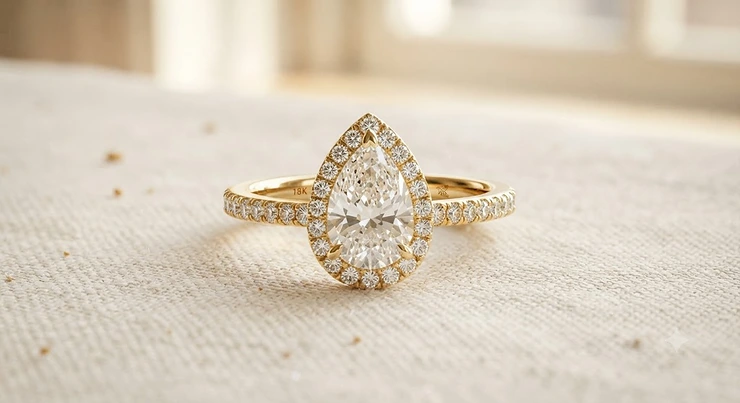
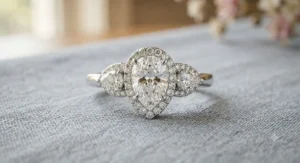
Somewhere between a teardrop and a wink, the pear shape has been quietly stealing engagement ring spotlight for decades — and wrapping it in a halo just turns the volume up. A pear shaped halo engagement ring pairs that elongated, one-pointed silhouette with a ring of smaller accent stones circling the center, and the combination does something clever: it makes a modest carat weight look considerably more generous while adding a rim of extra sparkle that catches light from every angle.
If you’ve been scrolling ring listings until your thumb cramps, you already know the category is crowded. Cheap knockoffs sit next to genuinely well-made pieces, and the marketing copy rarely tells you which is which. This guide skips the fluff. We researched real, currently listed rings — not fictional composites — spanning sterling silver budget picks up through 14-karat gold with genuine mined diamonds, and we’ll walk through what actually separates a ring that ages well from one that loosens its prongs by year two.
What is a pear shaped halo engagement ring? It’s a ring featuring a pear-cut (teardrop-shaped) center stone — diamond, moissanite, or another gem — surrounded by a “halo” of smaller pavé or bead-set stones. The halo boosts perceived size and brilliance while framing the center’s signature point-and-curve outline.
We’ll cover rose gold versus white gold, why “point protection” is a phrase you genuinely need to understand before buying, the size-illusion trick jewelers rely on, and a cathedral-set band option for anyone who wants their ring to sit up a little taller. As GIA’s own engagement ring shape guide points out, a diamond’s shape influences how it reflects light, how large it appears, and how well it suits your personal style — so picking the right pear halo setup is really a series of small, informed decisions rather than one big leap.
Quick Comparison Table
| Ring | Metal Options | Center Stone | Best For |
|---|---|---|---|
| Kobelli Pear Shape Forever One Moissanite Halo Ring | Rose, white, yellow gold | 10x7mm moissanite + diamonds | Rose gold seekers on a mid budget |
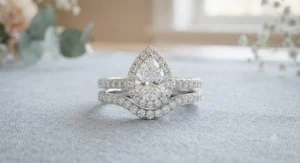
| Charles & Colvard Forever One Pear Halo Wedding Set | 14k white gold | Pear moissanite + diamond halo | Matched bridal sets |
| Kobelli Pear Double Halo Diamond Ring | 14k yellow gold | Genuine diamond, double halo | Cathedral-style band lovers |
| Kobelli Piper Ring | Rose gold (also white/yellow) | 12x8mm moissanite, hidden halo | Modern, low-profile halo |
| FYBIOD 3 Carat Halo Pear Cut Moissanite Ring | Sterling silver | 3ct moissanite | Tightest budgets, biggest look |
| THELANDA Simulated Pear Halo Ring | Sterling silver | Simulated diamond (CZ) | Trying the shape before committing |
| Diamond Wish 14k Gold Pear Halo Ring | White, yellow, rose gold | Genuine mined diamond | Real-diamond premium pick |
Looking at the spread above, the split is really about stone type and budget tier rather than style — nearly every ring here nails the halo silhouette, but FYBIOD and THELANDA get you into the shape for a fraction of what Diamond Wish or the Charles & Colvard Forever One Pear Halo Wedding Set cost. If a genuine mined diamond matters to you more than carat-for-dollar size, skip straight to the gold-and-diamond options; if brilliance-per-dollar is the priority, moissanite dominates this list for good reason.
💬 Just one click — help others make better buying decisions too!😊
Top 7 Pear Shaped Halo Engagement Rings: Expert Analysis
Picking seven rings out of a genuinely enormous category means drawing some lines, and here’s where we drew them: real, purchasable listings; a spread across budget, mid-range, and premium; and honest representation of both natural diamond and moissanite options, since plenty of shoppers are choosing the latter deliberately these days, not settling for it.
1. Kobelli Pear Shape Forever One Moissanite Halo Ring — brightest rose gold brilliance on a mid budget
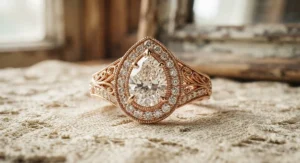
The name is a mouthful, but the ring earns it: a 10x7mm Forever One moissanite center sits inside a halo built from 48 natural white diamond side stones. That’s an unusually generous side-stone count for this price tier, and it matters practically — more stones means more surface area catching light, which is exactly what makes a halo look denser and more “finished” rather than sparse. The moissanite center itself is rated 9.25 on the Mohs hardness scale, just below diamond’s 10, so day-to-day scuffing from keys or countertops isn’t a realistic worry.
Who should care: shoppers who want a rose gold pear halo ring with genuine mined diamond accents but don’t want to pay full diamond prices for the center stone. Kobelli backs the piece with a company warranty card, and the brand has operated out of Los Angeles for over 45 years, which at least confirms this isn’t a fly-by-night import listing — a fact worth more than any anonymous star rating. Independent, verifiable customer reviews specific to this exact listing weren’t something we could confirm during research, so rather than guess at sentiment, we’d point you toward the documented warranty and manufacturing history as your due-diligence anchors here.
Pros:
- ✅ 48-stone diamond halo for unusually dense sparkle at this price
- ✅ Available in rose, white, and yellow gold
- ✅ Backed by a manufacturer warranty card
Cons:
- ❌ Moissanite has different fire/color behavior than diamond in bright light
- ❌ Ring sizing runs in half-size increments, so exchanges may be needed
Price sits in the low-to-mid hundreds range depending on size and gold color — check current price before buying, since moissanite and gold pricing shift. For the halo density and metal options offered, it’s a genuinely strong value pick.
2. Charles & Colvard Forever One Pear Halo Wedding Set — matched wedding set with a built-in second halo
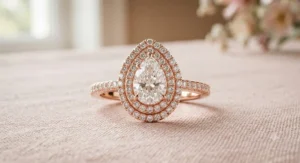
This one comes as a pair: the pear moissanite engagement ring plus a pavé wedding band, both in 14k white gold, both from Charles & Colvard — the company that essentially popularized commercial moissanite. The engagement ring’s halo carries 40 round natural diamonds totaling roughly 0.35 carats, D-E-F colorless grade, while the band adds another 23 diamonds at about a quarter-carat. Buying them together as a designed set solves a problem plenty of shoppers don’t anticipate: bands built separately from the engagement ring sometimes don’t sit flush against an asymmetrical halo, leaving an awkward gap.
Who this fits: buyers who want to lock in the wedding-day look now rather than hunting for a matching band later, and who specifically want Charles & Colvard’s laser-inscribed, warranty-card-backed moissanite rather than an unbranded stone. Because these are Charles & Colvard-branded Forever One stones, the company’s documented specs (D-E-F color, near-colorless grade) are independently verifiable in a way generic “moissanite” listings sometimes aren’t — that’s a real, checkable point in this ring’s favor rather than marketing spin.
Pros:
- ✅ Engagement ring and band pre-matched to sit flush together
- ✅ Branded, laser-inscribed Forever One moissanite with authenticity card
- ✅ SI1 clarity diamonds in the halo, a solidly eye-clean grade
Cons:
- ❌ Set pricing is higher than buying an unbranded moissanite halo alone
- ❌ White gold only — no rose or yellow gold option in this specific set
Expect a price in the $600-$900 range for the pair, depending on size — always confirm current pricing since sets like this fluctuate. If a coordinated bridal look matters more than mixing and matching later, this earns its premium.
3. Kobelli Pear Double Halo Diamond Ring — true cathedral bridge with a tiered double halo
This is the cathedral pear halo band pick on our list, and it earns the label literally: the setting description specifies curving vertical pillars that create a bridge around the profile angle, with the band reaching up to the halo in an actual cathedral shape. Layer on top of that a tiered double halo — one ring of diamonds nestled inside a second — and you get three visible levels of sparkle radiating out from the center stone, all in genuine 14-karat yellow gold with real natural diamonds (about 1/5ct total weight in the halo).
Cathedral settings exist for a structural reason as much as an aesthetic one: raising the center stone on arched shoulders lifts it further off the finger, which increases light entry from the sides and generally makes a smaller stone read as more prominent. Combine that lift with a double halo, and you’re stacking two separate size-illusion tricks on the same ring. This suits buyers who want their pear halo diamond ring for women to have visible architecture — something that doesn’t lie flat against the finger — rather than a low-profile, minimalist look.
Pros:
- ✅ Genuine natural diamonds, not simulants, throughout the halo
- ✅ Cathedral bridge setting raises and showcases the center stone
- ✅ Double halo adds a distinct third ring of sparkle
Cons:
- ❌ Raised cathedral settings can snag on gloves, sweaters, and pockets more than flush settings
- ❌ Yellow gold only in this specific listing; check for other finishes separately
Pricing runs in the low-to-mid hundreds for the 1/5ct total weight version — larger total-weight versions from the same collection climb from there, so check current price for your preferred size. For shoppers set on a cathedral silhouette with real diamonds, this is one of the more literal executions of the style we found.
4. Kobelli Piper Ring — hidden halo that boosts size without visual clutter
The Piper flips the classic halo formula: instead of a visible ring of stones circling the pear, the accent diamonds sit tucked beneath the center stone in a “hidden halo,” while a 12x8mm pear moissanite (rated at 3.5 carats diamond-equivalent weight) takes center stage on a slim basket setting. The band is a comfort-fit solid gold shank, and the whole piece reads as noticeably more minimalist than a traditional halo despite technically carrying one.
What most buyers overlook about hidden halos is that they still do real optical work — the concealed diamonds add sparkle and subtly increase the visual footprint of the setting when viewed from certain angles, without adding the bulk or maintenance surface area of a fully exposed halo. That’s a meaningful trade-off for anyone whose lifestyle involves a lot of hand-washing, gardening, or typing, since exposed halo prongs are the most common snag-and-catch point on any halo ring. Kobelli’s Signature Collection framing suggests this is a newer design line from the brand, built specifically around large moissanite centers paired with slimmer silhouettes.
Pros:
- ✅ Large 3.5ct-equivalent center stone with a lower-profile setting
- ✅ Comfort-fit band reduces pressure points during daily wear
- ✅ Hidden halo adds sparkle without the maintenance of exposed prongs
Cons:
- ❌ Hidden halo sparkle is less visible from a straight top-down view
- ❌ Basket settings expose more of the stone’s pavilion to potential chipping than bezel styles
Expect pricing in the $600-$800 range depending on size and gold tone — prices shift with moissanite market rates, so verify before ordering. This is a strong pick if your priority is a big-looking center stone that doesn’t snag on everything you own.
5. FYBIOD 3 Carat Halo Pear Cut Moissanite Ring — biggest look-at-me carat weight for the smallest price tag
At 3 carats of D-color, VVS1-clarity moissanite in a halo setting, this is the size-to-price outlier on our list, built in sterling silver rather than gold. Sterling silver won’t outlast solid gold structurally — it’s softer and more prone to scratching over years of daily wear — but for buyers testing whether the pear shape and halo combination even suits their hand before spending serious money, or for those who genuinely want a statement-size stone on a tight budget, it’s a legitimate entry point rather than a compromise.
Based on the spec sheet, D color and VVS1 clarity are near the top of the moissanite quality range commercially available, meaning the stone itself is a strong performer even if the metal setting is the budget component. Here’s what to weigh: sterling silver requires more frequent polishing to fight tarnish and is more likely to bend out of round over years of wear than 14k gold, so this ring rewards buyers who either upgrade later or use it as an engagement placeholder while a finer piece is being custom-made.
Pros:
- ✅ 3-carat center stone at a sterling-silver price point
- ✅ D color, VVS1 clarity — a high moissanite quality grade
- ✅ Engravable option available for personalization
Cons:
- ❌ Sterling silver is softer and scratches more easily than gold over years of wear
- ❌ Large stone-to-band ratio may feel top-heavy on smaller hands
Pricing typically lands under $100, making it one of the most accessible entries into the pear halo silhouette — always check the current price, as silver jewelry pricing can shift with metal costs. Treat it as a genuine budget option, not a lesser imitation of the “real” ring.
6. THELANDA Simulated Pear-Shaped Diamond Halo Ring — a low-risk way to test the shape before committing
THELANDA, a jewelry brand operating since 1990, built this piece around an 8x12mm simulated pear-shaped stone rated “AAAAA” quality, surrounded by a halo bringing the total stone count to 35 across the halo and shoulders. It’s fine sterling silver, hand-finished with a high polish, and priced to be genuinely disposable if your taste changes — which, when you’re this early in ring-shopping, is a real possibility worth planning for rather than dismissing.
The honest way to frame a simulated stone is straightforward: it’s cubic zirconia or a similar lab-made simulant, not a diamond or diamond alternative like moissanite, and it won’t hold value or hardness the way either of those will. What it will do is let you live with the pear-and-halo silhouette on your actual hand for weeks before you commit real money to a diamond or moissanite version — trying on a photo online tells you almost nothing about how an elongated shape reads on your specific finger length and knuckle size.
Pros:
- ✅ Extremely low financial risk for testing the pear halo shape
- ✅ 35 total stones across halo and shoulders for full sparkle
- ✅ Brand has operated since 1990, a documented track record
Cons:
- ❌ Simulated stones lack the hardness and resale value of diamond or moissanite
- ❌ Cubic zirconia can cloud or lose sparkle faster with heavy daily wear
Pricing generally sits well under $50, making this closer to a “try before you buy” tool than a forever ring — confirm current pricing before ordering. It earns its spot here precisely because not every shopper is ready to spend hundreds on a first attempt at this shape.
7. Diamond Wish 14k Gold Pear-Shaped Diamond Halo Ring — genuine mined diamond halo with a choice of gold tones
Closing out the list is the only entry built around a fully genuine mined diamond center paired with genuine mined diamond side stones throughout — no moissanite, no simulant. The pear-shaped center runs roughly 1 1/3 to 1 1/2 carats depending on the exact listing configuration, framed by 19 smaller round diamonds in the halo, and the whole piece is available in a buyer’s choice of 14-karat white, yellow, or rose gold. Diamond Wish, the Los Angeles-based jeweler behind the piece, states each stone is hand-selected and hand-set in-house rather than mass-imported.
For buyers who’ve decided that a natural diamond center is non-negotiable — whether for tradition, resale considerations, or personal preference — this is the clearest all-diamond option on our list. The clarity grade on the version we researched falls in the I1-I2 range, which is a real trade-off worth naming honestly: at that clarity level, inclusions are typically visible without magnification in at least some viewing angles, though a well-placed halo and pear’s natural light-scattering can help mask them. If eye-clean clarity matters more to you than an all-natural stone at this price point, weigh this trade-off carefully before buying.
Pros:
- ✅ Fully genuine mined diamond center and side stones
- ✅ Choice of white, yellow, or rose 14k gold
- ✅ Hand-set construction from a documented LA-based jeweler
Cons:
- ❌ I1-I2 clarity means some inclusions may be visible to the naked eye
- ❌ Costs meaningfully more than moissanite alternatives of similar visual size
Pricing for this style generally runs into four figures depending on gold choice and exact carat weight — always check current price given diamond market movement. For an all-natural stone in a halo setting, it’s a legitimately well-specified option.
Practical Usage Guide: Living With Your Pear Halo Ring Day to Day
Getting the ring is the easy part; keeping it looking sharp for the next fifty years takes a little maintenance discipline most listings never mention. In the first 30 days, resist the urge to wear your new ring while applying lotion, sunscreen, or hairspray — these products build an invisible film on halo stones especially fast, since the small accent diamonds have more total surface area and more nooks for residue to hide in than a single solitaire.
Set a maintenance rhythm early: a soft-bristle toothbrush and warm water with a few drops of mild dish soap, gently worked around the halo’s undersides, once every one to two weeks, keeps buildup from dulling the sparkle. Skip ultrasonic cleaners for moissanite and simulated stones unless the manufacturer explicitly says they’re safe — the vibration can loosen prongs on lower-cost settings faster than hand cleaning would. Genuine diamond halos in solid gold generally tolerate ultrasonic cleaning better, but even then, a jeweler check-up once a year for loose prongs is worth the ten minutes it takes.
One optimization trick worth knowing: because pear shapes concentrate wear differently than round stones — the point tends to face outward toward your fingers and catches on fabric more — rotate which hand position you favor for heavy activities like gym sessions or gardening. It’s a small habit that meaningfully extends how long the point-protecting prong stays intact.
✨ Don’t Miss These Exclusive Deals!
🔍 Take your ring search to the next level with these carefully selected pear halo styles. Click on any highlighted item to check current pricing and availability. These pieces will help you find an engagement ring your partner will treasure for a lifetime!
Real-World Scenarios: Which Pear Halo Ring Fits Your Life
Picture three different shoppers walking into this decision from three different directions. First, there’s the recent graduate on a tight post-degree budget, maybe six months into a new job, who wants something that photographs beautifully for the proposal without draining a starter emergency fund — for her, the FYBIOD 3 Carat Halo Pear Cut Moissanite Ring or the THELANDA Simulated Pear-Shaped Diamond Halo Ring make practical sense, since both deliver the shape and the sparkle for well under a hundred dollars while a more permanent upgrade gets planned for later.
Second, consider the couple who’s been together for years, has stable dual incomes, and wants a wedding-ready matched set from day one so there’s zero scrambling to find a complementary band before the ceremony — the Charles & Colvard Forever One Pear Halo Wedding Set solves exactly that problem, arriving pre-coordinated in 14k white gold with documented, branded stones.
Third, picture the buyer for whom “natural diamond, no substitutes” is a genuinely non-negotiable value — maybe it’s family tradition, maybe it’s a personal stance on what “real” means to them — and budget is flexible enough to support that choice. The Diamond Wish 14k Gold Pear-Shaped Diamond Halo Ring is built for exactly this buyer, offering a fully mined-diamond halo with a choice of metal tone. None of these three shoppers is making a “wrong” choice; they’re optimizing for different constraints, and the pear halo category is deep enough to serve all three well.
Problem → Solution: Common Pear Halo Ring Struggles, Solved
Problem: The halo looks lopsided in photos. This is almost always a symmetry issue with the pear cut itself, not the halo. Look for a length-to-width ratio in the 1.5-to-1.75 range, and check that the point lines up with the center of the rounded end. According to GIA’s own tips for picking a pear shaped diamond, when the shoulders, bellies, and wings mirror each other on either side of an imaginary center line, that’s considered an ideal, well-balanced pear shape. A halo can’t fix an asymmetrical center stone; it can only frame what’s already there.
Problem: The prong at the point keeps catching on sweaters. This is a near-universal pear-shape complaint, and it’s a setting issue, not a defect. A V-shaped prong specifically designed to cup the point, rather than a standard rounded prong, reduces snagging significantly and also protects the single most vulnerable spot on the stone from chipping.
Problem: The center stone looks smaller than expected once it arrives. Compare the actual millimeter dimensions listed (not just carat weight) against a size chart before buying — pear shapes with a shallower cut can carry more visible surface area per carat than a deep, narrow cut of the same weight.
Problem: Rose gold is discoloring my skin faintly. This is a copper-alloy reaction, common with lower-karat rose gold. Switching to 18k rather than 14k, or applying a thin rhodium-adjacent barrier coat some jewelers offer, typically resolves it.
Problem: Moissanite looks slightly yellow or gray in certain light. Lower-grade moissanite can show subtle body color in fluorescent light specifically. Requesting a documented “D-E-F” or “colorless” grade, like the stones in the Charles & Colvard Forever One Pear Halo Wedding Set, avoids this almost entirely.
How to Choose a Pear Shaped Halo Engagement Ring
- Start with the length-to-width ratio. Anywhere from 1.5:1 to 1.75:1 is generally considered the most balanced pear silhouette — narrower ratios look more elongated, wider ones look chunkier.
- Check for point protection. A dedicated V-prong at the tip meaningfully reduces chip risk versus a standard rounded prong.
- Decide diamond versus moissanite versus simulant early. This single decision affects price more than almost any other variable on this list.
- Pick your metal for skin tone and daily wear, not just photos. Rose gold flatters warmer skin tones and hides minor scratches better; white gold reads more classic and needs occasional rhodium replating.
- Match halo density to hand size. A dense, tightly packed halo tends to suit larger hands and fingers; a slimmer or hidden halo often reads better on petite hands.
- Confirm ring sizing and return policy before buying. Halo rings are harder to resize than solitaires because resizing can distort the halo’s alignment around the center stone.
- Verify grading documentation for anything above budget-tier. A branded stone with a warranty card or certified grading, like several entries on this list, gives you something concrete to fall back on if a dispute ever arises.
Pear Halo Ring Rose Gold vs White Gold: Which Metal Wins?
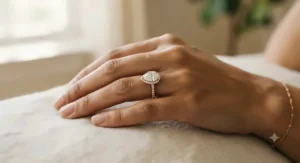
There’s no universal winner here, but there is a genuinely useful way to think about it. A pear halo ring rose gold setting tends to warm up the appearance of both diamonds and moissanite slightly, which can make lower color grades look less noticeably tinted — a practical bonus if you’re stretching a budget toward a bigger center stone rather than a higher color grade. Rose gold’s copper content also makes it marginally more scratch-resistant day to day than pure white gold, though every gold alloy will show wear eventually.
A pear halo ring white gold setting, by contrast, delivers a cooler, brighter contrast against the stone that many buyers associate with a more “classic” or “icy” look — and it tends to better showcase a genuinely colorless diamond or moissanite, since there’s no warm undertone competing with the stone’s own color grade. The trade-off: white gold isn’t naturally white. It’s rhodium-plated, and that plating wears thin over a few years of daily contact, requiring periodic replating to keep its bright finish — a maintenance cost rose gold and yellow gold simply don’t carry.
| Factor | Rose Gold | White Gold |
|---|---|---|
| Skin tone match | Warmer complexions | Cooler or neutral complexions |
| Maintenance | Minimal | Periodic rhodium replating needed |
| Best For | Masking lower color grades affordably | Showcasing high-color, colorless stones |
Reading across this table, rose gold generally wins on lower ongoing maintenance while white gold wins on maximizing the visual “ice” of a top-grade stone — so the right pick really comes down to which trade-off matters more to the person wearing it every day.
Cathedral Pear Halo Band: Why This Setting Style Matters
A cathedral pear halo band lifts the center stone and halo up on arched metal shoulders rather than setting them flush against the finger — visually, it echoes the arched ceiling architecture the name borrows from. Functionally, this raised profile does two things worth understanding before you buy. First, it increases light entry from the sides of the stone, which can measurably boost brilliance compared to a flush-set halo of identical stone quality. Second, it makes the ring read as taller and more substantial in photos and in person, which matters if a low-profile halo has ever struck you as underwhelming for the price.
The Kobelli Pear Double Halo Diamond Ring on our list is the clearest cathedral example here, and its tiered double-halo design compounds the effect — you get the cathedral lift and a second ring of stones working together. The honest trade-off: raised settings snag more easily on gloves, tight sleeves, and pocket linings than flush designs, and they sit higher off the hand, which some wearers with active jobs or frequent hand-washing routines find less practical for daily wear.
Halo Point Protection for Pear Shapes: The V-Prong Explained
If you take one technical detail from this entire guide, make it this one. The single sharpest, most vulnerable spot on any pear-shaped stone is its point — the narrow tip where the two curved “wings” converge. GIA’s own fancy shaped diamond buying guide recommends that if a prong setting is chosen for a pear diamond, it should include a V-shaped prong at the point specifically, because that helps protect the tip from chipping. A standard rounded prong at that spot leaves the thinnest, most chip-prone part of the stone essentially unguarded.
This matters more with moissanite and diamond than with simulants, since a chip in a genuine stone is a permanent, value-affecting flaw, while a scuffed cubic zirconia is a much lower-stakes loss. When evaluating any pear halo ring — including everything on this list — look closely at the product photos for that little V-shaped metal claw wrapping the tip. If you can’t confirm it’s there, ask the seller directly before buying, especially for a piece you plan to wear daily for decades. It’s a five-second check that can prevent a genuinely heartbreaking chip years down the line.
The Size Illusion: How a Halo Makes Your Pear Diamond Look Bigger
Here’s the mechanism behind one of the most repeated claims in engagement ring marketing, explained honestly rather than just asserted. As the GIA guide linked earlier in this article notes, elongated shapes like oval, marquise, or pear can give the illusion of greater size compared to a round diamond of the same carat weight, largely because their surface area, viewed face-up, spreads out more per carat than a compact round cut does. Add a halo around that already-elongated silhouette, and you’re stacking a second size illusion on top of the first — the ring of smaller stones expands the visual footprint of the entire top of the ring, so the eye registers “more sparkle, more coverage” even when the actual center carat weight is modest.
This is exactly why several rings on this list — the Kobelli Piper Ring with its hidden halo, or the Kobelli Pear Double Halo Diamond Ring with its tiered double halo — can look considerably more substantial in person than their stated carat weights might suggest on paper. What most buyers overlook is that this illusion works best when the halo stones are set close together with minimal visible metal between them; a loosely spaced halo doesn’t create the same continuous “sheet of sparkle” effect.
Common Mistakes When Buying a Pear Halo Diamond Ring for Women
The most frequent misstep buyers make with a pear halo diamond ring for women is shopping by carat weight alone and ignoring the length-to-width ratio entirely — two rings both labeled “1.5 carat” can look meaningfully different in person depending on how elongated or stubby the cut is. A second common mistake is skipping the point-protection check discussed above, only to discover a chip risk after the ring’s already been worn daily for a year.
Third, many buyers underestimate how much halo maintenance actually requires — the more stones in a setting, the more surface area collects lotion, soap residue, and skin oil, and the more prongs there are to eventually need tightening. Fourth, some shoppers assume rose and white gold are interchangeable stylistically and pick based on a photo rather than trying the tone against their actual skin under natural light, then find themselves wishing they’d chosen differently. Finally, buyers occasionally rush past the return-and-resize policy on halo rings specifically, not realizing that resizing a halo setting is a meaningfully more delicate (and sometimes costlier) jewelry-repair job than resizing a plain band.
Long-Term Cost & Maintenance of a Pear Halo Engagement Ring
Total cost of ownership on a halo ring extends well past the sticker price, and it’s worth budgeting for honestly rather than being surprised later. Expect an annual professional cleaning and prong check, generally in the range of a modest service fee at most local jewelers, plus periodic rhodium replating for white gold settings — typically needed every one to three years depending on how often the ring is worn. Sterling silver pieces, like the FYBIOD 3 Carat Halo Pear Cut Moissanite Ring and THELANDA Simulated Pear-Shaped Diamond Halo Ring, carry lower upfront costs but higher relative maintenance frequency, since silver tarnishes and bends more readily than gold over years of daily wear.
| Cost Factor | Sterling Silver Halo | 14k Gold Halo |
|---|---|---|
| Upfront Price | Lowest | Moderate to high |
| Replating/Maintenance | More frequent | Less frequent (white gold only) |
| Longevity | Shorter with daily wear | Decades with proper care |
| Best For | Budget or trial rings | Long-term, daily-wear rings |
The math generally favors gold for anyone planning to wear the ring every single day for decades — the higher upfront cost amortizes down to a lower true annual cost than a silver ring that needs replacement or heavy repair within a handful of years. That said, none of this replaces doing your own homework: the FTC’s Jewelry Guides exist specifically to help consumers get accurate information when shopping for gemstones and their laboratory-created and imitation substitutes, so a seller’s willingness to clearly disclose stone type, treatment, and origin is itself a useful signal of trustworthiness, separate from price entirely.
📌 Ready to compare your favorites side by side? Save this guide and revisit it before you check out.
Frequently Asked Questions
❓ Is a pear shaped halo engagement ring out of style in 2026?
❓ Does moissanite look fake next to a real diamond?
❓ What ring size should I estimate if I don't know her size?
❓ Can a pear shaped halo ring be resized later?
❓ How much should I budget for a pear shaped halo engagement ring?
Recommended for You
- 7 Best Halo Engagement Ring Women Picks for 2026
- Baguette Diamond Engagement Ring: 7 Real Picks for 2026
- 7 Best Trillion Cut Engagement Rings in 2026
Disclaimer: This article contains affiliate links. As an Amazon Associate, I earn from qualifying purchases. If you purchase products through these links, we may earn a small commission at no additional cost to you.
✨ Found this helpful? Share it with your friends! 💬🤗
