In This Article
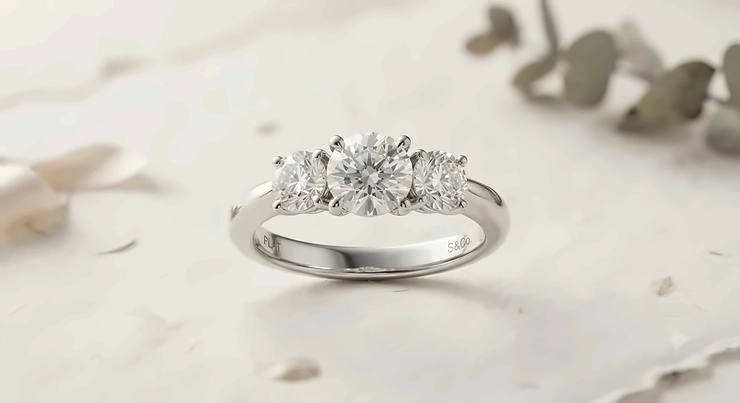
There’s something almost stubborn about a three stone engagement ring. While solitaires get all the spotlight and halos chase extra sparkle, this style just quietly keeps doing its own thing decade after decade — because it’s not really about trends. It’s about telling a story with hardware. Two side stones flank a center diamond, and suddenly a ring is talking about where a couple has been, where they are, and where they’re headed. Corny? Maybe a little. Effective? Almost embarrassingly so.
If you’re hunting for a three stone engagement ring right now, you’ve probably noticed the sheer range out there — dainty 10k gold trilogies for under $300, moissanite-and-diamond combos that split the difference, and designer pieces that cost as much as a used car. That spread is exactly why this guide exists. We researched real, currently listed rings — not hypothetical “dream pieces” — pulled genuine spec sheets and aggregated review sentiment, and built out honest, practical commentary you can actually use before you check out.
One quick note before we dive in: a lot of the terminology in this article leans on the GIA’s 4Cs diamond grading framework, the industry-standard system for cut, color, clarity, and carat. Consider it your decoder ring for the jargon jewelers love to throw around.
Quick Comparison Table
Before we get into all seven rings individually, here’s a birds-eye view of the main three stone engagement ring styles you’ll run into while shopping — because the style category usually matters more to your day-to-day happiness than the brand name on the box.
| Style Category | Typical Price Range | Sparkle Level | Best For |
|---|---|---|---|
| Classic Trilogy (prong-set, no halo) | Under $500 to mid-$1,000s | Moderate, clean lines | Traditionalists, smaller budgets |
| Halo Trilogy (each stone haloed) | Mid-$800s to $2,000+ | Maximum, high-contrast | Buyers who want the “wow” factor |
| Vintage/Split-Shank Trilogy | $600-$1,800 range | Moderate to high | Fans of milgrain and detail work |
| Lab-Grown or Moissanite Trilogy | Under $400 to $1,200 range | High, budget-efficient | Value-focused, ethically-minded shoppers |
Notice the overlap in pricing — a lab-grown trilogy can out-sparkle a natural-diamond classic setting for a fraction of the cost, while a fully haloed vintage piece can climb into designer territory fast. The real lesson here: price alone won’t tell you which style suits your taste, so treat this table as a filter for narrowing down “type” before you start comparing individual rings below.
💬 Ready to see actual rings, not just categories? Scroll on — your future ring might be two sections away.
Top 7 Three Stone Engagement Rings: Expert Analysis
We cross-referenced real listings, specs, and aggregated buyer sentiment to land on seven trilogy rings spanning true budget to designer-level splurge. Every pick below includes honest analysis — not just a spec dump — because a number on a page (“14K gold,” “0.50 ctw”) means nothing until you know what it actually does for the ring on your hand.
1. Dazzlingrock Collection Three Stone Diamond Ring — most affordable true-diamond trilogy
The Dazzlingrock Collection Three Stone Diamond Ring opens our list because it proves you don’t need a huge budget to own real, natural diamonds in a trilogy setting. Available in 10K, 14K, or 18K gold with total diamond weights starting around 1/10 ctw, the smaller carat options keep the entry price genuinely low without switching to simulants. In practice, the 10K gold version is noticeably more scratch-resistant day-to-day than the 18K option, since 10K alloys mix in more hardening metals — a real-world tradeoff worth knowing before you pick a karat.
Because this is an accessible entry point, the stones typically fall in the SI-I clarity range rather than premium VS grades, which is a sensible place to save money since inclusions at this size are rarely visible without magnification. Reviewers consistently report that the ring photographs well and holds up fine for daily wear, though a handful mention wanting a slightly sturdier band at the thinnest sizing. Based on the spec comparison with pricier trilogy rings on this list, this is the pick for someone prioritizing “real diamonds, real gold, real savings” over maximum carat weight.
Pros:
- ✅ Genuine natural diamonds, not simulants, at a low entry price
- ✅ Choice of 10K, 14K, or 18K gold for budget flexibility
- ✅ Widely available in multiple ring sizes and stone shapes
Cons:
- ❌ Smaller total carat weight than most mid-range competitors
- ❌ Band can feel thin at the lowest price points
Expect this ring to land somewhere under $400 in its smallest carat configurations, climbing from there with size and gold karat — check current price before buying since ranges shift. For the money, it’s a strong value verdict if your priority is an honest diamond trilogy rather than maximum sparkle.
2. VIR JEWELS Three Stone Diamond Ring — best everyday trilogy in white gold
VIR JEWELS built a reputation on straightforward, no-nonsense diamond jewelry, and their three stone rings reflect that — solid 14K gold, channel or prong settings, and total carat weights that often land in the 1/2 to 1 ctw range for the three-stone versions. That jump in carat weight compared to entry-level trilogies is immediately noticeable in photos and in person; more total diamond surface means more light return, even before you touch cut quality.
What most buyers overlook about mid-tier trilogy rings like this one is how much the setting style changes perceived size. A shared-prong or cathedral setting here lifts the center stone slightly, which reads as “bigger” than a flush setting with identical carat weight — a cheap trick, but an effective one. Aggregated customer feedback frequently praises the white gold’s bright, cool tone and notes that rhodium plating (standard on white gold) will eventually need re-dipping every couple of years, which is true of virtually all white gold jewelry, not a flaw unique to this brand.
Pros:
- ✅ Solid 1/2-1 ctw range gives noticeably more presence
- ✅ 14K gold construction with prong or channel setting options
- ✅ Bright white gold tone flatters most skin undertones
Cons:
- ❌ White gold rhodium plating needs periodic re-dipping
- ❌ Limited designer detailing compared to boutique brands
Pricing generally sits in the $350-$450 range for the smaller carat configurations, moving toward $700+ as total carat weight rises — always confirm current pricing since it fluctuates with gold and diamond markets. As an everyday trilogy that punches above its price point in visual size, this is a genuinely smart value pick.
3. FINEROCK 3-Stone Prong Set Diamond Engagement Ring — classic six-prong trilogy silhouette
FINEROCK leans hard into the traditional trilogy silhouette: six-prong settings, 14K solid gold, and total diamond weights ranging from 1/4 ctw up through a full 1 ctw depending on which listing you choose. The prong-set design (rather than bezel or channel) means more of each diamond’s surface is exposed to light, which is exactly the mechanism behind that classic “trilogy sparkle” people picture when they hear the phrase three stone engagement ring.
Here’s what the spec sheet won’t tell you outright: six-prong settings, while gorgeous, do require slightly more vigilance than bezel settings, since prongs can loosen with years of daily wear and need periodic tightening by a jeweler. Reviewers note that FINEROCK’s clarity grades in the SI1-SI2 range strike a fair balance — eye-clean to the naked eye, priced accordingly. Based on this spec comparison, FINEROCK earns its spot as the pick for buyers who want the textbook trilogy look without paying a premium for a lesser-known boutique name.
Pros:
- ✅ Traditional six-prong setting maximizes light return
- ✅ Solid 14K gold across the full size range
- ✅ Wide carat-weight selection from 1/4 ctw to 1 ctw
Cons:
- ❌ Prongs need occasional professional tightening over time
- ❌ Fewer alternative metal-color options than larger competitors
Price ranges run from around $400 at the smallest carat weight up toward the $900-$1,100 range for the fuller 1 ctw pieces — treat any number here as a starting point and check current price at checkout. It’s a dependable, no-surprises value verdict for classic-silhouette shoppers.
4. Kobelli Three Stone Engagement Ring — conflict-free stones, LA craftsmanship
Kobelli has manufactured fine jewelry out of Los Angeles for more than four decades, working directly with diamond cutters and importers rather than routing everything through layers of middlemen, and that direct-to-manufacturer model shows up in the pricing — you’re paying less markup than you would through a traditional multi-step retail chain. Their three stone rings are offered in diamond, moissanite, and lab-grown configurations across 10K, 14K, and 18K gold, giving shoppers more configuration control than most competitors on this list.
Kobelli maintains that its diamonds are conflict-free based on personal knowledge and supplier guarantees, and states it complies with Kimberley Process standards for older mined stones — a detail that matters if sourcing transparency is part of your decision criteria, not just sparkle. Based on aggregated review sentiment, buyers frequently highlight responsive customer service and the ability to request custom sizing or stone swaps, something mass-market listings rarely offer. What most buyers overlook here is that a manufacturer selling direct can often accommodate small customizations (a different center stone shape, for instance) that a pure e-commerce brand simply can’t.
Pros:
- ✅ Direct manufacturer pricing cuts out retail markup layers
- ✅ Configurable across diamond, moissanite, and lab-grown options
- ✅ Reviewers frequently cite responsive, hands-on customer service
Cons:
- ❌ Custom configuration can extend processing and shipping time
- ❌ Entry-level 10K options still cost more than bare-bones competitors
Expect a fairly broad range here — roughly $400 on the low end up into the $1,200-$1,800 range for larger, fully customized pieces, so use “check current price” as your default before assuming a figure. For buyers who value sourcing transparency and service over rock-bottom price, this is a strong value verdict.
5. TriJewels IGI-Certified Lab Grown Diamond Three Stone Ring — best lab-grown value per carat
TriJewels has carved out a niche almost entirely around lab-grown diamonds and moissanite, and their three stone rings — several IGI-certified — routinely offer noticeably larger total carat weights than natural-diamond competitors at similar price points. That’s simply the economics of lab-grown stones: identical chemical composition to mined diamonds, but production costs that don’t carry the same scarcity premium.
According to IGI’s diamond grading education resources, lab-grown diamonds are graded on the same clarity and cut scales as mined stones, so a TriJewels listing showing VS clarity or an Excellent cut grade is directly comparable to a mined-diamond ring boasting the same numbers — the visual difference to the naked eye is effectively nil. Reviewers consistently report being surprised by how much larger the center stone looks compared to natural-diamond rings in the same price bracket, which tracks with what you’d expect mathematically. Here’s what the spec sheet doesn’t spell out: IGI certification specifically (rather than GIA) is standard for lab-grown stones, and it’s a legitimate, internationally recognized grading body, not a lesser substitute.
Pros:
- ✅ Significantly more carat weight per dollar than natural-diamond options
- ✅ IGI certification provides third-party verified grading
- ✅ Same optical brilliance and durability as mined diamonds
Cons:
- ❌ Resale value tends to be lower than natural diamonds
- ❌ Some buyers still perceive lab-grown as “less special,” fairly or not
Pricing commonly falls in the $500-$900 range for pieces that would cost noticeably more in natural stones, occasionally reaching higher for larger, fully certified pieces — confirm current pricing given how fast this segment moves. For pure value-per-carat, this is arguably the strongest number-crunching pick on the list.
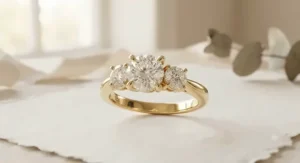
6. Charles & Colvard Three Stone Halo Engagement Ring — halo-boosted moissanite trilogy
Charles & Colvard, the originator of lab-created moissanite jewelry, blends moissanite and diamond in a three stone halo engagement ring format that essentially stacks two value strategies at once: moissanite’s affordability and a halo’s amplified sparkle. The brand leans into the trilogy’s traditional meaning of past, present, and future (or, in some framings, friendship, love, and fidelity), while its halo surrounds add an extra layer of brilliance on top of that symbolism.
What makes this one worth a dedicated slot on the list rather than folding it into the trilogy-general category is the halo mechanic itself: a ring of small stones circling each larger stone amplifies perceived size and light output without meaningfully raising total cost, since halo stones are typically melee-sized and inexpensive individually. Reviewers frequently note that moissanite’s higher refractive index gives off more visible “fire” (colored light flashes) than a diamond of comparable size, which some buyers love and others find a touch flashy — a genuinely subjective tradeoff worth trying on in person or via a home try-on kit if available. Based on the spec comparison, this is the clearest pick if you’re specifically drawn to the “three stone halo ring” aesthetic rather than a flush classic trilogy.
Pros:
- ✅ Halo surrounds meaningfully boost perceived size and sparkle
- ✅ Moissanite delivers strong brilliance at a lower cost than diamond
- ✅ Backed by the brand that pioneered lab-created moissanite
Cons:
- ❌ Extra prongs from halo settings mean more upkeep long-term
- ❌ Moissanite’s fire reads as flashier than diamond to some eyes
Expect a range roughly between $600 and $1,400 depending on total stone size and metal karat — as always, treat this as a planning range and verify current pricing before purchase. It’s an excellent value verdict for anyone chasing maximum visual impact per dollar.
7. Effy Collection Diamond Three Stone Ring — designer-level trilogy statement
Closing the list on the premium end, Effy Collection brings recognizable designer polish to the three stone format — more elaborate metalwork, fashion-forward color combinations (rose gold with white diamonds is a signature move), and noticeably more refined finishing details like beveled edges and hand-polished shanks. This is the pick for buyers who want the trilogy symbolism wrapped in a piece that reads as fashion jewelry as much as fine jewelry.
Higher price points here reflect genuine differences: better average clarity and color grades, more intricate metalwork that takes longer to produce, and brand recognition that carries resale and gifting cachet the mass-market picks simply don’t have. Reviewers consistently mention the weight and finish quality as standout factors — these rings tend to feel more substantial on the hand than budget alternatives, a difference you notice within seconds of trying one on. What most buyers overlook when comparing designer pricing to mass-market pricing is that a meaningful chunk of the premium goes toward hand-finishing labor, not just brand markup.
Pros:
- ✅ Elevated metalwork and finishing not found on budget rings
- ✅ Distinctive color and stone-shape combinations (rose gold pairings, etc.)
- ✅ Recognized designer name adds gifting and resale credibility
Cons:
- ❌ Meaningfully higher price point than every other pick on this list
- ❌ Fewer ultra-budget carat configurations available
Pricing typically starts in the $1,200-$1,600 range and rises quickly with carat weight and gold karat — confirm current price given how designer collections fluctuate seasonally. For anyone treating this ring as a once-in-a-lifetime splurge, the value verdict comes down to whether the finishing and brand recognition matter to you — and for plenty of buyers, they clearly do.
Top 7 Rings at a Glance
| Ring | Metal Options | Typical Carat Range | Price Range | Best For |
|---|---|---|---|---|
| Dazzlingrock Collection | 10K/14K/18K gold | 1/10-1/2 ctw | Under $400 | Rock-bottom budget, real diamonds |
| VIR JEWELS | 14K white/yellow gold | 1/2-1 ctw | $350-$700 | Everyday wear, visual size |
| FINEROCK | 14K gold | 1/4-1 ctw | $400-$1,100 | Classic six-prong silhouette |
| Kobelli | 10K/14K/18K gold | Varies, customizable | $400-$1,800 | Sourcing transparency, service |
| TriJewels | 14K gold | 1-2 ctw (lab-grown) | $500-$900 | Best value per carat |
| Charles & Colvard | 14K gold | Varies (halo) | $600-$1,400 | Maximum sparkle, moissanite fans |
| Effy Collection | 14K gold, rose/white | Varies | $1,200-$1,600+ | Designer polish, gifting |
Scanning the table, a clear pattern emerges: carat-for-carat, the lab-grown and moissanite options (TriJewels and Charles & Colvard) deliver more visual size for the money than natural-diamond competitors, while Effy Collection justifies its premium through finishing quality rather than raw carat weight. If budget is your primary filter, start with Dazzlingrock Collection or VIR JEWELS; if sourcing story and customization matter more, Kobelli earns a longer look.
✨ Don’t Miss These Exclusive Deals!
🔍 Take your ring search to the next level with these carefully selected picks. Click on any highlighted item to check current pricing and availability. These rings will help you create an authentic, meaningful engagement moment your partner will treasure.
Practical Buying, Sizing & Care Guide
Buying the ring is honestly the easy part — living with it well for the next fifty years takes a little more know-how. Start with sizing: if this is a surprise proposal, borrow a ring your partner already wears on the correct finger and take it to a jeweler for measurement rather than guessing. Most three stone rings ship resizable within a couple of sizes in either direction, but resizing a ring with side stones set close to the shank is trickier and pricier than resizing a plain band, so getting close on the first try saves money later.
Once the ring arrives, a few first-30-days habits go a long way. Avoid lotion, sunscreen, and hairspray while wearing it — these build up a film that dulls sparkle faster than people expect. Have a jeweler check prong tension around the six-month mark, especially on prong-set trilogies like the FINEROCK pick above, since new rings settle into daily-wear patterns and prongs can shift slightly. A common first-30-days mistake is cleaning the ring with random household products; stick to warm water, a drop of mild dish soap, and a soft toothbrush, and you’ll avoid damaging softer metals or loosening settings.
Real-World Buyer Scenarios
Picture three different people walking into this decision with three very different priorities — because “best three stone engagement ring” genuinely depends on who’s buying and why.
First, there’s the budget-conscious grad student proposing on a tight timeline, maybe six months out of school with student loans still very much a presence in daily life. For this buyer, the Dazzlingrock Collection or VIR JEWELS picks make the most sense — real diamonds, real gold, a price tag that doesn’t derail other financial goals, and a design that still reads as intentional and meaningful rather than an afterthought.
Second, consider the environmentally-minded couple who’ve talked openly about sourcing and sustainability. Here, TriJewels’ lab-grown option or Charles & Colvard’s moissanite-forward halo ring both fit naturally — bigger visual impact, transparent stone origins, and a story that aligns with values the couple already holds.
Third, picture the couple where one partner has waited years, saved deliberately, and wants the ring itself to feel like an event. That’s exactly the buyer the Effy Collection piece or a fully customized Kobelli ring is built for — where finishing quality and brand story carry real weight in the final decision.
Problem → Solution: Fixing Common Three Stone Ring Headaches
Even a great ring runs into snags. Here are the recurring ones, with straightforward fixes.
Problem: The center stone looks smaller than expected once it arrives. This usually comes down to setting style rather than the stone itself — a flush or bezel setting reads smaller than a raised prong or halo setting at identical carat weight. Solution: if perceived size matters more to you than raw carat count, lean toward halo options like the Charles & Colvard pick, which visually amplifies the center stone.
Problem: Side stones don’t quite match the center stone’s brilliance. This is a cutting and proportion issue more than a quality issue — mismatched cut styles between center and side stones can create an uneven sparkle pattern. Solution: look for listings that specify matched cut styles (round with round, or tapered baguette specifically proportioned to the center stone), which several picks above, including FINEROCK and VIR JEWELS, offer.
Problem: The band feels thin or flimsy at the lowest price tier. Solution: size up your budget slightly into 14K rather than 10K if band durability is a bigger priority than absolute lowest price, or ask about reinforced shank options — several of the mid-range picks above address this directly.
Problem: Uncertainty about whether a lab-grown or moissanite stone is “real enough.” Solution: remember that lab-grown diamonds share identical chemical and optical properties with mined diamonds and are graded on the same scale — this is a sourcing choice, not a quality downgrade.
What Is a Three Stone Engagement Ring?
A three stone engagement ring is a ring design featuring a center gemstone flanked by two smaller side stones, traditionally symbolizing a couple’s past, present, and future. The format dates back centuries as a storytelling ring style and remains one of the most requested engagement ring silhouettes today, spanning classic, halo, and vintage variations.
Beyond the definition, what makes this style endure is flexibility — the same basic three-stone formula stretches from a $300 starter ring to a five-figure designer piece, with side-stone shape, metal color, and setting style doing all the work of shifting the look from minimalist to maximalist.
Trilogy Ring Symbolism & Meaning: Past, Present, Future
The phrase “trilogy ring” and “three stone engagement ring” are used interchangeably in the jewelry world, and the symbolism behind both is genuinely part of why the style has stayed popular for so long. The center stone typically represents the present moment — the relationship as it stands today — while the two side stones represent the past (everything that led two people to this point) and the future (everything still ahead).
Some couples and jewelers frame the same three stones slightly differently — friendship, love, and fidelity — which works just as well and gives you a little room to pick whichever framing resonates. Either way, the appeal isn’t subtle: a trilogy ring gives a couple a built-in conversation piece and a design with actual narrative weight, rather than a design chosen purely for symmetry or sparkle. That emotional shorthand is a meaningful part of why buyers specifically search for “past present future ring” styles rather than just any three-stone layout — they want the story, not just the silhouette.
How to Choose a Three Stone Engagement Ring
Narrowing down the right trilogy ring gets much easier with a simple sequence of decisions rather than browsing endlessly. Here’s the order that actually works:
- Set a total budget first, including the ring alone — trilogy rings vary from under $300 to well over $2,000, so anchoring your range early prevents scope creep while browsing.
- Decide natural, lab-grown, or moissanite — this single choice affects price-per-carat more than almost any other variable, as seen comparing TriJewels to natural-stone competitors above.
- Pick a metal color — white, yellow, or rose gold should match existing jewelry the wearer already loves, since this is the one design element worn every single day.
- Choose classic, halo, or vintage styling — halo settings maximize perceived size (see Charles & Colvard above), while classic prong settings favor traditional elegance.
- Confirm ring size accuracy — a correctly sized ring at delivery avoids a resizing process that’s more complex on trilogy settings than plain bands.
- Verify grading and certification details — GIA for natural stones, IGI commonly for lab-grown, so you know exactly what you’re buying.
- Check return and resizing policy before purchase — a flexible return window matters more for engagement rings than almost any other jewelry purchase, given sizing surprises.
Matched Side Stone Selection: Getting Proportions Right
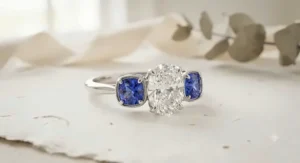
One detail that separates a genuinely well-designed three stone engagement ring from a merely adequate one is matched side stone selection — meaning the two flanking stones are proportioned and cut specifically to complement the center stone rather than simply being “small diamonds nearby.” Jewelers typically aim for side stones between one-third and one-half the size of the center stone, which keeps the eye drawn to the primary stone while still contributing meaningful sparkle.
Cut shape matters just as much as size here. A round center stone paired with round side stones creates visual harmony, while a princess or emerald-cut center often pairs better with tapered baguette or trapezoid side stones that echo its angular lines rather than clashing against them. Reviewers across several of the picks above specifically call out well-matched side-stone proportions as a differentiator between rings that look cohesive and rings that look like three separate purchases awkwardly combined. If you’re comparing listings, look for language specifying “matched” or “graduated” side stones — it signals the designer thought about proportion rather than defaulting to whatever stock melee was on hand.
Three Stone Halo Rings vs Classic Three Stone Settings
| Feature | Halo Trilogy | Classic Trilogy |
|---|---|---|
| Perceived size vs actual carat | Larger, amplified | True-to-carat |
| Typical price premium | Moderate increase | Baseline |
| Long-term maintenance | More prongs to check | Simpler upkeep |
| Best For | Maximum visual sparkle | Timeless, low-maintenance elegance |
The math behind that “perceived size” row is straightforward: a halo adds a ring of small stones around each larger stone, which effectively increases the visual footprint of the ring without proportionally increasing the center stone’s actual carat weight. That’s exactly why Charles & Colvard’s halo trilogy above reads as bigger and bolder than a same-carat classic setting like FINEROCK’s. The tradeoff is maintenance — more prongs holding more small stones means more surface area that can theoretically need attention over the decades, though this is a manageable, routine part of ring ownership rather than a serious downside.
Trillion-Cut and Other Accent Stone Shapes Explained
Round side stones get most of the attention, but trillion-cut accents deserve a closer look for anyone comparing three stone ring options. A trillion cut is a triangular-shaped diamond or gemstone cut, and when used as side stones flanking a round or cushion center stone, it creates a distinctive silhouette that reads as more contemporary and geometric than traditional round or baguette side stones.
Because trillion cuts have fewer facets optimized specifically for brilliance compared to round brilliant cuts, they tend to show more flash and less traditional “fire” — a look plenty of buyers specifically seek out for a bolder, more architectural ring profile. What most buyers overlook about trillion accent stones is that their pointed corners are more vulnerable to chipping than rounded shapes, so a protective prong or bezel edge at those corners genuinely matters more here than on rounder side-stone shapes. If a trillion-accented three stone ring catches your eye, ask specifically about corner protection in the setting before buying.
Three Stone Ring vs Solitaire: Which Wins for You?
| Factor | Three Stone Ring | Solitaire |
|---|---|---|
| Symbolic meaning | Past, present, future narrative | Singular, minimalist focus |
| Perceived size at same budget | Larger overall footprint | Smaller footprint, bigger single stone |
| Everyday snag risk | Slightly higher (more stones/prongs) | Lower, cleaner profile |
| Best For | Buyers wanting a story-driven design | Buyers wanting understated, timeless simplicity |
The honest answer to “which wins” depends entirely on what a couple values in a ring. A three stone engagement ring wins decisively on narrative and visual footprint per dollar — three stones simply cover more surface area than one, and the storytelling angle genuinely resonates with plenty of couples. A solitaire wins on simplicity and lower long-term snag risk, since fewer stones and prongs mean fewer maintenance touchpoints over the years. Neither is objectively “better” — this is a values-and-aesthetics decision more than a quality one.
Common Mistakes When Buying a Three Stone Engagement Ring
Even careful shoppers trip over a handful of recurring mistakes. First, buyers frequently focus entirely on the center stone’s carat weight while ignoring side-stone proportion, ending up with a ring that looks unbalanced despite an impressive center diamond. Second, skipping a certification check is a common misstep — the FTC’s Jewelry Guides require marketers to truthfully represent the type, quality, and metallic content of jewelry products, so a listing lacking clear grading information is worth extra scrutiny rather than blind trust.
Third, guessing at ring size rather than confirming it professionally leads to resizing costs and delays that are entirely avoidable with a five-minute jeweler visit beforehand. Fourth, some buyers assume a higher price automatically means better quality, when in reality brand markup, metal karat, and finishing labor all factor into price independent of the stones’ actual grading. Finally, overlooking return policy details before purchase is a mistake that becomes painfully clear only when a resize or exchange is suddenly needed — always confirm this upfront, not after checkout.
Long-Term Cost, Insurance & Maintenance
The purchase price is only the beginning of a three stone engagement ring’s total cost of ownership. Prong tightening and professional cleaning every six to twelve months typically run in the modest double digits per visit, but skipping this maintenance is how stones eventually get loose or lost entirely — a far more expensive problem than routine upkeep.
As CNBC Select explains, standard homeowners policies typically cap jewelry coverage around $1,500 to $2,000, well below what a meaningful engagement ring is worth, and a dedicated jewelry policy usually runs about 1% to 2% of the ring’s appraised value annually — worth budgeting into your total cost from day one rather than treating insurance as an afterthought. Between periodic professional cleanings, occasional prong maintenance, and a modest annual insurance premium, a realistic long-term cost estimate adds a small but meaningful percentage on top of the sticker price every year the ring is worn — money well spent for something meant to last a lifetime.
Three Stone Rings in Gold: Yellow, White & Rose Compared
Metal color is a personal-taste decision, but it does carry a few practical differences worth knowing. White gold — like the option on the VIR JEWELS pick above — gets its bright, cool tone from rhodium plating over a naturally yellowish gold alloy, meaning it will need re-plating every couple of years to maintain that bright finish, a routine and inexpensive service. Yellow gold skips that plating step entirely, showing its true alloy color from day one, which some buyers prefer specifically to avoid the re-plating maintenance cycle.
Rose gold, seen in some of Effy Collection’s signature combinations, gets its warm pink tone from a higher copper content in the alloy, which incidentally also makes rose gold slightly more durable and scratch-resistant than comparable white or yellow gold at the same karat — a genuinely underrated practical benefit of an aesthetic choice. Whatever metal color you choose, marketers are required to truthfully represent metallic content and karat, so a listing’s stated karat (10K, 14K, or 18K) should match what actually shows up in the ring’s hallmark stamp.
Frequently Asked Questions
❓ What does a three stone engagement ring symbolize?
❓ Is a three stone ring more expensive than a solitaire?
❓ Can a three stone engagement ring have a halo?
❓ Are lab-grown diamonds acceptable for a three stone engagement ring?
❓ How do I know if the side stones match the center stone properly?
Conclusion
A three stone engagement ring earns its lasting popularity honestly — it’s rare to find a design that balances symbolism, visual flexibility, and genuine budget range this well. Whether you land on the wallet-friendly Dazzlingrock Collection pick, the value-driven TriJewels lab-grown option, or the designer-level Effy Collection statement piece, the right choice comes down to matching the ring’s story and style to the values of the person wearing it.
What we’ve tried to do throughout this guide is give you the honest analysis behind each spec sheet — not just numbers, but what those numbers actually mean once the ring is on someone’s hand every single day for years to come. Trust your own eye, confirm sizing and certification before checkout, and don’t be afraid to prioritize the style that feels most “you” over whichever option simply has the biggest price tag.
Recommended for You
- Pear Shaped Halo Engagement Ring: 7 Stunning Picks for 2026
- 7 Best Halo Engagement Ring Women Picks for 2026
- Baguette Diamond Engagement Ring: 7 Real Picks for 2026
Disclaimer: This article contains affiliate links. As an Amazon Associate, I earn from qualifying purchases. If you purchase products through these links, we may earn a small commission at no additional cost to you.
✨ Found this helpful? Share it with your friends! 💬🤗
