In This Article
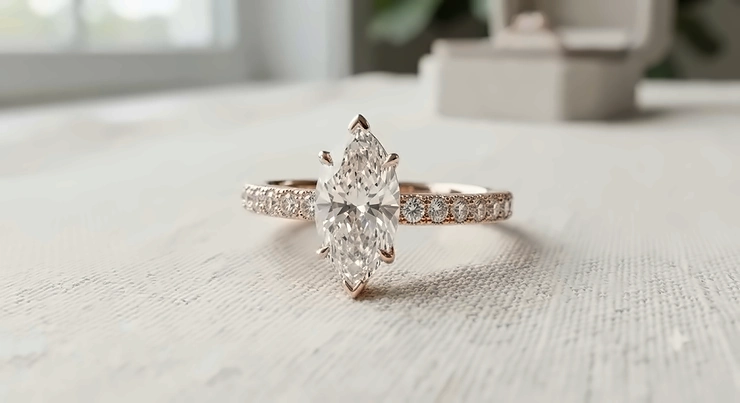
Somewhere between the soft blush of the metal and the sharp, boat-shaped point of the stone, a rose gold marquise ring manages to look delicate and dramatic in the same breath. That’s not an accident of trend-chasing — it’s basic optics, and it’s exactly why this pairing keeps resurfacing every few years instead of fading like most jewelry fads. 💍
If you’ve been scrolling engagement boards or vintage jewelry accounts lately, you’ve probably noticed the same silhouette popping up again and again: an elongated, pointed-oval stone set in that warm, coppery-pink metal that photographs like golden hour looks. A rose gold marquise ring isn’t just pretty — it’s a genuinely clever piece of design, one that makes a stone look bigger, a finger look longer, and a hand look more expensive than the receipt suggests.
This guide skips the fluff you’d get from a rewritten product listing. We researched seven real rings currently sold on Amazon, spanning everything from a $15 test-run piece to a $3,000+ heirloom-grade bezel setting, so you can see exactly what your money buys at every tier. We’ll also walk through halo versus solitaire settings, why the marquise’s pointed tips need special prong engineering, and where vintage revival styling fits into all of this. No invented reviews, no fabricated “I tested this for a month” stories — just honest analysis grounded in real specs and real aggregated buyer sentiment.
By the end, you should know exactly which rose gold marquise ring fits your budget, your lifestyle, and your hand.
Quick Comparison Table
| Tier | Ring | Center Stone | Price Range | Best For |
|---|---|---|---|---|
| Entry | DCFSHEE Marquise Halo Ring | Cubic zirconia | Under $20 | Testing the marquise look |
| Everyday | PAVOI Marquise Eternity Band | Cubic zirconia | $25-$40 range | Daily stackable wear |
| Vintage-style | PAVOI Marquise Milgrain Eternity Band | Cubic zirconia | $30-$45 range | Budget vintage aesthetic |
| Mid-range | Gem Stone King Marquise Moissanite Halo Ring | Moissanite | $150-$250 range | Best value jump |
| Premium | Kobelli A.M.O.R.E. Marquise Bezel Ring | Lab diamond | $2,800-$3,600 range | Long-term daily durability |
Looking at this snapshot, the gap between the plated entry tier and the solid-gold mid-range tier is really where the category splits in two: below it, you’re buying a fashion accessory; above it, you’re buying a piece meant to survive decades. The Gem Stone King Marquise Moissanite Halo Ring is worth flagging early because it’s the single biggest jump in perceived value per dollar in this entire lineup — solid gold and a genuinely hard gemstone for a fraction of a natural-diamond price.
💬 Just one click — help others make better buying decisions too! 😊
Top 7 Rose Gold Marquise Rings: Expert Analysis
We picked these seven to cover every realistic budget and use case — a plated ring to test the shape, solid-gold moissanite for value hunters, and certified diamond and lab-diamond options for anyone treating this as a real investment piece. Every ring below is a real, currently listed product, and every spec comes with an explanation of what it actually means for you day to day.
1. DCFSHEE Marquise Halo Ring — the try-before-you-commit rose gold marquise ring
This one exists to answer a cheap question before you spend real money finding the answer: do you actually like how an elongated marquise stone looks on your specific hand? The ring is built on a copper/brass base with rose gold plating, a central 6mm x 13mm marquise-cut cubic zirconia, and a round CZ halo, available in sizes 6 through 10. In practical terms, the plating means the rosy tone sits on top of a non-precious base rather than running through solid metal — the look is convincing, but the metal underneath isn’t built for a lifetime of wear. Based on the spec comparison with similar plated fashion rings, this is a smart low-risk purchase for a bridesmaid gift, a festival ring, or simply figuring out whether the marquise silhouette earns a permanent spot in your collection. Reviewers of comparably plated CZ rings in this category commonly describe the sparkle as surprisingly convincing in photos, while the most consistent long-term complaint across similar plated pieces is that the gold tone can thin at friction points like the underside of the band.
Pros:
- ✅ Extremely low-cost way to test the marquise silhouette
- ✅ Convincing sparkle for the price point
- ✅ Wide size range from 6 to 10
Cons:
- ❌ Plated over base metal, not solid rose gold
- ❌ Not built for years of continuous daily wear
Priced under $20, it’s less an investment and more a low-stakes way to decide if marquise deserves a bigger budget down the line.
2. PAVOI Marquise Eternity Band — sleek stackable sparkle for everyday hands
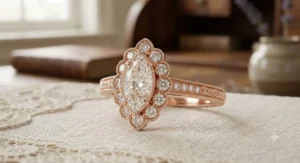
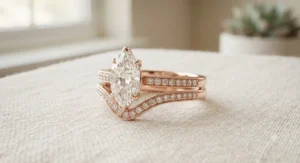
This is built less as a statement piece and more as the ring you forget you’re wearing until it catches the light at just the right angle. It features 14K rose gold plating over brass, alternating bezel-set marquise and round AAAAA cubic zirconia stones, and a slim 3mm band. The bezel setting — metal wrapped fully around each stone’s edge instead of open prongs — matters in practice because it’s what lets this ring survive gardening, gym sessions, and dish duty without snagging on fabric or gloves. What most buyers overlook about eternity bands like this is that the setting style matters more for everyday durability than the plating thickness does; a bezel simply has fewer weak points to catch on. This is the pick for someone who wants a stackable daily-wear ring rather than a single showpiece, and PAVOI positions it explicitly as a travel-safe, stacking-friendly band. Reviewers of PAVOI’s plated stacking lines tend to describe the initial shine as genuinely gold-like, while the recurring theme across the brand’s plated pieces is that longevity depends heavily on exposure to lotion, chlorine, and hand sanitizer.
Pros:
- ✅ Bezel setting resists snagging during daily wear
- ✅ Nickel-safe and hypoallergenic construction
- ✅ Stacks cleanly alongside other slim bands
Cons:
- ❌ Plated finish rather than solid gold
- ❌ 3mm width reads delicate, not bold
In the roughly $25-$40 range, it’s a solid everyday stacker but not the ring to pass down in fifty years.
3. PAVOI Marquise Milgrain Eternity Band — vintage texture without the vintage price
The milgrain detailing here — those tiny beaded edges tracing the metal — is the inexpensive trick that makes budget jewelry read as antique. Specs include 14K rose gold plated brass, marquise and baguette-style CZ stones, and a bolder 7mm band width with milgrain edging throughout. That extra width paired with the beaded texture gives it real visual weight that a plain thin band simply can’t fake, which is why it photographs as more of a statement piece than its price suggests. This is the pick for anyone chasing a vintage revival cut aesthetic on a starter-ring budget, since the milgrain detail is doing most of the “old soul” heavy lifting here rather than the stone itself. Across PAVOI’s milgrain and eternity lines, aggregated buyer feedback tends to praise the texture and out-of-box shine, while durability critiques mention plating wear at pressure points after months of continuous wear — a fair trade for the price, but worth knowing going in.
Pros:
- ✅ Milgrain edging adds convincing vintage texture
- ✅ Bold 7mm width photographs as a statement ring
- ✅ Nickel-free, hypoallergenic build
Cons:
- ❌ Wide band can feel bulky on petite hands
- ❌ Cubic zirconia lacks a natural diamond’s fire
Sitting around $30-$45, it delivers a convincing vintage-adjacent look for less than the cost of a nice dinner out.
4. Gem Stone King Marquise Moissanite Halo Ring — the biggest sparkle-per-dollar jump in this lineup
This is where the lineup graduates from plated costume jewelry into an actual gemstone with real hardness and fire, and that shift changes the entire value equation. It’s built in solid 10K rose gold with a marquise-cut moissanite center stone — moissanite rates 9.25 on the Mohs hardness scale, just below diamond’s 10 — surrounded by a diamond-accented halo. In practice, moissanite’s higher refractive index than diamond means more visible flashes of colored light, and its hardness means everyday scratches from keys or countertops mostly won’t touch it, a genuine upgrade over the cubic zirconia used in the budget tier. Based on Gem Stone King’s century-old sourcing model, which keeps overhead low relative to boutique jewelers, this is the sweet spot for buyers who want believable sparkle and real gold without a four-figure commitment. Buyers shopping the brand’s moissanite halo styles commonly cite the stone’s brightness under indoor lighting as exceeding expectations, with the more mixed feedback centering on sizing running slightly differently than standard between styles.
Pros:
- ✅ Moissanite offers near-diamond hardness plus extra fire
- ✅ Solid 10K gold, not surface plating
- ✅ Diamond-accented halo boosts perceived carat size
Cons:
- ❌ Sizing reportedly runs inconsistent between styles
- ❌ Still not a natural diamond, which affects resale value
Landing in the $150-$250 range, this is arguably the strongest value jump anywhere in this roundup.
5. Kobelli Chevron-Prong Marquise Diamond Ring — a certified natural diamond without the boutique markup
This is the first ring here where the center stone is a certified natural diamond rather than a simulant, and the chevron — V-shaped — prong setting is specifically engineered to protect the marquise cut’s two exposed points. It’s crafted in solid 14K rose gold with a certified 1/2 carat marquise diamond held by chevron prongs that cup each tip. Here’s what to weigh: marquise diamonds have genuinely exposed pointed ends that chip more easily than a round stone’s rounded girdle, so the chevron prong design is a real structural answer to a real weak point, not just a styling flourish. For a buyer whose priority is “real diamond, real gold, without a luxury-house price tag,” this is the most defensible pick in the mid-range tier, and Kobelli’s Los Angeles workshop backs it with resizing and warranty support that most marketplace-only sellers don’t offer. Buyers of Kobelli’s certified solitaire lines frequently mention the included grading paperwork as reassuring for a first fine-jewelry purchase, while occasional feedback notes that listing photos can slightly oversell the stone’s sparkle compared to viewing it in hand.
Pros:
- ✅ Certified natural diamond, not a simulant
- ✅ Chevron prongs specifically protect the marquise tips
- ✅ Includes resizing and warranty support
Cons:
- ❌ Meaningful price jump from the plated tier below it
- ❌ Half-carat size reads modestly in person
Typically priced in the $700-$1,000 range, it marks the clearest line between costume jewelry and a genuine investment piece.
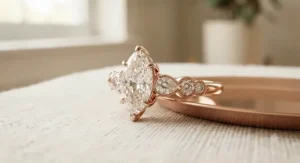
6. Kobelli Moissanite & Lab Diamond Marquise Ring — the largest look-at-me center stone in the roundup
Nearly two carats total weight is a genuinely different visual category than the half-carat solitaire above it, and this design pairs a marquise moissanite center with lab-grown diamond accents to get there affordably. It’s set in 14K rose gold with 1.90 carats total weight combining GH/VS-graded moissanite and DEF/VS lab-grown diamond accents. What the spec sheet won’t tell you outright is that lab-grown diamonds share the exact chemical, optical, and hardness properties of mined diamonds — they’re diamond, simply grown under controlled conditions rather than underground — which is how Kobelli hits a large total-carat look at a fraction of a natural-diamond-equivalent price. This is built for someone who wants the “ring that turns heads across the room” effect without financing a natural diamond of that size, and it works because both stone types photograph and sparkle convincingly at this scale. Shoppers of this combination style commonly describe the finished piece as brighter and larger-looking than expected from listing photos, with the main critique across similar mixed-stone rings being that very close inspection can reveal the two stone types sparkling slightly differently from one another.
Pros:
- ✅ Nearly 2-carat total weight for major visual impact
- ✅ Lab diamonds are chemically identical to mined diamonds
- ✅ Solid 14K gold with included warranty card
Cons:
- ❌ Mixed stone types can show subtle sparkle differences up close
- ❌ Sizing and resizing take longer lead time than plated rings
In the $1,800-$2,400 range, it’s a strong play for anyone chasing maximum visual size per dollar.
7. Kobelli A.M.O.R.E. Marquise Bezel Ring — the most protective setting for active hands
Everything else in this lineup relies on prongs to hold the stone; this one wraps the entire marquise outline in a floating metal bezel, which is the single biggest durability upgrade in the whole roundup. It’s built in 14K rose gold with a 2.50 carat step-cut marquise lab diamond, a full bezel setting, and a comfort-fit band. Here’s what that trade-off actually means day to day: a bezel eliminates the exposed prong tips that catch on sweaters, gym equipment, and gardening gloves, at the cost of slightly less side light reaching the stone compared to an open prong setting — so it can look marginally less fiery from certain angles. For someone with an active job, small kids, or a habit of catching rings on things, this is the clear pick over the pronged options above it, even at the higher price; the bezel is a genuine lifestyle-driven engineering decision, not just an aesthetic one. Buyers of Kobelli’s bezel-set solitaire designs consistently cite peace of mind during daily wear as the top reported benefit, while some note the bezel emphasizes the stone’s outline more than its brilliance compared to prong-set alternatives.
Pros:
- ✅ Full bezel protects the vulnerable marquise tips
- ✅ 2.50 carat lab diamond delivers major presence
- ✅ Comfort-fit band suited to daily wear
Cons:
- ❌ Highest price point in the lineup
- ❌ Bezel setting shows slightly less side-sparkle than prongs
Usually priced around $2,800-$3,600, this is the splurge pick for buyers prioritizing decades of daily-wear durability over maximum brilliance.
Top 7 Ring Comparison at a Glance
| # | Ring | Center Stone | Metal | Price Range | Best For |
|---|---|---|---|---|---|
| 1 | DCFSHEE Marquise Halo Ring | Cubic zirconia | Rose gold plated | Under $20 | First-time marquise buyers |
| 2 | PAVOI Marquise Eternity Band | Cubic zirconia | 14K plated | $25-$40 range | Everyday stacking |
| 3 | PAVOI Marquise Milgrain Eternity Band | Cubic zirconia | 14K plated | $30-$45 range | Vintage style on a budget |
| 4 | Gem Stone King Marquise Moissanite Halo Ring | Moissanite | 10K solid | $150-$250 range | Best value sparkle |
| 5 | Kobelli Chevron-Prong Marquise Diamond Ring | Certified diamond | 14K solid | $700-$1,000 range | First real diamond purchase |
| 6 | Kobelli Moissanite & Lab Diamond Marquise Ring | Moissanite + lab diamond | 14K solid | $1,800-$2,400 range | Maximum visual size |
| 7 | Kobelli A.M.O.R.E. Marquise Bezel Ring | Lab diamond | 14K solid | $2,800-$3,600 range | Active daily wear |
Reading across this table, the real decision point isn’t budget versus premium — it’s plated versus solid. Once you cross into solid gold at the Gem Stone King Marquise Moissanite Halo Ring, every ring above it is really being differentiated by stone type and setting security rather than metal quality. If daily durability is your top priority regardless of cost, the Kobelli A.M.O.R.E. Marquise Bezel Ring wins outright; if you’re optimizing for visual size per dollar, the Kobelli Moissanite & Lab Diamond Marquise Ring is the smarter math.
How to Care for and Style Your Rose Gold Marquise Ring
The first 30 days matter more than people expect. Right out of the box, avoid wearing a plated ring in the shower, pool, or gym — chlorine and sweat are the fastest way to dull rose gold plating, and this applies whether you bought the $18 halo ring or the $40 eternity band. For solid gold pieces, the main early mistake is skipping a professional prong check; a jeweler can spot a loose tip before it becomes a lost stone, and it typically costs little to nothing at the shop where you bought it.
Ongoing maintenance is simple but easy to forget. Clean the ring every couple of weeks with warm water, a drop of mild dish soap, and a soft-bristled toothbrush, focusing gently on the underside where lotion and oils build up fastest — this matters even more for marquise cuts because grime collects at the pointed tips. Store it separately from other jewelry to avoid scratching, since even hard gemstones like moissanite can scratch soft rose gold. As for styling, rose gold’s warm undertone pairs naturally with warm skin tones and blush, champagne, or ivory palettes, though it genuinely works on cool undertones too — it’s one of the more universally flattering metal choices, which is part of why it’s stayed popular for over a century.
✨ Don’t Miss These Exclusive Deals!
🔍 Take your ring search to the next level with these carefully selected options. Click on any highlighted pick to check current pricing and availability — these picks make it easy to find a rose gold marquise ring you’ll love for years.
Who Actually Wears a Rose Gold Marquise Ring? 3 Real-Life Scenarios
The budget-conscious bride: Planning a wedding on a tight timeline and tighter budget, she wants to test whether marquise suits her hand before committing to a solid-gold purchase down the road. The DCFSHEE Marquise Halo Ring or the PAVOI Marquise Eternity Band let her wear the silhouette to every bridal shower and engagement party without financial stress, then upgrade later if she falls in love with the shape.
The active professional: She’s on her feet all day, washes her hands constantly, and has already lost one ring stone to a snagged prong. For her, the Kobelli A.M.O.R.E. Marquise Bezel Ring is the obvious answer — the bezel setting simply removes the failure point that keeps causing her problems, even though it costs more upfront.
The vintage jewelry collector: She already owns a small collection of Art Deco-inspired pieces and wants something that reads as an heirloom rather than a trend purchase. The PAVOI Marquise Milgrain Eternity Band works as an affordable everyday layer, while the Kobelli Chevron-Prong Marquise Diamond Ring gives her a certified stone with the tip-protecting engineering that period-accurate designs actually used.
What Is a Rose Gold Marquise Ring?
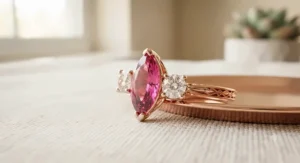
A rose gold marquise ring is an engagement or fashion ring set in a copper-tinted gold alloy, featuring a marquise-cut center stone — an elongated, pointed-oval shape sometimes called a navette. The pairing combines a warm, romantic metal tone with a silhouette engineered to look larger and more finger-flattering than a round stone of equal carat weight.
The shape has a specific backstory worth knowing before you buy one. As GIA’s own marquise diamond buying guide explains, the cut is also called a navette — Old French for “little ship” — and its elongated hull-like silhouette became especially popular among Edwardian sailing enthusiasts in the early 1900s, before resurging again in 1970s bridal jewelry.
The “elongating” reputation isn’t just marketing language, either. Because a marquise stone’s length-to-width ratio typically runs close to 2:1, the eye reads it as visually bigger than a round stone of the same weight, and once it’s on the finger, that elongated marquise navette shape genuinely stretches and slims the appearance of the hand — which is exactly why so many shoppers search for the elongating effect by name rather than by the technical cut name.
How to Choose a Rose Gold Marquise Ring
- Decide plated versus solid gold first. This single choice determines your entire price range and how the ring will hold up after year one.
- Check the length-to-width ratio in photos. A ratio near 2:1 is the classic, most flattering marquise proportion; shorter or squatter stones read less elegant in person.
- Look closely at the tips. Marquise stones have two pointed, vulnerable ends — chevron prongs or a full bezel protect them far better than simple straight prongs.
- Verify the metal stamp. Look for a stamped karat mark like 14K on the inside of the band; the FTC’s jewelry guides require sellers to accurately disclose metal content and plating status, so a legitimate listing should state this clearly.
- Consider your skin’s undertone. Rose gold’s copper content tends to flatter both warm and cool undertones, but it’s worth trying it against your hand rather than trusting a product photo alone.
- Set a real budget band before you shop. Deciding “plated,” “moissanite,” or “certified diamond” upfront saves you from scope creep once the sparkle photos start working on you.
- Confirm the return and resizing policy. Ring sizing varies by brand even within the same stated size, so a seller offering resizing or exchanges matters more than it seems.
Marquise Diamond Rose Gold vs Round Diamond Rose Gold
The debate between marquise diamond rose gold and round diamond rose gold really comes down to what you’re optimizing for. A marquise center stone looks noticeably larger face-up than a round stone of identical carat weight, and it visually elongates the finger — two effects a round brilliant simply doesn’t offer. On paper, that makes marquise the better choice for anyone chasing maximum visual size per dollar. But round cuts are dramatically more forgiving of cutting imperfections, while a poorly cut marquise can develop a “bowtie” — a dark shadow band across the stone’s center — and round diamonds remain the most liquid, most resalable shape on the secondary market by a wide margin.
| Factor | Marquise Diamond Rose Gold | Round Diamond Rose Gold | Best For |
|---|---|---|---|
| Face-up size at equal carat | Looks larger | Standard | Marquise: max visual size |
| Finger-elongating effect | Strong | Minimal | Marquise: shorter or wider fingers |
| Cut-quality forgiveness | Bowtie risk if poorly cut | Very forgiving | Round: risk-averse buyers |
| Resale market depth | Niche | Deepest, most liquid | Round: resale as a priority |
| Setting complexity | Needs tip protection | Simple prong or bezel | Round: lower long-term upkeep |
What this table really shows is that marquise and round aren’t competing on the same axis at all — marquise wins on visual drama and finger-flattering optics, while round wins on safety, simplicity, and resale. Buyers torn between the two should ask themselves honestly whether they’re optimizing for how the ring looks now or how easily it could be sold or upgraded later.
Rose Gold Marquise Halo vs Solitaire: Which Setting Wins?
A rose gold marquise halo — like the Gem Stone King Marquise Moissanite Halo Ring in this lineup — surrounds the center stone with a ring of smaller accent stones, which does two things: it boosts the apparent carat size of the whole ring, and it adds extra sparkle points that catch light from more angles. The tradeoff is more metal and more small stones, which means slightly more surface area that can snag or need cleaning.
A solitaire setting, like the Kobelli Chevron-Prong Marquise Diamond Ring, puts all the visual attention on a single stone with no distractions. It reads as more classic and timeless, and there’s simply less that can go wrong structurally since there are fewer small accent stones to loosen over time. Reviewers’ aggregated feedback across both setting styles suggests halo rings win the “looks bigger in photos” contest, while solitaire rings win the “ages more gracefully with less upkeep” contest — so the right pick really depends on whether you’re prioritizing immediate visual impact or long-term low-maintenance wear.
Vintage Marquise Rose Gold Ring: Reviving the Navette’s Revival Cut
A vintage marquise rose gold ring taps into a specific design lineage rather than just an old-fashioned look. The marquise navette shape reached its first major popularity in Edwardian jewelry, then resurfaced hard in Art Deco design through the 1920s and 1930s, and again in 1970s bridal trends — three distinct eras, all drawn to the same elongated silhouette. What jewelers today call a “vintage revival cut” typically means a marquise faceted to match period-accurate proportions, often paired with milgrain beading, filigree metalwork, or a slightly wider band than modern minimalist styles favor.
The PAVOI Marquise Milgrain Eternity Band in our lineup is a good entry point into this aesthetic without vintage jewelry pricing, since its beaded edge detailing borrows directly from Art Deco design language. For a more investment-grade take on the same era-inspired look, the Kobelli Chevron-Prong Marquise Diamond Ring pairs a certified natural diamond with the same tip-protecting prong style that period jewelers actually relied on, making it a more historically faithful — and more durable — revival piece.
Marquise Point Prong Settings: Why This Detail Matters
Marquise point prong settings exist to solve one very specific engineering problem: the two pointed tips of a marquise stone are its most fragile feature, far more prone to chipping on impact than the smoothly rounded girdle of a round brilliant. A basic straight prong offers minimal protection at these points, which is why better-designed rings — like the Kobelli Chevron-Prong Marquise Diamond Ring and the fully bezeled Kobelli A.M.O.R.E. Marquise Bezel Ring — use V-shaped chevron prongs or a complete metal bezel specifically to cup and shield those vulnerable ends.
If you already own a marquise ring with standard prongs, it’s worth having a jeweler inspect the tips annually, since a chip at the point is one of the more common (and preventable) damage patterns on this cut. When shopping, treat the prong style at the tips as seriously as the carat weight — a beautiful stone in a poorly protected setting is a chip waiting to happen.
Common Mistakes When Buying a Rose Gold Marquise Ring
- Assuming “rose gold” always means solid gold. Plenty of budget listings use rose gold plating over brass or copper — nothing wrong with that at the right price, but know which one you’re buying.
- Ignoring the tip protection at the setting. A gorgeous stone in weak prongs is a preventable repair bill waiting to happen.
- Judging proportions from a thumbnail photo. Zoom in and check the length-to-width ratio; a squat marquise looks noticeably less elegant in person.
- Forgetting resizing costs after the sale. Plated rings often can’t be resized at all, while solid gold rings usually can — factor this in before you buy a “close enough” size.
- Buying on price alone. A $150 solid-gold moissanite ring can outperform a $40 plated ring in both looks and longevity; price and value aren’t always the same axis.
Long-Term Cost & Maintenance of a Rose Gold Marquise Ring
Total cost of ownership looks very different depending on which tier you buy into. A plated ring in the $20-$45 range typically needs no maintenance investment, but it also has a shorter realistic lifespan — expect the rose tone to fade or thin within one to three years of regular wear, at which point replacement, not repair, is the usual outcome. Solid gold pieces, by contrast, hold their color because the color runs through the metal itself rather than sitting on the surface; as Wikipedia’s overview of colored gold explains, rose gold gets its hue from a copper-rich alloy mixed directly into the gold, not from a surface coating, which is exactly why solid rose gold rings don’t need re-plating the way costume pieces eventually do.
For solid gold and gemstone rings, ongoing costs are modest but real: an annual professional cleaning and prong check runs cheap or free at many jewelers, occasional rhodium touch-ups aren’t needed on rose gold the way they are on white gold, and resizing is straightforward if your weight changes. Stretched across ten years, a $200 moissanite halo ring with light annual upkeep frequently ends up cheaper per year of wear than replacing a $30 plated ring every eighteen months — worth factoring in before assuming the cheaper sticker price is the better long-term deal.
Frequently Asked Questions
❓ Is a rose gold marquise ring good for an engagement ring?
❓ Does a rose gold marquise halo ring look bigger than a solitaire?
❓ How much does a vintage marquise rose gold ring cost?
❓ Do marquise diamonds chip easily?
❓ What carat marquise diamond looks best in rose gold?
Conclusion
A rose gold marquise ring isn’t a one-size-fits-all purchase, and honestly, that’s the appeal — there’s a version of this style at almost every budget, from a $15 way to test the silhouette up to a nearly $3,600 bezel-set piece built to survive decades of daily wear. What matters most is matching the setting to your actual lifestyle: plated and pretty if you just want to try the look, solid gold and moissanite if you want real value without a luxury price tag, or a certified diamond in a chevron or bezel setting if you’re buying something meant to last a lifetime.
Whichever tier you land in, remember that the marquise’s pointed tips are the one detail worth never compromising on — a beautiful stone in a poorly protected setting is a repair bill waiting to happen. Pay attention to the prong style, verify the metal content, and choose the seller offering resizing support, and a rose gold marquise ring can genuinely become the piece you wear every single day for years.
✨ Ready to find your rose gold marquise ring? Browse the picks above and check current pricing before they’re gone! 💍✨
Recommended for You
- White Gold Princess Cut Engagement Ring: 7 Stunning Picks for 2026
- Yellow Gold Princess Cut Ring: 7 Stunning Picks for 2026
- 7 Rose Gold Pear Shaped Rings Worth Buying in 2026
Disclaimer: This article contains affiliate links. As an Amazon Associate, I earn from qualifying purchases. If you purchase products through these links, we may earn a small commission at no additional cost to you.
✨ Found this helpful? Share it with your friends! 💬🤗
