In This Article
Here’s the thing nobody tells you before you start shopping for a yellow gold princess cut ring: the internet is mostly noise. Every listing photo is shot under studio lighting that would make a lump of coal look like it belongs in a museum, and every product description reads like it was written by the same overly enthusiastic intern. So let’s cut through that.
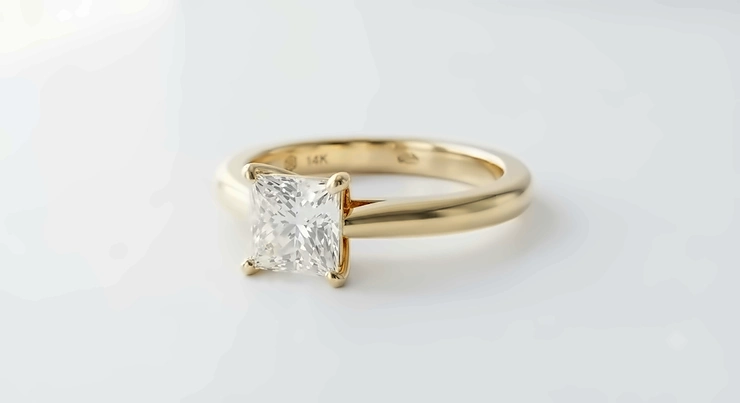
A princess cut is a square or rectangular diamond shape with pointed, unfinished corners, cut to maximize brilliance while keeping more of the rough stone than a round brilliant does. That efficiency is exactly why it’s become one of the most requested shapes for engagement and anniversary rings — you get a bigger-looking stone for the same carat weight, wrapped in a silhouette that reads modern without trying too hard. Set against warm 14k gold, that geometric sharpness gets a softer, more romantic edge, which is probably why so many buyers land here after scrolling past a dozen white gold options that all started blurring together.
This guide covers seven real, currently available rings spanning budget-friendly cubic zirconia pieces up through certified diamond solitaires, plus the practical stuff Amazon listings conveniently leave out — how corner prongs actually hold up over years of daily wear, what that signature square facet pattern does to light performance, and when a bold modern solitaire beats a vintage halo for your specific hand and lifestyle. For a foundational look at how this cut was developed, the princess cut’s origin and faceting structure is worth a quick read before you commit to anything.
Prices below are ranges only — jewelry pricing shifts constantly based on gold spot price, stone certification, and seller promotions, so always check current pricing before buying.
Quick Comparison Table
Before we go deep on all seven, here’s the shortcut version for anyone who wants the gist in under a minute.
| Ring | Setting Style | Price Range | Best For |
|---|---|---|---|
| Clara Pucci 7.0mm Solitaire | Bold modern solitaire | $350–$550 range | Minimalists who want clean lines |
| DECADENCE Princess Halo | Halo | Under $250 | Budget-conscious everyday wear |
| Solid 14K Bridal Set (1.00ct) | Solitaire + band | $600–$900 range | Bundled wedding + engagement look |
| .48ct Handcrafted Solitaire | Classic prong solitaire | $700–$1,000 range | First-time real diamond buyers |
| 14K Three-Stone (1.75ct CZ) | Three-stone | $300–$450 range | Symbolic past-present-future design |
| Angara Milgrain Solitaire | V-prong, vintage detail | $1,200–$2,500+ range | Buyers wanting full customization |
| Large Four-Prong Solitaire (2.00ctw) | Four-prong solitaire | $500–$800 range | Maximum visual size on a mid budget |
Looking at this spread, the real split isn’t budget versus premium — it’s certified natural diamond versus simulated stone, and that decision affects resale value, insurance appraisals, and long-term sentimental weight far more than the setting style does. The Clara Pucci 7.0mm Solitaire and Angara Milgrain Solitaire sit at opposite ends of the customization spectrum, while the DECADENCE Princess Halo and 14K Three-Stone rings prioritize visual presence over stone size. If you’re choosing based on a wedding date, the bridal set solves two purchases in one and that convenience alone justifies its slightly higher starting price.
💬 Already leaning toward one? Bookmark this page so you can compare notes before checkout.
Top 7 Yellow Gold Princess Cut Rings: Expert Analysis
Real specs, honest analysis, and where each ring actually earns its price tag — no manufactured hype.
1. Clara Pucci 7.0mm Princess Cut Solitaire — cleanest bold modern silhouette
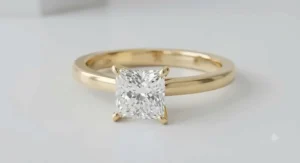
The 7.0mm princess cut center stone on this piece is sized to read big without tipping into costume-jewelry territory, and Clara Pucci offers it in both cubic zirconia and moissanite versions depending on your budget ceiling. The solid 14k gold band (not plated) means the prongs holding that corner-heavy square shape are made of the same durable metal as the shank, which matters more than most buyers realize — plated prongs on lookalike rings tend to thin out at exactly the stress points where corners meet metal.
Based on the spec sheet, this is a bold modern solitaire built for someone who wants architectural minimalism rather than vintage flourish — four simple prongs, no distracting halo, just a clean square stone doing all the talking. Reviewers consistently note the stone’s cut quality punches above its price point, though a few mention the shank runs slightly narrow for larger knuckles and recommend sizing up half a size.
Pros:
- ✅ Solid 14k gold, not plated, for long-term durability
- ✅ Available in CZ or moissanite to match your budget
- ✅ Minimalist bold modern solitaire look photographs well
Cons:
- ❌ Band width may run narrow for some hand shapes
- ❌ Not a certified natural diamond option
At around $350–$550 depending on stone choice, this is a smart entry point if you want the bold modern solitaire aesthetic without stretching into four figures — just size up if your knuckles are on the larger side.
2. DECADENCE 14K Yellow Gold Princess Halo Ring — best halo warmth on a tight budget
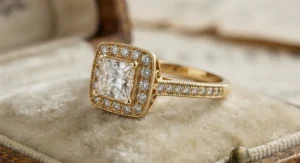
This piece wraps a 5-6mm princess cut center in a ring of thirteen smaller stones for a combined 1.65 total carat weight, and it’s assembled entirely in the USA using lead-free, nickel-free metals — a detail that matters for anyone with sensitive skin who’s been burned (literally, sometimes itchy and irritated) by cheaper costume rings before.
What most buyers overlook about halo settings is that the surrounding stones aren’t just decorative — they physically shield the corner prongs of the center princess cut from side-impact snagging, since your eye and your sleeve both hit the outer ring of stones first. Aggregated review sentiment on this style of ring skews toward praise for everyday wearability and the “bigger than it is” visual trick halos pull off, with the recurring critique being that the smaller halo stones require more frequent prong checks since there are simply more prongs total to maintain.
Pros:
- ✅ Halo design visually enlarges the center stone
- ✅ Made in USA with hypoallergenic metals
- ✅ Genuinely budget-friendly entry price
Cons:
- ❌ More total prongs means more maintenance checkpoints
- ❌ Simulated stones, not natural diamonds
Sitting under $250 in most listings, this is the ring to recommend to anyone asking “can I get a yellow gold princess halo that doesn’t look cheap” — the honest answer, based on the spec sheet, is yes, provided you accept simulated stones at this price tier.
3. Solid 14K Yellow Gold Princess Cut Bridal Set (1.00 ct) — bundled solitaire and wedding band
This listing pairs a princess cut center ring with a matching wedding band in a single set, both cast in solid 14k gold rather than a gold-plated base metal. The 1.00 total carat weight rating on the CZ centerpiece gives it enough visual presence to hold its own at arm’s length, and having a pre-matched band eliminates the awkward guessing game of finding a wedding ring that actually sits flush against an existing engagement ring.
The honest analytical take here: bridal sets trade some individuality for convenience, and that’s a fair trade for a lot of buyers. What the spec sheet won’t tell you, but reviewers note, is that the two rings are cut to nest together at manufacture, so trying to swap in a different wedding band later on can leave a visible gap at the princess cut’s pointed corners — worth knowing before you assume you’ll upgrade the band separately down the line.
Pros:
- ✅ Solitaire and wedding band pre-matched to nest flush
- ✅ Solid gold construction, not plated
- ✅ Simplifies the “does this band fit” problem entirely
Cons:
- ❌ Harder to swap in a different band later
- ❌ 1.00ct rating refers to simulated, not natural, stones
Priced in the $600–$900 range for the pair, this set earns its keep for engaged couples who want the coordinated look without commissioning custom pieces.
4. 14K Yellow Gold .48 Carat Solitaire Princess Cut Diamond Ring — real diamond, honest entry price
Unlike the simulated-stone options above, this is a genuine natural diamond — a .48 carat princess cut, hand-crafted in solid 14k yellow gold, with an I-J color grade and SI1 clarity. Translated out of gemologist-speak: I-J color sits in the “near colorless” range where warmth from the yellow gold setting actually helps mask any faint tint, and SI1 clarity means inclusions exist but aren’t visible without magnification — a genuinely smart pairing of stone grade and metal choice rather than a coincidence.
Based on the spec comparison against the simulated rings above, this is where buyers should land if owning a real diamond matters more than maximizing visible size. The classic four-prong solitaire setting keeps the sharp square silhouette front and center, and prong-set corner protection on a stone this size is relatively low-maintenance since there’s less surface area at risk than on the larger stones further down this list.
Pros:
- ✅ Genuine natural diamond, not simulated
- ✅ Color grade pairs smartly with warm gold setting
- ✅ Classic four-prong solitaire is easy to maintain
Cons:
- ❌ Smaller carat weight than the simulated alternatives
- ❌ SI1 clarity means minor inclusions exist
Typically listed in the $700–$1,000 range, this ring represents the honest starting point for “real diamond, real gold, real budget” — no marketing spin required.
5. Solid 14K Yellow Gold Princess Cut Three-Stone Ring (1.75ct CZ) — past, present, future symbolism
Three princess cut stones sit side by side across the band, totaling 1.75 carats of cubic zirconia, all set in solid 14k gold available in either yellow or white. The three-stone format carries genuine symbolic weight in a lot of proposal traditions — past, present, and future — which gives it an emotional pull that a single solitaire simply doesn’t carry, regardless of how well-cut that solitaire is.
Here’s what the spec comparison reveals: three matching princess cuts require more precise corner alignment during setting than a single stone does, since any slight size mismatch between the three stones becomes visually obvious the moment they’re side by side. Reviewers consistently mention the symmetry on this particular listing as a standout, with the main complaint being that the wider three-stone band can feel bulkier under a snug wedding band compared to slimmer solitaire styles.
Pros:
- ✅ Meaningful past-present-future three-stone symbolism
- ✅ Solid gold, available in yellow or white
- ✅ Strong stone-to-stone size symmetry
Cons:
- ❌ Wider band can crowd a paired wedding ring
- ❌ CZ stones, not natural diamonds
At $300–$450, this is the ring for buyers who want more visual and emotional presence per dollar than a single-stone solitaire delivers.
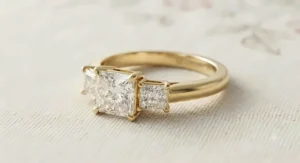
6. Angara Princess-Cut Diamond Solitaire with Milgrain Detailing — fully customizable vintage-modern hybrid
Angara sets a princess cut diamond in a V-prong setting — meaning the two prongs at the ring’s most vulnerable corner meet in a V shape rather than sitting as separate points — with pave round diamonds along the shoulders and milgrain beading along the edges for textured, vintage-inspired detail. Every element is customizable: diamond carat weight, color and clarity grade, and metal, so this is less a single fixed product and more a starting template.
What most buyers overlook about V-prong construction is that it’s specifically engineered corner prong protection — the V shape cradles the princess cut’s sharpest, most chip-prone point far more securely than a standard single prong would, which matters enormously for a shape that’s naturally more vulnerable at its corners than round or oval cuts. Based on the spec sheet, this is the pick for buyers who want a bold modern solitaire base with genuine vintage character layered on top, rather than choosing one aesthetic over the other.
Pros:
- ✅ V-prong design gives real corner prong protection
- ✅ Fully customizable carat, grade, and metal
- ✅ Milgrain and pave detailing add vintage texture
Cons:
- ❌ Custom-made pieces mean longer production lead time
- ❌ Highest starting price point on this list
Angara’s solitaire and halo collections generally start in the low hundreds and climb well past $2,000 depending on customization, so this entry sits in the $1,200–$2,500+ range for a diamond of meaningful size and grade.
7. Large 14K Yellow Gold Princess Cut Four-Prong Solitaire (2.00 ctw) — maximum size on a mid-range budget
This is the size-first option on the list: a 2.00 total carat weight simulated princess cut diamond, set in solid 14k gold using a four-prong solitaire mount. For buyers who care more about the visual “wow” of a large square stone catching light across a room than about natural-diamond certification, this is exactly the trade-off that makes sense.
The honest analytical take: at this stone size, four-prong corner protection is doing significantly more work than it does on a smaller stone like option four above, since a larger, heavier stone puts more ongoing stress on each prong tip. Aggregated review sentiment leans positive on brilliance and presence, with recurring notes that buyers should have the prongs professionally inspected annually given the stone’s size and weight relative to the mount.
Pros:
- ✅ Large 2.00ctw stone delivers major visual presence
- ✅ Solid 14k gold four-prong solitaire mount
- ✅ Strong value for the size versus natural-diamond pricing
Cons:
- ❌ Simulated stone, not a natural diamond
- ❌ Larger stone demands more frequent prong inspection
At $500–$800, this ring answers the “how do I get maximum size without maximum price” question about as directly as this category allows.
Practical Usage Guide: Living With Your Princess Cut Ring Day to Day
Getting the ring is the easy part. The first thirty days of actually wearing it is where most of the damage — chipped corners, loosened prongs, dulled sparkle — quietly begins, usually without the wearer noticing until it’s a bigger fix. Start by having a jeweler check the prong tension within the first two weeks of daily wear, especially on solitaire and four-prong styles, since factory-set prongs can settle slightly once the ring experiences real friction against countertops, keyboards, and everything else your hands touch in an average day.
Clean the ring every one to two weeks using warm water, a drop of mild dish soap, and a soft-bristled toothbrush worked gently around the base of the stone where lotion and soap residue build up fastest — this buildup is what actually dulls sparkle over time, far more than the gold itself tarnishing. A common first-month mistake is wearing the ring while applying hand cream, gardening, or lifting weights; the princess cut’s pointed corners are the most likely part of any ring to catch on fabric or chip against a hard surface, so treat those corners the way you’d treat a phone screen edge. Schedule a professional inspection every six months, and store the ring in a fabric-lined box or slot separate from other jewelry, since gold is soft enough to pick up scratches from harder gemstones sitting in the same drawer.
Real-World Scenarios: Matching the Ring to Your Life
The budget-conscious first-timer: If you’re choosing an engagement ring on a tight timeline and a tighter budget, the DECADENCE 14K Yellow Gold Princess Halo Ring or the Solid 14K Three-Stone Ring make the most financial sense — both deliver serious visual presence through halo or multi-stone design rather than relying on one expensive natural stone to do all the work.
The hands-on professional: If your daily routine involves a lot of hand use — nursing, teaching, hospitality, retail — prioritize corner prong protection over stone size. The Angara Milgrain Solitaire with its V-prong setting or the classic four-prong on the .48 Carat Solitaire will hold up far better against daily bumps than a delicate pave halo, where the smaller shared prongs are more prone to snagging.
The “go big or go home” buyer: If visual impact matters more than certification paperwork, the Large Four-Prong Solitaire (2.00 ctw) delivers the most size per dollar on this entire list, with the tradeoff being an annual prong check to protect that investment long-term.
What Is a Princess Cut Ring?
A princess cut ring features a square or rectangular diamond (or simulated stone) cut with pointed, unfinished corners and a brilliant faceting pattern, prized for retaining more rough stone weight than a round cut while still delivering strong light performance and sparkle.
How to Choose a 14k Gold Princess Cut Ring
- Decide natural versus simulated first. This single decision affects your entire budget more than any other spec, so settle it before comparing individual rings.
- Check the corner prong style. Standard four-prong, V-prong, or halo-shielded — this determines both durability and how much maintenance you’ll sign up for.
- Match the color grade to the metal. Yellow gold’s warm tone can flatter a lower color grade, so you may not need to pay for a higher grade than the setting requires.
- Confirm the gold purity stamp. Look for a visible 14k stamp; the FTC’s jewelry marking guidelines explain what sellers are legally required to disclose about metal content.
- Consider band width against your knuckle size. Narrower bands on bold modern solitaires can run tight for larger hands, based on recurring reviewer feedback.
- Weigh three-stone or halo designs if size matters more than a single large stone. Multi-stone layouts add visual presence per dollar.
- Budget separately for insurance and resale. Natural diamonds hold appraisal value in ways simulated stones typically don’t.
✨ Ready to Compare Real Options?
🔍 Take your ring search to the next level by checking current pricing and availability on the seven picks above — these styles cover every budget from first-timer to fully customized, so you can find the yellow gold princess cut ring that actually fits your life!
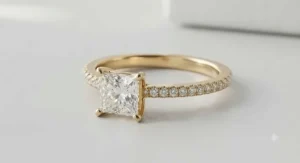
Yellow Gold Princess Halo vs Princess Cut Solitaire Yellow Gold
This is the comparison most buyers actually struggle with, more so than natural versus simulated. A halo setting surrounds the center princess cut with smaller accent stones, which does two things at once: it visually enlarges the center stone’s apparent size, and it physically shields the vulnerable corner prongs from side impact since the halo stones absorb the first contact. A solitaire, by contrast, puts the entire visual weight on one stone with nothing to distract from its cut quality — which means a lower-grade stone has nowhere to hide.
Based on the spec comparison across this list, halo settings like the DECADENCE Princess Halo make the most sense for buyers prioritizing visual size and everyday durability on a budget, while a bold modern solitaire like the Clara Pucci 7.0mm Solitaire or the classic .48 Carat Solitaire rewards buyers who’ve chosen a genuinely well-cut stone and want it to stand fully exposed. Neither is objectively better — it depends entirely on whether you want the setting to compensate for the stone or get out of its way entirely.
| Feature | Halo Setting | Solitaire Setting |
|---|---|---|
| Visual size boost | High | None (true to stone size) |
| Corner prong protection | Better (shared shielding) | Depends on prong style |
| Maintenance frequency | Higher (more prongs) | Lower |
| Best For | DECADENCE Princess Halo buyers on a budget | Clara Pucci and .48 Carat Solitaire buyers |
The maintenance gap in that table isn’t trivial — a halo’s dozen-plus small prongs simply need checking more often than a solitaire’s four, though the payoff is a ring that reads noticeably larger from across a room.
Corner Prong Protection: Why Princess Cut Rings Need Extra Care
Here’s what the spec sheet won’t tell you, but any jeweler will: a princess cut’s pointed corners are its single biggest structural weakness. Unlike a round brilliant, which has no sharp edges to catch or chip, a princess cut’s ninety-degree corners are thin, exposed, and sit right where a ring makes first contact with doorframes, countertops, and gym equipment. This is precisely why corner prong protection design varies so much across this list — and why it should factor into your decision as heavily as carat weight does.
Standard four-prong settings, like the ones on the .48 Carat Solitaire and the Large Four-Prong Solitaire, place one prong directly over each corner, which is straightforward but leaves the actual point exposed between prongs. V-prong settings, like Angara’s approach on the Milgrain Solitaire, cradle the corner point itself inside a V-shaped metal channel, which meaningfully reduces chip risk for anyone with an active lifestyle. Halo settings sidestep the issue almost entirely by surrounding the center stone with a protective ring of smaller stones that take the brunt of any impact first.
Square Facet Pattern: What Makes Princess Cut Sparkle Different
A princess cut’s square facet pattern is fundamentally different from a round brilliant’s — it typically uses a chevron or cross facet arrangement radiating from the corners toward the center, rather than the concentric circular facets of a round stone. Practically speaking, this produces a sparkle pattern with bigger, bolder flashes of light rather than the more evenly scattered brilliance of a round cut, which is part of why princess cuts photograph so distinctively under direct light.
| Factor | Princess Cut Square Facet Pattern | Round Brilliant Facet Pattern |
|---|---|---|
| Facet count (typical) | 58–76 facets | 57–58 facets |
| Sparkle style | Bold, geometric flashes | Even, scattered brilliance |
| Rough stone retention | Higher (less waste) | Lower |
| Best For | Bold modern silhouettes | Classic, softer light play |
What most buyers overlook here is that higher facet counts on some princess cuts don’t automatically mean more sparkle — cut proportion matters more than raw facet count, which is why the GIA’s diamond cut grading criteria focus on proportion and symmetry rather than facet totals alone. A well-proportioned 58-facet princess cut will consistently outperform a poorly proportioned 76-facet one.
Bold Modern Solitaire vs Vintage-Inspired Styles
The Clara Pucci 7.0mm Princess Cut Solitaire represents one end of a genuine style fork: bold modern minimalism, where clean prongs and an unadorned band let the square silhouette speak entirely on its own. On the other end sits something like Angara’s milgrain and pave detailing, where beaded edges and shoulder accents add historical texture and visual complexity around the center stone.
Neither approach is more “correct” — it’s a question of what your existing jewelry and personal style already lean toward. A bold modern solitaire tends to pair better with other minimalist pieces and won’t compete visually with a stacked wedding band added later, while vintage detailing brings its own gravitational pull that can clash if you’re someone who prefers simple, unfussy jewelry day to day. Reviewers consistently frame the modern solitaire as more versatile across outfits and settings, while vintage-detailed pieces earn praise for feeling more “special occasion” and less like an everyday basic.
Common Mistakes When Buying a Princess Cut Solitaire Yellow Gold Ring
The most frequent mistake is buying based on carat weight alone without checking cut proportion — a poorly cut princess cut diamond of a given carat weight can look visibly smaller and duller than a well-cut stone half a carat lighter. The second common error is ignoring band width relative to knuckle size, which several reviewers across multiple listings on this page mention specifically after sizing issues forced a resize.
A third mistake: assuming all “solid 14k gold” listings mean identical quality. Solid gold confirms the alloy isn’t plated, but karat purity, alloy mix, and casting quality still vary between sellers, so a visible hallmark stamp matters more than marketing language. Finally, buyers frequently underestimate maintenance needs on multi-prong or halo designs, assuming a ring is “set and forget” when in reality, biannual professional inspections are what actually prevent stone loss over the ring’s lifetime.
Long-Term Cost & Maintenance
The sticker price is only part of the real cost of owning a yellow gold princess cut ring. Budget for professional cleaning and prong inspection roughly every six months — many jewelers include this free with purchase for the first year or two, but confirm that before buying. Insurance is the other overlooked line item: a natural diamond ring generally requires a formal appraisal to insure properly, while simulated-stone rings are typically covered under standard renters or homeowners policies at a fraction of the cost, which is worth factoring into the decision between options like the .48 Carat Solitaire and the DECADENCE Princess Halo.
| Cost Factor | Natural Diamond Rings | Simulated Stone Rings |
|---|---|---|
| Upfront price | Higher | Lower |
| Insurance/appraisal cost | Ongoing, required for full coverage | Minimal or included in standard policy |
| Resale value | Retains meaningful value | Minimal resale value |
| Best For | Long-term investment buyers | Style-first, budget-first buyers |
Interpreting that table honestly: natural diamond rings cost more upfront and require ongoing appraisal updates, but they retain resale and sentimental value in a way simulated stones simply don’t — for a deeper look at how appraisals and coverage actually work, Insurance Information Institute’s guidance on insuring jewelry is a genuinely useful read before your purchase, not after.
Safety, Regulations & Compliance Guide
In the US, any ring marketed as “14k gold” is legally required to meet minimum purity standards under FTC guidelines, and reputable sellers stamp the metal purity directly on the inside of the band — always check for this stamp on arrival rather than trusting the listing description alone. For natural diamonds specifically, ask whether the stone comes with an independent grading report from a recognized lab; not every listing at this price tier includes one, and that omission is worth factoring into your decision rather than assuming certification by default.
Nickel allergies are a real, common concern with gold alloys, since 14k gold is only about 58% pure gold with the remainder made up of alloy metals that can include nickel unless the listing specifically states otherwise — several of the rings above call out nickel-free construction explicitly, which is worth prioritizing if you have sensitive skin.
Frequently Asked Questions
❓ Is a yellow gold princess cut ring good for everyday wear?
❓ What is the difference between 14k gold princess cut ring options and 18k gold?
❓ Does a princess cut solitaire yellow gold ring need a protective setting?
❓ How much does a yellow gold princess halo ring typically cost?
❓ Can a princess cut ring be resized after purchase?
Conclusion
If there’s one honest takeaway from comparing these seven rings side by side, it’s this: the “best” yellow gold princess cut ring depends almost entirely on where you land on the natural-versus-simulated question, because that single decision cascades into everything else — your budget, your insurance needs, your long-term resale expectations, and even how much prong maintenance you’re signing up for.
For budget-first buyers, the DECADENCE Princess Halo and Solid 14K Three-Stone Ring deliver serious visual presence without a natural-diamond price tag. For buyers ready to invest in a real stone, the .48 Carat Solitaire offers an honest, well-matched entry point, while the Angara Milgrain Solitaire rewards anyone wanting full customization and genuine corner protection engineering. And if size is the priority above all else, the Large Four-Prong Solitaire delivers the most visual impact per dollar on this entire list.
Whichever direction you go, check current pricing before buying, confirm the gold purity stamp on arrival, and get that first prong inspection scheduled within the first month of wear — small habits that protect a purchase you’ll likely be wearing for decades.
✨ Found the Right Fit? 💬
Check current pricing and availability on your favorite pick from this list before it changes — and if this guide helped you decide, share it with someone else deep in the ring-shopping spiral right now!
Recommended for You
- 7 Rose Gold Pear Shaped Rings Worth Buying in 2026
- White Gold Oval Engagement Ring: 7 Top Picks for 2026
- 7 Best rose gold oval engagement ring Picks for 2026
Disclaimer: This article contains affiliate links. As an Amazon Associate, I earn from qualifying purchases. If you purchase products through these links, we may earn a small commission at no additional cost to you.
✨ Found this helpful? Share it with your friends! 💬🤗
