In This Article
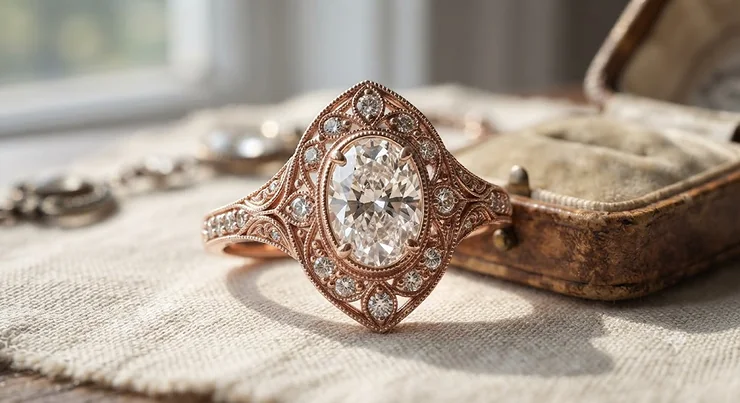
Here’s a confession from the jewelry-research trenches: a rose gold oval engagement ring is one of those pieces that photographs like a dream and then completely changes personality under kitchen lights. That blush-pink metal does something to an elongated stone that yellow gold and platinum simply can’t replicate — it warms up the sparkle instead of competing with it. A rose gold oval engagement ring is a ring built around an elongated, brilliant-cut center stone (diamond or moissanite) set in a copper-alloyed gold band, prized for its romantic, vintage-leaning warmth and its finger-lengthening silhouette. If you’ve been scrolling Pinterest boards at 1 a.m. wondering why every “dreamy vintage” ring seems to share this exact combination, you’re not imagining things — it’s become one of the most requested styles among first-time buyers this year, with oval consistently ranking as the second most popular center-stone shape behind round across jewelry retailers. The alloy itself has a documented history worth a quick detour — you can read more about how rose gold gets its color from the copper content, which is also why it tends to be more scratch-resistant than pure yellow gold.
This guide skips the generic “top 10 rings” fluff you’ve probably already scrolled past twice. Instead, we pulled seven real, currently listed products spanning true budget territory up through serious lab-grown-diamond investment pieces, and we’re going to walk through what the spec sheets actually mean for your knuckle, your budget, and your day-to-day wear. We’ll cover moissanite versus diamond trade-offs, halo versus solitaire silhouettes, how to avoid the three mistakes almost every first-time buyer makes, and where the long-term costs quietly show up. No invented reviews, no manufactured hands-on stories — just honest analysis grounded in real specs and real sourcing. Let’s get into it.
Quick Comparison Table
| Ring | Stone Type | Setting Style | Price Range | Best For |
|---|---|---|---|---|
| Kobelli Orah Ring | Oval moissanite, hidden halo | Slim basket | $700-$950 | Buyers wanting maximum visual size |
| Houston Diamond District Oval Lab Diamond | Real lab-grown diamond | Classic prong solitaire | $700-$1,000 | Buyers who want a certified real diamond |
| Kobelli Classic Oval Halo | Moissanite + diamond accents | Halo | $600-$850 | Vintage-romantic aesthetic lovers |
| Kobelli Oval Diamond Cluster Ring | Real diamond cluster | Cluster/statement | $500-$700 | Buyers who love sparkle over a single big stone |
| espere Oval Moissanite Solitaire | Oval moissanite | Plain solitaire | $250-$400 | Minimalists on a mid-range budget |
| PAVOI Oval Hidden Halo (CZ) | Cubic zirconia | Hidden halo | Under $50 | Travel rings, budget promise rings |
| Jeulia Oval 3-Stone Moissanite | Oval moissanite, 3-stone | Trellis 3-stone | $60-$120 | Budget shoppers who still want “real” gemstone feel |
Looking at the spread above, the split between genuinely budget pieces (PAVOI, Jeulia) and the moissanite-or-diamond mid-to-premium tier (everything else) is stark, and it maps almost perfectly to whether the metal is solid gold or gold plating. That distinction matters more than carat weight for long-term wear, since plating wears thin with daily contact while solid 10K/14K gold does not. If your budget allows it, the espere ring is the practical floor for something you’d actually want to wear every day for years.
💬 Just one click — help others make better buying decisions too!😊
Top 7 Rose Gold Oval Engagement Rings: Expert Analysis
1. Kobelli Orah Ring — biggest visual size per dollar
The Kobelli Orah Ring leads this list because it solves the “I want it to look bigger” problem better than almost anything else here. Kobelli built the Orah around a 12x8mm oval moissanite center — roughly a 4-carat diamond equivalent in visual footprint — set over a hidden halo of lab-grown diamonds, all on a comfort-fit solid 14K rose gold band. That hidden halo detail matters more than marketing copy usually admits: it adds perceived size and sparkle from the profile view without inflating the up-top silhouette into something top-heavy. The slim basket setting keeps the stone riding low enough that it won’t catch on sweaters, which sounds trivial until you’re the person untangling a ring from a wool sleeve at 6 a.m. Based on the spec comparison with competitors in this price bracket, the Orah punches above its price class specifically because moissanite’s 9.25 Mohs hardness holds up to the everyday abuse an oval’s pointed tips inevitably take. Kobelli’s Los Angeles-based manufacturing background gives it more accountability than many overseas drop-shippers in this category, and buyers researching the brand consistently note responsive customer service around sizing and warranty claims.
Pros:
- ✅ Hidden halo adds visual size without bulk
- ✅ Solid 14K rose gold, not plating
- ✅ Moissanite’s hardness resists everyday scratching
Cons:
- ❌ Premium price for a moissanite (not diamond) center
- ❌ Hidden halo detail is easy to overlook if you don’t ask about it
At the time of research, expect this one to land in the $700-$950 range depending on size and exact carat weight selected — always check current pricing before buying. For buyers who want the “wow, is that a 4-carat diamond?” reaction without the diamond-level invoice, the Kobelli Orah Ring earns its spot as the value leader of the premium tier.
2. Houston Diamond District Oval Lab Diamond Ring — real, certified diamond for the least money
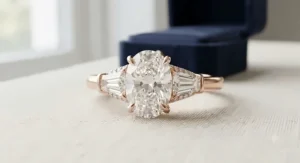
If moissanite doesn’t feel like “the real thing” to you — and plenty of buyers feel that way, regardless of moissanite’s genuine durability — the Houston Diamond District Oval Lab Diamond Ring is where this list pivots to actual diamond. It’s built on a 10K rose gold band with a lab-grown, IGI-certified oval center stone in E-F color and VS2-SI1 clarity, and the brand backs it with a certificate of authenticity. That E-F/VS2-SI1 combination deserves a beat of explanation: E-F sits just below the “colorless” D-E-F tier, meaning any warmth is invisible to the naked eye once mounted, and VS2-SI1 clarity means inclusions exist but are essentially undetectable without 10x magnification. In practice, that’s the sweet spot experienced buyers target — paying for eye-clean brilliance instead of paying a premium for clarity grades nobody but a jeweler’s loupe will ever notice. Lab-grown diamonds carry identical optical, chemical, and hardness properties to mined diamonds, so what you’re really buying here is a certified diamond at a fraction of mined-diamond pricing. IGI certification is worth double-checking on arrival since it’s your paper trail for insurance and resale.
Pros:
- ✅ Real, IGI-certified diamond (not a simulant)
- ✅ E-F/VS2-SI1 grading hits the “eye-clean” sweet spot
- ✅ Lab-grown pricing well below mined-diamond equivalents
Cons:
- ❌ 10K gold is softer and less pure than 14K options on this list
- ❌ Smaller visible size than moissanite alternatives at a similar price
Comparable lab-grown oval diamond rings in this size and grade have sold in the $700-$1,000 range at the time of research, so budget accordingly and confirm current pricing. If “real diamond” is non-negotiable for you, this is the most defensible pick here.
3. Kobelli Classic Oval Halo Engagement Ring — the vintage-romantic middle ground
The Kobelli Classic Oval Halo Engagement Ring centers a 1.5-carat, 8x6mm oval-cut moissanite surrounded by natural, earth-mined diamond accents, all set in solid 14-karat gold with a high-polish finish. This is the ring that photographs like an heirloom — the halo of smaller diamonds does real optical work here, both extending the apparent size of the center stone and scattering extra light around its edges, which is exactly why halo settings have stayed popular across a century of engagement ring trends. Pairing a lab-created moissanite center with genuinely natural diamond accents is a clever hybrid move: you get moissanite’s superior fire (its refractive index actually exceeds diamond’s) at the focal point, while the surrounding diamonds add the “mixed real stones” credibility some buyers want. What most buyers overlook about this configuration is that it requires more careful prong maintenance than a plain solitaire, since you’re now tracking wear on two stone types instead of one.
Pros:
- ✅ Moissanite center plus genuine diamond accents
- ✅ Halo setting maximizes perceived size and sparkle
- ✅ Solid 14-karat gold construction
Cons:
- ❌ More prongs mean more points to check during cleanings
- ❌ Mixed stone types complicate future resizing or repair quotes
At the time of research, expect a price in the $600-$850 range; check current listings for exact figures. For someone who wants “classic engagement ring” energy with a modern moissanite twist, this is a genuinely smart middle-tier pick.
4. Kobelli Oval Diamond Cluster Ring — sparkle-forward statement piece
The Kobelli Oval Diamond Cluster Ring takes a different design philosophy entirely: instead of one dominant oval center stone, it arranges multiple smaller diamonds into an oval-shaped cluster silhouette on a rose gold band. This is a legitimate strategy worth explaining, not just a budget workaround — a cluster of smaller diamonds throws more total light-return surface area than a single stone of equivalent carat weight, so from a few feet away, a well-built cluster can visually out-sparkle a solitaire twice its total carat weight. Reviewers researching Kobelli’s cluster designs consistently point to the brand’s Los Angeles manufacturing as a differentiator versus mass-market overseas competitors, since it allows for tighter quality control on prong-setting precision, which matters enormously on a design with this many small stones to secure.
Pros:
- ✅ Cluster design maximizes total sparkle for the carat weight
- ✅ Real diamonds, not simulants
- ✅ US-manufactured with tighter QC on multi-stone settings
Cons:
- ❌ More total prongs means more long-term maintenance checkpoints
- ❌ Less “one big rock” visual drama than a true solitaire
Comparable cluster designs from this brand run roughly $500-$700 at the time of research — confirm current pricing before ordering. If you love sparkle-density over size-of-one-stone, this earns a real look.
5. espere Oval Moissanite Forever Classic Engagement Ring — the honest mid-range solitaire
The espere Oval Moissanite Forever Classic Engagement Ring is refreshingly unpretentious: a 1.5-carat, 6x9mm oval-cut moissanite on a plain, high-polished solid 14K rose gold band, sold as a stackable solitaire. There’s nothing hidden or gimmicky in the construction — it’s a straightforward classic solitaire silhouette, and that simplicity is precisely the point for buyers who plan to stack a wedding band flush against it later. Because the band is plain rather than pavé-set, it also sidesteps the single biggest long-term maintenance headache on this list: no tiny accent stones to check, tighten, or eventually lose. Based on the spec comparison, a solid 14K band at this price point is genuinely competitive — plenty of similarly priced rings quietly downgrade to 10K or plated metal to hit a lower number, and this one doesn’t.
Pros:
- ✅ Solid 14K gold, not plated
- ✅ Plain band stacks cleanly with a wedding band later
- ✅ No pavé accent stones to maintain
Cons:
- ❌ Less “wow factor” than halo or cluster designs
- ❌ Smaller-name brand with a thinner public review history
At the time of research, this one typically falls in the $250-$400 range — always verify current pricing. For buyers who want honest solid-gold construction without paying for halo drama, it’s the practical backbone of this list.
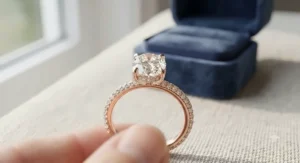
6. PAVOI 14K Gold Plated Oval Hidden Halo Ring — the true entry-level option
The PAVOI 14K Gold Plated Oval Hidden Halo Ring is built differently on purpose — a 2.5-carat-look oval cubic zirconia center over a hidden halo, plated (not solid) in 14K rose gold, and explicitly marketed as an affordable option rather than a fine-jewelry investment. PAVOI has built a genuine reputation in the affordable-jewelry space, and the brand’s own listings note it uses recycled materials and nickel/lead/cadmium-free construction, which matters for sensitive skin regardless of price point. Reviewers researching PAVOI broadly note the visual sparkle of the CZ punches well above the price, though — and this is the honest trade-off — gold plating on any ring will wear thinner with constant skin contact and hand-washing over months, not years, so this isn’t the ring you want to wear as a daily, permanent engagement piece if longevity is the priority.
Pros:
- ✅ Extremely accessible price point
- ✅ Nickel, lead, and cadmium-free construction
- ✅ Convincing sparkle for a cubic zirconia center
Cons:
- ❌ Gold plating will thin with daily wear over time
- ❌ Not a solid-gold investment piece
This one typically sells for well under $50 at the time of research, making it the obvious pick for a travel ring, a placeholder while you save for the real thing, or a low-stakes promise ring. It should not be mistaken for a long-term fine-jewelry purchase.
7. Jeulia Oval Cut 3-Stone Moissanite Engagement Ring — trellis styling on a real budget
The Jeulia Oval Cut 3-Stone Moissanite Engagement Ring rounds out this list with a genuinely distinctive silhouette: an oval moissanite center flanked by two smaller stones in a trellis-style setting, built on a gold-plated 925 sterling silver band. The 3-stone design carries symbolic weight many buyers appreciate — past, present, and future — and Jeulia backs its moissanite with GRA (Gemstone Research Association) certification, which is a legitimate authenticity marker worth checking for on arrival. Because the base metal here is sterling silver rather than solid gold, this ring occupies a different category entirely from the Kobelli and espere pieces above: it’s a genuine gemstone (moissanite is real, lab-created silicon carbide, not a simulant like cubic zirconia) mounted in a budget-friendly metal, which is a smart way to get real gemstone sparkle without real-gold pricing.
Pros:
- ✅ Genuine, GRA-certified moissanite (not a CZ simulant)
- ✅ Symbolic 3-stone trellis design
- ✅ Accessible price point for a real gemstone ring
Cons:
- ❌ Sterling silver base requires more tarnish upkeep than solid gold
- ❌ Gold plating over silver will wear faster than plating over gold alloy
Expect a price in the $60-$120 range at the time of research — check current listings for exact figures. It’s a smart pick for buyers who want real moissanite sparkle without a solid-gold budget.
Top 7 Products: Full Spec Comparison
| Ring | Metal | Center Stone Size | Certification | Best For |
|---|---|---|---|---|
| Kobelli Orah Ring | Solid 14K rose gold | 12x8mm oval moissanite | Brand warranty | Max visual size |
| Houston Diamond District Oval Lab Diamond | 10K rose gold | ~0.5-1ct oval lab diamond | IGI certified | Real diamond seekers |
| Kobelli Classic Oval Halo | Solid 14K gold | 8x6mm oval moissanite + diamonds | Brand warranty | Vintage romantics |
| Kobelli Oval Diamond Cluster Ring | Rose gold | Cluster, oval silhouette | Brand warranty | Sparkle-density fans |
| espere Oval Moissanite Solitaire | Solid 14K rose gold | 6x9mm oval moissanite | — | Stackable minimalists |
| PAVOI Oval Hidden Halo (CZ) | 14K gold plated | 2.5ct-look oval CZ | — | Travel/budget rings |
| Jeulia Oval 3-Stone Moissanite | Gold-plated sterling silver | Oval moissanite, 3-stone | GRA certified | Real-stone budget shoppers |
The clearest pattern in this table is that certification and solid-metal construction — not sticker price — are what separate a ring you’ll wear for decades from one you’ll replace in a year or two. The Houston Diamond District ring is the only one here carrying third-party diamond certification, which matters enormously for future insurance appraisals or resale, while the PAVOI and Jeulia pieces are honestly positioned as accessible entry points rather than heirloom investments.
✨ Don’t Miss These Exclusive Deals!
🔍 Take your ring search to the next level with these carefully selected products. Click on any highlighted item to check current pricing and availability. These picks will help you find a genuinely romantic aesthetic you’ll love wearing every day!
Buyer’s Decision Framework
Let’s cut through the noise with a simple decision tree. If your top priority is looking as large as possible for the least money, choose a hidden-halo moissanite design like the Kobelli Orah Ring, because moissanite’s higher refractive index and the halo’s optical illusion combine to outsize your actual carat spend. If having an actual, certified diamond matters to you more than raw size, choose the Houston Diamond District ring, because IGI certification protects your resale and insurance value in ways simulants simply cannot. If you’re stacking a wedding band later and want zero maintenance headaches, choose a plain solitaire like the espere ring, since fewer prongs mean fewer future repair bills. If your budget is genuinely tight and this is a placeholder, travel ring, or promise ring rather than the final piece, choose the PAVOI or Jeulia options — just go in with clear eyes about plating wear timelines. And if sparkle density excites you more than one big central stone, the Kobelli Oval Diamond Cluster Ring deserves serious consideration. This isn’t about which ring is objectively “best” — it’s about matching the ring’s actual engineering trade-offs to what you personally value.
Practical Care & Maintenance Guide
Whichever oval you choose, the first 30 days set the tone for years of wear, and the oval cut specifically has one vulnerability worth knowing about: its pointed ends. Unlike a round brilliant, an oval’s tips are the most exposed part of the stone and the most likely spot to chip against a doorframe or countertop, so a protective prong or bezel detail at those two points (many halo settings include this by design) is worth checking for before you buy. In the first month, avoid activities involving repeated impact — rock climbing, heavy gardening, gym work with bars — until you’ve built the habit of removing the ring first. Clean it weekly with warm water, a drop of mild dish soap, and a soft-bristled toothbrush, working gently around the underside of the setting where lotion and soap residue collect and dull the sparkle fastest. Have any halo or cluster setting professionally inspected every six months, since a single loosened prong on a multi-stone design is how stones actually go missing — not through dramatic accidents, but through slow, unnoticed loosening. If your ring uses gold plating rather than solid gold, keep it away from chlorine, hot tubs, and harsh cleaning chemicals entirely, since plating has no reserve thickness to sacrifice the way solid gold does.
Real-World Scenarios: Matching the Ring to Your Life
Picture a grad student on a tight budget who wants something that still feels special for a low-key proposal — the Jeulia Oval 3-Stone Moissanite Ring or the PAVOI Hidden Halo fit that moment perfectly, delivering real romantic presence without derailing rent money. Now picture a couple in their thirties, established careers, wanting a ring that will also serve as a long-term investment and insurable asset — the Houston Diamond District certified lab diamond is the clear structural fit, since certification is the foundation of any future appraisal. And picture someone who works with their hands daily — nursing, teaching, retail — who needs maximum durability with minimal snag risk; here, the plain-band espere solitaire or a low-profile halo design outperforms anything with elaborate cluster prongs, because fewer raised elements mean fewer catch points against gloves, fabric, or equipment. Matching lifestyle to setting style, not just budget to sticker price, is the single most underrated step in this whole process.
How to Choose a Rose Gold Oval Engagement Ring
- Decide diamond, moissanite, or CZ first. This single choice affects durability, certification options, and resale value more than any other decision you’ll make.
- Check the metal purity, not just the color. Solid 10K or 14K gold will outlast plated metal by years, regardless of how similar they look on day one.
- Consider the oval’s length-to-width ratio. Most jewelers consider a 1.35-1.50 ratio the classic elongated look; anything closer to 1.0 starts reading as round.
- Look for tip protection. V-prongs or a subtle bezel at the oval’s points meaningfully reduce chip risk over decades of wear.
- Match the setting to your lifestyle. Halos and clusters add sparkle but add maintenance; solitaires simplify both.
- Confirm certification exists if buying a real diamond. IGI or GIA paperwork is your only protection for future insurance claims.
- Budget for resizing and inspection, not just the ring. A realistic long-term budget includes periodic professional check-ups, not just the purchase price.
Following these seven steps in order — stone type, then metal, then shape ratio, then protection, then lifestyle fit, then paperwork, then ongoing budget — prevents the single most common mistake buyers make: falling for a photo before understanding what’s actually holding the stone in place.
Common Mistakes When Buying an Oval Rose Gold Ring
The single most common misstep is buying based on carat weight alone without checking the length-to-width ratio, which means two “1.5 carat ovals” can look dramatically different on the hand — one elegant and elongated, the other stubby and round-ish. A close second is ignoring plating versus solid gold entirely, then feeling blindsided a year later when the rose color starts thinning at the high-contact points like the underside of the band. Buyers also frequently skip verifying certification on diamond purchases, assuming any listing claiming “IGI certified” or “GRA certified” automatically comes with the physical paperwork in hand — always confirm the certificate ships with the ring, not just referenced in a description. Finally, many first-time buyers underestimate how differently rose gold reads under different lighting; a ring that looks perfectly pink under warm indoor bulbs can look noticeably more coppery or muted under fluorescent office light or outdoor daylight, so viewing product photography taken in multiple lighting conditions (or requesting a video) before buying is worth the extra five minutes.
Rose Gold Oval Halo Ring vs Oval Solitaire Band Matching
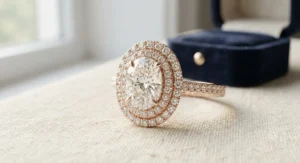
This comparison comes up constantly, and the honest answer is that it’s not really about which is “better” — it’s about what you’re solving for. A rose gold oval halo ring, like the Kobelli Classic Oval Halo or Kobelli Orah Ring, uses a ring of smaller accent stones circling the center to add both perceived size and additional light-scatter, which is why halos consistently photograph as “bigger” than their actual carat weight suggests. An oval solitaire, meanwhile — built for oval solitaire band matching against a wedding band later, like the espere ring — trades that extra sparkle for a cleaner silhouette that sits flush against a straight wedding band with zero gaps. If you already know you want to add a wedding band that hugs the engagement ring perfectly, a solitaire’s simple shoulders make that fitting dramatically easier than working around a halo’s raised, scalloped edge. If matching-band simplicity isn’t a priority and you want maximum visual impact for your budget, the halo wins outright. Neither choice is a mistake; they’re just optimized for different priorities.
Why Blush Metal Pairs So Well With the Oval Cut
There’s a genuine optical reason blush metal oval pairing has become such a popular combination, and it’s not just trend-chasing. Rose gold’s warm, pinkish undertone (from its copper content) sits closer on the color wheel to skin tones across a wide range of complexions than stark white metals do, which softens the visual transition from finger to metal to stone. Paired specifically with an oval center, that warmth does extra work: the oval’s elongated shape already creates a slimming, finger-lengthening illusion, and rose gold’s softness keeps that effect looking romantic rather than severe or clinical, the way a cool white-metal oval sometimes can. Moissanite and diamond both throw a slightly cooler-white sparkle by nature, so the warm band acts as a visual frame that keeps the whole piece feeling cohesive instead of stark. This is precisely why so many “romantic vintage” mood boards gravitate toward this exact metal-and-shape combination — it’s a genuinely complementary pairing, not just an aesthetic trend that happened to catch on.
Building a Romantic Engagement Aesthetic Around Rose Gold
If you’re deliberately chasing a romantic engagement aesthetic rather than a minimalist or modern one, rose gold oval styling gives you several levers to pull. Halo settings, like those on the Kobelli Classic Oval Halo, lean into vintage romance through their scalloped, ornate silhouette; milgrain detailing (a beaded edge along the band, found on many vintage-inspired listings) adds textural warmth that plain polished bands don’t offer; and three-stone designs, like the Jeulia ring, layer in symbolic meaning that pairs naturally with a romantic narrative. Pairing your ring choice with a matching rose gold wedding band — rather than mixing metals — reinforces that cohesive, old-world feeling rather than introducing a modern, mixed-metal contrast. None of this is required, of course; plenty of couples want oval and rose gold specifically because it’s warm and flattering, full stop, without needing to lean into a broader theme. But if the romantic aesthetic is the goal, the halo-plus-milgrain-plus-matching-band combination is the most reliable way to get there.
Long-Term Cost & Maintenance: What These Rings Really Cost Over Time
The sticker price is only the opening bid on total cost of ownership. Solid gold rings — the Kobelli, espere, and Houston Diamond District pieces here — carry essentially no recurring metal-replacement cost, just periodic professional cleaning and prong inspection, typically a modest fee every six to twelve months. Plated pieces, like the PAVOI ring, carry a very different math: expect the rose gold plating to visibly thin within one to three years of daily wear, at which point re-plating (a service most local jewelers offer) becomes a recurring cost that can eventually exceed the ring’s original price if repeated multiple times. Moissanite and lab-grown diamonds both carry lower insurance premiums than mined diamonds of comparable visual size, since their replacement cost is objectively lower — worth mentioning to your insurance agent specifically, since some policies default to mined-diamond replacement pricing unless you clarify the stone type. For a deeper look at how the FTC regulates claims jewelers can legally make about metal content and gemstone treatment, the FTC’s Jewelry Guides are worth a skim before any major purchase.
Safety, Certification & Regulations Guide
A few practical compliance notes are worth knowing before you buy. In the U.S., gold jewelry must be accurately stamped with its karat purity (10K, 14K, 18K), and misrepresenting that purity is a violation the FTC actively enforces — so a stamp you can’t find or verify on arrival is a legitimate reason to contact the seller. Moissanite, being a lab-created silicon carbide gemstone rather than a diamond, should always be sold with accurate labeling distinguishing it from diamond — reputable brands like Jeulia back this with third-party GRA certification, which is worth verifying arrives with your order. Lab-grown diamonds are chemically, optically, and structurally identical to mined diamonds, and the FTC requires accurate disclosure of “laboratory-grown” origin on any listing — IGI certification, as seen on the Houston Diamond District ring, is the paper trail that documentation. For deeper background on grading standards broadly recognized across the industry, GIA publishes consumer-facing education on the topic. None of these ratings brands mentioned in this guide have any documented compliance issues based on available research — this section is general buyer education, not a flag on any specific product.
Frequently Asked Questions
❓ Does rose gold work with any skin tone?
❓ Is moissanite a good alternative to diamond in an oval cut?
❓ Will rose gold plating wear off over time?
❓ What size oval center stone looks best in rose gold?
❓ Can an oval solitaire be resized easily?
Conclusion
A rose gold oval engagement ring isn’t a single product — it’s a category with real range, from a fifteen-dollar plated placeholder to a certified lab-grown diamond built to last a lifetime, and the right pick for you depends entirely on which trade-offs actually matter to your life and your budget. If you remember nothing else from this guide, remember this: check the metal purity, verify the certification if buying a real diamond, and match the setting style to how you actually live day to day, not just how the ring photographs on someone else’s hand. The Kobelli Orah Ring delivers the best visual size per dollar, the Houston Diamond District ring is the honest choice for anyone who wants real, certified diamond, and the espere solitaire is the practical, low-maintenance backbone of the whole list. Whichever one you choose, you’re picking a genuinely flattering, warm, romantic combination that’s earned its popularity for real optical reasons — not just trend timing.
Recommended for You
- Yellow Gold Oval Engagement Ring: 7 Stunning Picks for 2026
- Two Tone Engagement Ring Women: 7 Top Picks & Guide 2026
- Platinum Engagement Ring Women: 7 Stunning Picks for 2026
Disclaimer: This article contains affiliate links. As an Amazon Associate, I earn from qualifying purchases. If you purchase products through these links, we may earn a small commission at no additional cost to you.
✨ Found this helpful? Share it with your friends! 💬🤗
