In This Article
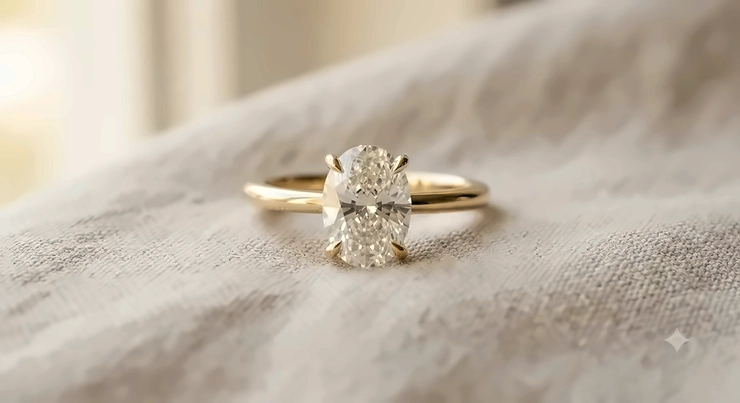
Picture this: a ring slides onto a finger for the first time, and instead of a cold flash of white metal, there’s this warm, honeyed glow that looks like it caught a little bit of sunset and decided to stay there. That’s the pull of a yellow gold oval engagement ring, and it’s not just nostalgia talking. A yellow gold oval engagement ring pairs an elongated, brilliant-cut stone with a warm-toned precious metal band, a combination prized for its vintage character and its slimming, finger-lengthening silhouette. Oval cuts have quietly become one of the most requested shapes at independent jewelers and online retailers alike, largely because they deliver more visual size per carat than a round brilliant, and yellow gold has swung back into fashion after nearly two decades of white-metal dominance.
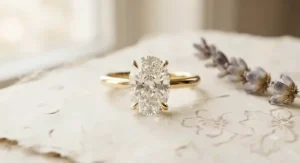
This guide skips the sales pitch you’d get standing under fluorescent mall lighting. Instead, you’re getting real products with real specifications, honestly summarized review sentiment where it’s verifiable, and straightforward analysis of what actually matters when you’re comparing a bezel-set solitaire to a hidden halo. Whether you’re weighing a solid 14k gold oval diamond ring against a moissanite alternative, or you’re just trying to figure out why an oval solitaire yellow gold ring looks so different on your hand than it did on your phone screen, you’ll find the specific answers here. We’ll walk through seven real rings across budget, mid-range, and premium tiers, then dig into buying criteria, common mistakes, cost realities, and the regulatory details that actually protect your wallet.
Quick Comparison Table
Before diving into full reviews, here’s a fast snapshot of how these seven rings stack up on metal purity, stone type, and who each one tends to suit best.
| Ring | Gold Purity | Stone Type | Price Range | Best For |
|---|---|---|---|---|
| Kobelli Bezel Solitaire Oval-Cut Ring | 14K | Lab-grown diamond | $700-$1,200 range | Active lifestyles, low-profile security |
| Dazzlingrock Collection Oval Aquamarine & Diamond Ring | 14K | Aquamarine + diamond accents | $300-$450 range | Budget-conscious, colored-stone lovers |
| Clara Pucci Oval Moissanite Ring | 14K | Moissanite | $450-$650 range | Big-look-for-less shoppers |
| Gem Stone King Two-Tone Oval Ring | 10K + 925 silver | Moissanite + lab diamond | $150-$250 range | First-time buyers, tight budgets |
| Vir Jewels Oval Halo Ring | 14K | Natural diamond | $900-$1,400 range | Traditionalists who want extra sparkle |
| PAVOI Hidden Halo Oval Ring | Gold-plated | Cubic zirconia | $40-$70 range | Placeholder rings, travel backups |
| Houston Diamond District Oval Solitaire Ring | 14K | IGI-certified lab-grown diamond | $1,600-$2,400 range | Buyers who want a real diamond with paperwork |
Reading across this table, the split between “solid gold with a real or lab-grown diamond” and “gold-plated with simulated stones” is the single biggest decision fork here — the PAVOI option is genuinely a different category of purchase than the Houston Diamond District ring, and neither is “better,” just built for a different budget and purpose. If your priority is a verifiable IGI certificate and long-term resale value, the Houston Diamond District and Vir Jewels rings pull ahead; if you want maximum visual size per dollar without natural-diamond pricing, the Clara Pucci and Gem Stone King moissanite options are worth a longer look.
💬 Found a favorite already? One click gets you the current price and availability — no obligation, just information.
Top 7 Yellow Gold Oval Engagement Rings: Expert Analysis
1. Kobelli Bezel Solitaire Oval-Cut Diamond Ring — sleek, snag-free bezel setting
The standout here is the floating bezel setting, which wraps a rim of 14-karat gold fully around the diamond’s girdle instead of relying on prongs. That single design choice changes the whole ownership experience.
Specs-wise, the oval lab-grown diamond sits north-south in the setting, which Kobelli notes is the most flattering orientation for elongating the appearance of the finger, and the comfort-fit interior band curves gently instead of sitting flat, which matters more than people expect once you’re wearing a ring daily for years rather than trying it on for thirty seconds in a store. Kobelli also builds this piece from recycled gold, a sourcing detail that’s becoming a genuine differentiator rather than a marketing footnote.
Based on the spec comparison with prong-set alternatives, this ring is best suited to people with active hands — nurses, teachers, anyone who’s constantly pulling on gloves or gripping equipment — because there’s no raised prong to catch on fabric or hair. Reviewers consistently report that the bezel setting feels noticeably more secure day-to-day, though a small number of aggregated comments note that a full bezel can make the stone appear slightly smaller than the same carat weight in an open prong setting, since less of the diamond’s girdle is visible from the side.
Pros:
- ✅ Bezel setting protects the stone from daily bumps
- ✅ Recycled gold sourcing for eco-conscious buyers
- ✅ Available in white, yellow, or rose gold
Cons:
- ❌ Bezel can visually shrink the stone slightly
- ❌ Fewer angles for light to enter compared to prongs
At a price generally in the $700-$1,200 range depending on carat and gold purity selected, this is a strong value pick if daily durability outweighs maximum sparkle for you — check current price and options before deciding on carat weight.
2. Dazzlingrock Collection Oval Aquamarine & Diamond Ring — budget oval with real color
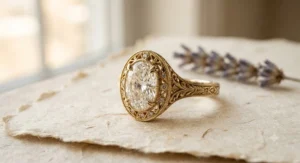
What jumps out immediately is that this isn’t a diamond ring at all — it’s a genuine 4x3mm oval aquamarine center stone flanked by white diamond accents, all set in solid 14-karat yellow gold, and that combination is exactly why it lands at a fraction of a diamond-centered ring’s cost.
The oval aquamarine gives you that same elongated, finger-flattering silhouette people chase with diamonds, but aquamarine runs dramatically cheaper per carat than diamond, which is how Dazzlingrock keeps this at an entry-level price point while still using solid gold rather than plating. The five-stone bridal design adds small diamond accents down the shoulders, so there’s still genuine diamond sparkle, just not concentrated in the center stone.
What most buyers overlook about colored center-stone rings like this one is durability nuance: aquamarine rates 7.5-8 on the Mohs hardness scale, which is very wearable for daily use but softer than diamond’s 10, so it benefits from a slightly more protective setting and a bit more care around abrasive contact. This is a genuinely good option for a March-birthday bride, someone drawn to a softer blue-green palette, or anyone who wants solid gold and a real gemstone without diamond-level spending.
Pros:
- ✅ Real solid 14k gold, not plated
- ✅ Genuine aquamarine center, not a simulant
- ✅ Diamond accents add authentic sparkle
Cons:
- ❌ Aquamarine is softer than diamond, needs more care
- ❌ Less resale value than a diamond-centered ring
Priced in the $300-$450 range at the time of research, this is one of the more honest budget plays in this lineup — real materials, just a different stone strategy.
3. Clara Pucci Oval Moissanite Ring — near-diamond fire at a fraction of the cost
The headline feature is the 2.5 total carat weight oval moissanite center stone, cut to 9.5×7.5mm, set in solid 14-karat yellow gold — a size and metal combination that would push well past $10,000 if that were a natural diamond of comparable clarity.
Moissanite’s refractive index actually exceeds diamond’s, which translates into more visible “fire” (flashes of rainbow color) under mixed lighting, though it can look slightly more colorful and less purely white than a top-color diamond depending on lighting conditions. On paper this means buyers get significantly more visual size and sparkle per dollar, which is exactly why moissanite has become the go-to diamond alternative for people who want the oval solitaire yellow gold look without the oval diamond price tag.
Here’s what to weigh: moissanite is durable (9.25 on the Mohs scale, just below diamond) and doesn’t chip or cloud with normal wear, so the honest tradeoff isn’t durability, it’s resale value and the slightly different light behavior compared to diamond. Reviewers consistently note the stone looks noticeably larger in person than the carat number suggests, a common effect of oval cuts generally and moissanite’s brilliance specifically.
Pros:
- ✅ Large, brilliant look at diamond-alternative pricing
- ✅ Excellent durability for daily wear
- ✅ Solid 14k gold construction, not plated
Cons:
- ❌ Slightly more colorful sparkle than a diamond
- ❌ Lower resale value than a natural or lab diamond
Expect this ring in the $450-$650 range, making it one of the best value-per-visual-carat picks in this entire roundup — check current price for the specific size and finger measurement you need.
4. Gem Stone King Two-Tone Oval Ring — the true entry point
The defining feature here is the two-tone construction: 925 sterling silver body with 10-karat yellow gold accents, pairing a small oval-cut moissanite and lab-grown diamond combination at 0.68 total carat weight.
This isn’t marketed as a forever-diamond investment piece, and honestly, it doesn’t need to be — the 10K gold content (41.7% pure gold by the karat system) keeps cost down while still legally qualifying as “gold” under U.S. labeling standards, and the moissanite-diamond pairing gives real sparkle rather than a fully simulated stone. Gem Stone King has operated as a family jewelry business since 1903, which lends some legitimate track record to a brand many shoppers encounter for the first time on Amazon.
Based on the spec comparison with fully solid-gold alternatives, this ring makes the most sense as a placeholder engagement ring, a promise-ring-adjacent gift, or a starter piece for someone still deciding on their long-term style before investing in a bigger stone. Aggregated buyer sentiment on similar Gem Stone King pieces tends to praise the packaging and gift presentation, while noting that sterling silver components require more frequent polishing than solid gold to resist tarnish.
Pros:
- ✅ Genuinely affordable entry point
- ✅ Real moissanite and lab diamond, not fully simulated
- ✅ Established brand with a long operating history
Cons:
- ❌ Sterling silver portion tarnishes faster than gold
- ❌ Smaller center stone than other rings on this list
At roughly $150-$250 depending on size and stone configuration, this is the ring to consider if budget is the deciding factor and you still want authentic gemstone content.
5. Vir Jewels Oval Halo Diamond Ring — traditional sparkle, elongated silhouette
What stands out on this piece is the halo-and-shoulder design: a 1 total carat weight natural diamond ring in 14-karat yellow gold, with the ring’s face measuring roughly 19mm long by 10mm wide — proportions that read as a classic yellow gold oval halo ring silhouette even before you factor in the stone shape.
The center diamond carries a comparatively modest individual carat weight, with the bulk of total carat weight distributed across accent stones in the halo and along the shank — a construction choice that, based on the spec sheet, maximizes visible sparkle and perceived size for the total diamond budget spent, versus concentrating everything into one larger center stone. This is a classic value-engineering move in the mid-range diamond ring category, and it’s one of the more honest ways brands stretch a diamond budget without resorting to simulants.
Reviewers consistently frame Vir Jewels pieces as good “step-up” rings — more substantial-feeling than entry sterling silver options, but priced well under boutique jeweler halo rings with comparable total carat weight. What most buyers overlook about halo constructions generally is maintenance: more prongs and more small stones mean more surface area to keep clean and more settings to have inspected annually.
Pros:
- ✅ Natural diamonds throughout, not lab-grown or simulated
- ✅ Halo design maximizes perceived size
- ✅ Solid 14k gold with gift box included
Cons:
- ❌ More prongs mean more maintenance checkups
- ❌ Center stone is smaller than total carat weight implies
Typically priced in the $900-$1,400 range, this ring suits buyers who specifically want natural diamonds and don’t mind that “1 carat total weight” is spread across several stones rather than one center diamond.
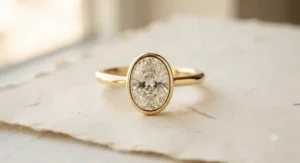
6. PAVOI Hidden Halo Oval Engagement Ring — the honest budget placeholder
The defining trait of this ring, and the reason it belongs in this roundup despite being fundamentally different from the other six, is that it’s 14-karat gold-plated rather than solid gold, paired with a 2.5-carat cubic zirconia in a hidden halo oval setting.
To be direct about what that means in practice: gold plating is a thin layer of gold bonded over a base metal, not gold throughout the piece, and cubic zirconia is a lab-created diamond simulant rather than a mineral or lab-grown diamond crystal. Neither of those facts makes this a bad product — PAVOI is transparent about the construction, and the ring delivers a convincingly large hidden-halo oval look for a genuinely tiny fraction of solid-gold diamond-ring pricing.
Here’s what to weigh honestly: gold plating wears thinner with contact and chemical exposure over months to a couple of years, and cubic zirconia can cloud or show wear faster than diamond or moissanite. What most buyers overlook is that this makes the PAVOI ring genuinely well-suited to specific use cases — a travel ring worn instead of the real engagement ring on vacations, a placeholder while a custom ring is being made, or a low-stakes way to test whether you actually like the hidden-halo oval silhouette before spending real money on it.
Pros:
- ✅ Extremely low price point for the visual size delivered
- ✅ Good travel or placeholder ring option
- ✅ Hidden halo adds sparkle without high cost
Cons:
- ❌ Gold plating wears down over time
- ❌ Cubic zirconia clouds faster than diamond or moissanite
Priced around $40-$70 at the time of research, this is not a forever ring for most people, but it’s a genuinely useful one for the specific situations described above.
7. Houston Diamond District Oval Solitaire Ring — the certified premium pick
The feature that separates this ring from everything else on this list is IGI certification on a genuine lab-grown oval diamond — a 1-carat center stone in H-I color and VS1-VS2 clarity, set as a solitaire in solid 14-karat yellow gold.
IGI (International Gemological Institute) certification means the diamond’s carat weight, color, clarity, and cut characteristics have been independently verified rather than simply stated by the seller, which matters enormously for both insurance purposes and any future resale or appraisal. VS1-VS2 clarity means any inclusions are very slightly visible only under 10x magnification, essentially invisible to the naked eye, and H-I color sits in the “near colorless” range that reads as bright white in a yellow gold setting specifically, since the warm metal tone actually helps mask the faintest hint of body color a diamond in that grade might carry.
Based on the spec comparison with the natural-diamond options earlier in this list, lab-grown diamonds are chemically, physically, and optically identical to mined diamonds — the only difference is origin — and they typically run 30-40% less expensive than a natural diamond of comparable grade, which is exactly why a 1-carat IGI-certified stone is achievable at this ring’s price point at all. Reviewers consistently highlight the included certificate and presentation box as reassuring for a purchase at this price level, while noting that buyers should always verify the exact IGI report number against the physical certificate upon delivery.
Pros:
- ✅ Independently IGI-certified diamond specs
- ✅ Lab-grown diamond at meaningfully lower cost than natural
- ✅ Solid 14k yellow gold solitaire setting
Cons:
- ❌ Highest price point in this roundup
- ❌ Lab-grown diamonds carry lower resale value than natural
Generally priced in the $1,600-$2,400 range depending on exact color and clarity selected, this is the pick for buyers who want a genuine diamond, verified paperwork, and don’t need the resale premium that comes with a natural stone.
Practical Usage Guide: Caring for Your New Ring
Getting the ring is only step one — the first thirty days of ownership set the tone for how it looks five years from now. Start by having any prong or bezel setting professionally inspected before you even leave the store or within a week of an online delivery arriving; a loose prong is invisible to the eye but easy for a jeweler to catch with a loupe. Clean the ring weekly with warm water, a few drops of mild dish soap, and a soft-bristled toothbrush reserved just for jewelry, focusing on the underside of the stone where lotion and soap residue build up fastest and dull the sparkle.
Remove the ring before applying lotion, sunscreen, or hairspray, and before workouts, gardening, or dishwashing — yellow gold is more resistant to scratching than platinum but still softer than the diamond, moissanite, or cubic zirconia it’s holding. A common first-30-days mistake is showering with the ring on; soap film builds an invisible layer over stones and settings that regular home cleaning can’t fully remove, eventually requiring an ultrasonic clean at a jeweler. Set a recurring reminder for a professional cleaning and prong check every six months for solid gold rings with natural or lab diamonds, and every three to four months for pieces with softer center stones like the aquamarine option covered earlier, since a professional visit catches problems while they’re still a five-minute fix.
Finally, get the ring appraised and insured within the first month, especially for anything in the mid-range or premium tier of this list — a scheduled personal articles policy or rider typically costs 1-2% of the ring’s value annually and covers loss, theft, and accidental damage that standard homeowner’s or renter’s insurance often caps or excludes entirely.
Real-World Scenarios: Which Ring Actually Fits Your Life
Consider Maya, a 27-year-old ICU nurse who’s constantly gloving up and scrubbing in. For her, prong-heavy halo designs are a snagging hazard, which is exactly why the Kobelli Bezel Solitaire Oval-Cut Diamond Ring earns its spot in this guide — the bezel setting has no raised edges to catch on nitrile gloves or bedsheets, and the recycled-gold sourcing appeals to her values without adding cost.
Then there’s Devon, a graduate student proposing on a strict $500 budget who still wants his partner to be floored by the size of the stone. The Clara Pucci Oval Moissanite Ring solves this directly: a 2.5-carat oval moissanite in solid 14k gold delivers a look that would cost five figures in natural diamond, landing comfortably in his price range with money left over for the honeymoon.
And consider Priya, who’s been eyeing engagement rings for two years and knows exactly what she wants: a genuine diamond, real paperwork, and a ring she can get formally appraised the same week it arrives. The Houston Diamond District Oval Solitaire Ring checks every box — IGI certification, solid 14-karat gold, and a lab-grown diamond that stretches her budget further than a natural stone of the same clarity ever could.
Buyer’s Decision Framework
Use this simple framework if you’re still torn between options in this list:
- If your top priority is daily durability with hands-on work, choose a bezel-set style like the Kobelli ring, because there’s nothing raised to catch or bend.
- If your top priority is maximum visual size on a tight budget, choose moissanite, like the Clara Pucci or Gem Stone King rings, because the refractive properties deliver more sparkle per dollar than diamond.
- If your top priority is verified paperwork and long-term insurability, choose the Houston Diamond District ring, because IGI certification gives you a documented baseline for appraisal and insurance.
- If your top priority is testing a style before committing real money, choose the PAVOI ring, because gold plating and cubic zirconia let you try the hidden-halo oval look at low financial risk.
- If your top priority is natural diamonds specifically, choose the Vir Jewels halo ring, because it keeps every stone mined rather than lab-grown while staying in a genuinely reachable price bracket.
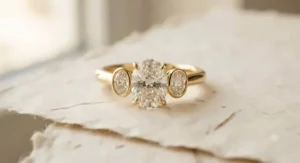
How to Choose a Yellow Gold Oval Engagement Ring
Narrowing down a purchase gets much easier once you break it into concrete criteria rather than shopping on vibes alone.
- Decide your stone type first. Natural diamond, lab-grown diamond, and moissanite each hit a different price-to-size ratio, and that decision affects every other choice downstream.
- Check the oval cut L/W ratio. According to GIA’s oval diamond buying guide, a length-to-width ratio between 1.30 and 1.40 reads as a gently rounded oval, while 1.40 to 1.50 gives the more classic, elongated look most people picture when they hear “oval engagement ring” — anything above roughly 1.50 starts to resemble a marquise cut instead.
- Confirm the gold karat and stamp. 14k gold (58.3% pure gold) balances durability and warmth of color better than 18k for everyday wear, since higher-karat gold is softer and scratches more easily.
- Match the setting to your lifestyle. Bezel and flush settings protect stones for active hands; prong and halo settings maximize light entry and sparkle.
- Look for a hidden halo if you want size without visual bulk. A hidden halo adds sparkle and perceived carat weight from the underside of the ring without changing the profile you see from above.
- Request certification on anything over roughly $1,000. IGI or GIA paperwork protects you on appraisal, insurance, and any future resale.
- Try the shape on your actual hand before finalizing. Oval cuts interact differently with finger length and width than round or cushion cuts do, and online photos rarely capture that accurately.
Why Oval Creates a Finger Elongation Illusion
The elongated finger illusion that draws people to oval cuts in the first place comes down to simple visual proportion: a north-south oriented oval stone extends the eye’s read of the finger’s length, the same reason elongated rectangular watch faces or pointed-toe shoes create a similar slimming effect. This works especially well paired with a thinner band, since a wider band shortens the visual line the oval is trying to create.
Common Mistakes When Buying an Oval Engagement Ring
The most frequent error isn’t choosing the wrong ring — it’s choosing the wrong length-to-width ratio sight unseen. Buyers who order online without checking the L/W ratio number sometimes receive a stone that reads as noticeably rounder or more elongated than they pictured, since two “oval” diamonds of the same carat weight can look meaningfully different depending on that ratio.
A second common mistake is confusing gold-plated with solid gold at checkout, especially across marketplace listings where the distinction is buried in the fine print rather than the headline. Under federal jewelry labeling rules, sellers are required to disclose plating versus solid construction accurately, but that disclosure can still be easy to skim past when you’re scrolling on a phone at 11pm three weeks before a proposal.
A third mistake is ignoring the bow-tie effect, a dark shadow that can appear across the center of some oval and other elongated diamond cuts depending on how the stone was faceted. It’s not a defect exactly, but a pronounced bow-tie is something buyers regularly regret not checking for in videos or in person before purchasing. Finally, many first-time buyers skip appraisal and insurance entirely, assuming a homeowner’s or renter’s policy already covers the ring — it frequently doesn’t, or caps jewelry claims far below the ring’s actual value.
Yellow Gold Oval Rings vs White Gold Oval Rings
The debate between yellow and white gold for an oval center stone comes down to more than personal color preference, though that’s certainly part of it. Yellow gold requires less maintenance long-term because it doesn’t rely on rhodium plating, the thin white surface layer applied to white gold that wears off over one to two years of daily wear and needs periodic professional re-plating to stay bright.
Where warm metal oval pairing really earns its reputation is with lower-color-grade diamonds and with moissanite: a yellow gold setting subtly warms the visual read of a stone, which can make an H-I color diamond appear whiter by contrast, or soften moissanite’s slightly warmer sparkle into something that reads as more classically elegant. White gold, by comparison, tends to visually emphasize a stone’s coolest, whitest characteristics, which is why jewelers often steer buyers toward white metal for the very highest diamond color grades and toward yellow gold as color grade (and price) comes down. Skin tone plays a role too — yellow gold traditionally complements warmer undertones, though this is genuinely a matter of taste rather than a hard rule, and plenty of cooler-toned wearers choose yellow gold specifically for the contrast.
✨ Ready to see these ovals in yellow gold up close? Compare current listings and pick the setting that matches your everyday life.
Long-Term Cost & Maintenance
Sticker price is only the entry fee; total cost of ownership over a decade looks different across this lineup. A solid 14k gold ring with a natural or lab-grown diamond, like the Houston Diamond District or Vir Jewels pieces, typically needs a professional cleaning and prong check twice a year (often free or low-cost at the retailer where it was purchased or at a local jeweler), plus insurance running roughly 1-2% of appraised value annually.
Moissanite rings like the Clara Pucci option carry similar gold-maintenance costs but skip some of the higher insurance premiums tied to natural diamond appraisal complexity, since moissanite’s replacement cost is dramatically lower and more standardized. The PAVOI gold-plated ring sits at the opposite end entirely: near-zero ongoing maintenance cost because there’s little to protect, but also a finite lifespan, since plating wear is essentially unavoidable and not something a jeweler can fully restore without a full re-plating service that can approach the ring’s original purchase price.
Resale value follows a similar pattern. Natural diamonds and their settings hold value best, lab-grown diamonds and moissanite hold considerably less resale value despite excellent durability, and gold-plated costume pieces have essentially no resale market beyond scrap gold weight on the tiny amount of actual gold present. If long-term value retention matters as much as up-front price, weigh that against the up-front savings each tier offers before deciding.
Safety, Regulations & Gold Purity Compliance
Every ring on this list marketed as “14k,” “10k,” or “gold-plated” falls under specific U.S. Federal Trade Commission rules, not just marketing language. Under the FTC’s Jewelry, Precious Metals, and Pewter Industries guides, a seller cannot legally call an item “gold” unless it meets a minimum karat threshold, and any karat stamp must accurately reflect the actual gold content within a small legal tolerance. This is exactly why the distinction on this list between the PAVOI ring’s gold plating and the solid 14k or 10k gold used in every other entry isn’t just a marketing detail — it’s a legally defined difference in what you’re actually buying.
For buyers, the practical safety takeaway is simple: check that any solid gold ring is stamped (commonly “14K,” “585,” “10K,” or “417,” reflecting parts-per-thousand purity), and be cautious of listings that use the word “gold” prominently while burying “plated” or “vermeil” in smaller text further down the page. Nickel allergy is another practical safety consideration — 14k and 10k yellow gold alloys sometimes include small amounts of nickel in the alloy mix, so buyers with known metal sensitivities should confirm the specific alloy composition, since some brands offer nickel-free formulations on request.
FAQ
❓ What does 'oval solitaire yellow gold' mean exactly?
❓ Is a yellow gold oval halo ring more expensive than a solitaire?
❓ What is the best oval cut L/W ratio 1.40 comparison to other ratios?
❓ Does a 14k gold oval diamond ring tarnish over time?
❓ Why do people prefer warm metal oval pairing over white gold?
Conclusion
A yellow gold oval engagement ring isn’t a single product — it’s a category with real range, from a $40 gold-plated placeholder to a $2,000-plus IGI-certified lab diamond solitaire, and the right choice depends far more on lifestyle, budget honesty, and stone-type preference than on any universal “best” pick. If daily wear and snag resistance top your list, the bezel-set Kobelli ring earns its place. If stretching a tight budget as far as visual impact goes, moissanite options like the Clara Pucci or Gem Stone King rings deliver outsized sparkle for the money. And if documented, certified diamond ownership matters most, the Houston Diamond District solitaire is built for exactly that.
What ties every recommendation here together is transparency: real gold purity where it’s claimed, honestly disclosed plating where that’s what you’re actually buying, and stone specifications you can verify rather than take on faith. Use the length-to-width ratio guidance, the decision framework, and the maintenance schedule above, and you’ll walk into this purchase with far more clarity than most shoppers standing under that fluorescent mall lighting ever get.
✨ Don’t Miss These Exclusive Deals!
🔍 Take your ring search to the next level with these carefully selected picks. Click on any highlighted ring above to check current pricing and availability. These options will help you find an authentic yellow gold oval engagement ring you’ll both love for years to come!
Recommended for You
- Two Tone Engagement Ring Women: 7 Top Picks & Guide 2026
- Platinum Engagement Ring Women: 7 Stunning Picks for 2026
- Rose Gold Engagement Ring Women: 7 Best Picks for 2026
Disclaimer: This article contains affiliate links. As an Amazon Associate, I earn from qualifying purchases. If you purchase products through these links, we may earn a small commission at no additional cost to you.
✨ Found this helpful? Share it with your friends! 💬🤗
