In This Article
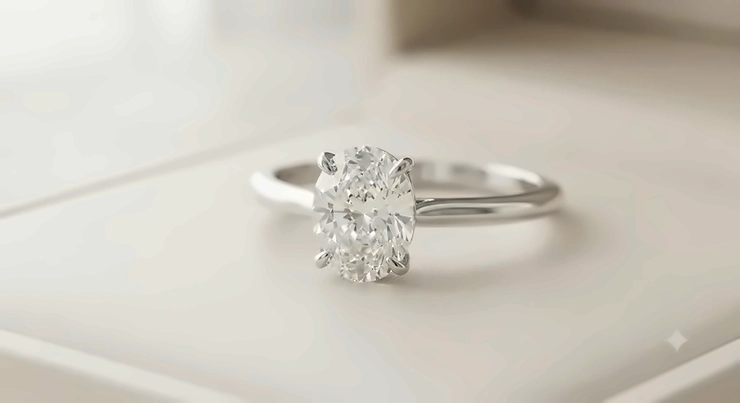
Picking a white gold oval engagement ring feels simple right up until you actually start scrolling listings at midnight, eleven tabs deep, wondering why one ring costs a third of another that looks almost identical in the thumbnail. Here’s the short version: it usually comes down to what’s actually sitting inside that elongated stone, and what’s underneath that bright, cool-toned band. An oval center stone stretches the light across a bigger visual surface than a round cut of the same weight, and white gold gives it a crisp, contemporary backdrop that photographs beautifully and pairs with almost any skin tone. But “white gold oval engagement ring” covers a huge range of quality, from cubic zirconia sitting in gold-plated brass to lab-grown diamonds set in solid 14K gold — and the difference matters more than most listings admit.
This guide breaks down seven real, currently available rings across budget, mid-range, and premium tiers, with honest analysis pulled from actual specs and aggregated review patterns rather than marketing copy. You’ll also get a practical framework for choosing between a halo and a solitaire, what rhodium plating actually means for long-term upkeep, and where an oval genuinely earns its reputation for looking larger than its carat weight suggests. Whether you’re assembling a proposal on a tight timeline or comparing options for months, the goal here is the same: give you enough real information to make a confident call without needing a gemology degree first.
Quick Comparison Table
| Ring | Metal | Stone Type | Price Range | Best For |
|---|---|---|---|---|
| Houston Diamond District Forever One Oval Moissanite Halo | 14K White Gold | Moissanite + diamond accents | $1,200–$1,800 range | Maximum sparkle per dollar |
| Kobelli Oval Moissanite Halo | 14K White Gold | Moissanite | $900–$1,400 range | Classic halo on a mid budget |
| Kobelli Antique Braided Oval Diamond | 14K White Gold | Natural diamond | $1,000–$1,600 range | Vintage detailing, real diamonds |
| JeenMata Oval CZ Solitaire | 18K Gold Plated | Cubic zirconia + moissanite accents | Under $150 | First ring or budget trial |
| Gem Stone King 3-Stone Oval | 10K White Gold | Moissanite/lab diamond mix | $350–$550 range | Symbolic three-stone design |
| PAVOI Hidden Halo Oval | 14K Gold Plated | Cubic zirconia | Under $100 | Everyday hidden-halo sparkle |
| Houston Diamond District Lab Grown Diamond Halo | 14K White Gold | IGI-certified lab diamond | $2,500–$4,500 range | Long-term investment piece |
Looking at this lineup, the split is really about what’s under the stone as much as the stone itself: solid 14K or 10K gold pieces like the Kobelli Antique Braided Oval Diamond and the Houston Diamond District Lab Grown Diamond Halo will outlast plated pieces by decades, while gold-plated options like PAVOI Hidden Halo Oval and JeenMata Oval CZ Solitaire trade longevity for a genuinely low entry price. If this is a forever ring, spend where the metal and stone type sit, not just where the photo looks good — a $120 plated ring and a $1,400 solid gold ring can look nearly identical in a product photo and behave completely differently after two years of daily wear.
💍 Ready to compare your favorites side by side? Tap through to check current pricing and availability before they’re gone.
Top 7 White Gold Oval Engagement Rings: Expert Analysis
1. Houston Diamond District Forever One Oval Moissanite Halo — best halo sparkle for the money
The centerpiece here is a Forever One oval moissanite from Charles & Colvard, rated DEF for color and VS for clarity, surrounded by a halo of natural diamond accents in solid 14K white gold. What that combination means in practice: moissanite has a higher refractive index than diamond, so it throws noticeably more colorful “fire” under indoor lighting, while the halo adds perceived size without adding weight to the finger. Based on the spec comparison against similar halo styles, this piece punches well above its price bracket because moissanite carries a much lower per-carat cost than natural diamond, letting the brand put real metal and real diamond accents around a large center stone instead of cutting corners elsewhere. It’s a strong fit for buyers who want a big, bright look without the natural-diamond price tag, and who don’t mind that a jeweler using a loupe could eventually tell the center stone isn’t a diamond. Reviewers consistently report the moissanite center is noticeably brighter and more colorful than expected, and a common note in aggregated feedback is that the halo setting makes the piece look considerably larger in person than the carat total implies. On the sourcing side, Houston Diamond District ships with a certificate of authenticity and offers a 30-day return window, which reduces the risk of buying sight-unseen.
Pros:
- ✅ Moissanite delivers more visible fire than a diamond of the same size
- ✅ Solid 14K white gold construction, not plated
- ✅ Certificate of authenticity and 30-day return policy included
Cons:
- ❌ Moissanite is not a diamond and some jewelers can tell under magnification
- ❌ Stock photography on the listing doesn’t always match the exact piece shipped
At around $1,200–$1,800 depending on size and total carat weight, this is one of the better value plays in the oval halo category — check current price and available sizes before deciding.
2. Kobelli Oval Moissanite Halo — warranty-backed halo classic
Kobelli‘s take on the oval moissanite halo is built around a 2 1/4 total carat weight design in solid 14K white gold, manufactured in-house at the brand’s Los Angeles workshop rather than dropshipped from a third party. What that in-house production means for buyers: tighter quality control on prong setting and metal purity, since the same team casts, sets, and polishes the piece rather than outsourcing each step. The halo of smaller stones circling the oval center is a classic design choice — it’s been a top seller in fine jewelry for over a decade because it reads as “bigger” from across a room without inflating the price the way an equivalent-looking solitaire would. This ring suits buyers who want a recognizable, traditional halo silhouette backed by a company that stands behind its own manufacturing with a warranty, rather than the fastest-shipping listing available. Aggregated customer feedback on Kobelli’s oval styles tends to highlight secure stone settings and accurate sizing, though a handful of buyers note the moissanite’s brightness can look almost “too white” compared to a warmer natural diamond under some lighting.
Pros:
- ✅ In-house manufacturing in Los Angeles with brand warranty
- ✅ Classic halo silhouette that reads larger from a distance
- ✅ Solid 14K white gold, available in a full size range
Cons:
- ❌ Moissanite’s extra brilliance can look slightly cooler than natural diamond
- ❌ Halo settings require more careful cleaning around the small accent stones
Priced in the $900–$1,400 range, it’s a dependable mid-tier pick — worth checking current availability by ring size, since popular sizes sell out first.
3. Kobelli Antique Style Oval Diamond Braided Engagement Ring — vintage braided band with real diamonds
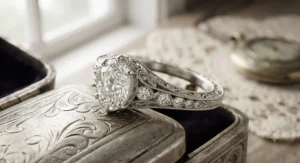
This is the one genuine natural-diamond piece in the mid-range tier: a 3/4-carat total weight design with an oval center diamond and 114 round-cut accent diamonds set into a braided split-shank band, all in solid 14K white gold. The braided detailing is the real differentiator — it’s a labor-intensive design element that most budget rings skip entirely because it requires more hand-finishing time per piece. In practical terms, that braid also does double duty structurally, since a split shank distributes some of the metal’s flex differently than a single solid band, which some wearers find more comfortable for long-term daily wear. Based on the spec sheet, this suits someone who specifically wants natural diamonds rather than a lab-created stone or simulant, and who is drawn to a vintage-inspired aesthetic over a stark modern one. What the spec sheet won’t tell you, but aggregated reviews often mention, is that the sheer number of small accent stones makes the ring look considerably more “loaded” with diamonds than the modest 1-carat total weight suggests on paper.
Pros:
- ✅ Genuine natural diamonds throughout, not lab-created or simulant
- ✅ Braided split-shank design adds texture rarely seen at this price point
- ✅ Conflict-free sourcing stated by the manufacturer
Cons:
- ❌ 114 small accent stones mean more settings that could eventually need re-tightening
- ❌ Vintage braided styling won’t suit buyers who want a minimalist look
Expect a price range of roughly $1,000–$1,600 depending on ring size — always confirm current pricing, since natural diamond costs shift with market conditions.
4. JeenMata Oval Cut Cubic Zirconia Solitaire — budget-friendly trial ring
JeenMata‘s entry is a 2.25-carat oval cut cubic zirconia center stone in a four-prong solitaire setting, with moissanite side stones set into a pavé band, finished in 18K gold plating over brass. The honest read here: this is not a fine jewelry piece in the traditional sense, and it isn’t trying to be — it’s a well-designed costume/fashion ring that mimics the visual weight of a much more expensive oval halo-and-pavé combination. What that plating means practically is that the gold layer sits on top of a base metal, so the surface can wear thin with frequent contact, sweat, or lotion exposure, typically over one to two years of regular wear. This is a smart pick for a proposal on a tight budget, a placeholder ring while a “real” one is being custom-made, or someone testing whether an oval shape suits their hand before committing real money to a diamond or moissanite version. Aggregated reviews on similarly constructed CZ solitaires tend to note that the stone itself looks impressively bright out of the box, with the most common complaint being plating wear after extended daily wear rather than any issue with the center stone’s brilliance.
Pros:
- ✅ Large 2.25-carat oval center at a fraction of fine jewelry pricing
- ✅ Moissanite side stones add real sparkle beyond the CZ center
- ✅ Available in a size range suited for quick gifting
Cons:
- ❌ Gold plating over brass will wear thinner than solid gold over time
- ❌ Not suited as a lifetime piece without eventual replacement or re-plating
This one sits comfortably under $150, making it one of the lowest-risk items on this list to simply add to cart and check out.
5. Gem Stone King 2-3 Cttw 10K White Gold 3-Stone Oval — symbolic three-stone design on a budget
This piece pairs an oval center stone (moissanite or lab-grown diamond, depending on the specific listing variant) with two smaller side stones in a classic three-stone setting, cast in solid 10K white gold rather than plating. The three-stone format carries symbolic weight in most bridal marketing — past, present, future — but functionally it also means the center stone gets structural support from the two flanking settings, which can make the ring feel more substantial on the hand than a solitaire of the same center carat weight. Here’s what to weigh: 10K gold contains less pure gold than 14K or 18K (about 41.7% versus 58.3% or 75%), which lowers the price but also means slightly less resistance to tarnishing over decades of wear. That trade-off makes this a sensible pick for buyers who want solid gold — not plating — but need the price to stay in a tighter range than the 14K options on this list. Reviewers commonly note that the three-stone layout photographs well for engagement announcement posts, and a recurring theme in aggregated feedback is that the ring runs slightly narrow, making it worth double-checking the sizing chart before ordering.
Pros:
- ✅ Solid 10K white gold, not plated over base metal
- ✅ Three-stone setting adds structural support and visual symbolism
- ✅ More affordable entry point into genuinely solid gold jewelry
Cons:
- ❌ 10K gold has lower purity than 14K or 18K, with slightly less tarnish resistance
- ❌ Sizing has been reported as running narrow in some batches
Typically priced in the $350–$550 range, it’s worth checking the current listing for which center stone variant (moissanite versus lab diamond) is in stock.
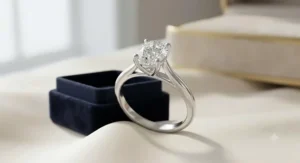
6. PAVOI 14K Gold Plated Oval Hidden Halo — hidden halo trick for extra sparkle
PAVOI built its reputation on gold-plated fashion jewelry that photographs like fine jewelry, and this 2.5-carat oval cubic zirconia ring with a hidden halo underneath the center stone is a good example of that formula in action. A hidden halo sits beneath the main stone rather than visibly surrounding it, which means from a top-down view the ring reads as a clean solitaire, but tilt it and a secondary ring of sparkle appears underneath the crown. What most buyers overlook about this design trick is that it adds visual complexity and perceived size without the added bulk or higher price of a traditional visible halo. On paper this is a fashion-forward, budget-conscious pick — ideal for someone who wants a distinctive design detail without spending fine-jewelry money, or as a stylish everyday-wear alternative kept separate from a primary engagement ring. Aggregated reviews on PAVOI’s gold-plated line frequently mention that the plating holds up reasonably well for the first year with careful wear, though — consistent with any plated piece — direct water and lotion contact accelerates wear over time.
Pros:
- ✅ Hidden halo design adds sparkle and perceived size without visible bulk
- ✅ Priced well under $100 for a piece with real visual complexity
- ✅ Popular brand with an established track record in plated bridal jewelry
Cons:
- ❌ Gold plating over brass, not solid gold
- ❌ Not intended for decades of daily wear without eventual replating or replacement
At under $100, this is a low-stakes way to add a hidden halo oval to a jewelry collection without committing fine-jewelry dollars.
7. Houston Diamond District LAB GROWN Halo Oval Cut Diamond — premium real diamond investment piece
The top of this lineup is a genuine IGI-certified lab-grown oval diamond, graded D–E color and VS1–VS2 clarity, set in a halo design in solid 14K white gold. This is the piece to compare against if the goal is a real diamond rather than a diamond simulant, and the numbers back that up: D–E color sits at the top of the near-colorless-to-colorless range, and VS1–VS2 clarity means any inclusions are typically invisible without 10x magnification. Lab-grown diamonds share identical chemical, optical, and physical properties with mined diamonds — the only real difference is origin — which is why IGI certification matters here as proof of what’s actually in the setting. Based on the spec comparison with the moissanite halo options earlier on this list, expect to pay meaningfully more for the same visual halo effect, since lab-grown diamond still costs more per carat than moissanite even though it costs far less than a comparable mined natural diamond. This suits a buyer who specifically wants “diamond” on the certificate, values traceability and grading documentation, and is treating the ring as a long-term piece worth insuring. Reviewers consistently point to the certification paperwork and stone brilliance as standout strengths, with the most common critique centering on wanting more transparency around exact carat weight before purchase.
Pros:
- ✅ IGI-certified genuine lab-grown diamond, D–E color, VS1–VS2 clarity
- ✅ Solid 14K white gold halo setting built for daily, long-term wear
- ✅ Meaningfully lower cost than a comparable natural mined diamond
Cons:
- ❌ Highest price point on this list by a significant margin
- ❌ Lab-grown diamonds currently hold less resale value than natural stones
Expect a price range of roughly $2,500–$4,500 depending on final carat weight — this is the piece worth getting insured the moment it arrives.
✨ Found the one that fits your budget? Click through now to check current pricing and lock in your size before it sells out.
Practical Usage Guide: Caring for Your Ring in the First 30 Days
The first month of wearing any new oval diamond white gold ring is when most preventable damage happens, mostly because the wearer isn’t yet used to a raised center stone catching on things. Start with sizing: an oval stone sits with its long axis across the finger, which means it’s more prone to snagging on gloves, sweaters, and gym equipment than a low-profile round stone, so a properly fitted band matters more here than with most shapes. In the first 30 days, avoid applying lotion, hand sanitizer, or perfume directly onto the ring, since the buildup dulls brilliance and, on plated pieces, can accelerate wear of the surface layer. A common early mistake is showering or swimming with the ring on — chlorine in particular can react with softer metal alloys over time, and hot water can loosen skin oils that make a ring more likely to slip off in the pool. Set a simple maintenance rhythm from day one: a soft-bristle toothbrush and warm water with a drop of dish soap once a week keeps the setting clear of everyday buildup, and a professional inspection every six months catches loose prongs before a stone is lost rather than after. If the ring is solid gold with real diamond or moissanite, get it appraised and added to a renters or homeowners policy — or a standalone jewelry policy — within the first few weeks, since most insurers won’t cover a loss that happened before the policy existed.
Real-World Scenarios: Matching the Ring to the Person
Scenario one — the budget-conscious proposal on a deadline. Someone proposing within the next two weeks on a total ring budget under $200 is best served by the JeenMata Oval Cut Cubic Zirconia Solitaire or the PAVOI 14K Gold Plated Oval Hidden Halo, both of which ship quickly and photograph beautifully for the inevitable social media announcement, with the understanding that an upgrade ring likely comes later. Scenario two — the couple who wants “real” but not extravagant. A couple with roughly $1,000–$1,600 to spend, who want solid gold and either genuine diamonds or high-quality moissanite, should be looking hardest at the Kobelli Antique Style Oval Diamond Braided Engagement Ring or the Kobelli Oval Moissanite Halo, since both deliver real, durable materials without premium diamond pricing. Scenario three — the long-term investment buyer. Someone in a stable financial position who wants a ring appraised, insured, and worn for decades, with documentation to match, is the ideal customer for the Houston Diamond District LAB GROWN Halo Oval Cut Diamond, where the IGI certification and D–E color grade justify the higher price as a genuine asset rather than just a fashion piece.
Problem → Solution Guide for Oval Ring Shoppers
A few problems come up again and again in oval engagement ring shopping, and each has a fairly direct fix. Problem: the oval looks smaller than expected once it arrives. This usually traces back to a low length-to-width ratio (closer to 1.2:1, which reads rounder) rather than the ideal 1.35–1.50:1 range that gives an oval its signature elongated look — check the exact ratio before buying, not just the carat weight. Problem: a visible “bow-tie” shadow across the stone’s center. This optical effect is common in oval cuts and varies by individual stone cutting; a halo setting like the one on the Houston Diamond District Forever One Oval Moissanite Halo can help visually break up a bow-tie by drawing the eye outward to the surrounding accent stones. Problem: the ring feels loose after a few months. Fingers change size seasonally with temperature and swelling, so a ring that fit perfectly in a warm store can feel loose in winter — a jeweler can add sizing beads or a hidden sizer bar rather than resizing the whole band. Problem: plating wears through faster than expected. This is inherent to any gold-plated piece like the PAVOI 14K Gold Plated Oval Hidden Halo or JeenMata Oval Cut Cubic Zirconia Solitaire, and the fix is either periodic professional re-plating or accepting the piece as a lower-cost, shorter-lifespan option from the start.
How to Choose a White Gold Oval Engagement Ring
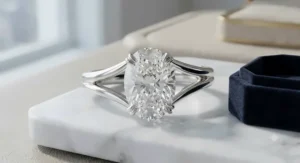
A white gold oval engagement ring is a bridal ring featuring an elongated, brilliant-cut center stone set in a gold-and-alloy blend finished with a bright, cool-toned rhodium plating. Choosing the right one comes down to a handful of decision points that matter far more than browsing photos:
- Confirm the stone type first. Decide upfront whether the goal is a natural diamond, a lab-grown diamond, moissanite, or cubic zirconia, since this single decision affects price more than any other factor on this list.
- Check the length-to-width ratio, not just carat weight. According to GIA’s oval diamond guide, most buyers prefer a ratio between roughly 1.35 and 1.50 to 1 for a classic elongated look rather than a rounder profile.
- Decide between solitaire, halo, or hidden halo early. Each changes both the visual size and the price meaningfully — a halo can make a smaller center stone look considerably larger for a fraction of the cost of a bigger solitaire stone.
- Verify solid gold versus plated gold in the listing. “14K white gold” and “14K gold plated” describe two entirely different products with very different long-term durability.
- Ask about certification for diamonds. A GIA or IGI report documents the actual color, clarity, and carat weight rather than relying on a seller’s description alone.
- Match the band width and prong style to daily habits. Someone who works with their hands may want a lower-profile setting with sturdier prongs than someone in an office setting.
- Build in a buffer for resizing and insurance. Most rings need at least one resizing in the first year, and insurance costs typically run 1–2% of the ring’s appraised value annually.
Common Mistakes When Buying an Oval Diamond White Gold Ring
The single most common mistake is buying purely off a product photo without checking the length-to-width ratio, which is why two ovals of the same carat weight can look meaningfully different on the hand. A close second is confusing “white gold” with “gold plated” — the terms sound similar in casual conversation, but under the Federal Trade Commission’s jewelry marketing rules, they refer to fundamentally different products with different disclosure requirements, and the FTC’s official Jewelry Guides exist specifically to keep those distinctions clear for consumers. Another frequent misstep is skipping ring sizing entirely and guessing based on a partner’s other jewelry, which often leads to at least one resizing appointment that could have been avoided with a proper sizing kit. Buyers also commonly underestimate ongoing costs — rhodium replating, insurance, and periodic prong tightening — treating the purchase price as the final number rather than the starting point of ownership. Finally, many shoppers assume a lower price always means lower quality, when in reality moissanite and well-made cubic zirconia pieces can offer excellent value if the buyer understands exactly what they’re purchasing rather than assuming it’s a diamond simulant in name only.
White Gold Oval vs Platinum: Which Cool Metal Contrast Setting Wins
Both white gold and platinum deliver a cool metal contrast setting that makes an oval center stone appear brighter against the band, but they get there through very different means and at very different price points. White gold achieves its bright white finish through rhodium plating over a gold-and-alloy base, meaning the surface color is technically a coating rather than the metal’s natural state — brilliant when fresh, but requiring periodic maintenance as the plating wears. Platinum, by contrast, is naturally white and doesn’t rely on plating, which means it never needs replating for color, though it does develop a soft “patina” surface finish over years of wear that many owners actually prefer for its lived-in look. Here’s what to weigh: platinum typically costs significantly more than white gold for an equivalent ring, both because the raw metal costs more and because it’s denser and heavier to work with, while white gold delivers a comparable visual result — especially right after replating — at a meaningfully lower price. For most buyers comparing options like the Kobelli Oval Moissanite Halo in white gold against a platinum equivalent, the honest answer is that white gold wins on value and platinum wins on truly zero-maintenance color, and the right call depends on whether the buyer would rather pay more upfront or accept an occasional replating appointment every few years.
Oval Diamond White Gold Ring: Halo vs Solitaire Design Features That Actually Matter
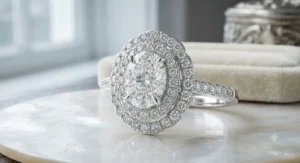
A white gold oval halo surrounds the center stone with a ring of smaller accent stones, while a white gold oval solitaire lets the center stone stand alone on a plain or pavé band — and the difference goes well beyond aesthetics. A halo genuinely increases perceived size; surrounding a modest center stone with smaller accents can make the overall face-up appearance read as noticeably larger than the same stone set alone, which is exactly why budget-conscious pieces like the Houston Diamond District Forever One Oval Moissanite Halo lean on this design. A solitaire, on the other hand, puts all the visual attention directly on the quality of the center stone itself, since there’s nothing else competing for the eye — meaning cut quality and clarity matter more in a solitaire than in a halo, where imperfections can hide among the surrounding sparkle. Marketing hype tends to oversell “hidden halo” designs as a totally free upgrade, but the honest read is that any halo — hidden or visible — adds more prong settings and therefore more potential maintenance points over the ring’s lifetime. What actually matters for most buyers is simpler than the marketing suggests: choose a halo for maximum perceived size per dollar, and choose a solitaire for a cleaner, lower-maintenance profile that puts full focus on the stone itself.
Modern Oval Band Design Trends for 2026
Modern oval band design has moved noticeably away from thick, traditional bands toward thinner, more architectural profiles that let the oval’s elongated silhouette do more of the visual work. Split-shank designs, like the one seen on the Kobelli Antique Style Oval Diamond Braided Engagement Ring, remain popular because they add textural interest without adding bulk, while cathedral settings that lift the stone slightly above the band continue to be favored for how they let light reach the stone from more angles. East-west settings — where the oval sits sideways rather than in the traditional vertical orientation — have grown in popularity among buyers wanting a distinctly modern look, though they’re worth trying on first, since they change how the ring interacts with the wearer’s other rings and daily hand movements. Pavé and hidden-halo detailing, as seen in the PAVOI 14K Gold Plated Oval Hidden Halo, continue to trend because they add perceived complexity and sparkle without requiring a larger center stone budget. The throughline across all of these trends is restraint: fewer oversized statement settings, more clean lines that let the natural elongation of the oval cut carry the design.
✨ Don’t Miss These Exclusive Deals!
🔍 Take your oval engagement ring search to the next level with these carefully selected picks. Click on any highlighted ring to check current pricing and availability. These pieces will help you create an authentic, unforgettable proposal moment your partner will treasure!
Rhodium Plated Oval Ring: Long-Term Cost & Maintenance
Nearly every rhodium plated oval ring in white gold needs periodic attention, and understanding that upfront prevents an unpleasant surprise down the road. Rhodium plating is a thin surface layer applied over the white gold alloy to achieve that bright, icy-white finish; without it, white gold actually carries a faint gray-yellow cast from the gold underneath. As Wikipedia’s overview of moissanite notes in comparing gem hardness, the center stone itself is remarkably durable — moissanite rates 9.5 on the Mohs hardness scale, just below diamond — but the metal surrounding it is a separate durability question entirely. Most solid 14K white gold rings need rhodium replating roughly every one to three years depending on wear frequency, with rings worn daily by someone who works with their hands needing it more often than an occasional-wear piece. Budget roughly $50–$100 per replating visit at a local jeweler, and factor that into the true cost of ownership alongside insurance, which typically runs 1–2% of the ring’s appraised value each year. Total cost of ownership over a 10-year period for a solid 14K white gold ring, once replating and insurance are included, often ends up 15–25% higher than the sticker price alone — worth knowing before comparing that number against a platinum piece that skips the replating step entirely.
What to Expect: Real-World Performance of an Oval Center Stone
On paper, an oval diamond white gold ring reads as a set of specs — carat weight, color grade, clarity grade — but daily wear translates those numbers into a very different, more tactile experience. In practice, the elongated shape catches light differently depending on the angle of the wrist, throwing longer streaks of brilliance across the stone’s length compared to the more contained sparkle of a round cut. Reviewers across multiple oval ring listings consistently mention that the shape photographs exceptionally well in natural light, which is part of why it’s become a favorite for engagement announcement photos specifically. On the practical side, the elongated profile does sit slightly higher and wider than a round stone of the same carat weight, meaning it’s marginally more prone to snagging on fabric during the adjustment period before the wearer learns to angle their hand differently. Expect a noticeable “settling in” period of a few weeks where the wearer becomes newly aware of the ring during everyday tasks — washing dishes, typing, pulling on gloves — before it fades into the background as a natural part of daily movement.
Frequently Asked Questions
❓ What is a white gold oval engagement ring?
❓ How much does a white gold oval engagement ring cost?
❓ Is white gold or platinum better for an oval engagement ring?
❓ How often does a rhodium plated oval ring need replating?
❓ Does a halo setting make an oval diamond look bigger?
Conclusion
Choosing among these seven rings really comes down to answering two questions honestly: what stone type actually matters to you, and how much long-term maintenance are you willing to take on. If budget and speed are the priority, the JeenMata Oval Cut Cubic Zirconia Solitaire and PAVOI 14K Gold Plated Oval Hidden Halo get the job done without pretending to be something they’re not. If you want real, solid gold with either genuine diamonds or high-quality moissanite at a reasonable mid-range price, the Kobelli Antique Style Oval Diamond Braided Engagement Ring, Kobelli Oval Moissanite Halo, and Houston Diamond District Forever One Oval Moissanite Halo all deliver strong value. And if this ring is meant to be a documented, insurable, long-term asset, the Houston Diamond District LAB GROWN Halo Oval Cut Diamond is the clear standout on this list, backed by real IGI certification rather than a seller’s description alone. Whichever tier fits your situation, the oval cut itself is a safe, timeless choice — it’s been a top-selling shape for decades precisely because it flatters the hand and photographs beautifully, regardless of what budget it’s paired with.
Recommended for You
- 7 Best rose gold oval engagement ring Picks for 2026
- Yellow Gold Oval Engagement Ring: 7 Stunning Picks for 2026
- Two Tone Engagement Ring Women: 7 Top Picks & Guide 2026
This article contains affiliate links. As an Amazon Associate, I earn from qualifying purchases. If you purchase products through these links, we may earn a small commission at no additional cost to you.
✨ Found this helpful? Share it with your friends! 💬🤗
