In This Article
Picking a white gold princess cut engagement ring feels a lot like picking a favorite song on a road trip — there are dozens of good options, everyone has an opinion, and somehow you’re still standing in the jewelry aisle three hours later, more confused than when you started. That’s normal. The princess cut is the second-most-popular diamond shape in America for a reason: sharp corners, serious sparkle, and a modern silhouette that photographs beautifully against the cool shine of white gold.
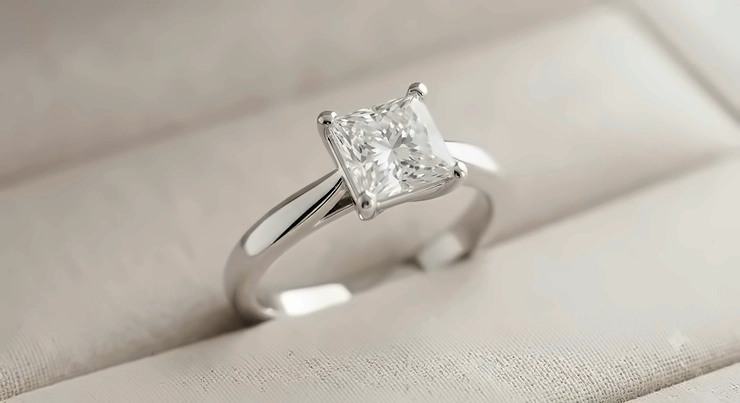
A white gold princess cut engagement ring pairs a square, brilliant-faceted diamond (or diamond simulant) with a rhodium-plated white gold band — a combination that reads clean, contemporary, and just a little architectural next to the softer curves of round or cushion styles. In this guide, we’re doing the homework so you don’t have to: real products, real specs translated into plain English, honest analysis of what reviewers actually say, and zero fabricated fluff. We looked at everything from budget-friendly starter rings under $400 to certified showstoppers, and we’ll walk through what actually matters — cut quality, prong style, halo versus solitaire, and whether a princess even beats a cushion for your particular hand and lifestyle.
What is a white gold princess cut engagement ring? It’s an engagement ring featuring a square or rectangular diamond with pointed corners and a brilliant (not step-cut) facet pattern, set in white gold — typically 14K or 18K — that’s rhodium-plated for extra brightness. As the GIA explains, the princess cut was developed in 1979 and has since become the go-to alternative to the round brilliant for buyers who want geometric edge without sacrificing fire.
Let’s get into the specifics — starting with a quick side-by-side before we dig into all seven rings in detail.
Quick Comparison Table
| Ring | Style | Total Carat Weight | Metal | Price Range | Best For |
|---|---|---|---|---|---|
| Amazon Collection Princess Solitaire | Solitaire | 1/4 ctw | 14K White Gold | Under $350 | First-time buyers on a tight budget |
| Dazzlingrock IGI Certified Solitaire | Solitaire | 0.76 ctw | 14K White Gold | $1,400-$1,800 | Buyers who want paperwork with their sparkle |
| Dazzlingrock 1-1/5 ctw Solitaire | Solitaire | 1.20 ctw | 14K White Gold | $2,000-$2,600 | Maximum visual carat weight per dollar |
| Kobelli GIA Halo | Halo | 1.00 ctw (0.5ct center) | 14K White Gold | $2,200-$2,900 | Making a smaller center stone look bigger |
| Kobelli Bridal Set | Solitaire + Band | 1 5/8 ctw | 14K White Gold | $2,800-$3,600 | Buyers who want the wedding band matched from day one |
| MSBLUE Staircase Moissanite | Solitaire | 1.00 ct | 14K White Gold Vermeil | Under $250 | Budget shoppers who love a step-cut look |
| Kobelli Moissanite Halo 3-Stone | Three-Stone Halo | 3.10 ctw | 14K White Gold | $900-$1,300 | Big, photogenic sparkle on a moderate budget |
A quick scan tells the real story here: price and carat weight don’t move together in a straight line. The Kobelli Moissanite Halo 3-Stone ring, for example, packs over three total carats of sparkle for less than the Dazzlingrock 1-1/5 ctw Solitaire‘s single natural diamond, because moissanite’s lower per-carat cost changes the math entirely. Meanwhile, the Amazon Collection Princess Solitaire is genuinely built for people who want a real diamond and real 14K gold without a four-figure commitment. We’ll unpack why each ring earns its spot in the rundown below.
💬 Found a favorite already? Bookmark it and keep reading — the details below might change your mind.
Top 7 White Gold Princess Cut Engagement Rings: Expert Analysis
1. Amazon Collection Princess-Cut Solitaire — most accessible real-diamond entry point
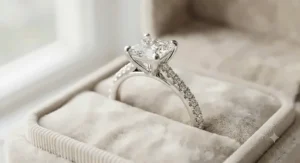
The standout here is simple: it’s a genuine 14K white gold ring with a genuine mined diamond, priced like a nice dinner out rather than a used car. The center stone is a 1/4 carat total weight princess cut diamond in I-J color and I1-I2 clarity, held in a classic four-prong setting on a tapered, polished band.
Here’s what that spec sheet actually means day to day: I-J color sits in the “near colorless” range, so under indoor lighting you won’t see an obvious yellow tint, though it will read slightly warmer than a D-F stone would. I1-I2 clarity means inclusions are visible under magnification and sometimes to the naked eye depending on the individual stone — this is where a princess cut’s brilliant faceting does you a favor, since the pattern of light and dark facets helps camouflage small inclusions better than a step cut would.
Based on the spec comparison against other sub-$400 rings, this is one of the few that skips cubic zirconia and lab-created simulants entirely in favor of a real mined diamond — that’s a meaningfully different purchase than a CZ ring at a similar price, even if the carat weight is modest. It’s best suited to first-time engagement ring buyers, students, or anyone who wants “we bought a real diamond” to be true without stretching a budget.
Reviewers consistently report that the setting feels sturdy for its price point and that the stone reads brighter in person than photos suggest, though a handful of buyers note the 1/4 ctw size is genuinely petite — worth knowing going in rather than being surprised by later.
Pros:
- ✅ Genuine 14K white gold and a real diamond at a budget price
- ✅ Resizable up or down by half a size after purchase
- ✅ Classic four-prong setting is easy to maintain and re-tip later
Cons:
- ❌ I1-I2 clarity means visible inclusions are possible
- ❌ 1/4 ctw center stone reads small compared to halo styles
At a price generally landing under $350 at the time of research, this is best thought of as an honest entry-level pick — a real diamond, real gold, and a fair trade-off in size for the savings.
2. Dazzlingrock IGI Certified Princess Solitaire — best paper trail for the price
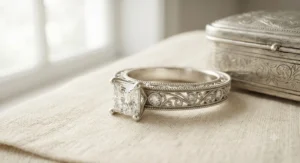
What stands out about this one is the IGI certification — an independent grading report that documents the diamond’s specs rather than asking you to take the listing’s word for it. The center stone weighs 0.76 carats total weight, set solitaire-style in solid 14K white gold.
An independent certificate matters more than most shoppers realize: it locks in the color, clarity, and carat weight in writing, which protects you at resale, insurance appraisal, or if a claim ever needs backing up. Dazzlingrock also backs its pieces with a 90-day warranty covering accent-stone loss or setting damage under normal wear, which is a genuine value-add most budget solitaires skip entirely.
Based on the size class, this ring sits comfortably as a “you’ll notice it across a dinner table” stone without tipping into show-off territory — a smart pick for buyers who want visible presence but not a stone that dominates every photo. It suits practical, detail-oriented buyers: the type who read the fine print on a mattress warranty, basically.
Aggregated review sentiment across Dazzlingrock’s solitaire line tends to praise the brand’s consistency and packaging (each piece ships in a gift box), with occasional notes that sizing between US ring sizes can run slightly tight — a common theme in reviews of the brand’s more petite prong settings.
Pros:
- ✅ IGI certification documents the diamond’s actual specs
- ✅ 90-day warranty against accent-stone loss or setting damage
- ✅ 0.76 ctw offers real visual presence without extreme cost
Cons:
- ❌ Certification adds cost versus uncertified comparable stones
- ❌ Some buyers report sizing runs slightly small
Expect this one to land in the $1,400-$1,800 range at the time of research — a fair value trade for buyers who want documentation alongside decent size.
3. Dazzlingrock 1-1/5 ctw Princess Solitaire — biggest look-per-dollar in the natural diamond lineup
The headline feature is straightforward math: 1.20 total carat weight for meaningfully less than what a single 1.2-carat stone of top color and clarity would cost elsewhere. That’s because the center stone here grades SI3 clarity and G-H color — genuinely eye-clean territory for most people at arm’s length, but a full quality tier below the flawless-adjacent stones that command premium pricing.
What most buyers overlook about SI3 clarity is that it’s not a GIA-recognized grade (GIA tops out its clarity scale differently), but it’s widely used by labs like EGL and by manufacturers to denote “slightly included, visible under magnification, typically not to the naked eye.” Paired with G-H color — solidly near-colorless — this stone should look convincingly white and clean face-up, especially against a princess cut’s camouflaging brilliance.
Here’s what the spec sheet won’t tell you, but reviewers note: at 3.75 grams of 14K white gold, the band itself has real heft and doesn’t feel flimsy, which matters for buyers worried that “bigger stone for less money” always means a corner-cutting setting too. This is best for buyers prioritizing visual carat weight above absolute top-tier grading — someone who wants the “wow, that’s a big diamond” reaction more than a gemological deep-dive.
Pros:
- ✅ 1.20 ctw offers serious size for the price bracket
- ✅ Substantial 3.75g white gold band feels solid on the hand
- ✅ G-H color reads clean and bright against white gold
Cons:
- ❌ SI3 clarity is a step below eye-clean guarantees on pickier stones
- ❌ Not independently certified at this specific listing tier
Typically priced in the $2,000-$2,600 range at the time of research, this ring rewards buyers who value size and presence over grading-report bragging rights.
4. Kobelli GIA Certified Princess Halo — GIA paperwork on a ring built to look bigger than its center stone
The defining feature is right there in the name: a GIA-certified 0.5 carat G color, SI2 clarity princess cut center stone, surrounded by a halo of accent diamonds that brings the total carat weight up to roughly 1.00 ctw. GIA is the grading lab most jewelers and appraisers treat as the gold standard, so this listing carries a level of trust that uncertified competitors can’t match.
Here’s the practical trick a halo pulls off: surrounding a 0.5-carat center stone with a ring of smaller diamonds visually expands the face-up footprint, often making the ring look closer to a solitaire one size class up — without the price jump that a genuinely larger single stone would demand. G color and SI2 clarity land solidly in “premium, but not ultra-rare” territory: G is essentially indistinguishable from colorless to the untrained eye, and SI2 typically stays eye-clean in a stone this size.
Based on the spec comparison, this is a smart pick for buyers who love the “bigger ring” look of a halo but still want the underlying center stone independently verified — you’re not just trusting a marketing description of quality, you’re trusting GIA’s lab. It suits detail-oriented buyers who’d rather pay a bit more upfront for certainty than gamble on an uncertified stone of the same visual size.
Pros:
- ✅ GIA certification on the center stone — the industry’s most trusted lab
- ✅ Halo setting makes a 0.5ct center stone read close to 1.00ct
- ✅ G color, SI2 clarity is a strong, dependable quality combination
Cons:
- ❌ Halo settings collect more dust/debris than solitaires, needing more frequent cleaning
- ❌ Premium pricing reflects the GIA certification and halo construction
Expect a price generally in the $2,200-$2,900 range at the time of research, reasonable for a certified center stone with the visual upgrade a halo provides.
5. Kobelli Princess-Cut Diamond Bridal Set — the premium pick for buyers who want the band solved on day one
What sets this one apart is scope: a 1 5/8 total carat weight princess-cut bridal set that includes both the engagement ring and a coordinating wedding band, both in solid 14K white gold, designed and finished in-house at Kobelli’s downtown Los Angeles workshop.
Buying a matched set solves a problem many couples don’t anticipate until months into the process — finding a wedding band whose profile, metal tone, and prong height actually sit flush against an already-chosen engagement ring. Because Kobelli engineers both pieces together, the fit is guaranteed rather than hoped for, and the combined 1 5/8 ctw gives serious sparkle across both rings when worn stacked.
Based on the brand’s four-decade manufacturing history, Kobelli tends to favor cathedral shanks and detailed gallery work even at this price tier, which reads as more “designer boutique” than “mass import” — a distinction that matters to buyers who’ve shopped enough rings to notice setting quality differences. This set suits couples who want to check the entire bridal-jewelry box in a single purchase rather than shopping engagement ring and wedding band separately over time.
Reviewers of Kobelli’s bridal sets consistently mention that the pieces ship in discreet, unmarked packaging from Los Angeles — a small but appreciated detail for anyone worried about a surprise proposal delivery.
Pros:
- ✅ Engagement ring and wedding band engineered to fit together perfectly
- ✅ 1 5/8 ctw total gives strong combined sparkle when stacked
- ✅ Four decades of in-house LA manufacturing experience behind the brand
Cons:
- ❌ Higher upfront cost than buying a solitaire alone
- ❌ Locks you into a specific wedding band style versus shopping separately later
Priced generally in the $2,800-$3,600 range at the time of research, this set earns its premium spot through fit guarantee and combined carat weight rather than through gimmicks.
6. MSBLUE Staircase Princess Moissanite — best budget pick with step-cut visual flair
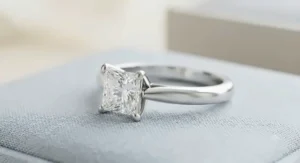
The standout feature is right in the name: a “staircase” faceting style that gives this princess-shaped moissanite a more linear, step-like light pattern than a traditional princess cut, all set in 14K white gold vermeil (a thick layer of solid gold over sterling silver, not solid gold throughout).
Moissanite is a lab-created gemstone, not a diamond, and that distinction is the whole value proposition here: moissanite’s refractive index is actually higher than a diamond’s, producing more rainbow-colored fire, at a fraction of the per-carat cost. The staircase-style faceting nods toward step-cut aesthetics (think emerald or Asscher cut) while keeping the pointed-corner princess silhouette — a nice middle ground for buyers who like the linear, architectural look of step cuts but still want the classic princess shape.
What most buyers overlook about vermeil construction is that it’s not the same as solid 14K gold — it’s a substantial gold layer over sterling silver, which changes the long-term care calculus (see our maintenance section below) even though it looks nearly identical new out of the box. This ring is best suited to budget-conscious buyers, younger couples, or anyone who wants a stunning, large-looking ring as a placeholder before eventually upgrading to a solid-gold, diamond piece down the line.
Aggregated customer sentiment on staircase-cut moissanite rings tends to highlight the unusually intense sparkle for the price, with the honest caveat — echoed across most vermeil jewelry reviews generally — that the gold layer can show base-metal wear at high-friction contact points after a couple of years of daily use.
Pros:
- ✅ Higher fire and brilliance than a diamond, at a fraction of the cost
- ✅ Unique staircase faceting gives a distinctive step-cut-inspired look
- ✅ 14K gold vermeil gives real gold color without solid-gold pricing
Cons:
- ❌ Vermeil is a gold layer over silver, not solid gold throughout
- ❌ Long-term durability is lower than solid 14K white gold
Generally priced under $250 at the time of research, this is the least expensive ring on the list and a genuinely smart placeholder or budget-first choice.
7. Kobelli Princess Moissanite Halo 3-Stone — biggest sparkle-per-dollar with a statement silhouette
The defining feature is scale: three princess-cut moissanite stones set in a vintage-inspired halo silhouette, surrounded by natural white diamond accents, bringing total carat weight to roughly 3.10 ctw in solid 14K white gold — genuinely more visual sparkle than several diamond rings on this list, for a fraction of their price.
A three-stone design carries symbolic weight beyond aesthetics (many buyers read it as past-present-future), and here the effect is amplified by a diamond-lined split shank that doubles the sparkle running down the band itself. Because moissanite costs a fraction of diamond per carat, Kobelli can afford to use three sizable center stones plus real diamond accents while still landing at a moderate price point — something that would be financially out of reach with three natural diamonds of comparable size.
Based on the construction, this ring is best suited to buyers who want maximum visual impact and don’t require every stone to be a natural diamond — a completely reasonable and increasingly common choice as moissanite has gained mainstream acceptance. It particularly suits buyers drawn to vintage filigree detailing, since the antique-style metalwork on the gallery is a step up in ornamentation from the plainer bands seen on solitaire listings.
Reviewers frequently describe this piece as “photographs like a much more expensive ring,” a sentiment that tracks with the sheer total carat weight on display, while a smaller number note that the multi-stone halo requires more careful cleaning to keep every facet free of buildup.
Pros:
- ✅ 3.10 total ctw delivers major visual sparkle for the price
- ✅ Diamond-lined split shank adds sparkle down the band itself
- ✅ Vintage filigree detailing elevates the design above plain solitaires
Cons:
- ❌ Multi-stone halo needs more frequent cleaning to avoid buildup
- ❌ Moissanite center stones aren’t natural diamonds, which matters to some buyers
Typically priced in the $900-$1,300 range at the time of research, this is the strongest sparkle-to-dollar ratio on the entire list.
Practical Usage Guide: Caring for Your Princess Cut White Gold Ring
Princess cut diamonds have sharp, exposed corners — genuinely the shape’s biggest practical vulnerability, since those 90-degree tips are more prone to chipping than the rounded girdle of an oval or round stone. In the first 30 days, get in the habit of removing your ring before gym sessions, gardening, or anything involving repeated hand-to-surface contact; corner chips almost always happen during exactly these moments, not while it’s just sitting on your finger at dinner.
Since white gold relies on rhodium plating for its bright white finish, plan on a professional re-plating roughly every 12-24 months depending on how often you wear the ring and how much it contacts lotions, cleaning products, and chlorine. You’ll notice the plating wearing thin well before it looks bad — the metal takes on a faint warm or grayish cast at high-contact points like the underside of the band. A common first-30-days mistake is assuming a slightly warm tone means something’s wrong with the ring itself, when it’s usually just early plating wear that any jeweler can correct in an afternoon.
For at-home maintenance, a soft brush with mild dish soap and warm water once every week or two keeps facets clear of the oils and lotion residue that dull sparkle over time — this matters even more for halo styles like the Kobelli GIA Certified Princess Halo and Kobelli Princess Moissanite Halo 3-Stone, where small accent stones trap debris faster than an open solitaire setting. Have the prongs checked by a jeweler annually; princess cut corners sit closer to the metal than round stones do, so a slightly loose prong poses a real risk of a chipped corner rather than just a loose stone.
Real-World Scenarios: Which Princess Cut Ring Fits Your Life
If you’re a grad student proposing on a teaching-assistant stipend, the Amazon Collection Princess-Cut Solitaire or the MSBLUE Staircase Princess Moissanite make the most sense — both deliver a genuine, good-looking ring under $350 without requiring a loan, and either one buys time before a future upgrade once careers are established.
If you’re a couple in your late twenties with steady dual incomes who wants something that reads as a “real investment piece” at a party, the Dazzlingrock IGI Certified Princess Solitaire or the Kobelli GIA Certified Princess Halo fit the moment — both carry independent lab documentation, both sit in a price range that feels intentional rather than impulsive, and the halo option specifically suits buyers who want maximum visual size from a moderate center stone.
If you’re planning an elaborate proposal and want the ring itself to be part of the spectacle — think engagement party, photographer, the whole production — the Kobelli Princess Moissanite Halo 3-Stone or the Kobelli Princess-Cut Diamond Bridal Set deliver outsized visual drama. The three-stone halo photographs enormous for its price, while the bridal set solves the wedding-band question in the same purchase, which matters if the proposal and wedding are happening close together.
How to Choose a White Gold Princess Cut Engagement Ring
- Start with your budget range, not the carat weight. Decide what you’re comfortable spending first — carat weight, clarity, and setting style are all levers you pull afterward to fit that number, not the other way around.
- Prioritize color over clarity for princess cuts specifically. Because princess cuts hide inclusions well thanks to their brilliant faceting, most buyers get more visual value from upgrading color (aim for G or better against white gold) than from chasing a flawless clarity grade.
- Check the length-to-width ratio. A true square princess cut keeps a ratio at or under 1.05:1; anything higher starts reading as rectangular, which changes the whole look of the stone.
- Decide solitaire versus halo based on how “big” you want the ring to look, not just the actual carat weight. A halo genuinely expands visual footprint for less cost than a bigger single stone — worth factoring in before assuming you need a larger center diamond.
- Confirm the prong style protects the corners. Princess cuts need V-shaped or double prongs at each corner specifically, since standard round prongs leave the vulnerable tips exposed.
- Ask whether the metal is solid white gold or vermeil/plated. Both can look identical new, but they have very different long-term durability and re-plating needs — know which you’re buying.
- Get independent certification whenever the budget allows. A GIA or IGI report locks in the diamond’s actual grade in writing, which protects you at appraisal, insurance, or resale down the line.
Princess Cut White Gold Solitaire vs Princess Halo Ring
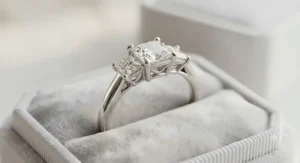
A princess cut white gold solitaire keeps all visual attention on a single stone — clean, architectural, and arguably the purest expression of the princess shape’s sharp geometry. A princess halo ring, by contrast, surrounds that same center stone with a ring of smaller accent diamonds, which does two things simultaneously: it makes the center stone look larger than its actual carat weight, and it adds continuous sparkle across a bigger visual area.
The trade-offs run deeper than looks alone. A solitaire like the Dazzlingrock 1-1/5 ctw Princess Solitaire is objectively easier to clean and maintain — fewer nooks for lotion and dust to hide in — and its cost goes almost entirely toward the center stone itself rather than being split across a dozen small accents. A halo like the Kobelli GIA Certified Princess Halo spends part of its budget on those accent stones, which is precisely how it manages to look close to a full carat while the certified center stone is only half a carat. Buyers who want a big, romantic silhouette and don’t mind slightly more maintenance tend to gravitate toward halos; buyers who value simplicity, easier resizing, and lower long-term upkeep tend to land on solitaires.
There’s also a resale and insurance nuance worth knowing: appraisers typically value a solitaire’s diamond more straightforwardly, since there’s one dominant stone to assess, while halo rings require accounting for the combined value of many smaller stones — something to keep in mind if you’re weighing long-term financial considerations alongside the emotional ones.
Princess vs Cushion Ring: Which Shape Wins?
Princess and cushion cuts get cross-shopped constantly because both offer a square-ish silhouette, but they deliver genuinely different personalities on the hand. The GIA’s guide to engagement ring shapes notes that princess cuts read as bold and modern, while cushion cuts carry a softer, more vintage feel thanks to their rounded corners and pillow-like outline.
That structural difference has real practical consequences. A princess cut’s pointed corners are more vulnerable to chipping and require protective prong styles, while a cushion’s rounded corners are inherently more durable day-to-day — genuinely a point in cushion’s favor for buyers with active hands or physical jobs. On the flip side, princess cuts tend to look larger for their carat weight than cushions do, because their squared shape uses more of the rough diamond’s surface area face-up, while cushion cuts lose more visual size to their rounded profile.
Color performance also diverges: princess cuts, with their crisp geometric facets, tend to hide slight body color slightly less effectively than a cushion’s softer facet pattern, so a cushion buyer can often get away with a marginally lower color grade and still look eye-white. If sharp, modern, and slightly larger-looking-per-carat is the goal, a princess cut like the Dazzlingrock IGI Certified Princess Solitaire wins. If a softer, more romantic, vintage-leaning look with a bit more built-in durability is the priority, a cushion cut deserves serious consideration alongside your princess cut shortlist.
Step Cut vs Brilliant Cut: Why It Matters for Sparkle
This is genuinely one of the most misunderstood distinctions in diamond shopping, and it explains a lot about why a princess cut sparkles the way it does. Step cuts — like emerald and Asscher — use long, rectangular, parallel facets arranged like the steps of a staircase, which produce a hall-of-mirrors effect: fewer, broader flashes of light rather than constant tiny sparkles. Brilliant cuts, including round and princess, use triangular and kite-shaped facets arranged specifically to maximize light return, producing that classic constant, fiery sparkle diamonds are known for.
Princess cuts occupy an interesting middle ground the GIA specifically calls out: they use a modified brilliant facet arrangement rather than a pure step-cut pattern, which is precisely why a princess cut sparkles noticeably more than an emerald cut of similar size and quality, despite sharing a square-ish outline. This modified-brilliant structure is also why princess cuts tolerate lower clarity grades more gracefully than step cuts do — the busier facet pattern breaks up light in ways that camouflage small inclusions, whereas a step cut’s broad, flat facets act almost like a window straight into the stone, making inclusions far more visible.
Practically, this means if you love the square silhouette but want maximum fire and forgiveness on clarity grade, a princess cut like the Kobelli GIA Certified Princess Halo delivers exactly that. If you’re drawn instead to the elegant, glassy, staircase-of-light look, a true step cut is worth cross-shopping — though as our MSBLUE Staircase Princess Moissanite entry shows, some rings borrow step-cut-inspired faceting details while keeping the underlying princess shape and its brilliant sparkle.
Modified Brilliant Princess: What the Name Actually Means
“Modified brilliant” sounds like marketing language, but it’s a specific, meaningful technical description. A standard round brilliant diamond has a fixed facet count and arrangement optimized for that circular shape; a princess cut can’t use that exact same arrangement because it’s square, so cutters modify the brilliant facet pattern to work within four corners instead of a continuous curve — typically resulting in anywhere from 50 to 58 facets, sometimes more in modified variations from individual cutters.
What most buyers overlook about this modification is that it’s precisely why no two princess cuts look quite identical, even at the same carat weight and grade — small differences in facet arrangement between cutters produce genuinely different sparkle patterns. This is also why princess cuts sometimes show a subtle “bowtie” effect (a dark area across the center) more in some individual stones than others, a phenomenon tied directly to how that modified brilliant pattern was executed on a given stone.
For shoppers, the practical takeaway is that photos and videos matter more for princess cuts than the spec sheet alone — since two 1-carat, G color, SI2 clarity princess cuts can genuinely sparkle differently depending on how their modified brilliant facets were cut and finished.
Prong Style for Princess Cut: A Buyer’s Guide
Prong style might be the single most overlooked spec on a princess cut engagement ring listing, and it directly affects both safety and appearance. Standard rounded prongs — the kind used on most round and oval solitaires — leave a princess cut’s sharp corners exposed and vulnerable, since the prong simply can’t wrap protectively around a 90-degree point the way it can around a curved girdle.
The safer, more common approach for princess cuts is a V-prong (sometimes called a V-tip prong), a specially shaped prong that cradles each corner in a protective V shape rather than pressing against a flat side. Double prongs at each corner — essentially two thinner prongs instead of one thicker one per corner — offer another layer of protection and a slightly less bulky look, which is why you’ll see this style on several rings in our lineup, including the Amazon Collection Princess-Cut Solitaire‘s four-prong setting.
Based on the spec comparison across our lineup, buyers should specifically confirm V-prong or double-prong corner protection before purchasing any princess cut ring, regardless of price point — this single detail matters more for long-term stone security than carat weight, color, or clarity combined. If a listing photo shows plain, single rounded prongs sitting flush against a princess cut’s corner without any visible V-shape or reinforcement, that’s worth a direct question to the seller before buying.
Common Mistakes When Buying a Princess Cut Engagement Ring
The single most common mistake is buying based on carat weight alone without checking the length-to-width ratio — a “1 carat princess cut” can look meaningfully different depending on whether it’s a true square or has drifted toward rectangular, and photos don’t always make that obvious. Always ask for or check the actual millimeter dimensions before assuming carat weight tells the whole story.
A second frequent misstep is skipping the prong-style question entirely, focusing purely on the diamond’s 4Cs while ignoring how those sharp corners will actually be protected day to day — a gorgeous, well-graded stone in an unprotective setting is a chip waiting to happen. A third mistake is assuming “solid white gold” and “white gold vermeil” or “gold-plated” are interchangeable, when they carry very different long-term durability and maintenance profiles, as we saw comparing the MSBLUE Staircase Princess Moissanite to the solid-gold options on this list.
Finally, many buyers underestimate how much rhodium re-plating costs add up over a decade of ownership, treating the ring’s sticker price as the entire financial picture rather than budgeting for the maintenance that keeps white gold looking bright over the long haul.
Long-Term Cost & Maintenance: Total Cost of Ownership
The upfront price tag on any of these seven rings is only part of the real financial picture. Rhodium re-plating for a white gold ring typically runs modestly per session and is needed roughly every 12-24 months with daily wear, which over a ten-year span adds a meaningful line item to the ring’s true lifetime cost — something almost never factored into initial budget planning.
Insurance is the next consideration: a diamond ring valued at a few thousand dollars is generally worth adding to a homeowner’s or renter’s policy as a scheduled item, or insuring separately, and doing so typically requires the exact kind of grading documentation that certified pieces like the Dazzlingrock IGI Certified Princess Solitaire and Kobelli GIA Certified Princess Halo already provide — a real, if easy to overlook, value-add of paying slightly more for certification upfront.
Comparing total cost of ownership across styles, solitaires generally cost less to maintain long-term than halos, simply because there are fewer stones and settings to inspect and clean. Moissanite rings like the Kobelli Princess Moissanite Halo 3-Stone carry lower material cost per carat but should still be evaluated on prong maintenance and, for vermeil pieces specifically, on the added expense of eventual re-plating or replacement as the gold layer wears. When you add re-plating, insurance, and periodic professional inspections together, a ring’s true decade-long cost typically runs 15-25% above its original purchase price — worth factoring into which ring actually fits a long-term budget.
Features That Actually Matter (And Those That Don’t)
Cut quality and prong protection matter enormously for princess cuts specifically — far more than most marketing copy emphasizes — because the shape’s inherent vulnerability at the corners means a well-executed cut and setting genuinely determine how the ring survives decades of daily wear. Independent certification matters too, not because it changes how the ring looks, but because it protects your investment at appraisal, insurance, and resale.
What matters far less than marketing suggests: exact facet count claims (princess cuts vary naturally in facet number without one count being objectively “better”), and vague brand claims like “showroom quality” or “designer inspired” that don’t correspond to any measurable spec. Similarly, dramatic sale percentages advertised on jewelry sites should be taken with real skepticism — jewelry markup structures mean a “70% off” listing often reflects an inflated original price rather than genuine savings, so comparing actual current price ranges across sellers matters more than any single discount claim.
Where marketing hype and genuine substance overlap is halo settings: they’re often pitched purely as a style trend, but as we’ve covered, they deliver a real, measurable visual-size benefit per dollar that’s worth taking seriously rather than dismissing as just a trend.
Safety, Certification & Regulations Guide
Under FTC jewelry regulations, any ring marketed using the term “gold” must disclose accurate karat fineness, and rhodium-plated white gold products marketed as precious metal must disclose that plating — meaning a properly labeled listing should note something like “14K WG” alongside any rhodium plating disclosure, protecting buyers from being misled about what metal they’re actually purchasing.
For diamonds specifically, independent grading reports from GIA or IGI provide the closest thing to an objective safety net against inflated quality claims, since these labs have no financial stake in a particular sale. Buyers should also know that moissanite must legally be disclosed as a diamond simulant or lab-created gemstone rather than marketed in any way that implies it’s a natural diamond — a distinction every reputable listing on our list, including the MSBLUE Staircase Princess Moissanite and Kobelli Princess Moissanite Halo 3-Stone, handles transparently by naming the stone type directly in the product title.
Finally, for anyone with nickel sensitivities, it’s worth knowing that some white gold alloys contain nickel beneath the rhodium plating — worth asking the seller directly about alloy composition if you have a known metal allergy, since the protective plating does eventually wear thin with daily use.
FAQ
❓ Is white gold or platinum better for a princess cut engagement ring?
❓ How much should a white gold princess cut engagement ring cost?
❓ Do princess cut diamonds chip easily?
❓ Can you get a princess cut halo ring in white gold?
❓ Is a princess cut or cushion cut more durable?
Conclusion
A white gold princess cut engagement ring earns its popularity honestly: sharp, modern geometry, serious brilliance thanks to that modified brilliant facet arrangement, and a bright metal that flatters the shape’s clean lines. Across our seven picks, the real differentiator isn’t which ring is “best” in some universal sense — it’s matching carat weight, certification, prong protection, and setting style (solitaire, halo, or three-stone) to your actual budget and lifestyle.
Budget-conscious buyers land well with the Amazon Collection Princess-Cut Solitaire or MSBLUE Staircase Princess Moissanite. Buyers who want documented, verifiable quality should look toward the Dazzlingrock IGI Certified Princess Solitaire or Kobelli GIA Certified Princess Halo. And anyone chasing maximum visual drama per dollar should seriously consider the Kobelli Princess Moissanite Halo 3-Stone, while couples wanting a matched set from day one should look at the Kobelli Princess-Cut Diamond Bridal Set. Whichever direction you go, prioritize prong protection and, budget permitting, independent certification — those two details matter more to a princess cut ring’s long-term happiness than almost anything else on the spec sheet.
✨ Don’t Miss These Exclusive Deals!
🔍 Take your search for the perfect white gold princess cut engagement ring to the next level with these carefully researched picks. Click on any highlighted ring above to check current pricing and availability. The right one is out there waiting to make your proposal unforgettable! 💍
Recommended for You
- Yellow Gold Princess Cut Ring: 7 Stunning Picks for 2026
- 7 Rose Gold Pear Shaped Rings Worth Buying in 2026
- White Gold Oval Engagement Ring: 7 Top Picks for 2026
Disclaimer: This article contains affiliate links. As an Amazon Associate, I earn from qualifying purchases. If you purchase products through these links, we may earn a small commission at no additional cost to you.
✨ Found this helpful? Share it with your friends! 💬🤗
