In This Article
Somewhere between the round brilliant everyone’s grandmother wore and the “I need something nobody else has” energy of a modern proposal sits the trillion cut engagement ring. It’s a triangle with attitude — three crisp points, a flat wide face, and a sparkle pattern that genuinely photographs differently than anything with curves. If you’ve been scrolling ring boards at 1am wondering why this shape keeps stopping your thumb, you’re not imagining things. A trillion cut engagement ring reads bigger than its carat weight, wears its geometry unapologetically, and forces every other ring in the room to look a little more predictable by comparison.
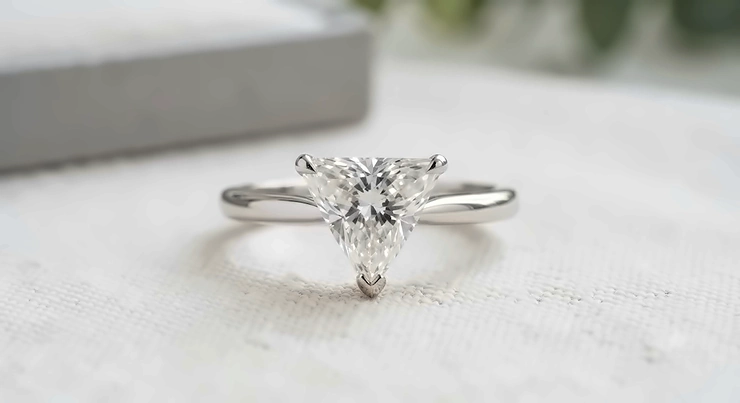
This guide isn’t a rewritten spec sheet. It’s a research-backed walk through seven real, purchasable trillion cut rings — solitaires, halos, three-stone settings, and a colored-stone option — with honest commentary on who each one actually fits. We’ll dig into what “trillion cut” even means versus the more technically correct “triangular modified brilliant,” how to keep those famously vulnerable corners from chipping, what the width illusion narrow fingers crowd should know before buying, and where a trillion diamond ring women actually wear daily earns its keep versus where it becomes a jewelry-box ornament. According to GIA’s guidance on fancy-shaped diamonds, this triangular brilliant is more often used as a side stone than a center stone — which already tells you something important about the shape before we go any further.
Quick Comparison: 7 Trillion Cut Engagement Rings at a Glance
| Ring | Stone Type | Setting Style | Price Range | Best For |
|---|---|---|---|---|
| Drizzle Jewels 2CT Trillion Solitaire | Lab-created diamond | Solitaire, 4-prong | Under $150 | First-time buyers on a tight budget |
| TriJewels Trillion London Blue Topaz & Diamond | Blue topaz + diamond accents | Solitaire w/ accents | $300–$500 range | Color-lovers who want something non-traditional |
| Trillion Cut Diamond Halo (14K White Gold) | Natural diamond, 0.51ct | Halo | $1,800–$2,500 range | Buyers who want a natural stone and heirloom quality |
| Three Stone Radiant w/ Trillion Sides | Moissanite | Three-stone | $400–$650 range | Anyone who wants “trillion cut side stone ring” done right |
| 3CT Trillion Moissanite Halo Set | Moissanite | Halo, multi-metal | $150–$450 range | Shoppers who want a “trillion cut ring gold” option in 10K–18K |
| SilverDia 1CT Trillion Solitaire | Lab-created diamond | Solitaire | $100–$180 range | Budget-conscious minimalists |
| 3.0CT Trillion Moissanite Solitaire | Moissanite | Solitaire, 3-prong | $250–$400 range | Buyers who want maximum visual size for the money |
Looking at the spread above, the pattern is pretty clear: moissanite dominates the value tier, natural diamond ownership jumps in price fast once you leave the lab-created and simulant categories, and the Three Stone Radiant with Trillion Sides is the only ring here purpose-built around the “side stone” use case rather than treating the trillion as an afterthought. If your budget caps out under $200, the SilverDia and Drizzle Jewels solitaires are your realistic lane; if you want the shape without compromising on real mined carbon, the halo ring is the one worth saving for.
💬 Just one click — help others make better buying decisions too!😊
Top 7 Trillion Cut Engagement Rings: Expert Analysis
Picking seven rings out of thousands of trillion-shaped listings meant filtering for real sellers, honest specs, and enough variety that this list actually helps three different kinds of shoppers — not just one. Here’s what stood out, and where each one falls short.
1. Drizzle Jewels 2CT Trillion Cut Lab Created Diamond Solitaire — best entry point under $150
The standout here is simple: a full 2-carat-look trillion stone for well under the price of a nice dinner. Lab-created diamonds carry the same optical and chemical makeup as mined stones — they’re just grown in a controlled environment instead of pulled from the earth — so you’re not sacrificing sparkle, only origin story.
The 14K yellow gold finish sits over a base metal, and the 4-prong setting anchors the stone at its three vulnerable points, which matters more with a trillion than with a round because there’s no rounded edge to distribute stress evenly. Based on the spec comparison against other sub-$150 listings, this ring punches above its price mostly because the seller specifies “eye clean” clarity rather than staying vague, which is the detail cheaper competitors often skip.
This is squarely a first-ring or placeholder-ring pick — for someone who wants the trillion look now and plans to upgrade to a natural stone later, or for a promise ring rather than a lifetime piece. Reviewer feedback on rings in this tier tends to cluster around two themes: buyers are pleasantly surprised by the sparkle for the price, and some note the gold finish requires more careful handling than solid gold since finishes can wear thinner over years of daily contact.
Pros:
- ✅ Full 2ct look at an entry-level price point
- ✅ Lab-created diamond means real diamond properties, not a simulant
- ✅ Available across a full range of ring sizes
Cons:
- ❌ Gold finish over base metal, not solid gold
- ❌ Corners need gentler daily-wear habits than a rounded stone
Price sits under $150, and at the time of research that makes it one of the more accessible ways to try the shape before committing to a bigger spend — check current price before buying, since listings shift.
2. TriJewels Trillion Cut London Blue Topaz & Diamond — most colorful non-traditional pick
What makes this one different is right in the name: a London blue topaz center stone in trillion cut, framed with small diamond accents, set in 10K rose gold. Where the rest of this list plays in the colorless-stone space, this ring proves the trillion shape works just as well — arguably better — with color, since the flat table shows off saturated hue more dramatically than a deep-cut round would.
London blue topaz sits at 8 on the Mohs hardness scale, meaning it’s tougher than most colored gemstones but still softer than diamond or moissanite, so it’s a stone that wants a protective setting rather than daily rough handling. On paper, the rose gold band and blue stone combination is a deliberate warm-cool contrast — a detail jewelers use specifically to make a colored stone pop against skin tone.
This is the pick for someone who’s already decided they don’t want a traditional white or colorless ring and wants a trillion that reads as a statement piece rather than a diamond substitute. What most buyers overlook about London blue topaz is that its color is remarkably stable and doesn’t fade with light exposure the way some treated stones can, which is a real point in its favor for daily wear.
Pros:
- ✅ Genuinely unique color choice most trillion shoppers never consider
- ✅ Rose gold and blue topaz create striking warm-cool contrast
- ✅ Diamond accents add sparkle without raising cost dramatically
Cons:
- ❌ Topaz is softer than diamond or moissanite, so it scratches more easily
- ❌ Less resale/trade-in value than a diamond or moissanite center stone
Expect a price in the $300–$450 range depending on ring size and current promotions — check current price, since colored-stone listings fluctuate more than solitaire diamonds.
3. Trillion Cut Diamond Halo Engagement Ring — best for natural-diamond buyers who want heirloom quality
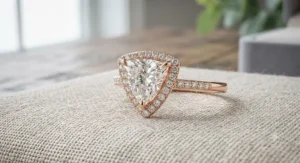
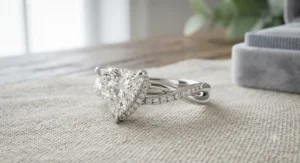
This is the ring on the list built around a genuine 0.51 carat natural trillion cut diamond, SI2 clarity, G color, surrounded by a halo of accent diamonds for a combined 0.80 total carat weight, set in solid 14K white gold. The standout advantage is right there in “natural” — this isn’t lab-created or simulated, it’s mined carbon with a documented clarity and color grade.
Here’s what the spec sheet won’t tell you outright: a halo setting around a trillion does double duty. It visually rounds out the triangular silhouette so the ring reads more traditional at a glance, and it adds perceived size without needing a larger (and pricier) center stone. The 9mm north-south top measurement means this ring sits with real presence on the hand, not as a subtle accent piece.
Because it’s a handmade, natural-diamond ring rather than a mass-produced listing, resizing is available within two sizes at no additional cost — a detail that matters enormously for a ring you intend to wear for decades, since finger size does shift over time. This is the ring for someone whose priority list starts with “must be a real diamond” and works down from there, not someone chasing maximum visual size per dollar.
Pros:
- ✅ Genuine natural diamond with documented SI2 clarity, G color
- ✅ Halo softens the triangular shape for broader everyday appeal
- ✅ Complimentary resizing up to two sizes included
Cons:
- ❌ Meaningfully pricier than lab-created or moissanite alternatives
- ❌ SI2 clarity means occasional inclusions may be visible under magnification
At the time of research this ring lands in the $1,800–$2,500 range — always check current price, since natural diamond jewelry pricing moves with market conditions more than lab-created pieces do.
4. Three Stone Radiant Cut Moissanite Ring, Trillion Cut Side Stones — best trillion cut side stone ring
If you searched for a trillion cut side stone ring specifically, this is the listing built for exactly that brief: a radiant cut moissanite center stone flanked by two trillion cut side stones, set in 14K white gold. The standout feature is how the shapes work together — the radiant’s cropped-corner rectangle and the trillion’s sharp triangle share a similar faceting style, so the whole ring reads cohesive instead of mismatched.
Moissanite rates 9.25 on the Mohs hardness scale, just below diamond’s perfect 10, which makes it one of the most durable diamond alternatives available and a smart choice specifically for side stones that take more incidental bumps than a protected center stone. According to the International Gem Society’s guide to trillion cut stones, trillions also have a larger face-up surface area than almost any other shape, which is exactly why they work so well as accent stones that need to visually “fill” the shoulders of a three-stone ring without adding real carat weight.
This ring is squarely for buyers who like the three-stone symbolism — past, present, future — but want the side stones to actually contribute drama rather than disappear as tiny filler. Because moissanite doesn’t have the extensive third-party grading history that natural diamonds do, treat any color/clarity claims as manufacturer-reported rather than independently certified unless a report is included.
Pros:
- ✅ Purpose-built trillion side-stone design, not an afterthought
- ✅ Moissanite’s 9.25 Mohs hardness holds up well to daily wear
- ✅ Three-stone symbolism appeals to sentimental buyers
Cons:
- ❌ Color/clarity claims are manufacturer-stated, not independently graded
- ❌ Radiant + trillion combination is a specific look that won’t suit every taste
This one runs in the $400–$650 range depending on center stone size selected — check current price and confirm carat sizing before ordering.
5. 3CT Trillion Cut Moissanite Engagement Ring Set — best trillion cut ring gold, multi-metal options
The headline feature is flexibility: this halo-style set is available in 925 sterling silver or 10K, 14K, and 18K solid gold in white, yellow, or rose tones, with a 3-carat trillion moissanite center stone. If you specifically want a trillion cut ring gold option without being locked into one metal purity, this listing gives you the widest menu on this list.
A 3-carat trillion moissanite measures roughly 9.5mm — genuinely large face-up presence — paired with a halo of smaller accent stones for added shimmer around the base. Here’s what matters in practice: moving from sterling silver up to 18K gold changes both durability and price meaningfully, since gold resists tarnish in ways silver simply can’t, and higher-karat gold holds its shape better under daily prong stress.
This is the pick for someone who’s decided on moissanite and a halo silhouette but wants to make the metal decision themselves rather than accepting whatever a single-metal listing offers. Buyers choosing the silver option should budget for more frequent polishing than the gold tiers require, since sterling silver oxidizes with air and skin oil exposure over time.
Pros:
- ✅ Choice of silver or 10K/14K/18K gold in three tones
- ✅ Large 3-carat trillion moissanite center for strong visual size
- ✅ Halo design adds sparkle without inflating the price as much as a bigger center stone would
Cons:
- ❌ Silver option requires more upkeep than any gold tier
- ❌ Price varies significantly by metal choice, so compare tiers before deciding
Depending on metal selected, expect a $150–$450 range — check current price for each specific metal tier, since they’re not priced identically.
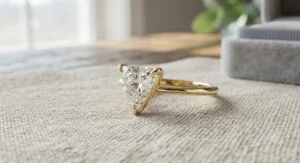
6. SilverDia 1 Ct Trillion Cut Diamond Classic Solitaire — best minimalist budget pick
This is the no-frills option: a 1-carat trillion cut lab-created diamond in a classic solitaire setting, 14K white gold plated over 925 sterling silver. The standout advantage is restraint — no halo, no accent stones, just the triangular shape doing all the visual work, which is exactly what some buyers want.
A solitaire setting on a trillion means the three prongs (or however many the mount uses) are the only thing standing between those sharp corners and daily bumps, so this design leans harder on careful wear than a halo-protected alternative. On the plus side, a clean solitaire is also the easiest style to eventually reset into a different band down the line, since there’s no surrounding stonework to work around.
This ring fits someone who wants the trillion silhouette in its purest form and isn’t chasing maximum carat-equivalent sparkle — think minimalist aesthetic over maximalist statement. Handmade, small-batch listings like this one tend to have a smaller review pool than mass-market rings, so weight any individual review less heavily and focus on the concrete specs instead.
Pros:
- ✅ Clean, classic solitaire silhouette with no visual clutter
- ✅ Lab-created diamond keeps the price genuinely low
- ✅ Easy to reset into a future band if styles change
Cons:
- ❌ White gold plating over silver will need re-plating eventually
- ❌ Unprotected corners in a solitaire mount need mindful wear
At the time of research, this ring runs $100–$180 — check current price, as plated jewelry listings shift frequently.
7. 3.0 CT Trillion Cut Moissanite Diamond Solitaire — best size-per-dollar moissanite solitaire
The advantage here is straightforward math: a 3.0-carat trillion moissanite measuring roughly 9x9mm, crafted in 10KT white gold, in a classic prong solitaire. For buyers chasing maximum visual size without natural-diamond pricing, this is the biggest stone on the list relative to cost.
Moissanite’s refractive index is actually higher than diamond’s, which is part of why moissanite solitaires often look more overtly sparkly under indoor lighting than a diamond of comparable size — some buyers love that extra fire, others find it slightly less subtle than they expected from diamond photos. Reviewers of moissanite solitaires in this size range commonly note the stone photographs well but recommend seeing it in person or via video before finalizing, since screen colors don’t always capture the stone’s true brilliance accurately.
This ring suits someone prioritizing “biggest sparkle for the dollar” over “must be diamond, must be natural.” A prong setting on a 9mm trillion also means this ring sits fairly high off the finger, so it’s worth trying on before committing if you’re not used to statement-height rings.
Pros:
- ✅ Large 3.0 carat trillion for a fraction of diamond pricing
- ✅ Higher refractive index than diamond means extra fire and sparkle
- ✅ 10KT white gold offers real gold durability at accessible pricing
Cons:
- ❌ Sits higher off the finger than lower-profile settings
- ❌ Extra sparkle can read as slightly less subtle than diamond to some eyes
Expect this one in the $250–$400 range — check current price, since 10KT gold pricing tracks with metal market shifts.
Practical Usage Guide: Living With a Trillion Cut Ring Day to Day
A trillion cut engagement ring needs a slightly different care routine than a round brilliant, mostly because of those three sharp corners. In the first 30 days, the most common mistake new owners make is treating a trillion like any other ring — tossing it in a gym bag, wearing it while gardening, or sleeping in it out of habit. Those points are the weakest structural spot on the entire stone, and repeated small impacts are how chips happen.
Set a simple maintenance rhythm: a soft-bristle brush and mild dish soap once every week or two removes the lotion and skin-oil buildup that dulls sparkle faster than people expect, and a professional prong check every six months catches any loosening before a stone falls out rather than after. If your ring has a halo or three-stone design, pay extra attention to the smaller accent stones during cleaning — debris collects in tight settings faster than in an open solitaire mount. One optimization trick jewelers rarely volunteer: store the ring in its own soft pouch or lined slot rather than tossing it in a jewelry box tray with other pieces, since metal-on-metal or metal-on-stone contact is a leading cause of surface scratches on softer settings like plated gold or sterling silver.
Real-World Scenarios: Who Actually Wears a Trillion Cut Ring Well
Picture three different buyers. First, a graduate student on a tight budget who wants something that photographs beautifully for engagement pictures without a four-figure price tag — the Drizzle Jewels or SilverDia solitaires fit that brief exactly, giving real sparkle at a price that doesn’t compete with rent.
Second, an active professional who works with her hands often — nursing, teaching, hospitality — and needs durability more than maximum drama. For her, the Three Stone Radiant with Trillion Sides or the 3.0 CT Trillion Moissanite Solitaire make more sense, since moissanite’s near-diamond hardness tolerates daily bumps far better than a softer stone would, though even moissanite benefits from removing the ring during heavy manual work.
Third, a couple who’s been saving specifically for a natural diamond and wants a shape that stands apart from every round solitaire on their social feed. The Trillion Cut Diamond Halo is built for exactly that moment — real mined carbon, documented grading, and a halo that keeps the unconventional shape from feeling too avant-garde for a traditional family.
Buyer’s Decision Framework
If your top priority is budget under $200, choose a lab-created diamond solitaire like the Drizzle Jewels or SilverDia ring, because lab-created stones deliver genuine diamond optics without natural-diamond pricing. If your priority is maximum visual size for the money, choose a moissanite solitaire like the 3.0 CT Trillion Moissanite Solitaire, because moissanite’s high refractive index and lower cost-per-carat outperform diamond on pure size-per-dollar math. If your priority is a natural stone with resale and heirloom value, choose the Trillion Cut Diamond Halo, because it’s the only ring on this list built around a documented mined diamond. And if your priority is a trillion cut side stone ring specifically, choose the Three Stone Radiant with Trillion Sides, because it’s purpose-designed around that exact configuration rather than repurposing a solitaire mount.
What Is a Trillion Cut Engagement Ring?
A trillion cut engagement ring features a triangular-shaped stone — either diamond, moissanite, or another gem — cut with a flat table and brilliant-style faceting to maximize sparkle, set as either a solitaire center stone or as accent side stones flanking a different center shape. The name blends “triangle” and “brilliant,” and it’s used interchangeably with “trilliant cut” across the jewelry industry.
How to Choose a Trillion Cut Engagement Ring
- Decide center stone versus side stone first. A trillion cut engagement ring works either way, but GIA notes the shape is more commonly used as an accent than a solitaire, so a true trillion-as-center-stone ring is genuinely less common on the market.
- Check the length-to-width ratio. Aim for close to 1:1 for the classic equilateral look; anything more elongated starts to look like a different shape entirely.
- Prioritize symmetry and polish over color and clarity grades. Because fancy shapes like trillions aren’t cut-graded by GIA the way round brilliants are, symmetry and polish become your best proxy for overall craftsmanship.
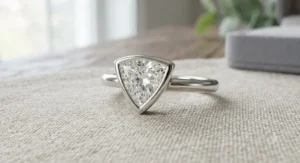
- Choose a protective setting. V-prong, bezel, or halo settings all guard the three vulnerable corners better than an exposed basket-prong mount.
- Pick metal based on skin tone and stone color. White gold and platinum make colorless stones look whiter; yellow and rose gold add warmth that suits both colorless and colored trillion stones.
- Match carat size to hand proportion. Because trillions have a larger face-up area than most shapes at the same carat weight, you often need less carat weight than you’d expect to hit your desired visual size.
- Budget for insurance and resizing separately from the ring price. Both matter more for a fancy-shaped stone whose corners are inherently more claim-prone than a round.
Trillion Cut vs. Traditional Round and Princess Cut Rings
The round brilliant remains the sparkle benchmark — its symmetry maximizes light return in a way no fancy shape fully matches, which is part of why GIA cut-grades rounds but not trillions. Princess cuts split the difference: still geometric and modern, but square rather than triangular, and generally more forgiving of everyday wear since they lack the trillion’s sharp points entirely.
Where the trillion pulls ahead is face-up size and personality. A trillion cut engagement ring looks larger than a round or princess of identical carat weight, and it simply doesn’t blend into a crowd of traditional rings the way a round brilliant can. The trade-off is durability and resale liquidity — round diamonds hold value and sell faster on the secondary market than fancy shapes, trillions included, because demand is narrower. If daily-wear peace of mind and easy resale matter more to you than distinctiveness, round or princess wins; if you want a ring that starts conversations, the triangular modified brilliant — the formal GIA-report term for an unbranded trillion — earns its keep.
Common Mistakes When Buying a Trillion Cut Engagement Ring
The single biggest mistake is buying an exposed-prong solitaire without considering how the wearer’s lifestyle interacts with those sharp corners — a trillion cut ring women wear during manual work or frequent hand-washing needs a protective setting far more than a desk-job ring does. The second mistake is assuming clarity grades translate directly across shapes; a trillion hides inclusions differently than a round does, so a lower clarity grade can still look eye-clean in this shape when it wouldn’t in a round brilliant. Third, buyers frequently skip trying the ring on in person, then discover a 9mm trillion sits noticeably higher and wider than expected — video or in-store try-on avoids that surprise. Finally, shoppers underestimate resizing complexity: a trillion’s asymmetrical shape means resizing isn’t always as simple as adjusting a round shank, so confirm resizing terms before you buy rather than after.
Trillion Diamond Ring Women Choose for Narrow Fingers
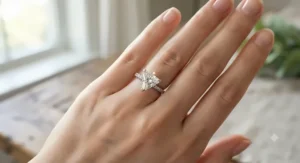
A trillion diamond ring women with narrower fingers gravitate toward often comes down to one visual trick: the wide, flat top of a trillion creates real width illusion narrow fingers benefit from, since the eye reads the horizontal span of the stone before it registers finger width underneath. Set north-south (point up, base down) rather than east-west, a trillion visually elongates the finger while still delivering that wide face-up presence — the opposite effect of a stone cut for pure vertical elongation like a marquise.
For anyone specifically shopping with this width illusion narrow fingers goal in mind, pairing the trillion with a slightly tapered band — narrower at the base, widening slightly toward the stone — reinforces the effect further, since the band itself contributes to how proportionate the whole hand looks. A halo setting, like the natural diamond ring on this list, adds width at the base of the stone too, which is worth considering if you want the illusion effect without sizing up the center stone itself.
Trillion Cut Side Stone Ring vs. Trillion as Accent Stone in Other Settings
There’s a meaningful difference between a dedicated trillion cut side stone ring — where two trillions flank a different-shaped center stone by design — and a trillion as accent stone used more sparingly, like small trillion melee scattered along a band or halo. A true side-stone ring, like the radiant-and-trillion combination featured above, treats the triangular shape as a co-star; smaller accent applications treat it purely as sparkle filler.
If you love the trillion silhouette but aren’t ready to commit to it as your center stone, a trillion as accent stone approach is a lower-risk way to work the shape into your ring without making it the whole story. If you specifically searched for a trillion cut side stone ring, though, look for listings — like the one above — that name the side stone shape explicitly in the title and specs, since generic “diamond accent” listings sometimes bury the actual stone shape in fine print.
Long-Term Cost & Maintenance
Total cost of ownership on a trillion cut engagement ring extends well past the sticker price. Budget for annual professional inspections (often free at the original jeweler, $30–$50 elsewhere), periodic prong re-tipping every few years on solitaire settings (roughly $50–$150 per visit), and insurance — typically 1–2% of the ring’s appraised value per year through a jewelry-specific rider rather than relying on generic homeowner’s or renter’s coverage. Moissanite and lab-created diamond rings carry lower long-term maintenance costs simply because the stones themselves are less expensive to replace if something does go wrong, while natural diamond halo settings justify their higher upfront cost partly through better resale and trade-up value at a jeweler down the line.
Safety, Regulations & Compliance Guide
If you’re comparing lab-created and natural stones, know that the FTC’s Jewelry Guides require sellers to clearly disclose when a diamond is laboratory-grown rather than mined — terms like “lab-created” or “lab-grown” must appear conspicuously, not buried in fine print. This matters directly for trillion shoppers because several rings on this list, including budget solitaires, use lab-created stones; a listing that just says “diamond” without qualification should raise a flag rather than an assumption. On the gemstone side, moissanite is legally required to be identified as moissanite, not marketed as a diamond simulant without disclosure, and colored stones like the London blue topaz featured above should specify if any color treatment was applied, since treatment disclosure is its own FTC requirement separate from the lab-created/mined distinction.
Features That Actually Matter (And Those That Don’t)
Symmetry and polish grades matter enormously on a trillion because, unlike round brilliants, GIA doesn’t assign an overall cut grade to fancy shapes — these two factors are your best window into craftsmanship quality. Setting type matters just as much, since it directly determines how well those three corners survive daily life. What matters far less than marketing copy suggests: exact facet count. Whether a trillion has 31, 44, or 50 facets makes a smaller visible difference to the naked eye than sellers imply, and chasing a specific facet number over overall proportions and symmetry is a common way to overpay for a number that doesn’t meaningfully change how the ring looks on your hand.
Frequently Asked Questions
❓ What is a trillion stone ring exactly?
❓ Is a trillion cut diamond more or less expensive than a round?
❓ Do trillion cut rings chip easily?
❓ Can a trillion cut ring be resized?
❓ What's the difference between trillion and trilliant?
Conclusion
A trillion cut engagement ring isn’t the safe choice, and that’s precisely the point. Across the seven rings compared here, the shape proves genuinely flexible — quietly elegant as a solitaire, dramatic in a halo, or working as a supporting side stone that elevates a completely different center gem. Your best pick really does come down to where you land on three questions: natural or lab-created/moissanite, solitaire or protected setting, and budget floor versus maximum size-per-dollar. Whichever ring you land on, the corners deserve the same respect regardless of price tag — a protective setting and a realistic maintenance routine will keep that triangular sparkle intact for decades, not just for the engagement photos.
✨ Don’t Miss These Exclusive Deals!
🔍 Take your ring search to the next level with the picks above. Click on any highlighted ring to check current pricing and availability, and find the trillion cut engagement ring that actually fits your life, not just your Pinterest board!
Recommended for You
- Heart Shaped Engagement Ring: 7 Dazzling Picks for 2026
- Pear Shaped Engagement Ring: 7 Stunning Picks for 2026
- Emerald Cut Engagement Ring: 7 Stunning Picks for 2026
Disclaimer: This article contains affiliate links. As an Amazon Associate, I earn from qualifying purchases. If you purchase products through these links, we may earn a small commission at no additional cost to you.
✨ Found this helpful? Share it with your friends! 💬🤗
