In This Article
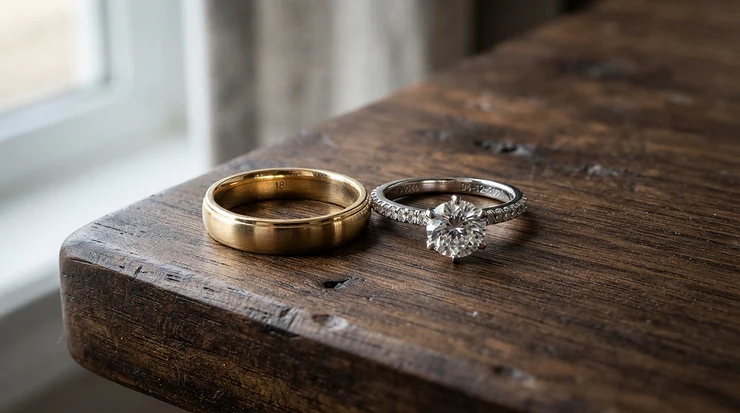
You’re about to put something on your finger that will stay there through job changes, kids, bad haircuts, and at least one disastrous home-improvement project. So the choice between meteorite wedding bands vs traditional metal bands is bigger than it looks. One path leads to a slice of asteroid core older than any mountain on Earth. The other leads to the quiet confidence of gold, platinum, or a modern workhorse like tungsten.
Here’s the honest tension. Meteorite is gorgeous, meaningful, and a little needy. Traditional metals are sturdy, familiar, and, let’s be real, a bit less likely to start a conversation at the barbecue. Neither is “better.” They’re built for different people.
I’ll be upfront about my method. Everything below comes from researched specs, jeweler care guidelines, and published material science, not from hands-on wear. Where I couldn’t verify something, like review data on specific Amazon listings, I say so. You’ll get seven real products, four comparison tables, and a decision framework you can use in about five minutes.
What Are Meteorite Wedding Bands vs Traditional Metal Bands?
Meteorite wedding bands are rings inlaid with, or cut from, slices of iron-nickel space rock, usually Gibeon from Namibia or Muonionalusta from Sweden, etched to reveal a crystal pattern. Traditional metal bands are solid gold, platinum, or silver. Tungsten and titanium sit between them as modern, harder alternatives.
Quick Comparison: Meteorite Inlay vs Gold, Platinum, Tungsten and Titanium
| Feature | Meteorite Inlay Band | Gold / Platinum Band | Tungsten / Titanium Band |
|---|---|---|---|
| Look | Natural crystal lattice, one of a kind | Classic, warm or cool luster | Modern, uniform, many finishes |
| Scratch resistance | Depends on the host metal | Low to moderate | High (tungsten) to moderate (titanium) |
| Upkeep | Moderate: keep dry, oil, re-etch | Low: polish occasionally | Very low |
| Resizing | Usually not possible | Easiest to resize | Tungsten no; titanium rarely |
| Typical price | Mid-range to premium | Mid-range to premium | Budget-friendly |
| Best For | Space nerds, collectors, storytellers | Traditionalists, heirloom buyers | Hands-on workers, budget buyers |
Reading across the rows, you can see that meteorite trades convenience for character, while tungsten and titanium trade character for convenience. Gold and platinum win on resizing and heirloom value but lose on scratch resistance. If you want the most meaning per dollar and can handle a little ritual, meteorite earns its place.
💬 Just one click — help others make better buying decisions too!😊
Top 7 Meteorite and Metal Wedding Bands: Expert Analysis
I picked seven real Amazon-listed bands across budget, mid-range, and premium territory. Five feature meteorite (or are honestly labeled meteorite-style), and two are traditional-metal benchmarks so you can compare like with like. Prices are ranges only, so check current price before buying.
| Product | Main Material | Width | Resizable? | Price Range | Best For |
|---|---|---|---|---|---|
| Gibeon Cobalt 8mm Meteorite Ring | Cobalt chrome + Gibeon | 8mm | No | Mid-range | Meteorite purists |
| Gibeon Meteorite Cobalt Chrome Band 6mm | Cobalt chrome + Gibeon | 6mm | No | Mid-range | Slimmer fingers, stackable styles |
| Core Carbon Rings Gibeon Meteorite Band | Carbon fiber + Gibeon shavings | 4-10mm | No | Mid-range | Lightweight comfort |
| King Will Meteorite Tungsten Band | Tungsten carbide + meteorite-style inlay | 6mm / 8mm | No | Budget | Scratch-proof on a budget |
| Three Keys Imitated Meteorite Tungsten Ring | Tungsten carbide, imitation pattern | 6mm / 8mm | No | Budget | The look without the upkeep |
| TIGRADE Titanium Dome Band | Titanium | 2-10mm | Rarely | Budget | Classic, ultralight, no-fuss |
| King Will Basic Tungsten Ring | Tungsten carbide | 8mm | No | Budget | Active lifestyles |
Notice the column that says “No” almost all the way down. That is the single biggest practical difference from gold or platinum, and we’ll dig into it later. Notice also the budget spread: authentic meteorite costs more than tungsten or titanium, so the question is whether the rock earns its premium for you.
1. Gibeon Cobalt 8mm Meteorite Ring — authentic Gibeon in USA-made cobalt
The headline here is the inlay: a 4mm acid-etched strip of Gibeon meteorite down the center of an 8mm band, framed by cobalt chrome sleeves. That layout matters because the tough cobalt takes the daily knocks while the rust-prone iron only shows its face in a protected channel.
The listing describes a comfort-fit interior, USA-made construction, and made-to-order delivery in about a week. Cobalt chrome is scratch-resistant, and one seller’s note says a separating disc can cut it off in an emergency, a safety detail tungsten buyers don’t get. Because every ring is made to order, a wrong size means starting over, so measure carefully.
Based on the spec comparison, this is the purist’s pick: more visible meteorite than pinstripe designs, still sheltered by a durable frame. It suits the groom who wants the pattern as the star and can spare a minute of care each week.
I couldn’t verify rating counts or review text for this listing at the time of research, so I won’t paraphrase any. When you check the live reviews, look specifically for comments about rust and sizing.
Pros:
- ✅ Large visible Gibeon inlay with strong pattern
- ✅ Cobalt chrome frame resists everyday scratches
- ✅ Emergency removal possible with a separating disc
Cons:
- ❌ Made to order, so no easy returns
- ❌ Meteorite strip still needs moisture care
Price range: authentic Gibeon cobalt bands commonly land in the few-hundred-dollar range, so check current price. Value verdict: fair for genuine meteorite without a premium-gold surcharge.
2. Gibeon Meteorite Cobalt Chrome Band 6mm — slimmer profile, same genuine Gibeon
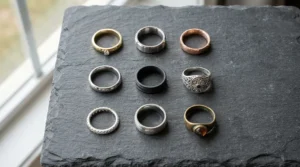
If Gibeon Cobalt 8mm Meteorite Ring feels like a billboard, this 6mm version is the whisper. The listing calls out genuine Gibeon, hand-formed and acid-etched by an artisan, set in a cobalt chrome sleeve.
A narrower band means less metal on the finger and a more refined look, which many people prefer for smaller hands or a daily-wear ring that doesn’t snag on gloves. The trade-off is less meteorite surface area, so the Widmanstätten pattern reads as a delicate accent rather than a showpiece. Cobalt chrome still gives it that hard, tough frame.
My analytical take: this is the better “first meteorite ring” for people unsure about statement jewelry. It also pairs well with a wider, plainer partner band if you’re buying a matching set. Reviewers of cobalt meteorite rings in general discuss the need to keep the inlay dry, a theme worth remembering here, though I couldn’t verify review text for this exact listing.
Pros:
- ✅ Slim, comfortable profile for everyday wear
- ✅ Genuine hand-etched Gibeon meteorite
- ✅ Tough cobalt chrome sleeve
Cons:
- ❌ Less visible pattern than wider designs
- ❌ Not resizable once crafted
Price range: typically mid-range for authentic meteorite, so check current price. Value verdict: good entry point into real meteorite.
3. Core Carbon Rings Gibeon Meteorite Band — featherweight carbon fiber with real meteorite shavings
This is the oddball of the group, and I mean that kindly. Instead of a metal sleeve, the band is carbon fiber with Gibeon meteorite shavings laid into the inlay, in a comfort-fit, USA-made design offered in widths from 4mm to 10mm.
What does that mean in practice? Carbon fiber is dramatically lighter than any metal here, so the ring practically disappears on the hand. Because the meteorite appears as shavings rather than a solid slab, you get a speckled, galactic look instead of a crisp lattice. That’s a different aesthetic, not an inferior one.
Who is it for? Based on the construction, it’s ideal for anyone who hates the heft of tungsten, such as pianists, cyclists, or anyone sensitive to weight. The caution is that carbon fiber and resin finishes can’t take the same abuse as solid metal. A jeweler’s care guidance generally says to avoid submerging rings with non-metal components, so treat it gently.
I couldn’t verify customer review data for this listing, so confirm real-world wear reports before you buy.
Pros:
- ✅ Ultralight comfort for all-day wear
- ✅ Custom widths from 4mm to 10mm
- ✅ Real Gibeon shavings, USA-made
Cons:
- ❌ Shavings look less crisp than slab inlays
- ❌ Non-metal body needs gentle handling
Price range: mid-range, so check current price. Value verdict: unique and light, but best for low-impact lifestyles.
4. King Will Meteorite Tungsten Band — the budget scratch-proof option
Here we cross into tungsten territory. This 6mm or 8mm black or silver tungsten carbide band has a beveled edge and a comfort-fit interior. The listing markets it as a meteorite inlay design.
One flag matters here. The listing language I found doesn’t make clear whether the inlay is genuine meteorite material or a meteorite-style pattern, and meteorite-style rings are common in this price tier. Treat it as a look-alike unless the listing or seller explicitly confirms authentic meteorite, and ask before you buy if authenticity matters.
On durability, tungsten carbide ranks around 9 on the Mohs scale, so it shrugs off keys, tools, and countertops. One review roundup describes King Will’s tungsten line as ideal for men wanting a durable, low-maintenance band for an active lifestyle and advises checking the brand’s sizing guide first.
Pros:
- ✅ Tungsten carbide resists scratches
- ✅ Comfort fit with beveled edge
- ✅ Black or silver finishes
Cons:
- ❌ Meteorite authenticity unclear in listing language
- ❌ Cannot be resized if your size changes
Price range: budget, often under the $100 range, so check current price. Value verdict: strong for the look, but verify the inlay.
5. Three Keys Imitated Meteorite Tungsten Ring — honest about being imitation
I’ll give this one credit for transparency. The listing says “imitated meteorite” outright, built on jewelry-grade tungsten carbide with a domed comfort fit in several metal tones. That honesty is worth something in a category where some sellers blur the line.
What you get is the visual drama of a lattice pattern with none of the iron, none of the rust, and none of the care ritual. A jeweler’s authenticity standard suggests meteorite-pattern or imitation rings generally cost under $200 and should be labeled as such, which fits this listing. If someone sells you a “real meteorite” ring at that price, ask hard questions.
Analytically, this is the right pick for a groom who loves the space aesthetic but works with his hands, swims often, or simply doesn’t want to oil a ring. Just don’t expect the story, because the Widmanstätten pattern here is cosmetic.
I couldn’t verify aggregated review sentiment for this specific listing.
Pros:
- ✅ Clearly labeled as imitation
- ✅ No rust, no special care
- ✅ Hard-wearing tungsten carbide base
Cons:
- ❌ No genuine meteorite story or rarity
- ❌ Cannot be resized
Price range: budget, so check current price. Value verdict: great cosmetic value if you’re comfortable with the imitation label.
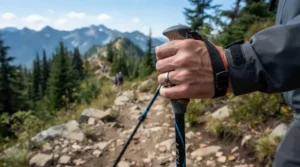
6. TIGRADE Titanium Dome Band — lightweight classic for the minimalist
Now for a traditional-style benchmark. This polished titanium dome band comes in widths from 2mm to 10mm with a comfort-fit interior, in plain, matte, and gold-plated variants.
Titanium sits around 5 to 6 on the Mohs scale, harder than gold but softer than tungsten, and it’s famously light at about 4.5 g/cm³. Spec sheets also point out that it doesn’t tarnish and is nickel-free, which suits sensitive skin. Unlike tungsten, it tends to bend rather than shatter under extreme force.
One buyer’s guide ranks it a top pick for budget-conscious shoppers wanting a classic, no-frills band, and praises the comfort-fit interior. That’s one source’s view, so verify against live reviews. My analysis is that it’s the safe, sensible choice for anyone choosing between meteorite wedding bands vs traditional metal bands who still isn’t sold on meteorite upkeep.
Pros:
- ✅ Very light and comfortable
- ✅ Won’t tarnish or rust
- ✅ Available in widths from 2mm to 10mm
Cons:
- ❌ Scratches more easily than tungsten
- ❌ Resizing is rarely possible
Price range: budget, so check current price. Value verdict: excellent baseline for comparison shopping.
7. King Will Basic Tungsten Ring — the 8mm tank for active lives
If TIGRADE Titanium Dome Band is the featherweight, this is the heavyweight. It’s an 8mm silver tungsten carbide band with a matte brushed center, polished step edges, and a comfort fit.
Tungsten carbide’s Mohs rating of about 9 means a brushed finish stays brushed, and a polished edge stays polished for years. The step-edge design also hides micro-scratches better than a mirror finish. What the spec sheet won’t highlight is the downside: tungsten is brittle, so a hard, sharp strike can crack it rather than dent it. One jeweler also advises removing tungsten before sports, because swelling after an injury makes removal harder.
Based on the spec comparison, this suits mechanics, tradespeople, and gym regulars who want zero maintenance. Reviewers across tungsten listings often note the substantial weight, so expect it to feel more present than titanium.
Pros:
- ✅ Extreme scratch resistance for daily abuse
- ✅ Matte brushed finish hides wear
- ✅ Very affordable for the durability
Cons:
- ❌ Brittle under sharp impact
- ❌ Cannot be resized or cut with standard tools
Price range: budget, often under the $50 range, so check current price. Value verdict: arguably the best durability-per-dollar here.
Meteorite Composition: What Your Ring Is Actually Made Of
Strip away the romance and meteorite composition is straightforward chemistry. Gibeon, the most popular ring meteorite, is an iron meteorite from chemical group IVA. A typical analysis shows about 91.8% iron, 7.7% nickel, 0.5% cobalt, and a trace of phosphorus.
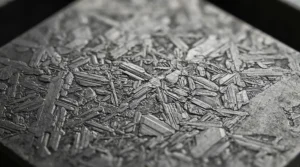
That nickel is the star. When the parent asteroid core cooled slowly over millions of years, iron and nickel separated into two alloys: kamacite (low nickel) and taenite (high nickel). Etching a polished slice with weak acid eats the two at different rates and reveals the interlocking Widmanstätten pattern, a latticework that doesn’t appear in terrestrial iron.
Why should a buyer care? Because composition predicts behavior. Gibeon’s relatively high nickel content makes it more resistant to oxidation than many other iron meteorites, though about 92% iron means it can still rust. Muonionalusta carries a moderate rust risk per one jeweler’s comparison, and Campo del Cielo the highest. Nickel and cobalt also matter if you have metal sensitivities, so ask about sealing and check with your dermatologist if you’ve reacted to jewelry before.

Meteorite Ring Pros and Cons: The Honest Ledger
Every meteorite ring pros and cons list starts with the same trade: extraordinary character in exchange for a bit of attention. Let’s lay it out.
The upsides:
- ✅ A pattern that exists nowhere else on Earth, so no two rings match
- ✅ A genuine origin story, from an asteroid core that formed billions of years ago
- ✅ Restorable beauty: if the pattern dulls, a jeweler can re-etch it
- ✅ Great pairing with tough sleeves like titanium, tungsten, or cobalt
The downsides:
- ❌ Rust risk, since iron plus moisture equals iron oxide
- ❌ Usually not resizable, because inlays and heat don’t mix
- ❌ Price premium over tungsten or titanium
- ❌ Counterfeit and imitation products blur the market
What this means in practice is that the best meteorite rings aren’t solid meteorite. Jewelers typically use it as an inlay inside a durable sleeve, because meteorite alone is mostly iron and prone to rust and damage. One jeweler’s guide puts it bluntly: if you want a zero-effort ring, meteorite isn’t the one. If you can accept a quick wipe and an occasional re-etch, the cons shrink considerably.
Traditional Metal Wedding Band Durability: Gold, Platinum, Tungsten and Titanium
Traditional metal wedding band durability is a story of trade-offs, not winners. Gold is soft, roughly 2.5 to 3.5 on the Mohs scale, so it scratches and dents but can be polished and, crucially, resized. Platinum is harder at about 4 to 4.5 and develops a soft patina rather than losing metal. Titanium lands around 5 to 6 and tungsten carbide around 9, with the downside that tungsten is brittle.
| Benefit | Meteorite Inlay Band | Gold / Platinum | Tungsten / Titanium |
|---|---|---|---|
| Scratch resistance | Frame dependent | Low to moderate | High |
| Uniqueness | Unmatched | Low | Low to moderate |
| Easy resizing | No | Yes | No |
| Low maintenance | No | Fairly | Yes |
| Heirloom value | Moderate | High | Low |
| Best For | Story-driven buyers | Traditionalists | Active, budget buyers |
A plain men’s gold band can run $500 to $1,000 or more by one retailer’s estimate, which gives tungsten and titanium their obvious appeal. Reading the table, gold and platinum win on tradition and flexibility, while tungsten and titanium win on hardness per dollar. A meteorite inlay band wins on personality, and its toughness is borrowed from whichever sleeve surrounds the rock.
Tungsten and Titanium Bands: The Modern Middle Ground
For many people, tungsten and titanium bands are the sensible answer to the meteorite vs traditional debate. They cost less than gold, need almost no care, and look sharp in matte, brushed, or black finishes.
Here’s the short version of how they differ. Tungsten carbide is dense and heavy, close to gold in weight, and very scratch-resistant. It cannot be cut with an ordinary jeweler’s ring cutter, so emergency rooms use a diamond-tipped tool to crack it, which is why tungsten buyers should remove rings before sports or heavy gripping. Titanium is far lighter, tends to bend instead of cracking, and is nickel-free.
Many meteorite rings use exactly these metals as sleeves. A meteorite inlay set into titanium gets titanium’s lightness and corrosion resistance, while one set into tungsten gets scratch armor. Product-wise, TIGRADE Titanium Dome Band and King Will Basic Tungsten Ring represent the pure, plain versions, and King Will Meteorite Tungsten Band shows the hybrid approach. Choose titanium for comfort, tungsten for toughness, and either one for budget.
Ring Resizing Challenges: Plan Your Fit Before You Buy
Ring resizing challenges are the quiet dealbreaker of this whole topic. Gold and platinum are the resizing champions, since a jeweler can cut, add or remove metal, and solder. Tungsten carbide cannot be resized at all, because it’s sintered rather than cast and its melting point is roughly 2,870°C. Titanium is extremely difficult, with only some niche shops able to bore it out a half size larger and almost never smaller. Meteorite inlays add another problem: heat and pressure can destroy the inlay, so these rings are usually listed as non-resizable.
What can you do? Several things help:
- Use a caliper or micrometer to measure the inside diameter, and get at least two jewelers to agree on your size.
- Ask about lifetime size-exchange programs, which many tungsten and titanium sellers offer.
- Use a silicone ring guard or sizing bead if the ring ends up loose.
- Remember that fingers change with temperature and time, so size at the end of a normal day.
Because Gibeon Cobalt 8mm Meteorite Ring is made to order, check the seller’s size policy before you pay. If you can’t commit to a size, a gold band is the safer choice.
How to Choose Between Meteorite Wedding Bands vs Traditional Metal Bands
Use these six steps in order. They take about five minutes.
- Decide how much care you’ll actually give. If a weekly wipe and an occasional oil sounds like a chore, skip real meteorite and choose tungsten, titanium, or gold.
- Check your job and hobbies. Constant water, chemicals, or heavy gripping favor tungsten or titanium, while desk life tolerates meteorite easily.
- Pick the sleeve first. Cobalt, titanium, and tungsten each change weight, durability, and emergency removal, so choose that before the inlay.
- Confirm authenticity. Look for the meteorite name, fall location, and a certificate of authenticity, and treat “meteorite-style” wording as imitation.
- Lock your size. Remember resizing is rarely possible, so measure, then measure again.
- Set a realistic budget. Imitation runs low, real meteorite in titanium or tungsten sits mid-range, and meteorite in gold climbs higher.
If you’re still torn, the two extremes of the spectrum are Gibeon Cobalt 8mm Meteorite Ring for character and King Will Basic Tungsten Ring for sheer toughness.
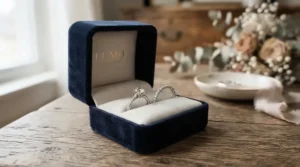
Meteorite Ring Maintenance: A Practical Care Guide
Good meteorite ring maintenance is boring in the best way. It’s a handful of habits, not a science project.
Daily and weekly habits:
- Keep it dry. Take it off to shower, swim, wash dishes, and exercise, because even sealed meteorite shouldn’t stay wet.
- Apply lotion first and let it absorb before putting the ring on, since some creams contain oils or acids that speed oxidation.
- Wipe with a soft cloth after contact with water.
- Apply a thin protective coat, such as gun oil or a care-kit wax, as recommended by your maker.
- Store it in a cool, dry place and avoid chlorine, bleach, vinegar, citrus, and acidic cleaners.
If rust appears: one jeweler’s guide suggests soaking meteorite-only items in rubbing alcohol for about 30 minutes while gently brushing. Don’t submerge rings that combine meteorite with wood, resin, or carbon fiber, such as Core Carbon Rings Gibeon Meteorite Band. For stubborn spots or a faded pattern, jewelers can re-etch the surface, and GIA notes the final step in revealing a pattern is etching with weak acid.
Common first-30-day mistakes: wearing it in the shower, skipping the oil, and using hand sanitizer constantly. Hand sanitizer is an alcohol-based product, so wash and dry carefully instead of letting it linger on the inlay.
Real-World Scenarios: Which Band Fits Which Life?
Numbers are useful, but lives are messy. Here are three hypothetical buyers.
The nurse who washes hands forty times a shift. Water exposure is relentless, so real meteorite is a poor match. A tungsten or titanium band such as TIGRADE Titanium Dome Band or King Will Basic Tungsten Ring handles the abuse, and Three Keys Imitated Meteorite Tungsten Ring gives the cosmic look if that matters.
The desk-job astronomy nerd, budget around the mid-hundreds. He wants a story, and his daily routine keeps the ring dry. Gibeon Cobalt 8mm Meteorite Ring fits perfectly, and a weekly wipe is no burden.
The weekend camper, outdoors every Saturday. He needs toughness plus personality. A sealed meteorite inlay in a durable sleeve works if he stows the ring in a dry pouch before kayaking, or he can choose King Will Meteorite Tungsten Band if he’s content with a meteorite-style inlay.
✨ Don’t Miss These Exclusive Deals!
🔍 Take your ring shopping to the next level with these carefully selected bands. Click on any highlighted item to check current pricing and availability. These picks will help you choose a wedding band your partner will love for decades!
Authenticity and Safety: Spotting Real Meteorite
The meteorite market has a labeling problem. Etched stainless steel and patterned alloys can mimic the look, so authenticity deserves a few minutes of scrutiny.
A jeweler-published standard says authentic pieces should state the meteorite name and fall location, include a certificate of authenticity, provide care instructions, and use “meteorite-pattern,” “meteorite-style,” or “imitation” when the material isn’t real. Pricing helps too: the same standard cites roughly $400 to $900 or more for meteorite with titanium or tungsten and under $200 for imitation. That’s one jeweler’s benchmark, not a law, but a suspiciously cheap “genuine” ring is a red flag.
Regulation is lighter than you’d hope. The FTC’s Jewelry Guides explain how marketers can avoid deceptive claims in jewelry, but they don’t police every meteorite listing. On Amazon, read the title carefully: “authentic Gibeon” is a material claim, while “meteorite style” or “imitated meteorite” is a design claim.
Two more checks: ask about provenance, since Gibeon fragments are protected as national monuments in Namibia according to one mineral dealer, and check for nickel or cobalt sensitivity. Compare what the listing says against what Three Keys Imitated Meteorite Tungsten Ring openly admits.
Long-Term Cost and Value: Cost Per Year of Wear
A wedding band is a forty-year purchase, so cost per year is the smartest lens. A budget tungsten ring that costs a small fraction of a gold band might need replacing once if your size changes, yet it still comes out cheaper. A mid-range meteorite band costs more up front but adds care supplies and occasional re-etching.
| Band Type | Typical Price Range | Upkeep | Resize / Exchange | Value Verdict |
|---|---|---|---|---|
| Imitation meteorite tungsten | Under $200 | Minimal | Exchange only | Best style per dollar |
| Real meteorite + titanium or tungsten | $400-$900+ | Moderate | Mostly exchange | Best story per dollar |
| Real meteorite + gold | $700-$2,000+ | Moderate | Limited | Premium keepsake |
| Plain gold or platinum | $500-$1,000+ | Low | Easiest resize | Best long-term flexibility |
| Plain tungsten or titanium | Under $100 | Minimal | Exchange only | Best durability per dollar |
| Best For | Budget stylists | Space fans | Heirloom buyers | Hard-working hands |
The takeaway is that meteorite isn’t an irrational splurge, but it isn’t a bargain either. Spread a mid-range meteorite band over decades and the yearly cost is modest, yet King Will Basic Tungsten Ring still wins on pure economics. If you want something distinctive that costs less than gold, a meteorite-and-titanium or meteorite-and-tungsten ring sits in a sweet spot.
Frequently Asked Questions
❓ Can you wear a meteorite wedding band every day?
❓ Is a tungsten or titanium band better for a meteorite inlay?
❓ How do I know a meteorite ring on Amazon is real?
❓ Can a meteorite wedding band be resized later?
❓ Do meteorite rings rust more than traditional metal bands?
Conclusion: Which Ring Wins for You?
So where does this leave meteorite wedding bands vs traditional metal bands? If you want a ring with a story, a pattern that exists nowhere else, and you’re willing to give it small, regular attention, a genuine meteorite band is a strong choice. Gibeon Cobalt 8mm Meteorite Ring delivers the biggest visible meteorite, Gibeon Meteorite Cobalt Chrome Band 6mm keeps things slim, and Core Carbon Rings Gibeon Meteorite Band is the lightweight oddball.
If you want maximum durability with minimum fuss, tungsten and titanium win on practicality. King Will Basic Tungsten Ring is the tank, TIGRADE Titanium Dome Band is the featherweight, and King Will Meteorite Tungsten Band and Three Keys Imitated Meteorite Tungsten Ring give you the cosmic look at a budget price, with the caveat that you should confirm authenticity claims. And if resizing flexibility matters most, nothing beats gold or platinum.
My honest framework: choose on lifestyle first, sleeve second, inlay third. Then confirm authenticity, lock in your size, and check current price before buying.
✨ Ready to pick your ring?
🔍 Click any highlighted product above to check current pricing and availability, and choose the band that fits your life, not just your Pinterest board. Your hands will be wearing it for a very long time! 💍
Recommended for You
- Unique Wedding Bands For Nature Lovers: 7 Stunning Picks 2026
- Mixed Material Wedding Bands: 7 Smart Budget Picks (2026)
- Mixed Material Wedding Bands For Outdoor Lifestyles: 7 Best (2026)
Disclaimer: This article contains affiliate links. As an Amazon Associate, I earn from qualifying purchases. If you purchase products through these links, we may earn a small commission at no additional cost to you.
✨ Found this helpful? Share it with your friends! 💬🤗
