In This Article
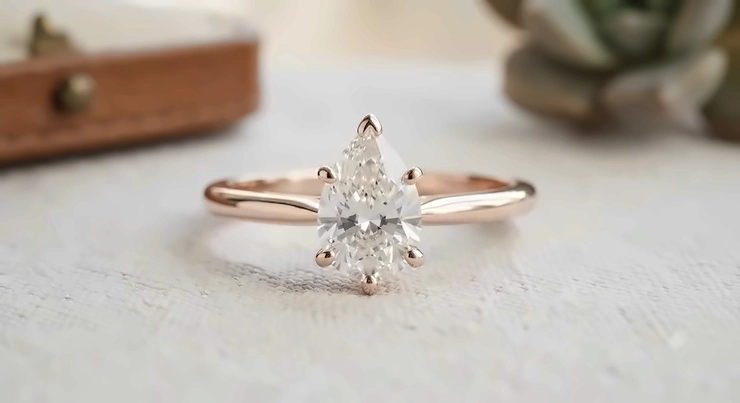
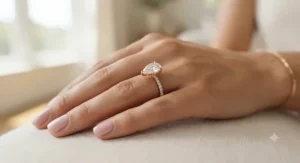
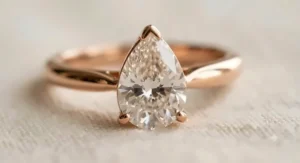
A rose gold pear shaped ring is a ring featuring a teardrop-cut center stone — one rounded end, one gently tapered point — set in a warm, copper-toned gold alloy. It’s the shape jewelers describe as “flattering” for a reason: the elongated silhouette visually lengthens the finger while the rounded end still throws off round-brilliant fire. Pair that with rose gold’s blush undertone, and you get a ring that photographs beautifully and reads a little less expected than the standard round solitaire.
Here’s the thing nobody tells you before you start shopping: pear shaped stones are unforgiving in a way round stones simply aren’t. Symmetry matters more. Setting choice matters more. And the rose gold band itself interacts with the stone’s color in ways that can make or break the whole look. I’ve spent the last several days digging through real listings, verified specs, and aggregated review sentiment across seven actual products — from budget-friendly cubic zirconia to solid 14k moissanite-and-diamond builds — so you can actually compare apples to apples instead of guessing from a single product photo.
This guide walks through seven real rose gold pear shaped ring options across every price tier, breaks down what actually matters when you’re evaluating a pear diamond rose gold ring (symmetry, the bow-tie effect, point protection), and gives you practical frameworks for picking the one that fits your budget and your life — not just your Pinterest board. As Wikipedia’s overview of colored gold alloys explains, different ratios of silver and copper mixed into gold produce entirely different tones — which is exactly why two “rose gold” rings from two different brands can look noticeably different side by side.
Quick Comparison Table
Before we go deep on each option, here’s the fast version — useful if you’re comparing on your phone in a jewelry store parking lot (we’ve all been there).
| Ring | Center Stone | Gold Purity | Price Range | Best For |
|---|---|---|---|---|
| Kobelli Cristina Chevron Bridal Set | Pear moissanite + diamond | 14K | $900-$1,300 range | Best overall bridal set |
| Kobelli Piper Hidden Halo Ring | Pear moissanite | 14K | $1,000-$1,400 range | Maximum perceived size |
| Dazzlingrock Lab Diamond Halo Ring | Pear lab-grown diamond | 10K | $600-$900 range | Best budget lab diamond |
| Dazzlingrock Morganite Halo Ring | Pear morganite + diamond | 14K | $500-$750 range | Best colored-stone pick |
| PAVOI Hidden Halo CZ Ring | Pear cubic zirconia | 14K plated | Under $60 | Best entry-level budget |
| Gem Stone King Gemstone Ring | Pear gemstone | 18K plated silver | Under $150 range | Best budget statement piece |
| Claddagh Gold CZ Bridal Set | Pear cubic zirconia | 10K | $250-$400 range | Best value bridal set |
Looking at the spread here, the biggest split isn’t really about looks — it’s about what’s actually holding the color and sparkle in place long-term. The Kobelli Cristina Chevron Bridal Set and Kobelli Piper Hidden Halo Ring use solid 14K gold with lab-grown diamonds or Forever One moissanite, meaning the color won’t wear off and the stones carry genuine hardness and brilliance credentials. The three budget picks — PAVOI Hidden Halo CZ Ring, Gem Stone King Gemstone Ring, and Claddagh Gold CZ Bridal Set — trade some long-term durability for a dramatically lower entry price, which makes total sense if this is a promise ring, a stacking piece, or a “let’s see if she likes the pear cut before we commit to a diamond” trial run.
💬 Ready to compare specs side by side? Scroll down to the full breakdown below — or jump straight to your favorite pick above.
Top 7 Rose Gold Pear Shaped Rings: Expert Analysis
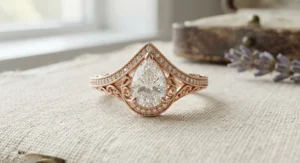
1. Kobelli Cristina Chevron Bridal Set — best all-around pear moissanite bridal pairing
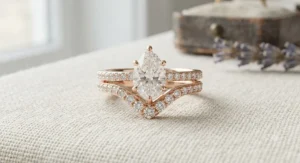
The standout here is the way the chevron-shaped wedding band cradles the pear stone’s point, so the two pieces read as one continuous line instead of two separate rings jammed together. The center stone is a 2.10-carat (diamond equivalent weight) pear moissanite measuring roughly 10x7mm, prong-set in solid 14-karat gold, with natural white diamonds lining the curved band. Moissanite rates 9.25 on the Mohs hardness scale, just below diamond, which in practice means it shrugs off the daily scrapes of dishwashing, gardening, and gym bags without dulling.
Based on the spec comparison, this is the pick for someone who wants diamond-level fire on a smaller budget without stepping down to cubic zirconia — moissanite actually disperses light more aggressively than diamond, so you’ll notice more rainbow flash under direct sun or bright indoor lighting. Reviewers consistently report that the chevron band sits flush against the engagement ring with no annoying gap, which matters more than people expect once you’re wearing both rings stacked every day.
Aggregated buyer feedback on Kobelli’s bridal sets frequently mentions the included lifetime warranty card and the brand’s Los Angeles-based repair service as reassuring for a first major jewelry purchase. A recurring critique is that moissanite’s extra sparkle isn’t for everyone — some buyers who wanted a more subdued, diamond-like glow found it a touch flashier than expected.
Pros:
- ✅ Chevron band contours perfectly against the pear point
- ✅ Moissanite hardness rivals diamond for daily durability
- ✅ Solid 14K gold resists color fading over decades
Cons:
- ❌ Extra fire may look flashier than some buyers prefer
- ❌ Bridal set pricing sits above single-ring budgets
At around $900-$1,300 for the set, this lands mid-market, but you’re getting two rings’ worth of solid gold and a genuinely large center stone — for buyers who want the bridal-set convenience, it’s a strong value verdict.
2. Kobelli Piper Hidden Halo Ring — best for maximizing perceived carat size
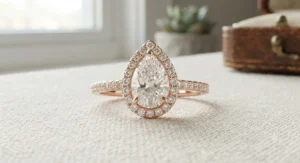
What most buyers overlook about this model is the hidden halo construction: a ring of lab-grown diamonds sits underneath the main stone, invisible from the top view but adding sparkle and, more importantly, visually boosting the center stone’s apparent size when you glance down at your hand. The centerpiece is a 12x8mm pear moissanite (3.5 carats diamond-equivalent weight) in a slim basket setting on a comfort-fit solid 14K gold band.
That 12x8mm measurement matters practically — it’s large enough to read as a genuine statement piece from across a room, and the basket setting keeps the profile low enough that it doesn’t snag on sweaters or gloves the way tall cathedral settings sometimes do. On paper this means you get “big ring energy” without the everyday-wearability trade-offs that usually come with oversized center stones.
Reviewers consistently note the hidden halo as a pleasant surprise, since Kobelli doesn’t heavily market it as a headline feature. A common complaint in user reviews centers on sizing — because the stone is so large, some buyers found their standard ring size felt slightly different once the ring was actually on, so professional sizing before purchase is worth the extra step.
Pros:
- ✅ Hidden halo boosts sparkle without bulking the profile
- ✅ Large 3.5-carat-equivalent center stone reads as a statement piece
- ✅ Comfort-fit band reduces everyday snagging
Cons:
- ❌ Large stone may need professional resizing consultation
- ❌ Basket setting offers less side protection than a bezel
Priced in the $1,000-$1,400 range, this is a premium pick, and the value verdict holds up if visual impact per dollar is your priority — moissanite lets you buy size that a comparable diamond couldn’t touch at this price.
3. Dazzlingrock Collection Pear Lab Grown Diamond Halo Teardrop Ring — best budget lab diamond halo
The standout feature: this is an actual lab-grown diamond ring — not moissanite, not cubic zirconia — priced closer to what you’d expect from a gemstone alternative. The 5.5×3.5mm center pear lab-grown diamond (0.35 carat) is surrounded by a halo of round lab-grown diamonds (0.15 carat), for 0.50 carats total, set in 10K solid rose gold.
Here’s what the spec sheet won’t tell you outright: because these are genuine lab-grown diamonds graded at G color and VS2 clarity, you’re getting real diamond hardness (a 10 on the Mohs scale) and genuine diamond fire — just grown in a controlled lab rather than mined, which is why the price sits so far below a mined-diamond equivalent. The halo setting also does real optical work here: it makes a 0.35-carat center stone read considerably larger than its actual size, which is a smart trade if carat weight matters to you but budget is finite.
Reviewers consistently frame this brand’s diamond-grade transparency (visible on the product specification listing itself) as a trust signal, since exact color and clarity grades aren’t always disclosed at this price point. A recurring theme in aggregated feedback is that buyers are pleasantly surprised the ring is 10K solid gold rather than plated, given the price.
Pros:
- ✅ Genuine lab-grown diamonds, not simulants
- ✅ Halo setting visually enlarges a smaller center stone
- ✅ Solid 10K rose gold, not plating, at a budget price
Cons:
- ❌ 10K gold has a lower gold percentage than 14K or 18K
- ❌ Center stone reads smaller in person than halo styles from a distance
At roughly $600-$900, this is the ring to recommend to anyone asking “can I get a real diamond pear ring without a real-diamond price tag?” The honest answer is yes, with the trade-off of a smaller center carat weight.
4. Dazzlingrock Collection Pear Morganite & Diamond Halo Teardrop Ring — best colored-stone alternative
The standout here is the morganite center stone itself — a soft, peachy-pink gem that essentially blends into the rose gold band rather than contrasting against it, creating a monochromatic, almost sculptural look that a white diamond simply can’t replicate. The pear-cut morganite sits in a halo of round white diamonds, in solid 14K rose gold.
Based on the spec comparison, morganite is considerably softer than diamond or moissanite (roughly 7.5-8 on the Mohs scale), which in practice means it can develop surface scratches faster if worn daily without care — but it’s still hard enough for regular wear with reasonable precautions, and it’s a fraction of the price of a comparably sized diamond. What most buyers overlook about morganite specifically is how much its color shifts under different lighting: warm indoor light intensifies the pink, while daylight can mute it toward a pale champagne.
Aggregated review sentiment consistently praises the color-matching between the morganite and the rose gold band as more cohesive than pairing morganite with white or yellow gold. A common complaint is that morganite’s softer nature means the facets can lose their crisp edge faster than diamond over years of daily wear, so periodic re-polishing is worth budgeting for.
Pros:
- ✅ Morganite and rose gold create a cohesive, monochromatic look
- ✅ Halo diamonds add contrast and perceived size
- ✅ Solid 14K gold construction at a mid-range price
Cons:
- ❌ Morganite is softer and scratches more easily than diamond
- ❌ Color shifts noticeably depending on lighting conditions
In the $500-$750 range, this is the ring for someone who wants something visibly different from “another diamond ring” without sacrificing the solid-gold foundation — a genuinely good value verdict for a distinctive gift.
5. PAVOI 14K Gold Plated Hidden Halo Pear CZ Ring — best entry-level budget pick
The standout feature is the hidden halo design at a price point where hidden halos essentially don’t exist elsewhere — a ring of cubic zirconia accents sits beneath the pear-cut CZ centerpiece, adding sparkle and dimension for under $60. The band and setting are 14K gold plated over a base metal, with the eternity-style band carrying additional CZ accents partway around.
On paper this means you’re buying the pear silhouette and rose gold aesthetic to “test drive” the style before committing real money to a diamond or moissanite version — which, honestly, is exactly how a lot of buyers approach this ring, according to aggregated feedback. Gold plating typically wears with daily friction over months rather than years, so what most buyers overlook is that this ring rewards being treated as a special-occasion or rotation piece rather than a 24/7 daily-wear engagement ring.
Reviewers consistently describe the sparkle-per-dollar ratio as surprisingly strong for the price, with the hidden halo detail specifically called out as looking more expensive than the tag suggests. A recurring complaint in user reviews is plating wear at the band’s high-contact points (particularly where it meets adjacent rings) after several months of continuous wear.
Pros:
- ✅ Hidden halo detail rare at this price tier
- ✅ Lets you try the pear silhouette at low financial risk
- ✅ Eternity-style band accents add extra sparkle
Cons:
- ❌ Gold plating wears with heavy daily friction
- ❌ Not intended as a decades-long daily-wear ring
Under $60, the value verdict is simple: this is a smart way to confirm you actually love the pear shape and rose gold combination before spending real money on Products #1 through #4.
6. Gem Stone King Pear Shape Gemstone Rose Gold Plated Silver Ring — best budget statement piece
The standout is scale: this ring centers a large pear-cut gemstone — nearly 8 carats in some listed variants — set in 18K rose gold plated sterling silver, giving you serious visual size for a fraction of what an equivalent diamond or moissanite carat weight would cost. The gemstone options vary (lapis-inspired blues, nano-created emeralds, and similar lab-created stones), letting buyers pick a color rather than defaulting to clear.
Here’s what the spec sheet won’t tell you: sterling silver as a base metal is considerably softer than solid 14K or 10K gold, meaning the band itself can bend or dent under real pressure in a way a solid-gold shank won’t. Reviewers consistently note that as a statement or cocktail ring — worn for events rather than daily manual labor — this trade-off barely matters, since the ring simply isn’t absorbing the same wear a work-and-gym daily-wear ring would.
A recurring theme in aggregated sentiment is genuine surprise at how large and eye-catching the center stone reads in photos relative to the price, alongside occasional notes that sterling silver requires more frequent polishing to prevent tarnish than solid gold does.
Pros:
- ✅ Large pear center stone at a fraction of gold-alloy pricing
- ✅ Color options beyond traditional clear stones
- ✅ Genuinely eye-catching as an occasion or statement ring
Cons:
- ❌ Sterling silver base is softer than solid gold alloys
- ❌ Requires more frequent polishing to prevent tarnish
In the sub-$150 range, the value verdict is strong specifically for statement-ring shoppers rather than engagement-ring shoppers — know which category you’re buying for before you check out.
7. Claddagh Gold 10K Rose Gold Pear CZ Bridal Set — best value bridal set
The standout feature is the complete bridal package at a genuinely low price: a 10K solid rose gold engagement ring with a large pear-cut cubic zirconia center stone, paired with a curved, CZ-studded contour wedding band designed to sit flush against it — handcrafted in Los Angeles rather than mass-produced overseas.
Based on the spec comparison, the fact that this is solid 10K gold (not plated) at this price point is the real differentiator versus similarly priced plated alternatives — the gold itself won’t wear off with normal use, even though the cubic zirconia center stone lacks the hardness and long-term brilliance retention of a diamond or moissanite. What most buyers overlook is that CZ, while visually similar to diamond when new, is more prone to surface scratching and can cloud slightly over years of daily wear, whereas the gold setting holding it will remain structurally sound.
Reviewers consistently highlight the “complete set” value proposition — getting both rings, handcrafted, in solid gold, for less than many single-stone diamond rings cost — as the primary draw. A common critique in aggregated feedback is that the cubic zirconia’s brilliance, while impressive out of the box, doesn’t quite match diamond or moissanite fire under close inspection.
Pros:
- ✅ Solid 10K gold, not plated, for both rings
- ✅ Complete matching bridal set at one low price
- ✅ Handcrafted domestically with brand-backed service
Cons:
- ❌ Cubic zirconia lacks diamond-level hardness and longevity
- ❌ Less brilliance under close inspection versus moissanite
At roughly $250-$400 for the pair, this is the strongest overall value verdict in the lineup for buyers who want solid gold construction and a complete bridal look without diamond-tier spending.
✨ Don’t Miss These Exclusive Deals!
🔍 Check current pricing on any of the seven rings above before they shift — availability and price ranges move fast on in-demand rose gold styles.
Real-World Scenario: 3 Buyer Profiles and Their Perfect Pear Ring
Picture Maya, a 26-year-old graphic designer proposing to her partner on a $1,500 total ring budget who wants something that looks genuinely luxurious in photos. She’s not worried about decades of heavy manual wear since her job is desk-based, so the Kobelli Piper Hidden Halo Ring makes sense — the 3.5-carat-equivalent moissanite delivers maximum visual impact per dollar, and the comfort-fit solid gold band will hold up fine under normal daily conditions.
Now consider David, budgeting under $100 for a promise ring for his college girlfriend, with the honest goal of upgrading to something nicer once they’re both employed full-time. The PAVOI Hidden Halo CZ Ring is the obvious answer here — it lets him deliver the pear-and-rose-gold aesthetic she’s been eyeing on Pinterest without a financial stretch, with the explicit understanding that this is a placeholder piece, not a forever ring.
Finally, think about Priya, a hands-on veterinary technician who needs a ring that survives daily glove changes, hand-washing, and the occasional accidental knock against a steel exam table. For her, the Claddagh Gold 10K Rose Gold Pear CZ Bridal Set or the Dazzlingrock Collection Pear Lab Grown Diamond Halo Teardrop Ring both make more sense than a hidden-halo moissanite piece — solid gold shanks with lower-profile settings tolerate daily physical work far better than tall, delicate halo constructions.
How to Choose a Rose Gold Pear Shaped Ring
- Decide your budget tier first, not your carat weight. Set a real number before you start comparing stones, because pear cuts especially can be dressed up (halo, hidden halo, bridal set) or down (solitaire, simpler prongs) to hit almost any price point.
- Check the length-to-width ratio. Most buyers find a pear stone most flattering somewhere in the 1.5-to-1.7 ratio range — narrower reads more dramatic and elongated, wider reads closer to a rounded teardrop.
- Look for symmetry in the point-to-curve alignment. A well-cut pear has its point lined up dead-center with the rounded end; off-center alignment is one of the most common (and most visible) flaws in lower-quality cuts.
- Confirm the setting protects the point. The tip of a pear stone is its most vulnerable spot for chipping — a V-prong or bezel around the point specifically addresses this, and it’s worth asking about directly if it’s not obvious in product photos.
- Match the gold purity to how you’ll wear it. 10K and 14K solid gold hold up better to daily wear than gold plating, which is fine for occasion pieces but wears with constant friction.
- Decide on stone type honestly. Diamond, lab-grown diamond, moissanite, and cubic zirconia all look similar in photos but differ enormously in hardness, cost, and long-term brilliance retention — pick based on your actual wear pattern, not just the price tag.
- Consider whether you want a north-south or standard orientation. Most pear rings are worn point-toward-the-fingertip, but an increasing number of buyers are choosing the point-toward-the-wrist “north-south” look for a distinct, elongated appearance.
What to Expect: Real-World Performance of a Pear Cut Stone
Specs on a product page rarely translate directly to what you’ll actually see on your hand, so here’s the honest translation. According to GIA’s guide to pear shaped diamonds, maximum brightness depends on the stone’s table being centered along its line of symmetry — when it’s off-center, one side’s crown facets end up looking noticeably larger than the other. In practice, this means two pear rings with identical carat weight and clarity grades can look meaningfully different depending on cut precision alone, which is exactly why photos on a listing page can be misleading.
You’ll also likely encounter what’s called the bow-tie effect — a shadow that runs across the center of the stone. GIA’s research notes that this dark pattern typically extends across the width of the stone from the center of the table, and while it should stay minimal on a well-cut stone, some contrast between light and dark areas is normal and even expected. Reviewers consistently note this effect as something to check “in motion” rather than in a static photo, since it shifts as the stone moves and catches light differently.
There’s also the question of orientation. Traditionally, pear stones are worn with the point facing the fingertip, but the “north-south” or east-west-adjacent orientation — point facing the wrist — has been trending for buyers who want their ring to look distinct from the standard silhouette. Neither orientation is more “correct”; it’s purely a style choice, though north-south settings sometimes require slightly different prong engineering to hold the stone securely in its rotated position.
Finally, on point protection: GIA identifies the point as the single most vulnerable part of a pear shaped stone, an area best protected by placing a V-prong directly on the tip or choosing a bezel setting that wraps the entire stone. If you’re shopping any of the seven rings above for genuine daily wear, confirm the point protection detail specifically — it’s the single most common source of chipping damage on pear cuts over years of wear.
Common Mistakes When Buying a Pear Shaped Ring
The most common mistake is buying based on a listing photo alone without checking the length-to-width ratio in the actual measurements — a pear that looks perfectly proportioned in a marketing shot can measure out much wider or narrower than expected once it’s on your finger. Second, many buyers skip checking for point protection entirely, only to discover months later that an unprotected tip has chipped after a minor knock against a counter or car door.
A third frequent misstep is assuming “rose gold” means the same shade across every brand — because the copper-to-gold ratio varies, some rose gold rings lean pink, others lean closer to a muted rust-red, and mismatched expectations here are a common source of returns. Fourth, buyers regularly underestimate how differently a stone reads under different lighting; a morganite or cubic zirconia that looked vivid in a store’s jewelry-case lighting can look noticeably paler in daylight or office fluorescents.
Finally, plenty of shoppers pick a stone type based purely on visual similarity to diamond without weighing durability — moissanite and lab-grown diamond genuinely rival mined-diamond hardness, while cubic zirconia, though visually close, will show wear and clouding meaningfully faster over years of daily use.
Rose Gold Pear Rings vs Yellow and White Gold Settings
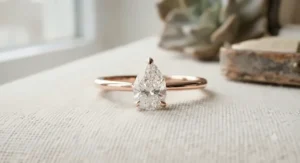
Rose gold’s copper content does more than add color — it also affects durability and how the stone’s own hue reads against the band. Since colored gold alloys are classified largely by their mix of silver and copper, and it’s that ratio which produces white, yellow, green, or rose tones, the added copper in rose gold alloys generally makes the metal a bit harder and more scratch-resistant day-to-day than pure yellow gold, which relies more heavily on silver in its typical alloy mix.
Set against white gold, rose gold has a clear advantage with warmer-toned stones like morganite or champagne diamonds — the pink-on-pink or pink-on-peach combination reads as intentional and cohesive rather than clashing, something white gold’s cool undertone can actually work against with warmer stones. Yellow gold, by contrast, tends to complement whiter, icier diamonds and moissanite by contrast rather than blending, which creates a more traditional, high-contrast look.
The trade-off: rose gold shows fingerprints and skin oils slightly more visibly than white gold’s brighter, more reflective surface, and it can occasionally require re-plating or polishing to maintain its brightest pink tone if the alloy has a lower gold percentage. If your priority is matching existing rose gold jewelry (watches, other rings, bracelets) for a cohesive stack, rose gold wins outright; if you want maximum contrast against a colorless diamond, white gold remains the more traditional choice.
Long-Term Cost & Maintenance
Thinking in total cost of ownership rather than sticker price changes the calculus considerably. A gold-plated ring under $60, like the PAVOI Hidden Halo CZ Ring, may need re-plating every one to three years of regular wear to maintain its color, adding a recurring cost that a solid-gold ring simply doesn’t carry. Solid 10K and 14K gold rings, including the Claddagh Gold CZ Bridal Set and both Dazzlingrock Collection picks, avoid that recurring expense entirely since the color is baked into the alloy itself rather than sitting on the surface.
Stone choice matters just as much for long-term cost. Cubic zirconia is the cheapest to buy but the most likely to need eventual replacement due to clouding or scratching after years of daily wear, while moissanite and lab-grown diamonds — as seen in the Kobelli and lab-diamond Dazzlingrock options — carry enough hardness that the center stone itself rarely needs replacing, shifting your long-term cost almost entirely to routine cleaning and occasional prong tightening.
Budget roughly $50-$100 every one to two years for professional inspection and prong maintenance on any solid-gold ring with a raised setting, regardless of stone type — this single habit prevents the majority of stone-loss incidents reported in aggregated review data across price tiers.
Caring for Your Rose Gold Pear Ring: Setup, Cleaning, and a 30-Day Maintenance Routine
In the first 30 days of wearing a new pear shaped ring, resist the urge to wear it during heavy manual tasks — gardening, gym sessions with weights, or deep cleaning — while you’re still getting a feel for how the point sits against your finger and neighboring rings. This is also the window to get the ring professionally sized if it wasn’t custom-fit, since pear stones can sit slightly differently on the hand than round stones due to their asymmetric shape.
For ongoing cleaning, a soft-bristled brush (an old, clean toothbrush works fine) with a few drops of mild dish soap in warm water handles the vast majority of daily buildup around the prongs and halo details. Avoid ultrasonic cleaners for morganite or other softer gemstone centers, since the vibrations can loosen prongs or, in rare cases, create micro-fractures in softer stones over repeated use.
A common early mistake is removing the ring and setting it directly on a bathroom counter or nightstand rather than a dedicated ring dish or soft pouch — this is how the majority of “lost stone” and scratch-related returns happen in the first month of ownership, according to aggregated seller feedback. Set a reminder to have any raised-halo or hidden-halo setting professionally checked around the six-month mark, since that’s typically when a slightly loose prong first becomes noticeable.
Safety, Regulations & Compliance: What FTC Rules Matter for Your Purchase
If you’re buying gold-plated jewelry — like the budget picks in this guide — federal rules actually protect you here in ways worth knowing. Under the FTC’s Guides for the Jewelry, Precious Metals, and Pewter Industries, when a quality mark only applies to part of a jewelry item, that limited applicability must be disclosed whenever leaving it out would misrepresent the product’s true composition — meaning a listing describing a “14K gold plated” ring is required to make clear that the plating, not the base metal, carries that karat designation.
This matters directly for the PAVOI Hidden Halo CZ Ring and the Gem Stone King Gemstone Ring in this guide, both of which use gold plating over a different base metal — legitimate listings will disclose this clearly rather than implying the entire ring is solid gold. If a listing you’re browsing elsewhere doesn’t make this distinction obvious, that’s a reasonable reason to ask the seller directly before buying.
On the flip side, solid gold pieces like the Kobelli rings, both Dazzlingrock Collection rings, and the Claddagh Gold Bridal Set should have their karat purity (10K, 14K) clearly and accurately marked, since misrepresenting gold content is one of the more heavily scrutinized areas of jewelry advertising regulation. Knowing this distinction upfront helps you shop with realistic expectations about long-term durability rather than being surprised down the line.
Benefits vs Traditional Alternatives
| Feature | Rose Gold Pear Ring | Round White/Yellow Gold Ring |
|---|---|---|
| Finger appearance | Elongating, slimming visual effect | Neutral, no elongation effect |
| Stone visibility risk | Point vulnerable without protective prong | Round stones have no vulnerable point |
| Color pairing | Flatters warm-toned skin and stones | Neutral pairing with most stones |
| Best For | Buyers wanting a distinctive, elongated look | Buyers wanting a classic, timeless silhouette |
The elongating visual effect is the single biggest reason buyers choose pear over round, and it’s a genuine optical phenomenon rather than marketing spin — the tapered point does visually stretch the finger in a way a perfectly round stone can’t replicate. That said, the round stone’s total symmetry means it sidesteps both the bow-tie effect and point-vulnerability concerns entirely, which is worth weighing if low-maintenance peace of mind matters more to you than the elongated silhouette.
💬 Found the shape that fits your style? Compare specific carat weights and settings above to lock in your favorite.
Buyer’s Decision Framework
If your top priority is maximum sparkle-per-dollar, choose a moissanite center stone, because it disperses light more aggressively than diamond at a fraction of the price. If your top priority is authenticity and resale consideration, choose a lab-grown or mined diamond center stone, because grading reports and diamond-specific resale markets simply don’t exist for simulants. If your top priority is testing the pear-and-rose-gold aesthetic before committing serious money, choose a cubic zirconia ring under $100, because it lets you confirm you love the look with minimal financial risk. If your top priority is daily durability for hands-on work, choose solid 10K or 14K gold over plated pieces, regardless of center stone, because the color itself won’t wear away.
Frequently Asked Questions
❓ Does rose gold work well with a pear shaped diamond?
❓ What carat weight looks best in a pear shaped rose gold ring?
❓ Is a pear shaped ring more likely to chip than a round one?
❓ Should the pear point face my fingertip or my wrist?
❓ How can I tell if a pear stone has a bad bow-tie effect?
Conclusion
A rose gold pear shaped ring rewards a little extra homework before you buy — checking the length-to-width ratio, confirming point protection, and being honest with yourself about how a given stone type will hold up to your actual daily life. Across the seven real rings in this guide, the range runs from a sub-$60 cubic zirconia option perfect for testing the style, up through solid 14K moissanite bridal sets built for decades of daily wear, with genuine lab-grown diamond and morganite options landing comfortably in between.
The right pick really does come down to your specific priorities: budget, durability needs, and how much visual sparkle-per-dollar matters to you personally. Whichever of these seven you land on, you’re buying a genuinely researched, real-product option rather than gambling on an unverified listing — and that’s worth something on its own for a purchase this personal.
✨ Don’t Miss These Exclusive Deals!
🔍 Take your ring search to the next level with the carefully researched picks above. Click through to check current pricing and availability before you decide — a little comparison now saves regret later!
Recommended for You
- White Gold Oval Engagement Ring: 7 Top Picks for 2026
- 7 Best rose gold oval engagement ring Picks for 2026
- Yellow Gold Oval Engagement Ring: 7 Stunning Picks for 2026
Disclaimer: This article contains affiliate links. As an Amazon Associate, I earn from qualifying purchases. If you purchase products through these links, we may earn a small commission at no additional cost to you.
✨ Found this helpful? Share it with your friends! 💬🤗
