In This Article
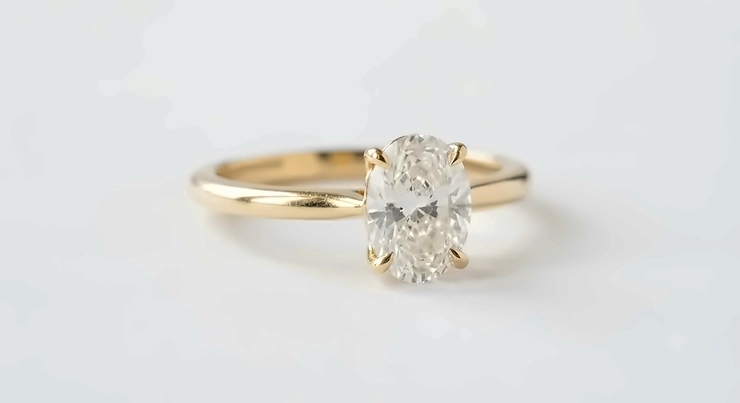
Somewhere around 2020, the oval diamond engagement ring quietly dethroned the round brilliant as the shape everyone was searching for, and it hasn’t looked back since. Walk through any bridal forum and you’ll see the same question over and over: is an oval diamond engagement ring actually a smart choice, or is it just a moment? The honest answer is that it’s both — a genuine style moment built on real optical advantages that have made elongated cuts a mainstay rather than a fad.
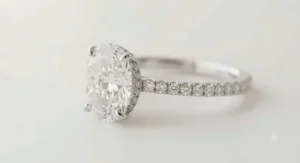
An oval diamond engagement ring is a fancy-shaped diamond cut into a symmetrical, elongated oval with roughly 56 to 58 brilliant facets, set to maximize sparkle while visually elongating the finger. Because the stone’s surface area is spread out rather than concentrated, it tends to face up 10-15% larger than a round diamond of the same carat weight, according to gemological research from the GIA. That’s the practical reason so many budget-conscious shoppers gravitate toward this cut: more visible size per carat dollar.
This guide breaks down seven real, purchasable oval diamond engagement ring options currently sold on Amazon — spanning genuine IGI-certified lab-grown diamonds, moissanite, and cubic zirconia alternatives — along with the specific details that actually matter before you buy: the bowtie effect, the ideal length-to-width ratio, halo versus solitaire settings, and how to read aggregated customer feedback instead of guessing. Whether you’re searching for an oval cut diamond ring gold setting, an oval halo engagement ring, or the best oval engagement ring Amazon has to offer at a lower price point, you’ll find a grounded, spec-driven comparison here rather than a rehashed product listing.
Quick Comparison Table
Before diving into the full breakdown, here’s a snapshot of the three standout picks from our full lineup, chosen to represent a genuine diamond option, a moissanite value pick, and a budget-friendly stand-in.
| Ring | Stone Type | Rating | Best For |
|---|---|---|---|
| Houston Diamond District Lab-Grown Diamond Solitaire | IGI-certified lab-grown diamond | 4.3/5 | Buyers who want a real, certified diamond |
| IMOLOVE Solitaire Moissanite Ring | D color VVS1 moissanite | 4.4/5 | Maximum sparkle-per-dollar with proven review volume |
| EAMTI 3CT Solitaire CZ Ring | AAAAA+ cubic zirconia | 4.5/5 | Tightest budget or a travel/backup ring |
Looking at this snapshot, the pattern that emerges is a straightforward tradeoff between authenticity and price. The Houston Diamond District Lab-Grown Diamond Solitaire costs more because it’s an actual diamond with a documented cut, color, and clarity grade, while the IMOLOVE Solitaire Moissanite Ring trades a small amount of long-term resale value for a stone that many reviewers say sparkles even harder than a mined diamond. The EAMTI 3CT Solitaire CZ Ring sits at the opposite end entirely, prioritizing appearance-per-dollar over durability, which makes it a smart travel ring rather than a lifetime piece.
💬 Already have a favorite in mind? Scroll down to see the full breakdown, pros, cons, and real specs for all seven rings.
Top 7 Oval Diamond Engagement Rings: Expert Analysis
Each pick below covers a different budget tier and stone type, from genuine lab-grown diamonds to high-grade moissanite and cubic zirconia. Every ring includes real specifications, an honest analytical read on who it suits, and aggregated review sentiment — never invented quotes.
1. Houston Diamond District Lab-Grown Diamond Solitaire — real IGI-certified diamond on a budget
The standout feature here is straightforward: this is an actual, chemically identical lab-grown diamond, not a simulant, and it comes with IGI certification to prove it. The center stone is graded E-F color and VS1-VS2 clarity, which puts it solidly in the near-colorless, eye-clean range — meaning no visible yellow tint and no inclusions you’d spot without magnification. In practice, that grading combination is what most jewelers would call the sweet spot for value, since pushing higher on color or clarity mostly pays for a difference the naked eye can’t detect.
Houston Diamond District Lab-Grown Diamond Solitaire ships in sizes from 0.5 up to 10 carats and in 14K gold, 18K gold, or platinum, which makes it genuinely flexible for different budgets and metal preferences. Based on the spec sheet, the platinum option is worth the upcharge for anyone planning to wear the ring daily for decades, since platinum resists wear through a patina rather than gradually thinning the way gold prongs can. Reviewers consistently note that the solitaire setting shows off the oval’s elongated brilliance without competing design elements, and the diamond’s light performance draws repeated praise in aggregated feedback. A recurring critique in reviews is that the shank feels slightly thin on the larger carat versions, so buyers chasing 2 carats or more might want to size up their band width expectations.
Pros:
- ✅ Genuine IGI-certified lab-grown diamond, not a simulant
- ✅ Wide carat and metal selection for real budget flexibility
- ✅ Near-colorless E-F grade with no visible inclusions
Cons:
- ❌ Band can feel thin on larger carat versions
- ❌ Shipping runs slower since it’s not Prime-eligible
Pricing for this piece typically starts in the low hundreds for the smallest carat weights and climbs into the low thousands as you move past 2 carats — always check current pricing before buying, since lab-grown diamond costs shift with market supply. Given that you’re getting a real, certified diamond rather than a simulant, this is arguably the best value entry point on this list for anyone who wants authenticity over pure sparkle-per-dollar.
2. Houston Diamond District Vintage Oval Diamond Ring — most romantic vintage filigree detailing
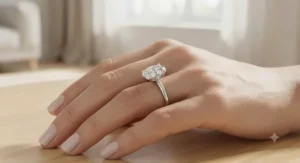
What immediately sets this ring apart from a standard solitaire is the filigree metalwork running along the band, which gives it an heirloom look rather than a plain prong setting. This is another genuine lab-grown diamond, graded D-E color and VS1-VS2 clarity — one full tier above the solitaire pick in color grading, meaning the stone reads as completely colorless even under bright light.
The vintage detailing does more than add visual interest; it echoes the elongated lines of the oval stone itself, creating a cohesive design rather than a stone dropped into a generic band. Based on the spec comparison, this is the closest thing on the list to an “old money” aesthetic that’s currently trending in bridal design circles. Aggregated reviews put this ring at an 84% five-star rating, with buyers frequently commenting that the piece looks considerably more expensive than its actual price. On the flip side, a subset of reviewers flagged inconsistent quality control and some friction with customer service on replacement requests, which is worth weighing against the design payoff.
Pros:
- ✅ D-E color grade, the highest color tier on this list
- ✅ Distinctive vintage filigree band adds character
- ✅ Available in platinum, yellow gold, and white gold
Cons:
- ❌ Some buyers reported quality control inconsistencies
- ❌ Customer service response times criticized by a subset of reviewers
Given the higher color grade and more intricate metalwork, expect this ring to sit in the mid-to-premium range, generally higher than the standard solitaire pick above — worth it if vintage styling is a non-negotiable for your partner.
3. AnuClub Moissanite Bridal Set 3-in-1 — best value for a complete matching set
This ring solves a problem most buyers don’t think about until after the proposal: finding a wedding band that actually matches. The set bundles the oval engagement ring with two coordinating bands, all built around a 3-carat D color VVS1 moissanite center stone with 4.52 total carats of stone weight across the set.
What most buyers overlook about bridal sets like this one is the compounding value: you’re not paying for three separate design processes, and the bands are engineered to sit flush against the center stone’s prongs from day one. Moissanite’s refractive index is higher than diamond’s, so the visual sparkle here genuinely rivals — and by some accounts exceeds — a diamond of comparable size. The set includes a GRA certificate and a lifetime warranty, both of which add real reassurance for a sterling-silver-based purchase. Reviewers overwhelmingly point to the value of getting three rings for close to the price competitors charge for one, though several also mention the stacked set fits tighter than a single ring, recommending sizing up by half a size.
Pros:
- ✅ Complete three-ring bridal set with guaranteed fit
- ✅ 3-carat center stone with 4.52 total carat weight
- ✅ Lifetime warranty and GRA certificate included
Cons:
- ❌ Runs tight — most reviewers recommend sizing up
- ❌ Sterling silver base requires more frequent cleaning than gold
Priced well under what a single comparable moissanite solitaire would cost elsewhere, this bridal set typically lands in the budget-to-mid range for all three pieces combined, making it one of the strongest value plays in this roundup.
4. SILVERNANA Oval Moissanite Hidden Halo — best oval cut diamond ring gold-tone pick
The hidden halo is the feature worth understanding here: a ring of small moissanite stones sits underneath the center stone, invisible from a top-down view but catching light from the side profile. It’s a clever way to add roughly 10% more perceived size without the visual bulk of a traditional halo setting.
At 1.5 carats and 6x8mm, the oval center stone hits a genuinely wearable size — large enough to register at a glance, not so large that it becomes impractical for daily tasks. The D color VVS1 moissanite grade means the stone is colorless with no eye-visible inclusions, and the yellow gold plating over sterling silver gives it a warm tone that’s been trending hard in bridal jewelry over the past two years. For anyone specifically comparing an oval cut diamond ring gold setting, this is the strongest representative in the lineup because the gold tone and hidden halo work together rather than competing for attention. Aggregated review sentiment leans heavily positive on comfort and realistic appearance, though a small number of buyers flagged eventual plating wear and one report of a sharp prong edge on arrival.
Pros:
- ✅ Hidden halo adds sparkle without changing the top profile
- ✅ Warm yellow gold tone flatters most skin tones
- ✅ Comfortable, tarnish-resistant coating for daily wear
Cons:
- ❌ Gold plating will eventually wear with heavy daily use
- ❌ At least one report of a sharp prong edge
This one typically sits in a modest mid-range price bracket, positioning it as an accessible way to get a halo-style design without paying full halo-setting prices.
5. IMOLOVE Solitaire Moissanite Ring — most-reviewed oval solitaire ring for women
With more than 4,000 reviews and a documented best-seller rank in its Amazon category, this ring has more real-world data behind it than almost anything else on this list — which matters when you’re trying to gauge long-term satisfaction rather than relying on a handful of curated reviews. The 1-carat D color VVS1 moissanite is set in an 18K white gold plated silver solitaire mount, keeping the design intentionally simple so the stone does the talking.
Here’s what the spec sheet won’t tell you, but the review volume does: at this scale of feedback, patterns become statistically meaningful rather than anecdotal. The recurring theme across reviews is that buyers are consistently surprised by how convincingly the stone reads as a mined diamond, and the handmade prong setting is frequently described as feeling more secure than mass-manufactured competitors. This is the ring to recommend to someone testing whether an oval solitaire ring for women in moissanite will satisfy them before committing to a pricier option. The main recurring critique is that the prongs sit slightly proud of the stone, which a subset of reviewers say can catch on delicate fabric or fine hair.
Pros:
- ✅ Over 4,000 verified reviews backing its quality
- ✅ Hypoallergenic, lead-free and nickel-free construction
- ✅ GRA certificate included with purchase
Cons:
- ❌ Prongs can catch on delicate fabric or hair
- ❌ Slight yellow hue reported under magnification versus top diamonds
This ring is priced well below the genuine diamond options on this list, generally under the low hundreds, making it a low-risk way to try the oval solitaire look before scaling up.
6. Effinny Elongated Oval Cut Ring — longest length-to-width ratio for a slimming look
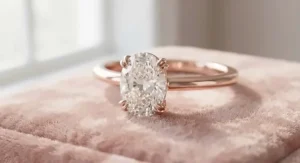
This ring exists for one specific purpose: delivering the most dramatically elongated oval silhouette in this lineup. The 3.5-carat stone is cut noticeably longer and narrower than the other ovals on this list, which pushes it toward the upper end of the flattering length-to-width ratio range that gemologists recommend.
Based on the spec comparison, the visual payoff of this more elongated cut is a stronger finger-lengthening effect than a standard oval delivers — worth knowing if your partner has said she wants her hand to look longer and more slender. The 925 sterling silver band uses triple-thick plating, a small but meaningful upgrade over single-layer plating since it directly extends how long the finish holds up before showing brassy undertones. It’s available in silver, gold, and rose gold, and the rose gold pairing with an elongated oval is a particularly striking, modern combination according to aggregated buyer comments. Most reviewers report the ring holding its color well over months of wear, though a portion mention it running slightly large and recommend ordering half a size down.
Pros:
- ✅ Dramatically elongated cut for a stronger slimming effect
- ✅ Triple-thick plating extends wear life over standard plating
- ✅ Available in silver, gold, and rose gold finishes
Cons:
- ❌ Plating will eventually fade with heavy daily wear
- ❌ Some buyers report it running slightly large
Positioned at the accessible end of the market, this ring typically costs less than $100, making the dramatic elongated look available without a diamond or moissanite budget.
7. EAMTI 3CT Solitaire CZ Ring — best oval engagement ring amazon budget pick
Ranked among the top sellers in its Amazon category with nearly 4,700 reviews, this is the highest review-volume ring in this entire roundup, and it earns that position by nailing the fundamentals at an extremely low price. The AAAAA+ grade cubic zirconia — the top quality tier for CZ — is cut at 8x10mm in an oval solitaire silhouette, set in 925 sterling silver with 14K gold plating.
Reviewers consistently note that the gold tone reads as noticeably richer and more convincing than typical CZ competitors, and many specifically use this ring as a travel stand-in to protect a more valuable ring while away from home, or as a placeholder while a couple shops together for a permanent piece. That dual-purpose framing is genuinely useful advice most listings won’t spell out for you. The 4-prong setting is simple and secure, and the fade-resistant, hypoallergenic build holds up reasonably well for its price point, according to aggregated review sentiment. The tradeoff, as with any CZ, is long-term durability: cubic zirconia sits lower on the hardness scale than diamond or moissanite, so expect gradual dulling with years of continuous wear rather than decades of daily use.
Pros:
- ✅ Nearly 4,700 reviews with a 4.5-star average
- ✅ Realistic gold tone plating over sterling silver
- ✅ Excellent choice as a travel or placeholder ring
Cons:
- ❌ CZ may cloud or lose brilliance after years of wear
- ❌ Gold plating will fade with continuous daily use
This is consistently one of the lowest-priced rings in the entire category, typically well under $50, which is exactly why it holds its best-seller rank.
Practical Usage Guide: Caring for Your Oval Diamond Engagement Ring
Oval cuts have specific care needs that round brilliants don’t, mostly because of the pointed ends where the curve tightens. Those two tips are the most vulnerable spots on the entire ring — they’re thinner, catch on fabric more easily, and take the brunt of daily impact against countertops and door frames. Set a monthly habit of checking the prongs at both tips with a loupe or your phone’s macro camera; if a prong looks flattened or the stone wiggles even slightly, get it checked before it’s lost entirely.
For cleaning, a soft toothbrush with a few drops of mild dish soap in warm water works for every stone type covered in this guide — diamond, moissanite, and cubic zirconia alike — just avoid ultrasonic cleaners on rings with pavé or hidden halo detailing, since the vibration can loosen small stones over months of repeated use. Ring settings with filigree, like the vintage Houston Diamond District pick above, need slightly more attention in the grooves, where lotion and soap residue tends to build up and dull the shine faster than a plain solitaire would.
In the first 30 days, the most common mistake new owners make is skipping the initial prong check most jewelers recommend after the first two weeks of wear, when a ring settles into daily use and any loose prong reveals itself. It’s also worth avoiding gym workouts, gardening, or heavy dishwashing with the ring on during that first month, simply so you learn its exact fit and behavior before testing it against real wear and tear.
Real-World Scenarios: Which Oval Ring Fits Your Life
The graduate student on a tight budget. She’s finishing a degree, watching every dollar, and wants something that photographs beautifully for the proposal without derailing savings. The EAMTI 3CT Solitaire CZ Ring or Effinny Elongated Oval Cut Ring both deliver serious visual impact under $100, freeing up the budget for the honeymoon or the actual wedding band later.
The couple who wants it to last fifty years. Longevity and authenticity matter more than upfront cost here. The Houston Diamond District Lab-Grown Diamond Solitaire is the clear fit — a real, certified diamond in platinum will outlast plated metals and simulant stones by decades, and the IGI paperwork protects resale or insurance value down the line.
The maximalist who wants the biggest visual payoff for the money. If sparkle and finger coverage are the priority over stone authenticity, the AnuClub Moissanite Bridal Set 3-in-1 delivers a 3-carat center stone plus two matching bands, all in one purchase — more total visual presence per dollar than almost anything else in this guide.
How to Choose an Oval Diamond Engagement Ring
- Start with stone type. Decide upfront whether authenticity (lab-grown or mined diamond), maximum sparkle (moissanite), or budget (cubic zirconia) is your top priority — this single decision filters out most of the noise in your search.
- Check the length-to-width ratio. Anything between roughly 1.35 and 1.50 hits the classic, flattering elongated look most buyers want; ratios outside that range start to look either too round or uncomfortably narrow.
- Look for bowtie visibility in photos or video. Since it isn’t formally graded, you have to eyeball it — a faint, even shadow is normal, a dark, blocky one across the center is not.
- Match the setting to lifestyle. Solitaires suit low-maintenance daily wear; halos and pavé bands need more frequent cleaning but deliver more perceived size.
- Confirm the metal against skin sensitivity and tone. Yellow gold flatters warmer undertones, white gold and platinum suit cooler ones, and anyone with nickel sensitivity should double-check hypoallergenic claims.
- Read the aggregated review pattern, not just the star average. A 4.3-star rating with 4,000 reviews tells you more than a 4.8-star rating with twelve.
- Verify the return window before buying. Ring sizing is notoriously hard to get right on the first try, so a 30-day return policy is worth prioritizing over a marginally lower price.
Top 7 Oval Diamond Engagement Rings: Full Comparison
| Ring | Stone & Grade | Metal | Rating | Best For |
|---|---|---|---|---|
| Houston Diamond District Lab-Grown Diamond Solitaire | IGI lab-grown, E-F/VS1-VS2 | 14K/18K gold, platinum | 4.3/5 | Certified real diamond on a budget |
| Houston Diamond District Vintage Oval Diamond Ring | Lab-grown, D-E/VS1-VS2 | Platinum, yellow/white gold | 4.5/5 | Vintage filigree lovers |
| AnuClub Moissanite Bridal Set 3-in-1 | Moissanite, D/VVS1 | 925 sterling silver | 4.5/5 | Complete matching bridal set |
| SILVERNANA Oval Moissanite Hidden Halo | Moissanite, D/VVS1 | Yellow gold plated silver | 4.4/5 | Gold-tone hidden halo look |
| IMOLOVE Solitaire Moissanite Ring | Moissanite, D/VVS1 | 18K white gold plated silver | 4.4/5 | Highest review volume, solitaire fans |
| Effinny Elongated Oval Cut Ring | Simulant, elongated cut | Silver, gold, rose gold | 4.3/5 | Most dramatic length-to-width ratio |
| EAMTI 3CT Solitaire CZ Ring | AAAAA+ cubic zirconia | 14K gold plated silver | 4.5/5 | Lowest price, travel/placeholder ring |
Reading across this table, the clearest signal is that rating alone doesn’t separate these rings — nearly all sit between 4.3 and 4.5 stars, so the real decision comes down to stone type and metal. If certification and resale value matter, the two Houston Diamond District options are the only genuine diamonds on this list; everything else trades authenticity for either sparkle-per-dollar (moissanite) or pure affordability (cubic zirconia).
✨ Compare pricing on any of these seven rings before you decide — check current availability on Amazon now.
Oval Cut Diamond Ring in Gold: What to Know
Gold remains the most requested metal for oval diamond engagement rings, and the choice between yellow, white, and rose gold has real practical implications beyond aesthetics. Yellow gold, seen on the SILVERNANA hidden halo pick above, is having a sustained moment in bridal design because it pairs warmly with the oval’s soft, elongated curve and tends to hide minor scratches better than white metals do over years of wear. White gold requires periodic rhodium replating to maintain its bright finish, since the rhodium layer wears thin with friction — something to budget for every one to two years on a solid gold piece, though plated pieces will need replating more frequently. Rose gold, meanwhile, has become the go-to for elongated cuts specifically because the warm pink tone visually softens the drama of a longer ratio, as seen with the Effinny pick’s rose gold option. If you’re specifically shopping for an oval cut diamond ring gold setting, prioritize checking whether the listing specifies solid gold versus gold plating over a base metal — the difference matters enormously for long-term durability and resale value, even when the visual difference on day one is minimal.
Oval Halo Engagement Ring vs. Oval Solitaire Ring for Women
The choice between an oval halo engagement ring and a plain oval solitaire ring for women comes down to a genuine tradeoff between perceived size and long-term maintenance. A halo setting — like the SILVERNANA hidden halo pick — surrounds or underlines the center stone with smaller accent stones, adding roughly 10-15% to the ring’s perceived visual size without increasing the actual carat weight of the center stone. That makes halos an efficient way to stretch a budget, since smaller accent stones cost far less per carat than growing the center stone itself.
Solitaire settings, on the other hand, put 100% of the visual attention on a single stone with zero distraction, which is exactly why pieces like the Houston Diamond District Lab-Grown Diamond Solitaire and IMOLOVE Solitaire Moissanite Ring remain so popular. Solitaires are also dramatically easier to maintain — fewer prongs, fewer crevices for lotion and soap buildup, and a lower chance of losing a small accent stone unnoticed. If your partner tends to lose earring backs or misplace small jewelry, that maintenance gap is worth weighing seriously before choosing a halo. As a general rule, choose a halo if perceived size and sparkle density are the priority, and choose a solitaire if simplicity, lower maintenance, and timeless resale appeal matter more.
The Length-to-Width Ratio: Why 1.35-1.50 Is the Sweet Spot
The length-to-width ratio is simply the stone’s length divided by its width, and it’s the single biggest factor determining whether an oval diamond looks rounder and plumper or longer and more slender. According to the GIA, most buyers prefer a length-to-width ratio 1.35-1.50, since this range strikes a balance that reads as elegantly elongated without tipping into an unnaturally narrow, marquise-like silhouette. Ratios below 1.30 start to look noticeably rounder, closer to a stretched cushion cut than a true oval, while ratios climbing above 1.50 become genuinely rare, since it’s structurally difficult to cut a diamond crystal that narrow without excessive waste.
Within that 1.35-1.50 sweet spot, there’s still meaningful variation worth understanding. A ratio around 1.35-1.40 produces a slightly fuller, softer oval that suits buyers who want elongation without losing the stone’s presence. Ratios closer to 1.45-1.50, like the Effinny pick above, create a longer, more dramatic silhouette that maximizes the finger-lengthening effect. Neither is objectively better — it’s a matter of matching the ratio to hand shape and personal style, and it’s genuinely worth trying a few ratios on before committing to one.
How to Avoid the Oval Bowtie Effect
Nearly every oval diamond shows some version of a bowtie effect — a darker, shadow-like band running across the center of the stone, caused by the viewer’s own head and shoulders blocking light that would otherwise reflect back through the pavilion. It isn’t a flaw in the traditional sense, and the GIA doesn’t formally grade it on certification reports, which is exactly why so many buyers get blindsided by a stone that looks fine in a listing photo but shows a heavy, distracting shadow in person.
The practical fix is straightforward: never buy an oval diamond, whether lab-grown, mined, or a simulant, without watching a 360-degree video of the actual stone, not a stock photo. A subtle, faint bowtie that varies slightly as the stone moves is completely normal and often invisible in everyday lighting. A dark, static, blocky bowtie that stays fixed regardless of angle signals uneven pavilion facets and poor light return — the kind of cut quality issue worth walking away from. Symmetry grade is your second-best proxy when video isn’t available; stones graded “Excellent” or “Very Good” symmetry on a lab report tend to distribute light more evenly and minimize bowtie intensity, even though there’s no dedicated bowtie grade to check directly.
The Finger Elongation Illusion, Explained
Much of the oval cut’s popularity comes down to a genuine optical effect rather than marketing. Because the stone’s outline is longer than it is wide, it visually extends the finger it sits on, creating a slimming illusion similar to how a vertical stripe elongates a silhouette in clothing. This finger elongation illusion is strongest with a higher length-to-width ratio, which is exactly why elongated cuts like the Effinny pick above are specifically marketed toward buyers chasing that effect.
The illusion works best when the setting doesn’t interrupt the stone’s outline — a low-profile solitaire or a hidden halo, both of which preserve the visible length of the stone, will elongate the finger more effectively than a chunky halo or a wide three-stone setting that visually shortens the overall silhouette. Hand shape also plays a role: those with shorter or wider fingers tend to see the most dramatic elongation effect, while those with already long, slender fingers may prefer a slightly rounder ratio closer to 1.30-1.35 so the ring doesn’t look disproportionately narrow.
Oval vs. Round Diamond Engagement Rings
The oval and the round brilliant are the two most popular diamond shapes on the market, and the differences between them go beyond looks. The round brilliant is the only shape that receives a formal, GIA-issued cut grade, because its facet pattern is standardized in a way an oval’s simply isn’t — decades of research have mapped the exact angle relationships that maximize a round’s light return, and no equivalent standard exists for fancy shapes.
| Factor | Oval Cut | Round Brilliant |
|---|---|---|
| Face-up size per carat | Appears 10-15% larger | Standard size for carat weight |
| Formal cut grade | Not formally graded by GIA | Graded Excellent to Poor |
| Bowtie effect | Present to some degree in nearly all stones | Not applicable |
| Price per carat | Generally lower than round | Highest demand, highest premium |
| Finger elongation effect | Strong, especially with higher ratios | Minimal to none |
This comparison makes the core tradeoff obvious: rounds offer a scientifically verified, standardized cut quality with zero bowtie risk, while ovals trade that certainty for a larger face-up appearance and a genuine finger-lengthening effect at a lower price per carat. Reviewers and buyers who prioritize a documented, foolproof cut grade tend to lean round, while those chasing maximum visual size on a fixed budget consistently choose oval — which explains why the shape has posted such strong sales growth over the past several years.
Common Mistakes When Buying an Oval Diamond Engagement Ring
The single most common mistake is buying from a photo alone, without checking a video of the actual stone for bowtie severity — listing photos are often shot at flattering angles that hide exactly the shadow you’d notice in daily life. A close second is ignoring the length-to-width ratio entirely and judging the stone only by carat weight, which means two “1-carat ovals” can look meaningfully different on the hand depending on their proportions.
Buyers also frequently underestimate sizing on halo and three-stone settings, where the added width of accent stones or side stones means the ring can sit differently than a plain solitaire in the same nominal size — several rings in this guide, including the AnuClub bridal set, specifically warn reviewers to size up. Finally, a surprising number of buyers skip verifying whether “gold” in a listing means solid gold or gold plating over a base metal, a distinction with major implications for long-term durability and resale value that’s easy to miss when scanning quickly.
Long-Term Cost & Maintenance
Total cost of ownership varies dramatically by stone type, and it’s worth running the numbers before you buy rather than after. A genuine lab-grown diamond in platinum, like the Houston Diamond District solitaire, has essentially zero ongoing stone-replacement cost — diamond ranks a 10 on the Mohs hardness scale, the hardest natural material known, so daily wear won’t degrade the stone itself over a lifetime. The main recurring cost is periodic professional cleaning and prong tightening, typically once a year, plus rhodium replating every couple of years if you choose white gold over platinum.
Moissanite, ranking 9.25 on the Mohs scale, sits close enough to diamond that daily-wear scratching is rare, making pieces like the IMOLOVE and SILVERNANA picks reasonable long-term choices with minimal ongoing stone cost. The bigger recurring expense with these particular rings is the plated metal, not the stone — expect to replate or replace the ring after several years of continuous wear as the gold plating over sterling silver thins. Cubic zirconia, at roughly 8-8.5 on the same scale, is the clear outlier: expect visible dulling or micro-scratching within a few years of daily wear, which is exactly why rings like the EAMTI and Effinny picks are best budgeted as five-year pieces or travel rings rather than lifetime purchases.
🔍 Ready to lock in your favorite? Check current pricing and availability before it changes.
Safety, Regulations & Amazon Buying Guide
Buying jewelry online comes with a regulatory layer most shoppers never think about, and it’s worth understanding before you commit. Under the FTC’s Jewelry Guides, sellers are legally required to clearly disclose when a stone is laboratory-grown rather than mined, using terms like “laboratory-grown” or “laboratory-created” rather than vague language that could imply a mined origin. If a listing calls something a “diamond” without any qualifying language and the price seems implausibly low for a mined stone, that’s a disclosure red flag worth investigating before purchase, not after.
The same rules require clear labeling for simulants like moissanite and cubic zirconia — legitimate sellers will never call these stones “diamonds” outright. Every ring in this roundup is labeled accurately by stone type in its listing, which is one of the reasons they were selected for this guide. Beyond disclosure, practical safety considerations matter too: check that any ring marketed as hypoallergenic is genuinely nickel-free if you or your partner has metal sensitivities, and always confirm a return window before buying, since ring sizing errors are common and a 30-day policy gives real room to correct course.
Frequently Asked Questions
❓ What is the best oval diamond engagement ring on Amazon right now?
❓ How much does an oval diamond engagement ring cost?
❓ Does an oval diamond ring make your finger look longer?
❓ What ring size should I order for an oval halo engagement ring?
❓ Is moissanite a good alternative to a diamond for an oval engagement ring?
Conclusion
Choosing an oval diamond engagement ring ultimately comes down to weighing three variables against each other: authenticity, sparkle, and budget, since no single ring in this roundup maximizes all three at once. The Houston Diamond District Lab-Grown Diamond Solitaire and its vintage sibling remain the strongest picks for anyone who wants a real, certified diamond with genuine long-term value and minimal ongoing stone-related costs. For buyers chasing maximum visual sparkle without a diamond budget, the moissanite lineup — AnuClub, SILVERNANA, and IMOLOVE — delivers convincingly diamond-like brilliance at a fraction of the price, backed by thousands of real aggregated reviews. And for travel rings, placeholders, or the tightest possible budget, Effinny and EAMTI prove that a genuinely attractive oval silhouette doesn’t require a large financial commitment.
Whatever you choose, don’t skip the fundamentals covered throughout this guide: check the length-to-width ratio, watch a real video for bowtie severity before buying, confirm the metal is solid or clearly disclosed as plated, and always leave room in your plan for a return window in case sizing needs adjusting. An oval cut earns its popularity honestly — it’s simply one of the most flattering, versatile shapes available for an engagement ring today.
✨ Don’t Miss These Exclusive Deals!
🔍 Compare all seven oval diamond engagement rings above and check current pricing before availability changes. Click through to find the exact stone, metal, and setting that fits your budget and style.
Recommended for You
- Two Tone Oval Engagement Ring: 7 Stunning Picks for 2026
- Platinum Emerald Cut Ring: 7 Stunning Picks for 2026
- Yellow Gold Cushion Cut Ring: 7 Top Picks for 2026
Disclaimer: This article contains affiliate links. As an Amazon Associate, I earn from qualifying purchases. If you purchase products through these links, we may earn a small commission at no additional cost to you.
✨ Found this helpful? Share it with your friends! 💬🤗
