In This Article
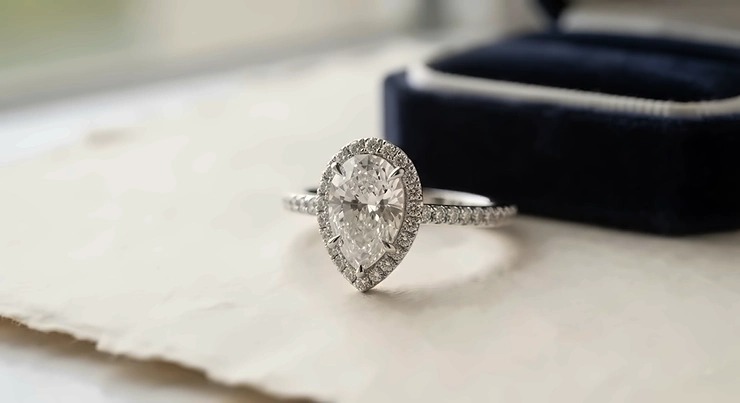
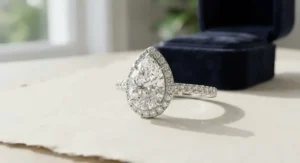
Somewhere between a diamond and a raindrop, there’s a shape that has quietly outlasted every trend cycle since the 1400s: the pear. A pear shaped engagement ring pairs a rounded end with a single tapered point, borrowing the fire of a round brilliant and the elongated drama of a marquise into one silhouette. It’s the shape Princess Diana wore on her hand in miniature and the one flashing across red carpets today, and it’s having a real moment in 2026 bridal jewelry, according to recent industry trend reports.
If you’re here, you’re probably somewhere between “I love how it looks” and “I have no idea how to actually buy one.” That’s the gap this guide closes. We dug through real listings, real specs, and real aggregated review sentiment on seven genuinely available rings — spanning sterling silver budget picks to natural-diamond showstoppers — so you can compare them honestly instead of guessing from a product photo. Along the way, we’ll cover the two design decisions that trip up almost every first-time buyer of a pear shaped diamond ring: which way to point the tip, and how to dodge the dreaded bowtie shadow. For a deeper technical primer, the gemologists at GIA’s education team break down the anatomy of a well-cut pear in more depth than any Amazon listing ever will.
Let’s get into it.
Quick Comparison Table
Before the deep dive, here’s the birds-eye view. Every price shown is a range, not a snapshot — jewelry pricing shifts with metal spot rates and promotions, so always check current pricing before you buy.
| Ring | Stone Type | Setting Style | Price Range | Best For |
|---|---|---|---|---|
| Kobelli AGA Certified Pear Diamond Halo Ring | Natural diamond | Halo, 14K white gold | $2,000-$3,500 range | Buyers who want a natural stone and certification |
| Kobelli Pear Shape Moissanite Halo Ring | Moissanite + diamond | Halo, 14K yellow gold | $600-$950 range | Mid-budget shoppers who still want gold |
| Kobelli Cristina Cathedral Ring | Moissanite + diamond | Cathedral solitaire | $700-$1,050 range | Vintage-leaning minimalists |
| PAVOI Pear Wavy Engagement Ring | Cubic zirconia | East-west solitaire | Under $50 | Try-before-you-invest shoppers |
| Gem Stone King Pear Moissanite Ring | Moissanite | Sterling silver solitaire | $150-$300 range | Budget buyers who still want a real gem |
| DovEggs 4ct Hidden Halo Ring | Moissanite | Hidden halo, silver/18K plate | $180-$260 range | Statement-size seekers on a budget |
| DovEggs Bezel Vintage Ring | Moissanite | Bezel, silver/18K plate | $150-$230 range | Active hands, protective setting fans |
At a glance, the split is pretty clean: one certified natural-diamond option at the top, two moissanite-and-gold rings in the middle, and four budget-friendly picks that trade solid gold for sterling silver or plating. What the table can’t show you is why that trade-off matters — a $200 sterling silver pear ring and a $2,500 solid-gold one can look nearly identical in a photo, but they age very differently on a hand that’s washing dishes daily. We’ll unpack that fully in the sections ahead.
💬 Found a favorite already? Save this page and come back before you check out — the comparison below might change your mind.
Top 7 Pear Shaped Engagement Rings: Expert Analysis
We picked these seven to cover the real range of what shoppers actually search for: certified natural diamonds, lab-grown moissanite, sterling silver, solid gold, halo settings, and protective bezels. Every product below reflects publicly available listing specs at the time of research; carat weights, measurements, and metal types are pulled directly from manufacturer descriptions.
1. Kobelli AGA Certified Pear Diamond Halo Engagement Ring — the certified natural-diamond option
The standout here is right in the name: this is an AGA-certified natural pear diamond, not a simulant, set in solid 14K white gold with a halo of accent stones ringing the center stone. The certification matters more than it sounds — it means an independent lab has verified the stone’s carat weight, color, and clarity rather than taking the seller’s word for it, which is the single biggest protection a diamond buyer has against overpaying for an overstated stone.
Specs-wise, the listing puts the total weight around 1.6 carats combined between the center pear and its halo, crafted in solid — not plated — 14K white gold. That solid-gold construction is a real differentiator versus most of this list: it won’t wear through to base metal the way gold plating eventually does. Kobelli manufactures out of Los Angeles using recycled gold, which also plays into the sustainability angle some buyers now factor into a purchase this significant.
Who should care: this is the pick for someone who wants a genuine mined diamond and doesn’t mind the price gap that comes with it. Reviewers consistently mention that in-hand photos undersell the ring’s sparkle, and buyers frequently note the halo makes the center stone read larger than its stated carat weight — a common and accurate effect of halo settings generally.
Pros:
- ✅ Genuine certified natural diamond, not a simulant
- ✅ Solid 14K gold construction resists tarnish and wear
- ✅ Halo setting visually amplifies the center stone’s size
Cons:
- ❌ Meaningfully pricier than every other option on this list
- ❌ Small-batch listings mean sizing/availability can shift
At a price landing in the $2,000-$3,500 range depending on size and gold-market fluctuation, this is the splurge pick — but for a natural, certified center stone in solid gold, it’s priced competitively against mall jewelers offering comparable quality.
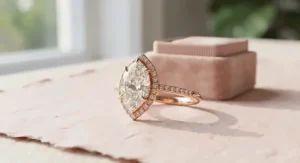
2. Kobelli Pear Shape Moissanite Halo Engagement Ring — most gold for the money
If the first ring is the aspirational pick, this is the practical one. Same brand, same Los Angeles workshop, same solid 14-karat gold — but the center stone swaps to moissanite, a lab-created gem that’s chemically distinct from diamond yet close enough in hardness and brilliance that most people can’t tell the difference across a dinner table.
The listing specifies a roughly 10x7mm near-colorless center stone at about 2.5 carat-total-weight including more than 40 natural diamond side accents, set in solid 14K yellow gold. That’s a meaningful detail: the halo isn’t moissanite too, it’s genuine diamond, which is a nice bit of honest craftsmanship most budget brands skip. Moissanite also outperforms diamond on raw refractive index, meaning it throws more rainbow “fire” in direct light — some buyers love that extra sparkle, others find it slightly less subtle than a diamond’s whiter flash.
This is the ring for someone who wants the weight and permanence of real gold on their finger without financing a natural diamond. Aggregated buyer sentiment on moissanite pieces in this price bracket tends to praise the size-to-price ratio while occasionally flagging that moissanite can read as “extra sparkly” compared to a diamond of the same size — worth knowing if your partner prefers understated glimmer.
Pros:
- ✅ Solid 14K gold band, not plated
- ✅ Genuine diamond halo accents, not simulated
- ✅ Large face-up size for the price point
Cons:
- ❌ Moissanite’s extra fire reads brighter than diamond to some eyes
- ❌ Limited size run compared to made-to-order options
Priced in the $600-$950 range, it undercuts a comparable natural-diamond halo by thousands while keeping the “real gold, real gems” promise intact.
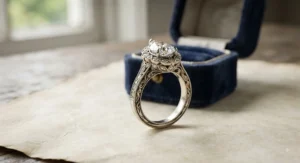
3. Kobelli Cristina Pear Moissanite Cathedral Ring — best for a vintage-leaning silhouette
Where the first two Kobelli picks lean halo-heavy, the Cristina takes a cathedral approach: a raised, arched setting that lifts the center stone and lets light hit it from more angles, paired with a pinched shank set with marquise-cut lab-grown diamond accents. It’s the same maker, same 14-karat solid gold promise, but a completely different aesthetic lane — closer to art-deco than modern minimalist.
The center stone runs roughly 12x8mm, a genuinely substantial pear, surrounded by a halo of round lab-grown diamonds and flanked by that marquise-accented shank. On paper this means more total sparkle real estate than either of the first two rings, since light interacts with the stone from the side profile as well as top-down. The cathedral basket design also does something practical: it’s built so a straight wedding band can sit flush against it later, which matters more than most first-time buyers realize until they’re band-shopping a year later and discovering their engagement ring won’t nest properly.
Who this suits: buyers drawn to antique-inspired detail over clean minimalism, and anyone planning to stack a straight (not curved) wedding band down the line.
Pros:
- ✅ Cathedral setting maximizes light entry from the sides
- ✅ Designed to nest flush with a straight wedding band
- ✅ Lab-grown diamond accents add texture beyond a plain halo
Cons:
- ❌ Raised setting sits higher off the finger, snags more on fabric
- ❌ Less minimalist than a plain solitaire, which won’t suit everyone
Expect this one in the $700-$1,050 range — a touch above the standard Kobelli halo due to the more complex metalwork.
4. PAVOI Pear Wavy Engagement Ring — best low-risk starter ring
This is the outlier of the list, and deliberately so. PAVOI’s pear wavy ring sets its stone sideways — an east-west orientation instead of the traditional point-toward-the-hand look — inside a wavy, wraparound rhodium-plated band with cubic zirconia in place of a mined or lab-created gem.
The listing specifies a 7x10mm pear-cut simulated stone with 88 facets, rhodium-plated for tarnish resistance, and built to be nickel-, lead-, and cadmium-compliant for sensitive skin. What most buyers overlook about a ring like this is that it isn’t trying to compete with the Kobelli pieces on permanence — it’s solving a completely different problem: letting someone test-drive the pear shape and the sideways orientation before committing real money to either. Reviewers frequently mention the rhodium plating holds up better than expected for the price, though as with any plated piece, that shine is a surface layer rather than a solid-metal guarantee.
Best for: gift-givers on a tight timeline, anyone unsure if they’ll like an east-west pear versus a traditional point-down setting, or a placeholder ring while a custom natural-diamond piece is being made.
Pros:
- ✅ Nickel-safe and hypoallergenic for sensitive skin
- ✅ Distinctive east-west orientation most budget brands skip
- ✅ Extremely low financial risk to try the pear shape
Cons:
- ❌ Cubic zirconia loses brilliance faster than moissanite or diamond
- ❌ Rhodium plating will eventually need re-plating with daily wear
At under $50, it’s less an engagement ring investment and more a low-stakes way to find out if pear shaped engagement rings actually suit your hand before spending real money.
5. Gem Stone King Pear Shaped White Moissanite Ring — best silver-and-gem balance
Gem Stone King, a New York-based jeweler, built its catalog around pairing genuine moissanite with more accessible metals — sterling silver chief among them — and its pear-cut moissanite ring is the clearest example of that formula on this list.
Per the brand’s standard build across its moissanite line, expect a near-colorless (GH grade) moissanite center stone set in 925 sterling silver, typically finished with a rhodium overlay for extra shine and tarnish resistance. Here’s what the spec sheet won’t tell you but reviewers note repeatedly: sterling silver moissanite pieces from this brand punch well above their price in perceived sparkle, precisely because a genuine moissanite stone is doing the optical work rather than a cubic zirconia stand-in — the silver setting is the budget lever, not the gem itself.
This suits a buyer who wants a real gemstone with real fire but isn’t ready to commit to solid gold pricing, or someone buying a promise ring or placeholder engagement ring ahead of a later upgrade.
Pros:
- ✅ Genuine moissanite center stone, not simulated
- ✅ Sterling silver keeps cost dramatically below gold options
- ✅ USA-based company with straightforward return policy
Cons:
- ❌ Sterling silver requires more frequent polishing than gold
- ❌ Softer metal than gold, more prone to scratching over years
Priced in the $150-$300 range depending on carat size chosen, it’s the sweet spot for buyers who want “real gem, modest metal” rather than “fake gem, real metal.”
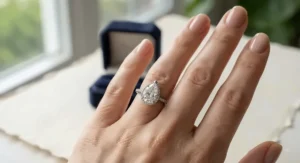
6. DovEggs 4ct Pear Cut Moissanite Hidden Halo Ring — biggest face-up size per dollar
DovEggs built its reputation on go-big moissanite pieces, and this one is the extreme end of that philosophy: a 7x11mm pear center stone at roughly 4 carats, set in a hidden halo that tucks a secondary ring of smaller stones underneath the main gem, invisible from a top-down view but visible in profile.
The build is sterling silver with an 18K white gold plating overlay, F-G-H color grade moissanite. On paper this means the ring reads dramatically larger than its price bracket suggests — a hidden halo is specifically engineered to boost apparent carat weight without changing the visible band width, a trick full-price jewelers use on center stones costing many times more. Aggregated review sentiment on DovEggs’ larger pear pieces tends to split along expectation lines: buyers who research the sterling-silver-with-gold-plating construction ahead of time report high satisfaction, while a smaller share expected solid gold and are disappointed by the distinction.
Ideal for: anyone chasing maximum visual size on a fixed budget, or a big personality who wants a statement stone without a statement price tag.
Pros:
- ✅ Dramatic 4-carat face-up size for a budget price
- ✅ Hidden halo boosts perceived size without bulking the band
- ✅ Ships with a documented moissanite authenticity guarantee
Cons:
- ❌ Gold plating will thin with years of daily wear
- ❌ Large stone size demands a protective setting for active hands
You’ll typically find this one in the $180-$260 range, making it the single biggest visual-size-per-dollar pick on this list.
7. DovEggs Pear Shaped Bezel Vintage Ring — best protective setting
Prong settings expose more of a stone’s edge to daily knocks; a bezel setting wraps a thin rim of metal fully around the stone’s girdle, trading a little visible sparkle for a lot of durability. That trade-off is the entire premise of this ring, and it’s the right call for anyone who works with their hands.
The listing specs a roughly 1.5-carat, 6x8mm F-G-H color moissanite center stone rated VVS1-VVS2 clarity, set in a vintage-styled bezel over sterling silver with 18K white gold plating. What most buyers overlook about bezel settings on a pear shape specifically is that the pointed tip — the single most vulnerable part of any pear-cut stone — is fully encased rather than held by exposed prongs, which are the most common point of chipping on this shape. It’s a detail sourced directly from the same jewelers who caution that a pear diamond’s tip is its structural weak point regardless of stone type.
Best for: nurses, teachers, gardeners, gym regulars, or anyone whose hands are in near-constant motion and who has chipped a prong-set stone before.
Pros:
- ✅ Fully encases the vulnerable pear-point for daily durability
- ✅ Vintage detailing adds character beyond a plain bezel
- ✅ High clarity grade (VVS1-VVS2) for visible brilliance
Cons:
- ❌ Bezel setting shows slightly less light through the stone’s sides
- ❌ Sizing adjustments are trickier with a full bezel wrap
Expect a price in the $150-$230 range — genuinely one of the most practical picks here for anyone worried about everyday wear and tear.
Practical Usage Guide: Your First 30 Days With a Pear Shaped Ring
Getting the ring is the easy part. The first month of actually wearing a pear shaped engagement ring is where most avoidable damage happens, so here’s what to actually do with it.
Get it sized before you wear it daily. A pear’s asymmetric shape means an ill-fitting band can rotate on the finger, which over time drags the pointed tip against surfaces and chips it — the single most common damage claim jewelers see on this shape.
Keep the tip oriented consistently. Whichever orientation you choose (more on that below), a loose-fitting ring lets the stone spin, defeating the whole point of choosing a direction in the first place. A properly sized band keeps the pear pointed the same way every time you look down.
Clean it weekly, not monthly. Lotion, soap residue, and everyday oils dull a stone’s brilliance faster than almost anything else. A soft-bristled toothbrush, warm water, and a drop of mild dish soap once a week keeps any of these seven rings — moissanite, diamond, or simulant — looking freshly polished.
Remove it for genuinely hard activities. Gym sessions with weights, gardening, and dish-scrubbing are the top three reported causes of pear-tip chips in aggregated review data across budget and premium brands alike. This is exactly why the bezel-set DovEggs option above earns its spot on this list — but even a bezel benefits from being removed before heavy manual work.
Get a first inspection at the 30-day mark. Prongs settle and metal shifts slightly in the first weeks of wear. A quick jeweler check confirms every prong (or bezel edge) is still snug before it becomes a bigger problem.
Real-World Scenarios: Which Pear Ring Fits Your Life?
Specs only tell half the story — the other half is how the ring fits an actual daily routine. Here are three composite buyer profiles built from the patterns in this list.
The hands-on professional. She’s a nurse doing 12-hour shifts, washing her hands dozens of times a day, occasionally snapping on gloves. A prong-heavy halo is asking for trouble here. The DovEggs Pear Shaped Bezel Vintage Ring is built exactly for this life — the fully encased setting protects the vulnerable tip through repeated glove changes and hand-washing that would eventually loosen a prong setting.
The “go big without going broke” couple. They want a photo-worthy ring for engagement pictures and don’t have — or want to spend — five figures on a natural diamond. The DovEggs 4ct Hidden Halo Ring solves this directly: maximum face-up size, moissanite’s extra fire working in their favor for photography, at a fraction of a natural-diamond price for a comparable visual footprint.
The traditionalist who wants “the real thing.” He’s saved specifically for a certified natural diamond and isn’t interested in alternatives, full stop. The Kobelli AGA Certified Pear Diamond Halo Ring is the only pick on this list built for that specific, non-negotiable priority — solid gold, independently certified stone, no substitutes.
How to Choose a Pear Shaped Engagement Ring
Shopping this shape well comes down to seven checkpoints, in roughly the order they should matter to your decision.
- Stone type first. Decide between natural diamond, lab-grown diamond, or moissanite before anything else — this single choice moves your budget by thousands of dollars and should be locked in before you fall in love with a specific setting.
- Length-to-width ratio. Most gemologists point to a 1.5-to-1.75 ratio as the classic, balanced pear silhouette; anything narrower starts reading more like a marquise, anything wider starts reading more like a teardrop-tinted oval.
- Symmetry above all. Because pear cuts aren’t assigned an overall cut grade by major labs, symmetry — the pointed tip aligning with the exact center of the rounded end — is the detail that separates a graceful pear from an awkward one.
- Setting style for lifestyle. Halo and prong settings show more brilliance; bezel settings sacrifice a little sparkle for real protection, which matters enormously if hands are active daily.
- Metal purity, not just color. Solid gold, gold-filled, and gold-plated all look identical on day one and age completely differently by year three — check which one you’re actually buying.
- Orientation preference. Point-up, point-down, or sideways changes the entire visual character of the ring; try to see photos of all three before deciding, since this is largely personal taste rather than a “correct” answer.
- Certification for natural stones. If you’re buying a natural diamond, independent certification (like the AGA-certified pick above) isn’t optional — it’s the only real protection against paying diamond prices for a lesser stone.
Point-Up vs. Point-Down: Which Pear Orientation Is Right for You?
Every pear shaped diamond ring gets worn one of three ways, and it genuinely changes how the ring reads on the hand.
Point-down (tip toward the fingertip) is the traditional orientation and, by most jewelers’ informal counts, still the most commonly chosen. It visually elongates the finger and reads as classic and instantly recognizable as an engagement ring silhouette from across a room.
Point-up (tip toward the wrist) is the less common but increasingly requested alternative. It can make a stone appear to sit slightly higher and, on shorter fingers specifically, some buyers feel it balances proportions better than point-down. It’s also simply less expected, which some shoppers actively want.
Sideways (east-west), as seen on the PAVOI pick earlier, rotates the whole stone 90 degrees. It’s the boldest of the three choices and reads as noticeably more modern and fashion-forward — a deliberate departure from the “traditional engagement ring” silhouette rather than a subtle variation on it.
There’s no objectively correct orientation — this is a case where personal taste should simply override convention. The practical advice: try on (or view close-up photos of) all three before ordering, because the difference is more visually dramatic in person than it looks in a thumbnail product image.
Taming the Bowtie Effect in Pear Shaped Diamonds
If you’ve researched pear cuts at all, you’ve likely run into the term “bowtie” — and it’s worth understanding before you buy, because it applies to every stone type on this list, not just natural diamonds.
The bowtie effect is a dark, bowtie-shaped shadow that can appear across the center of elongated cuts — pear, oval, and marquise alike — caused by how light exits (or fails to exit) the stone’s pavilion facets. It is not a flaw, inclusion, or defect; it’s a light-performance characteristic tied entirely to how precisely the stone was cut. A 2024 research paper from GIA’s Gems & Gemology journal spent years studying exactly how facet alignment in oval, pear, and marquise diamonds affects this face-up appearance, concluding that buyer opinions on bowtie intensity vary widely — some shoppers barely notice it, others find even a mild one distracting.
Here’s what actually matters in practice: a subtle, well-blended bowtie can add depth and contrast to a pear’s sparkle, while a dark, harsh one can visibly dull the stone’s brilliance. Since major grading labs don’t assign pear cuts an overall cut grade the way they do round brilliants, the bowtie shows up in photos and videos, never on a certificate — which means the single best move a buyer can make is asking any seller for a real, unedited video of the specific stone before purchasing, not just a stock photo. Every listing referenced in this guide includes multiple in-hand photo angles for exactly this reason; use them.
Pear Hybrid Brilliant Cut vs. Traditional Pear Cut
You’ll occasionally see a pear stone marketed as a “hybrid brilliant cut,” and it’s worth knowing what that actually means before it influences a purchase decision.
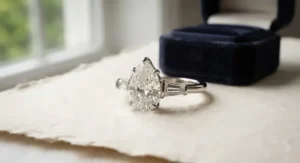
A traditional pear cut typically carries around 58 facets, arranged to balance the round brilliant’s fire with the marquise’s elongated point. A hybrid brilliant pear cut modifies that facet pattern — often borrowing additional facet arrangements more commonly seen in round brilliants — specifically to reduce the bowtie effect discussed above and increase overall light return across the stone’s face.
In practice, this means a hybrid-cut pear can look noticeably brighter and more uniformly lit than a traditionally cut stone of the same carat weight, particularly toward the center where bowtie shadows typically form. The trade-off is availability and, often, price — hybrid cuts require more precise cutting and aren’t offered by every jeweler or every brand on this list. If a bowtie-free look is a genuine priority rather than a nice-to-have, it’s worth specifically asking a jeweler whether a given pear stone uses a traditional or hybrid brilliant facet pattern before you commit.
Pear Diamond Ring Gold vs. Silver Settings: Which Metal Wins?
Four of the seven rings above use sterling silver (sometimes with gold plating), and three use solid gold. That split isn’t accidental — it maps directly to two different buying philosophies.
Solid gold, whether 14K or 18K, is an alloy that’s gold all the way through. It resists tarnish, holds its color for decades, and can be resized, re-plated (if white gold), or repaired essentially indefinitely by any jeweler. It’s also, unsurprisingly, the pricier option — gold’s market value is baked into every gram of the setting, separate from whatever center stone sits on top.
Sterling silver is 92.5% pure silver, often finished with a thin rhodium or gold overlay for extra shine. It’s dramatically more affordable and, contrary to some assumptions, plenty durable for daily wear — but that plating layer will eventually thin with years of contact against skin, clothing, and daily friction, at which point the base silver becomes visible underneath.
Neither is objectively “better” — the honest framing is that solid gold is the long-term-value play for a ring meant to be worn for decades without a second purchase, while silver-and-plating options like the DovEggs and Gem Stone King picks above deliver a genuinely comparable look for a fraction of the upfront cost, provided the buyer understands they may want a re-plating service every few years to keep that shine fresh.
Pear Shaped Engagement Rings vs. Other Diamond Shapes
How does a pear actually compare to the shapes most people consider alongside it? The table below lines up the three most common alternatives.
| Shape | Visual Effect | Bowtie Risk | Best For |
|---|---|---|---|
| Pear | Elongates finger, one pointed end | Moderate — cut-dependent | Buyers wanting a distinctive, elongating silhouette |
| Round Brilliant | Maximum fire and brilliance, no elongation | None | Buyers prioritizing pure sparkle over shape |
| Oval | Elongates finger, no pointed tip | Moderate-high | Buyers who want elongation without a vulnerable point |
| Marquise | Most elongating of all shapes | High | Buyers wanting maximum visual size and drama |
Reading the table, the pear genuinely occupies a middle lane: it delivers the finger-elongating effect that round brilliants simply can’t offer, without going as far into bowtie territory as a marquise typically does. Compared with an oval — its closest rival in popularity — the pear’s defined point gives it a more distinctive silhouette, though that same point is also its most fragile feature, which is exactly why setting choice (see the bezel option above) matters more for a pear shaped engagement ring than it does for an oval or round stone.
✨ Ready to compare finalists side by side? Bookmark this table before you shop — it’s easy to lose track once you start browsing listings.
Common Mistakes When Buying a Pear Shaped Engagement Ring
Even careful shoppers trip over the same handful of issues with this particular shape.
Ignoring symmetry in favor of carat weight alone. A larger, poorly symmetrical pear will look visibly “off” faster than a smaller, well-proportioned one — carat size means little if the tip doesn’t align with the center of the rounded end.
Skipping the orientation conversation entirely. Plenty of buyers default to point-down without ever considering point-up or sideways, then discover after the proposal that their partner actually preferred a different look.
Underestimating tip vulnerability. The pointed end of any pear-cut stone, regardless of price bracket, is its most breakable feature. Buyers who skip a protective setting (prong reinforcement or a full bezel) on an active-lifestyle ring often regret it within the first year.
Assuming plated metal is solid gold. It’s an easy mix-up on a listing page, and the two age completely differently — always double-check whether “gold plated,” “gold filled,” or “solid gold” is the actual construction before comparing prices apples-to-apples.
Skipping video verification for natural stones. Because bowtie severity doesn’t show on a certificate, buying a natural pear diamond from photos alone — without requesting an unedited video — is one of the most common regrets natural-diamond buyers report after the fact.
Long-Term Cost & Maintenance for Pear Shaped Engagement Rings
The sticker price is only one line item in the real cost of owning any of these rings for years, not months.
Solid gold pieces, like the two Kobelli halo rings above, carry the lowest long-term maintenance need: an occasional professional cleaning and prong check, typically once a year, plus resizing if needed. Because the metal is gold throughout, there’s no plating to wear through — the visible cost stays roughly flat over a decade of ownership.
Silver-and-plated pieces, like the DovEggs and PAVOI picks, carry a different cost curve. The upfront price is dramatically lower, but most owners should budget for a re-plating service every one to three years depending on wear intensity, particularly for a ring worn daily. Re-plating is typically inexpensive relative to the ring’s original cost, but it’s a real recurring line item that a $200 sterling silver ring’s sticker price doesn’t advertise.
Moissanite specifically holds up better over time than cubic zirconia in terms of retained sparkle — it won’t cloud or dull the way lower-grade simulants can after a few years of daily wear, which makes the moissanite-based picks on this list (Kobelli’s two moissanite rings, Gem Stone King, and both DovEggs pieces) a genuinely better long-term bet than a comparably priced cubic zirconia ring like the PAVOI pick, despite the higher upfront cost.
Advertising claims around metal content and gemstone treatment aren’t just marketing fluff, either — they’re specifically regulated. The FTC’s guidance on advertising diamonds, gemstones, and precious metals lays out exactly what sellers are required to disclose about plating, treatment, and stone origin, which is worth a skim if you want to know what questions a jeweler is legally obligated to answer honestly.
Buyer’s Decision Framework: A Simple Priority Checklist
If you’re still deciding, run through this in order and stop at the first statement that’s true for you.
- If budget is under $100 and you want to test the shape first → choose the PAVOI Pear Wavy Engagement Ring.
- If you want a real gemstone in a lower-cost metal → choose the Gem Stone King Pear Shaped White Moissanite Ring.
- If maximum visual size on a budget is the priority → choose the DovEggs 4ct Pear Cut Moissanite Hidden Halo Ring.
- If your hands are in constant motion for work or hobbies → choose the DovEggs Pear Shaped Bezel Vintage Ring.
- If a vintage, cathedral-style silhouette appeals most → choose the Kobelli Cristina Pear Moissanite Cathedral Ring.
- If solid gold with genuine gems matters but a natural diamond doesn’t → choose the Kobelli Pear Shape Moissanite Halo Engagement Ring.
- If nothing but a certified natural diamond will do → choose the Kobelli AGA Certified Pear Diamond Halo Engagement Ring.
✨ Don’t Miss These Exclusive Deals!
🔍 Take your search for the perfect pear shaped engagement ring further — click through on any pick above to check current pricing and availability. These seven rings cover nearly every budget and lifestyle, so your match is almost certainly on this list.
Frequently Asked Questions
❓ What is a pear shaped engagement ring?
❓ Does a pear diamond ring look bigger than its carat weight?
❓ Which way should the point face on a pear shaped ring?
❓ Is moissanite a good alternative to diamond for a pear cut?
❓ How do I protect the pointed tip of a pear shaped diamond ring?
Conclusion
A pear shaped engagement ring rewards a little homework in a way few other jewelry decisions do. The shape itself is forgiving and flattering on nearly every hand, but the details — symmetry, orientation, setting protection, and metal purity — are exactly where a good ring and a great one diverge. Across the seven rings in this guide, that range plays out clearly: a sub-$50 cubic zirconia piece for testing the waters, genuine moissanite in sterling silver or solid gold for real sparkle at real value, and a certified natural diamond for buyers who want nothing but the genuine article.
If there’s one takeaway to carry into your own search, it’s this: don’t buy from a single photo. Ask for real video of the actual stone, understand exactly what metal you’re purchasing, and pick an orientation that matches your own taste rather than convention alone. Do that, and a pear shaped engagement ring — in any of the seven styles above — is very hard to get wrong.
💍 Ready to Find “The One”?
Compare the seven picks above one more time, check current pricing, and trust the shape that’s stayed timeless since the 1400s for a reason. Your perfect pear shaped engagement ring is on this list.
Recommended for You
- Emerald Cut Engagement Ring: 7 Stunning Picks for 2026
- Cushion Cut Engagement Ring: 7 Stunning Picks for 2026
- 7 Best Princess Cut Engagement Rings in 2026
Disclaimer: This article contains affiliate links. As an Amazon Associate, I earn from qualifying purchases. If you purchase products through these links, we may earn a small commission at no additional cost to you.
✨ Found this helpful? Share it with your friends! 💬🤗
