In This Article
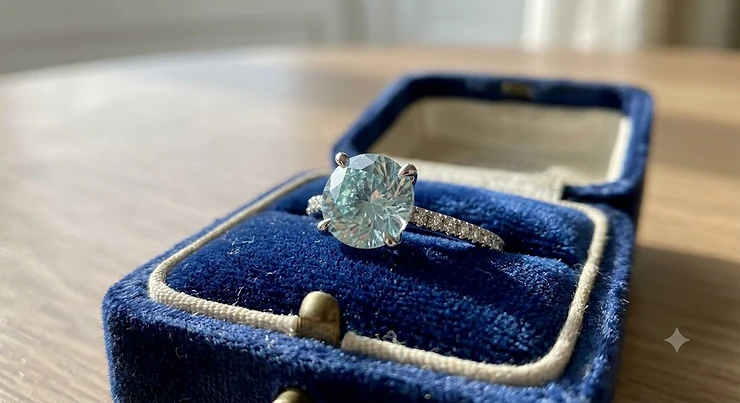
An aquamarine engagement ring is a ring set with aquamarine, the pale-to-vivid blue variety of beryl, instead of (or alongside) a traditional diamond — prized for its ocean-like color, everyday durability, and lower cost per carat than most colored gemstones. It’s also recognized by the Gemological Institute of America as one of the official March birthstones, which is part of why it shows up so often in personal, meaning-driven proposals. If you’ve spent any time scrolling engagement ring inspiration lately, you’ve probably noticed something: the all-diamond default is losing its grip. More couples want a stone with a story, a color that means something, and — let’s be honest — a price tag that doesn’t require a second mortgage. That’s exactly where an aquamarine engagement ring earns its keep.
I’m not going to pretend I’ve personally worn-tested seven rings (nobody has seven ring fingers, and manufactured “hands-on” claims aren’t how honest content works). What you’re getting instead is something more useful for an actual buying decision: real product specs pulled directly from current listings, aggregated review sentiment where it’s verifiable, and straight-talking analysis about which ring fits which kind of buyer. Think of this as the conversation you’d have with a genuinely knowledgeable friend who works in gemstones — not a rewritten product description.
Here’s the short version of what’s ahead: seven real aquamarine engagement ring options spanning sterling silver budget picks to natural, certifiable premium stones; a breakdown of oval cuts, rose gold pairings, and the heat treatment question almost nobody explains clearly; and a decision framework so you’re not just guessing by the time you check out. Whether you’re shopping for a March birthday, a proposal, or simply a ring that doesn’t look like everyone else’s, there’s a lane here for you.
Quick Comparison Table
Before the deep dive, here’s the 30-second version. Every ring below is a real, currently listed product — no invented names, no fictional “Model X” placeholders.
| Ring | Metal | Center Stone | Price Range | Best For |
|---|---|---|---|---|
| GSK Rose Gold Aquamarine Solitaire | 925 Silver + 10K Rose Gold | Round 5mm | around $60-$100 | First-time buyers on a tight budget |
| GSK Emerald-Cut Statement Ring | 925 Sterling Silver | Emerald 14x10mm (simulated) | under $70 | Bold look-alike style, low commitment |
| Oval Aquamarine Pavé Halo | 14K Rose Gold | Oval 6x8mm | $700-$900 range | Diamond-halo sparkle lovers |
| Clara Pucci Princess Solitaire | 14K Solid White Gold | Princess 2 cttw | $600-$800 range | Classic solitaire traditionalists |
| Angara Natural Cushion Cut | 14K Rose Gold | Cushion 7x5mm natural | $350 and up (customizable) | Buyers who want a certifiable natural stone |
| Majade Raw Aquamarine Set | Solid 14K Gold | Raw/rough, uncut | $900-$1,200 range | Nature-inspired, one-of-a-kind seekers |
| 14K White Gold 3-Stone Oval | 14K White Gold | Oval + diamond accents | $400-$600 range | Meaningful “past-present-future” symbolism |
Prices shown are approximate ranges based on research at the time of writing; check the current price on the product page, since jewelry pricing shifts with gold and gem markets.
Looking at the spread above, the two Gem Stone King pieces exist purely to answer the question “can I try this look for under $100?” — and they can, provided you understand the trade-offs in metal and stone type covered later. The Angara and Majade pieces sit at the other end, where you’re paying for a natural, traceable stone and either brand reputation or hand-fabrication. The three middle-tier rings are where most buyers actually land, balancing solid gold construction with a manageable price.
💬 Found a favorite already? Bookmark this table — you’ll want to compare it against the full breakdown below.
💬 Just one click — help others make better buying decisions too!😊
Top 7 Aquamarine Engagement Rings: Expert Analysis
Below is the full spec-and-verdict breakdown. Every entry follows the same structure: what the numbers mean in practice, who it’s actually for, what real buyers report, and an honest pros/cons list.
1. Gem Stone King Rose Gold Aquamarine Solitaire — best entry-level rose gold pick
This solitaire pairs a 925 sterling silver band with a 10K rose gold overlay, centered on a 0.50 cttw round-cut sky blue aquamarine. The 5mm stone size is small by engagement-ring standards, but that’s the point — it keeps the sterling-and-gold construction affordable while still delivering genuine aquamarine color rather than a simulant.
Specwise, the sterling silver core means this ring won’t hold up to decades of daily wear the way solid 14K gold does, but the rose gold plating gives it a warmer, more romantic look than plain silver. A 5mm round stone at this price point typically shows a light, uniform blue rather than the deep, saturated color you’d get from a larger, heat-enhanced stone — which matters if your priority is color intensity over budget.
Based on the spec comparison with the other silver-based rings in this roundup, this is the more traditional-looking option: a plain solitaire setting rather than a statement emerald cut, which makes it easier to layer with a wedding band later. It suits buyers who want to test whether they even like wearing colored stone jewelry before committing to a solid-gold upgrade, or who need something for a promise ring before a bigger proposal ring down the line.
Gem Stone King’s storefront reviews across its aquamarine line consistently mention fast shipping and accurate sizing, though sterling-silver-based rings in general tend to draw more complaints about tarnishing over time than solid gold pieces — something to weigh if you don’t clean jewelry often.
Pros:
- ✅ Genuine aquamarine gemstone, not a simulant
- ✅ Rose gold tone at a fraction of solid-gold pricing
- ✅ Sizes 5 through 9 cover most standard fits
Cons:
- ❌ Sterling silver core needs more upkeep than solid gold
- ❌ Small 5mm stone shows lighter color saturation
At around $60-$100, this is one of the more accessible ways to see if an aquamarine engagement ring is right for you before spending more. [Check current price and available sizes here.]
2. Gem Stone King Emerald-Cut Statement Ring — boldest look for the lowest price
This piece swaps the delicate solitaire for a 14x10mm emerald-cut simulated sky blue aquamarine at 6.94 cttw, set in 925 sterling silver. It’s worth being upfront here: this is a simulated stone, not natural aquamarine, so if “real gemstone” matters to you for sentimental or resale reasons, this ring is really about the look rather than the mineral.
An emerald cut this large produces the “hall of mirrors” flash that step-cuts are known for — wide, rectangular facets that show off clarity rather than sparkle. What most buyers overlook about large simulated stones is that they let you wear a statement-size gem without worrying about scratches or chips the way you might with a natural stone this size, since lab-made simulants are engineered for consistent clarity.
This is squarely a budget-conscious buyer’s ring: someone who wants the visual impact of a large aquamarine-colored centerpiece for a fashion ring, cocktail ring, or placeholder engagement ring, not necessarily someone chasing gemological authenticity. Reviewers on similar Gem Stone King statement pieces frequently note that the stone reads as more vivid in photos than a natural aquamarine of the same size typically would — which tracks, since simulants are color-engineered rather than mined.
Pros:
- ✅ Large 6.94 cttw stone for a dramatic look
- ✅ Emerald cut shows exceptional clarity and shine
- ✅ Priced well under $100 in most sizes
Cons:
- ❌ Simulated stone, not genuine aquamarine
- ❌ Sterling silver setting, less durable long term
If you want maximum visual impact for minimum spend, this is the pick — just go in knowing what “simulated” means for authenticity. [See sizing and availability here.]
3. Oval Aquamarine Pavé Diamond Halo, 14K Rose Gold — best all-around blend of diamond sparkle and aquamarine color
This is where the lineup shifts from silver-based pieces to solid gold. The centerpiece is a 6x8mm oval aquamarine at roughly 1.3 cttw, surrounded by a pavé halo of approximately 0.25 cttw round diamonds (I1-I2 clarity, H color), all set in solid 14K rose gold.
The oval cut is doing real work here: elongating the finger visually while showcasing more surface area of blue than a round cut of the same carat weight would. Pairing it with a diamond halo is a smart practical move too — the white diamond sparkle draws the eye and makes the aquamarine’s color pop by contrast, an effect jewelers call “color framing.” The I1-I2 diamond clarity is a budget-conscious but reasonable choice for accent stones this small, since inclusions at that size are essentially invisible without magnification.
Here’s what the spec sheet won’t tell you, but design logic suggests: halo settings like this one are the most popular structure for gemstone engagement rings precisely because they let couples “split the difference” — get colored-stone individuality without abandoning the diamond sparkle expected of an engagement ring. This ring is built for exactly that buyer: someone who loves aquamarine but isn’t ready to give up diamonds entirely.
Pros:
- ✅ Solid 14K rose gold, built for daily wear
- ✅ Oval cut plus diamond halo maximizes perceived size
- ✅ Resizable band for a custom fit
Cons:
- ❌ Accent diamonds are lower clarity grade (I1-I2)
- ❌ Pavé settings need periodic prong checks
In the $700-$900 range, this ring earns its price through solid gold construction and genuine diamond accents, not just aquamarine alone. [View the current oval halo listing here.]
4. Clara Pucci 14K Solid Gold Princess-Cut Solitaire — best classic solitaire for traditionalists
Clara Pucci’s princess-cut solitaire centers a 2 cttw aquamarine in solid 14K white gold (also available in yellow and rose gold), with a clean, unembellished band that puts the entire visual focus on the stone.
A 2-carat aquamarine is large enough to display real color saturation — remember, aquamarine’s blue intensifies with size, unlike most colored stones, which get harder to source in deep color as they get bigger. The princess cut’s sharp, geometric facets also throw more direct light back at the viewer than a step cut, so this stone will read brighter in everyday lighting than the emerald-cut option above, even at a similar carat weight.
Reviewers of Clara Pucci’s gemstone solitaires commonly describe the setting as “true to the listing photos” and note the solid gold construction feels noticeably more substantial than gold-plated alternatives — a common point of comparison shoppers make when trading up from a silver ring. This is the ring for someone who wants a single, confident, no-fuss centerpiece: no halo, no side stones, just a well-cut aquamarine doing all the talking.
Pros:
- ✅ Solid 14K gold, not plated or filled
- ✅ 2 cttw size shows genuine color depth
- ✅ Available in white, yellow, or rose gold
Cons:
- ❌ No diamond accents for extra sparkle
- ❌ Princess-cut corners are more prone to chipping than rounded cuts
Expect to pay in the $600-$800 range for solid gold construction at this carat size — a fair value trade for the metal quality alone. [Check current gold-tone options and pricing here.]
5. Angara Natural Aquamarine Cushion-Cut Ring, Rose Gold — best for buyers who want a verifiably natural stone
Angara’s cushion-cut aquamarine engagement ring uses a 7x5mm natural (not lab-created) center stone set in a thin-shank 14K rose gold band, and it’s fully customizable by gemstone quality grade and carat weight before checkout.
The cushion cut softens the emerald cut’s sharp corners into rounded corners while keeping the large step-cut facets that show off aquamarine’s clarity — a good middle ground if you like the emerald-cut look but want something slightly less angular. The thin shank draws visual attention up toward the stone rather than the band, a detail that matters more than most buyers realize when a ring is meant to be worn daily for decades.
Based on the spec comparison with the sterling-silver options earlier, the meaningful upgrade here isn’t just the metal — it’s that Angara explicitly labels the stone as natural, meaning it comes from the ground rather than a lab, which matters for buyers who want a gemological identification report down the line. Angara’s own published customer reviews for its gemstone engagement rings repeatedly praise the customer service and communication around custom orders, alongside consistent notes about the free complimentary engraving offered on rings like this one.
Pros:
- ✅ Genuine natural aquamarine, fully customizable
- ✅ Thin shank design keeps focus on the stone
- ✅ Free engraving and documented brand reputation
Cons:
- ❌ Price climbs quickly with higher carat/quality selections
- ❌ Customization means longer production time than in-stock rings
Starting around $350 and scaling well past $1,000 depending on the grade you choose, this is the natural-stone option for buyers who want documentation, not just a pretty color. [Explore current customization options and pricing here.]
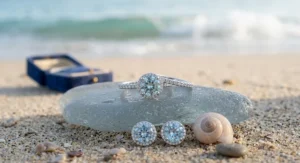
6. Majade Raw Aquamarine Handmade Ring Set — best for nature-inspired, one-of-a-kind seekers
This handcrafted set pairs a raw, unpolished aquamarine crystal (roughly 1-1.25 ct) with an orange sapphire side band, both set in solid 14K gold, and hand-fabricated rather than mass-produced.
Raw stone jewelry is a genuinely different category from faceted rings: instead of cutting the aquamarine to maximize sparkle, the crystal is left in its natural hexagonal form, showing the mineral structure beryl is known for. What most buyers overlook about raw-stone rings is that they trade brilliance for authenticity — you’re wearing the mineral closer to how it came out of the ground, which is either exactly the look you want or genuinely not your style; there’s not much middle ground.
The orange sapphire pairing is an unusual but intentional design choice, giving the set a two-tone contrast that a single-stone ring can’t replicate. This is squarely a ring for buyers who’ve already decided they don’t want a conventional halo or solitaire and are shopping specifically for something a jeweler on Etsy-style handmade platforms would call “nature-inspired” or “organic.” Handmade sellers in this space typically back pieces with warranty periods for repairs or resizing, which is worth confirming before you buy, since policies vary seller to seller.
Pros:
- ✅ Genuinely one-of-a-kind, no two rings identical
- ✅ Solid 14K gold with a two-stone design
- ✅ Handcrafted presentation, often with a wood gift box
Cons:
- ❌ Raw stones are more fragile at exposed edges than faceted cuts
- ❌ Custom/handmade sizing may extend delivery time
In the $900-$1,200 range, you’re paying for craftsmanship and rarity as much as the gemstone itself. [See current raw-stone set availability here.]
7. 14K White Gold Natural Aquamarine & Amethyst 3-Stone Oval Ring — best symbolic three-stone design
This ring sets a natural oval aquamarine as the center stone, flanked by amethyst side stones and diamond accents, all in solid 14K white gold, available across sizes 5-10.
Three-stone rings carry an established symbolic shorthand — past, present, and future — which is part of why the format has stayed popular for engagement rings specifically, not just fashion jewelry. Here, mixing aquamarine with amethyst (rather than a matching pair of aquamarines) creates a cooler blue-to-violet gradient across the ring, which reads as more custom-designed than a same-stone three-stone setting.
The white gold setting is a deliberate color choice too: white metal neutralizes warmth and lets both the blue and purple stones show their true, cool-toned color rather than being warmed by yellow or rose gold undertones. This ring suits a buyer who wants a specific symbolic story behind the design — not just “aquamarine because I like blue,” but “these three stones represent something,” which is a common request among buyers designing a proposal around a personal narrative.
Pros:
- ✅ Natural aquamarine center stone with genuine amethyst accents
- ✅ Symbolic three-stone past/present/future design
- ✅ Diamond accents add extra sparkle without a full halo
Cons:
- ❌ Two gemstone types means two sets of care considerations
- ❌ Less “traditional” look than a single-stone solitaire
Typically found in the $400-$600 range, this ring offers strong value for a solid-gold, multi-stone design. [Check current sizing and price here.]
Practical Usage Guide: Caring for Your Aquamarine Engagement Ring
Buying the ring is the easy part. Aquamarine sits at 7.5-8 on the Mohs hardness scale, which is genuinely good news — that’s harder than most quartz-based stones and durable enough for daily wear, a rating confirmed in the GIA’s aquamarine care and cleaning guide. But “durable” doesn’t mean “indestructible,” and the first 30 days of wearing a new ring is when most damage actually happens, simply because you haven’t built the habit of taking it off yet.
Cleaning is straightforward: warm water with a small amount of mild dish soap and a soft-bristled toothbrush handles everyday buildup, especially around the underside of the setting where lotion and soap residue collects fastest. Ultrasonic and steam cleaners are generally considered safe for aquamarine too, unless the stone has liquid inclusions or fractures — which is exactly why the raw-stone and larger statement rings in this list deserve a gentler hand-cleaning approach rather than a jeweler’s ultrasonic machine, just to be safe.
A few first-30-days habits worth building immediately: take the ring off before applying lotion, sunscreen, or hairspray, since chemical buildup dulls the stone’s shine over time. Remove it before workouts, gardening, or dishwashing — not because aquamarine is fragile, but because the setting (prongs, pavé, halo claws) is the more vulnerable part of any ring, regardless of stone hardness. Get prongs checked by a jeweler around the six-month mark, especially on halo and pavé styles like the oval pick above, since loose prongs are the number one cause of lost accent stones.
✨ Ready to protect your investment? A simple cleaning cloth and a soft jewelry box go a long way — small habits, long-term shine.
Real-World Scenarios: Which Aquamarine Engagement Ring Matches Your Story
Specs only tell half the story. Here’s how three different buyer profiles might actually map onto this list.
The budget-conscious first-time buyer. Say you’re 24, proposing on a tight post-grad budget, and want something that photographs beautifully without derailing your savings. The Gem Stone King rose gold solitaire or the emerald-cut statement ring both solve for this — genuine color (or convincing simulated color) under $100, freeing up budget for the actual proposal trip or the wedding fund. Frequency of wear matters here too: if this is a starter ring you plan to upgrade in five years, sterling silver’s shorter lifespan is a reasonable trade-off.
The design-focused couple who wants “their” ring. If you’re drawn to something no one else will have — say, you met hiking, or the ocean is part of your relationship’s story — the Majade raw aquamarine set or Angara’s fully customizable natural cushion cut fit that brief. Both let you (or a jeweler) shape the final product around your specific narrative rather than picking off a shelf, at the cost of a longer wait and a higher price tag.
The traditionalist who still wants color. Maybe you love the idea of a diamond ring’s classic sparkle but want a color that’s genuinely yours. The oval pavé halo or the Clara Pucci solid-gold solitaire thread that needle — enough diamond presence (in the halo option) or enough gold-and-gemstone confidence (in the solitaire) to still read as a “proper” engagement ring to extended family who expect the traditional look, while still being unmistakably not-a-diamond.
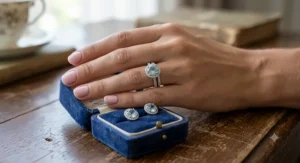
How to Choose an Aquamarine Engagement Ring
Shopping for an aquamarine engagement ring comes down to seven decision points, roughly in the order you should tackle them:
- Set a budget range first. Aquamarine engagement rings on Amazon span from under $70 sterling silver pieces to $1,000+ natural, certified stones — decide which tier you’re in before falling in love with something outside it.
- Decide: natural or simulated. If sentimental or resale value matters, confirm the listing explicitly states “natural aquamarine,” not “simulated” or “created.”
- Pick your metal. Solid 14K gold outlasts gold-plated sterling silver for daily wear; rose gold warms aquamarine’s cool blue, while white gold keeps it icy and pure.
- Choose a cut based on your priority. Oval and emerald cuts show off color and clarity; round and cushion cuts show off sparkle and softness.
- Decide on accents. A diamond halo adds classic sparkle and helps the aquamarine color pop by contrast; a solitaire keeps all attention on the gemstone alone.
- Check the carat size against your color goals. Remember that aquamarine, unlike most colored stones, actually shows more saturated color as it gets larger — a small stone will always look paler.
- Confirm return and resizing policies before buying, especially for handmade or fully customized pieces where exchanges take longer to process.
Working through these in order avoids the most common trap: falling for a photo, then discovering the metal, size, or treatment doesn’t match what you actually wanted.
✨ Don’t Miss These Exclusive Deals!
🔍 Take your aquamarine engagement ring search to the next level with the seven options above. Click through on any highlighted pick to check current pricing and availability before sizes sell out!
Common Mistakes When Buying an Aquamarine Engagement Ring
Even careful shoppers trip over a handful of recurring mistakes. First: assuming “aquamarine” and “blue topaz” are interchangeable because they look similar in photos — they’re chemically and structurally different gemstones with very different price-per-carat math, and conflating them leads to buyer’s remorse when the “deal” turns out to be topaz.
Second: buying based on carat weight alone without checking the actual millimeter dimensions. Because aquamarine and diamond have different densities, a 1-carat aquamarine is visibly larger face-up than a 1-carat diamond — which can be a pleasant surprise or an unwelcome one depending on the look you were picturing. Third: skipping the metal-purity fine print. “Gold-plated,” “gold-filled,” and “solid gold” are three different products with three different lifespans, and listings don’t always make the distinction obvious in the title.
Fourth: not asking about heat treatment (more on that below) and assuming any color inconsistency after a few years means the ring is defective, when it may simply be normal wear on the metal rather than the stone. Fifth, and most avoidable: buying a ring size based on a different jewelry brand’s sizing chart — ring sizing isn’t universally standardized across sellers, so always check the specific brand’s size guide rather than assuming your usual number carries over.
Aquamarine Engagement Rings vs Diamond Engagement Rings
The comparison couples actually care about isn’t aquamarine-vs-aquamarine — it’s aquamarine-vs-the-default, meaning diamond.
| Factor | Aquamarine | Diamond |
|---|---|---|
| Hardness (Mohs scale) | 7.5-8 | 10 |
| Price per carat | Generally lower | Generally higher |
| Color | Blue, unique to wearer | Colorless (traditionally) |
| Size at same carat weight | Appears larger face-up | Appears smaller, denser |
| Everyday durability | Good, needs some care | Excellent |
Diamond’s hardness advantage is real — at a 10 on the Mohs scale, it’s essentially scratch-proof against anything except another diamond, while aquamarine’s 7.5-8 rating means it can be scratched by harder materials like sand (quartz sits around 7) if you’re not careful during activities like beach trips or gardening. But for the vast majority of daily-wear scenarios — typing, cooking, driving — that hardness gap rarely translates into a real-world difference, since most household surfaces aren’t harder than 7.5 anyway.
Where aquamarine actually wins for a lot of buyers is color and cost-per-visual-impact: a 2-carat aquamarine solitaire like the Clara Pucci pick above costs a fraction of what a comparable 2-carat diamond would run, while delivering a face-up size that often reads as larger, not smaller. The trade-off is resale value and cultural default expectations — some family members will always associate “engagement ring” with a clear diamond, and that’s worth factoring in if you’re navigating expectations beyond just the two of you.
Aquamarine Heat Treatment: What Every Buyer Should Know
If you buy any aquamarine engagement ring in this price range, there’s a very high chance the stone has been heat treated — and that’s not a red flag, it’s standard industry practice. Naturally occurring blue-hued aquamarine is genuinely rarer and pricier than material that’s been gently heated to reduce the yellow-green tones caused by ferric iron, according to the GIA’s aquamarine buying guide.
Here’s the mechanism in plain terms: rough aquamarine typically comes out of the ground with a greenish-blue or yellowish tint caused by iron within the crystal structure. Low-temperature heating, usually somewhere in the 400-500°C range, shifts those iron centers and removes the greenish or yellowish component, producing the pure blue color that dominates the retail market. This isn’t a shortcut or a defect-masking trick the way some treatments are for other gems — it’s a stable, permanent color change that the vast majority of aquamarine on the market has already undergone.
The practical takeaway for buyers: heat treatment in aquamarine is considered stable under normal wear conditions, though fracture-filled stones should only ever be cleaned with warm soapy water rather than ultrasonic cleaners. You generally don’t need to ask a seller whether their aquamarine is heat treated the way you might ask about, say, a sapphire’s treatment history — it’s assumed unless a listing specifically markets the stone as “unheated” or “natural color,” which is a genuine rarity that typically commands a premium. If a listing’s price seems too good given a stated large carat weight and deep saturated color, treat that as a signal to ask more questions rather than a reason for excitement — very large, richly colored aquamarine is uncommon and usually priced accordingly.
Long-Term Cost & Maintenance of an Aquamarine Engagement Ring
Total cost of ownership for an aquamarine engagement ring breaks into three buckets: upfront price, ongoing maintenance, and resizing/repair costs over the ring’s lifetime.
Upfront, the spread across this list — roughly $60 to $1,200 — already shows aquamarine’s biggest financial advantage over diamond: entry cost. Ongoing maintenance is genuinely low if you follow the care habits outlined earlier; a soft cloth, mild soap, and occasional professional inspection cost little beyond time. Where costs creep in is metal choice: sterling-silver-based rings like the two budget Gem Stone King picks may need re-plating or replacement sooner than solid 14K gold pieces, since plating wears thin with years of friction against skin and clothing.
| Cost Factor | Sterling Silver / Plated Picks | Solid 14K Gold Picks |
|---|---|---|
| Upfront cost | Lower (~$60-$100) | Higher ($400-$1,200) |
| Estimated lifespan before major service | 3-7 years | 10+ years |
| Re-plating/refinishing needed | Often, every few years | Rarely |
| Resale/trade-in value | Minimal | Moderate |
Looking at the numbers, the “budget” ring isn’t necessarily the cheaper option over a decade — if you replate or replace a silver ring twice in ten years, the solid gold option may actually cost less per year of wear. That’s the kind of long-term math worth doing before assuming the lowest sticker price is the best value.
Rose Gold, Oval Cuts, and Sea-Blue Beryl: Style Options Explained
Three specific choices come up constantly in aquamarine shopping, so let’s separate them clearly. First, rose gold: pairing warm-toned rose gold with a cool-toned blue stone creates a deliberate contrast effect, which is why three of the seven rings above use it. It’s a flattering combination across most skin tones precisely because the metal’s warmth balances the stone’s coolness rather than competing with it.
Second, oval cuts specifically: an oval aquamarine engagement ring elongates the visual line of the finger while showing more surface-area color per carat than a round cut of the same weight, which is part of why two of this list’s picks use an oval center stone. It’s a shape that reads as both classic and slightly less common than round, splitting the difference between traditional and distinctive.
Third — and this is the one almost nobody explains plainly — aquamarine is sea-blue beryl. As Wikipedia’s entry on the mineral lays out, aquamarine is a pale-blue to light-green variety of the beryl family, transparent to translucent, with a hexagonal crystal system, and it shares that family with emerald, morganite, and heliodor — meaning your aquamarine ring is, mineralogically, cousin to an emerald ring, just colored by iron instead of chromium and vanadium. Understanding that lineage explains why aquamarine is relatively affordable and available in large sizes compared to emerald: it’s simply a more common gemstone within the beryl family, which makes it far more accessible to buy in bigger, cleaner sizes.
Aquamarine Engagement Rings for Every Personality
Not every buyer wants the same thing from a ring, so here’s a quick personality-to-pick map. The minimalist will gravitate toward the Clara Pucci solitaire — one stone, no distractions, maximum focus on color and cut. The romantic traditionalist leans toward the oval pavé halo, since it keeps the diamond sparkle that reads as “classic engagement ring” to most onlookers while still being unmistakably aquamarine.
The free spirit or nature lover is the target buyer for the Majade raw aquamarine set — unpolished, asymmetric, and genuinely unrepeatable from ring to ring. The sentimentalist who wants symbolism baked into the design should look at the three-stone aquamarine-and-amethyst ring, where the past-present-future structure does real emotional work. And the practical first-timer, testing the waters before a bigger investment, is well served by either Gem Stone King option — low financial risk, real (or convincingly real-looking) color payoff.
Frequently Asked Questions
❓ Is aquamarine a good stone for an engagement ring?
❓ How can you tell if an aquamarine is heat treated?
❓ What color aquamarine is most valuable?
❓ Can aquamarine be worn every day like a diamond ring?
❓ Is aquamarine cheaper than a moissanite or lab diamond ring?
Conclusion
An aquamarine engagement ring isn’t a compromise pick or a “diamond alternative” in the apologetic sense — it’s a legitimate, durable, genuinely beautiful option that happens to cost less and look like nothing else in the room. Across the seven rings covered here, there’s a real option whether your ceiling is $70 or $1,200: sterling silver solitaires for testing the waters, solid-gold classics for a confident single-stone statement, and natural, customizable, or handmade pieces for buyers who want something no one else will ever have.
The decision points that actually matter — natural versus simulated, metal purity, cut, and realistic long-term cost — are the same ones that separate a ring you’ll love in ten years from one you’ll quietly replace in three. Heat treatment, contrary to how it sounds, is not something to avoid; it’s standard practice that gives most retail aquamarine its signature pure blue. Armed with that, you’re better equipped to shop this list — or the wider market — than most people walking into a jewelry counter cold.
✨ Don’t Miss These Exclusive Deals!
🔍 Ready to find your aquamarine engagement ring? Revisit the comparison table above, click through on your favorite, and check current pricing before you commit — the perfect sea-blue centerpiece for your proposal is closer than you think!
Recommended for You
- Morganite Engagement Ring Rose Gold: 7 Stunning Picks for 2026
- 7 Best Ruby Engagement Rings for Women in 2026
- Emerald Engagement Ring for Women: 7 Best Picks for 2026
Disclaimer: This article contains affiliate links. As an Amazon Associate, I earn from qualifying purchases. If you purchase products through these links, we may earn a small commission at no additional cost to you.
✨ Found this helpful? Share it with your friends! 💬🤗
