In This Article
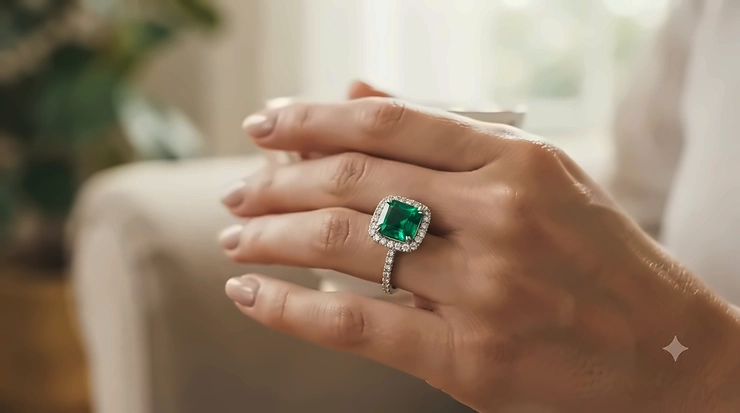
An emerald engagement ring for women isn’t the safe choice — and that’s exactly the point. While roughly 86% of brides still walk away with a diamond, a small but growing number are choosing color on purpose, and emerald sits at the top of that list. It’s the gemstone that says “I know what a diamond looks like, and I wanted something else.”
So what is an emerald engagement ring for women, really? It’s a ring centered on emerald — the green variety of the mineral beryl — set as the focal stone instead of (or alongside) a diamond, typically in a solitaire, halo, or three-stone design, in metals ranging from sterling silver to 14K gold or platinum.
I spent the past few weeks digging through real listings, comparing setting styles, and reading through buyer feedback to figure out which emerald rings are actually worth your money in 2026 — not just which ones photograph well. Below, you’ll find seven specific rings spanning every budget, an honest comparison table, and the buying knowledge that Amazon’s product page won’t hand you (jardin inclusions, why your ring size matters more with emerald than diamond, and which “emerald” rings aren’t emerald at all).
One thing worth knowing upfront: emeralds are a Type III gemstone under GIA’s clarity classification, meaning visible inclusions are normal, not a flaw. Keep that in mind as we go — it changes how you should shop.
Quick Comparison Table: Best Emerald Engagement Rings at a Glance
| Category | Ring | Stone Type | Best For |
|---|---|---|---|
| 🏆 Best Overall | Dazzlingrock Lab-Created Emerald Halo | Lab-created emerald + diamond | Buyers who want real stones without the natural-emerald price |
| 💰 Best Budget | PEORA Simulated Emerald Ring | Simulated emerald | First-time buyers, gifting, trying the look before committing |
| 💍 Best Halo Style | Gem Stone King Nano Emerald Halo | Nano/simulated emerald | Rose gold lovers who want maximum sparkle for the price |
| 🌿 Best Natural Emerald (Entry) | Angara Sterling Silver Halo | Natural emerald | Anyone who wants a genuine mined stone under $300 |
| 👑 Best Premium | Angara 14K Gold/Platinum Oval Halo | Natural emerald + diamond | Buyers ready to invest in a natural emerald as a centerpiece |
Looking at this lineup, the split between simulated, lab-created, and natural emerald is the single biggest factor driving price — far more than carat weight alone. If you’re buying as a placeholder or for everyday wear without worry, simulated stones from PEORA or Gem Stone King make sense; if the ring needs to hold up to a lifetime of “is that real?” questions, the Angara and Dazzlingrock natural and lab-created options are worth the jump.
💬 Just one click — help others make better buying decisions too!😊
Top 7 Emerald Engagement Rings for Women: Expert Analysis
Comparison Table: Top 7 Products
| Ring | Metal | Stone | Setting | Price Range | Best For |
|---|---|---|---|---|---|
| PEORA Simulated Emerald Ring | 925 Sterling Silver | Simulated emerald | Solitaire | Under $50 | Budget gifting |
| Gem Stone King 7.10 Cttw Ring | 925 Sterling Silver | Simulated emerald | Emerald-cut solitaire | $40–$90 range | Bold statement on a budget |
| Gem Stone King Nano Emerald Halo | 18K Rose Gold Plated Silver | Nano emerald | Oval halo | $50–$100 range | Romantic, rose gold aesthetic |
| Dazzlingrock Lab-Created Halo | 925 Sterling Silver | Lab-created emerald + diamond | Halo | $130–$250 range | Real stones, mid budget |
| Angara Sterling Silver Halo | Sterling Silver | Natural emerald | Halo | $150–$300 range | Entry-level natural emerald |
| Dazzlingrock 14K White Gold Ring | 14K Solid White Gold | Natural emerald + diamond | Round prong | $400–$700 range | Solid gold, mid-to-high budget |
| Angara 14K Gold/Platinum Oval Halo | 14K Gold or Platinum | Natural emerald + diamond | Oval halo | $700–$1,500+ range | Premium, lifetime piece |
The pattern across this table is straightforward once you see it laid out: every jump in price corresponds almost exactly to a jump in stone authenticity or metal purity — not a jump in “more diamonds” or “bigger size.” A simulated stone in sterling silver and a natural emerald in solid gold can look nearly identical in a product photo, so the spec sheet is doing a lot of the explaining your eyes can’t.
1. PEORA Simulated Emerald Ring in Sterling Silver
PEORA’s Simulated Emerald Ring is the one I’d point a first-time buyer toward, and the standout feature is how unfussy it is — a round-cut simulated emerald in a clean solitaire setting that doesn’t try to do too much.
The stone is cut at 8mm with roughly 1.75 carats total weight, set in genuine 925 sterling silver with a rhodium coating. In practice, that rhodium layer is what keeps sterling silver from tarnishing and dulling the way cheaper silver-tone alloys do — it’s a small spec line that actually determines whether this ring still looks good in year two. What most first-time buyers overlook is that “simulated” doesn’t mean cheap-looking; cut correctly, a simulated stone throws more even color than many lower-grade natural emeralds.
Feedback on Peora’s simulated emerald line consistently points to the color looking richer in person than expected, and the silver finish holding up well with normal wear. The brand backs this with a Certificate of Authenticity and ships in a gift-ready box.
✅ Genuinely affordable entry point
✅ Comfort-fit band for daily wear
✅ Hypoallergenic, nickel-free metal
❌ Simulated stone, not a real emerald
❌ Sterling silver needs occasional polishing
In the under-$50 range, this is hard to beat as a placeholder ring, a gift, or a way to test the emerald look before committing to a natural stone.
2. Gem Stone King 7.10 Cttw Green Simulated Emerald Engagement Ring
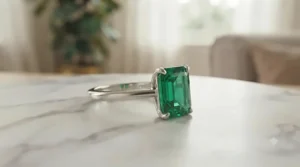
Gem Stone King’s 7.10 Cttw ring goes the opposite direction from Peora — it’s built to be seen across a room.
The headline spec is the 14x10mm emerald-cut stone at a substantial 7.10 carats total weight, set in 925 sterling silver. What that size means in practice: this isn’t a daintily-sized ring. It reads as a serious presence on the hand, which is exactly why it’s been compared by some buyers to the statement rings worn in films like Crazy Rich Asians — big, clean lines, unmistakable from across a room. If you want a ring that doesn’t whisper, this is the one in this lineup that shouts (politely).
Gem Stone King has operated as a New York jewelry house since 1903, and the company backs its products with a lifetime warranty — worth noting for a stone this size, since a larger simulated stone has more surface area to show wear over time.
✅ Dramatic size-to-price ratio
✅ Classic emerald-cut shape flatters the stone
✅ Lifetime warranty from a century-old brand
❌ Large stone may feel heavy for petite hands
❌ Simulated, not natural or lab-created
This is the pick for someone who wants maximum visual impact without spending into four figures — a costume-jewelry-adjacent budget with a fine-jewelry look.
3. Gem Stone King 1.76 Ct Oval Green Nano Emerald Halo Ring
Gem Stone King’s Nano Emerald Halo Ring softens the brand’s usual boldness into something more romantic, thanks to the 18K rose gold plating.
The oval-cut nano emerald sits at 1.76 carats total weight, surrounded by a halo setting in rose gold-plated sterling silver. Here’s the part the spec sheet won’t tell you: rose gold doesn’t just look trendy — it visually warms up a cooler-toned simulated emerald, making the green read richer than the same stone would in white metal. The halo setting does double duty too, adding perceived size to the center stone while distributing light around it, which is the same design logic high-end jewelers use on natural stones costing ten times as much.
This sits squarely between Gem Stone King’s bolder, larger statement piece and Peora’s minimalist solitaire — a halo gives you sparkle and presence without the visual weight of a 7-carat stone.
✅ Rose gold tone flatters most skin tones
✅ Halo adds perceived size and sparkle
✅ Backed by lifetime warranty
❌ Plating will eventually wear with heavy use
❌ Not a natural or lab-created stone
If you’ve been drawn to rose gold engagement rings generally, this is the spot in the lineup where that aesthetic and the emerald color meet.
4. Dazzlingrock Collection Lab-Created Emerald & Diamond Halo Ring
This is where the lineup shifts from simulated stones to something chemically real. Dazzlingrock’s Lab-Created Emerald Halo Ring pairs a 9x8mm lab-created emerald with genuine round white diamond accents, set in 925 sterling silver.
The practical distinction matters here: a lab-created emerald shares the same chemical composition and optical properties as a mined stone — the FTC’s jewelry guides require it to, or it can’t legally be marketed using the word “emerald” at all. What you’re paying extra for over a simulated stone isn’t appearance; it’s the fact that this is genuinely beryl, grown rather than mined, with the same physical properties a jeweler would test for. The diamond halo (not cubic zirconia) is the second upgrade — real diamonds hold their brilliance and resist clouding in a way simulants don’t over a decade of wear.
Dazzlingrock backs every purchase with a 90-day warranty covering lost stones or setting damage during normal wear, plus 30-day returns — a meaningfully longer commitment than most budget brands offer.
✅ Genuine lab-created emerald, not simulated
✅ Real diamond accents, not CZ
✅ 90-day warranty + 30-day returns
❌ Sterling silver setting (not solid gold)
❌ Smaller center stone than the statement pieces above
For someone who wants to tell their partner “that’s a real emerald” without the natural-stone price tag, this is the sweet spot in the entire lineup.
5. Angara Natural Emerald Halo Ring in Sterling Silver
Angara’s Natural Emerald Halo Ring is the most quietly impressive ring on this list — a genuinely mined, natural emerald at a price point usually reserved for simulants.
The 4mm Grade-A natural emerald sits in a halo setting in sterling silver. Here’s what the grade designation actually means in practice: Angara grades its emeralds A through AAAA based on color and clarity, and Grade-A stones (the entry tier) are still genuinely mined gemstones — they just carry more visible jardin (the garden-like inclusions naturally found in nearly all emeralds) than the rarer top grades. That’s not a defect; per GIA’s own clarity standards, emerald is a Type III gemstone where eye-visible inclusions are expected and accepted, even in fine examples.
Angara is a family-run brand with deep gemstone sourcing experience, and every piece ships with a Certificate of Authenticity. Because this is a natural stone, no two rings will look perfectly identical — which is part of the appeal if you want a one-of-a-kind feel.
✅ Genuine natural emerald, not a substitute
✅ Certificate of Authenticity included
✅ Surprisingly accessible price for a real stone
❌ Sterling silver, not gold or platinum
❌ Visible inclusions are normal but not for everyone
If “I want it to actually be an emerald” is non-negotiable but your budget caps out under $300, this is the ring that solves that exact problem.
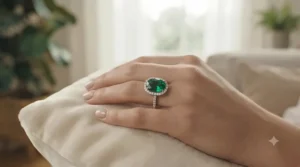
6. Dazzlingrock Collection Emerald & Diamond Ring in 14K Solid White Gold
Dazzlingrock’s 14K White Gold Emerald Ring moves the lineup into solid precious metal territory — no plating, no silver base.
The round-cut natural emerald is paired with genuine white diamond accents in 14K solid white gold. The real-world difference between plated and solid gold shows up years down the line: plated pieces thin and discolor at the edges with daily wear, while solid 14K gold can be resized, re-polished, and worn indefinitely without that risk. That matters specifically for an engagement ring, which by design gets worn every single day for years. Dazzlingrock also backs this tier with the same 90-day setting warranty as their sterling silver line.
Buyers consistently describe these dainty band styles as comfortable for daily wear, with the emerald and diamond accents reading as more substantial than the price suggests.
✅ Solid 14K gold — no plating to wear off
✅ Genuine natural emerald and diamonds
✅ Resizable, since it’s solid gold
❌ Smaller stone proportions than the premium pick below
❌ Pricier jump from the sterling silver tier
This is the realistic “forever ring” pick for buyers who want solid gold and real stones without going fully into four-figure territory.
7. Angara Natural Emerald & Diamond Halo Ring in 14K Gold or Platinum
Angara’s Oval Emerald Diamond Halo Ring is the premium anchor of this list — a prong-set natural emerald with a diamond halo, available in either 14K solid gold or platinum.
What separates this from every other ring here is customization depth: Angara lets you select the emerald’s quality grade (up to Heirloom, their top 1% tier) and carat weight, and choose between gold tones or platinum, since each is made to order rather than pulled from existing stock. In practice, that means the metal-and-stone combination you choose changes the look meaningfully — platinum and white gold sharpen the emerald’s green through contrast, while yellow gold deepens and warms it. Every Angara ring includes free, fully insured express shipping and a Lifetime Warranty, plus a 30-day no-questions return policy if it isn’t right.
✅ Fully customizable stone grade and metal
✅ Lifetime warranty + insured shipping
✅ Natural emerald with diamond halo brilliance
❌ Highest price point in this lineup
❌ Made-to-order means longer lead time than off-the-shelf rings
If this ring is meant to be worn for decades and the budget allows it, this is the pick that won’t need replacing as your taste or expectations evolve.
✨ Don’t Miss These Exclusive Deals!
🔍 Take your emerald engagement ring search to the next level with these carefully selected picks above. Click on any highlighted ring to check current pricing and availability — these styles help you find a piece your future fiancée will treasure for years. 💚
Find Your Match: Real-World Buyer Scenarios
The first-time gifter on a tight budget. If you’re proposing soon and need something beautiful without a big spend, the PEORA Simulated Emerald Ring or Gem Stone King’s 7.10 Cttw piece both deliver real visual impact under $100. Neither will disappoint in a ring box reveal, and neither puts financial pressure on a moment that should be about the relationship, not the receipt.
The “I want it to be real” buyer on a mid-range budget. This is where Dazzlingrock’s lab-created halo or Angara’s sterling silver natural emerald earn their place. Both let you say “it’s a real emerald” honestly, without natural-stone-in-solid-gold pricing. Pick the lab-created option if matching diamonds matter to you visually; pick Angara’s natural stone if authenticity of origin matters more than perfect uniformity.
The couple planning for decades, not just the proposal. Dazzlingrock’s 14K white gold piece or Angara’s premium oval halo are built for this. Solid gold resizes as your finger size changes over the years (a real consideration through pregnancy, weight changes, or simply aging), and a natural emerald with a documented grade holds resale and sentimental value that plated pieces don’t.
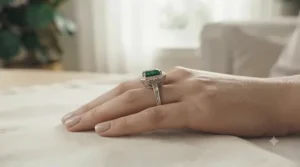
Common Emerald Ring Problems—And How to Solve Them
Problem: “I’m worried the green will look fake or too bright.” Solution: oval and cushion cuts (like Angara’s halo styles) show more depth and a softer color gradient than round cuts, which can look flatter on simulated stones. If color realism matters to you, lean toward emerald-cut or oval stones over round.
Problem: “I don’t know if I can afford a natural emerald.” Solution: you likely can, in a smaller size. Angara’s sterling silver Grade-A halo proves a genuine mined emerald doesn’t require a four-figure budget — it just requires a smaller stone or simpler metal than the premium pieces.
Problem: “I’m scared the stone will chip or crack.” Solution: choose a protective setting. Halo settings (like options 3, 4, 5, and 7 above) use diamonds or accent stones to shield the emerald’s edges from impact, which matters more for emerald than diamond given emerald’s “fair to good” toughness rating.
Problem: “The ring tarnished/discolored after a few months.” Solution: this points to a plated piece exposed to lotion, perfume, or chlorine. Switch to solid gold (option 6) or sterling silver with proper care, and remove the ring before swimming, showering, or applying skincare products.
Caring for Your Emerald Ring: A Practical Guide
Setup and first 30 days matter more with emerald than with diamond, mostly because of what you shouldn’t do. Skip the ultrasonic cleaner entirely — most natural and lab-created emeralds are treated with oil to fill microscopic fractures (a disclosed, industry-standard practice per the FTC’s Jewelry Guides), and ultrasonic vibration can damage that treatment and the stone itself.
Clean it instead with mild soap, lukewarm water, and a soft cloth — never harsh chemicals. Take the ring off before workouts, gardening, dishwashing, or swimming; emerald’s natural inclusions make it more prone to chipping under impact than diamond, even though both score similarly high on the Mohs hardness scale (emerald sits at 7.5–8, per Wikipedia’s mineralogy data).
The most common 30-day mistake: wearing a new ring to bed. Friction against pillowcases and sheets is a surprisingly common source of loose prongs in the first month. Have the setting checked by a jeweler around the 6-month mark, then annually after that.
How to Choose an Emerald Engagement Ring for Women
- Decide between natural, lab-created, and simulated first. This single decision affects price more than any other factor — natural costs the most, lab-created sits in the middle, simulated is most affordable.
- Pick a protective setting if daily wear is the priority. Halo and bezel settings shield the stone’s edges; solitaires show off color but offer less protection.
- Choose your cut based on how much color depth you want. Emerald cuts and ovals show more nuance; round cuts can look flatter.
- Match the metal to your skin tone and lifestyle. Yellow gold deepens green tones; white gold and platinum sharpen contrast; rose gold warms simulated stones.
- Set a realistic carat expectation for your budget. A smaller, well-cut natural stone often looks better than a larger, lower-grade one.
- Confirm the warranty and return policy before buying. Brands like Angara and Dazzlingrock back rings with lifetime or 90-day warranties — budget brands may not.
- Size correctly the first time. Resizing a halo setting is more complex (and pricier) than resizing a plain band, so get an accurate size upfront.
Common Mistakes When Buying an Emerald Engagement Ring
The biggest mistake I see is buyers assuming “emerald cut” and “emerald” are the same thing — they’re not. Emerald cut refers to a rectangular, step-cut shape that can be applied to a diamond, moissanite, or any gemstone; it has nothing to do with stone color. If you want a genuinely green emerald stone ring, check the gemstone type in the listing, not just the cut name.
The second mistake is buying based on carat weight alone without checking clarity grade or treatment disclosure. A larger, heavily-treated low-grade stone can look worse than a smaller, well-cut higher grade one. The third common error is skipping return policy details — emerald color can look different under store lighting versus daylight, so a workable return window protects you if the color doesn’t match expectations at home.
Emerald vs. Diamond Engagement Rings: Which Should You Choose
| Factor | Emerald | Diamond |
|---|---|---|
| Hardness (Mohs) | 7.5–8 | 10 |
| Toughness | Fair to good (more brittle) | Excellent |
| Visible inclusions | Normal, expected (jardin) | Generally avoided |
| Color | Natural, can’t be improved by cut alone | Colorless is standard; fancy colors are rare/costly |
| Symbolism | Growth, renewal, individuality | Tradition, durability |
| Typical price for comparable size | Lower than fine diamond, higher than common diamond grades | Wide range depending on the 4Cs |
The honest takeaway: diamonds win on sheer durability and resale liquidity, but emerald wins on individuality and color that diamonds simply can’t replicate. If you want a ring that looks like everyone else’s, diamond is the safer bet. If you want one that starts a conversation every single time, emerald does that in a way no diamond cut can.
What to Expect: Real-World Performance
Day-to-day, an emerald engagement ring for women behaves differently than the spec sheet suggests. The color shifts subtly under different lighting — warmer under incandescent bulbs, cooler and more vivid in daylight — which is part of the appeal but can surprise first-time buyers expecting diamond-like consistency. Sparkle is also different: emerald has a lower refractive index than diamond, so it glows with color rather than throwing the same fiery brilliance, which reads as more sophisticated to some and less “engagement ring sparkly” to others.
Expect to remove the ring more often than you would a diamond — before workouts, housework, and swimming — simply because the stone’s natural inclusions make it more vulnerable to chips from impact. With that small adjustment in habit, an emerald ring in a protective setting holds up for decades.
Features That Actually Matter (And Those That Don’t)
Actually matters: stone authenticity disclosure (natural vs. lab-created vs. simulated), setting protection (halo/bezel vs. exposed prongs), solid metal vs. plating, and warranty terms.
Doesn’t matter much: exact carat weight beyond what looks proportionate to your hand, matching the ring to a specific celebrity’s exact stone (inspiration is fine, but proportions vary by hand size), and chasing the absolute largest stone in your price range — a smaller, well-cut stone in a thoughtful setting consistently outperforms a larger one in flattering on-hand appearance.
Safety, Treatments & What the Law Actually Requires Sellers to Tell You
Under the FTC’s Jewelry Guides (16 CFR Part 23), sellers are legally required to disclose gemstone treatments — including the standard oiling process most emeralds undergo — if the treatment isn’t permanent, requires special care, or significantly affects value. This is why reputable listings note “treated” or describe the stone as lab-created or simulated explicitly rather than letting “emerald” stand alone if it isn’t a natural stone.
Practically, this protects you as a buyer: a listing that’s vague about whether the stone is natural, lab-created, or simulated is worth a second look before purchasing. All seven rings above disclose this clearly.
❓ FAQ
❓ How much does an emerald engagement ring for women typically cost?
❓ Is an emerald a good choice for an engagement ring?
❓ Can lab-created emerald engagement rings pass as real?
❓ What carat size emerald engagement ring should I get?
❓ Do emerald engagement rings need a matching wedding band?
Conclusion
After comparing all seven of these rings side by side, the right pick really does come down to one honest question: how much does it matter to you that the stone is real? If the answer is “not much, I just want it to look beautiful,” PEORA and Gem Stone King’s budget pieces deliver real impact for very little money. If the answer is “it matters a lot,” Angara’s natural emerald options — at either the sterling silver entry point or the 14K gold/platinum premium tier — are where I’d point you.
An emerald engagement ring for women isn’t about following tradition; it’s about choosing a stone with genuine personality, inclusions and all. Whichever of these seven you land on, you’re choosing a ring that looks like nobody else’s in the room.
Recommended for You
- 7 Best Sapphire Engagement Rings for Women in 2026
- 7 GIA Certified Diamond Rings on Amazon Actually Worth Buying (2026)
- Natural Diamond Engagement Ring: 7 Best Amazon Picks (2026)
Disclaimer: This article contains affiliate links. As an Amazon Associate, I earn from qualifying purchases. If you purchase products through these links, we may earn a small commission at no additional cost to you.
✨ Found this helpful? Share it with your friends! 💬🤗
