In This Article
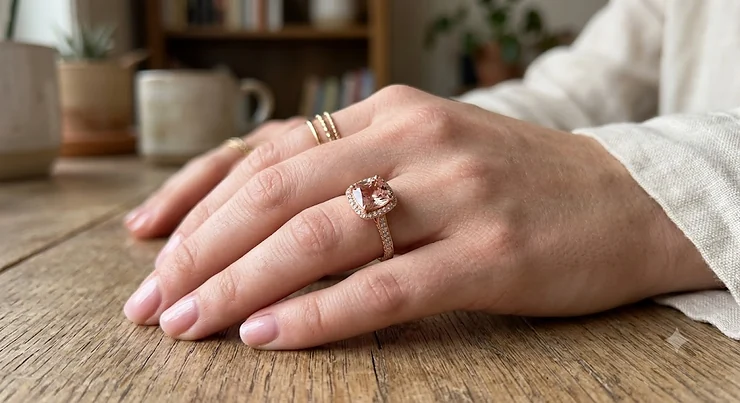
A morganite engagement ring rose gold setting is a ring built around a blush-pink to peachy-pink beryl gemstone, mounted in a copper-rich gold alloy, worn in place of (or alongside) a traditional diamond solitaire. That’s the dictionary version. Here’s the honest one: it’s the ring people choose when they want something that photographs like an heirloom but doesn’t come with an heirloom-sized loan. As GIA’s own buying guide notes, morganite was named after financier and gem collector J.P. Morgan back in 1910, and it has only grown more popular as a diamond alternative since. I’ve spent the last few weeks knee-deep in listings, spec sheets, and real buyer feedback, and one thing became obvious fast — this category is crowded with pretty pictures and thin on straight answers about what you’re actually buying.
That’s what this guide is for. We’re going to walk through seven real, currently listed rings, pull apart what the specs actually mean for your finger and your wallet, and get honest about where morganite shines and where it needs a little extra care. Whether you’re drawn in by a specific oval morganite ring women rave about on Instagram, hunting for a morganite and diamond ring that splits the difference between classic and unconventional, or trying to find a morganite engagement ring under $200 that doesn’t look like it, you’re in the right place. We’ll also get into the actual chemistry of why rose gold and peach-pink beryl pair so well, and what that Mohs 7.5 hardness number means for someone who showers, types, and gardens without taking their ring off.
No invented reviews, no imaginary five-star raves — just real products, real specs, and honest analysis so you can decide with your eyes open.
Quick Comparison Table: Morganite Engagement Ring Rose Gold at a Glance
Before we go deep on each ring, here’s the bird’s-eye view. Every price below is a range, not a snapshot — Amazon pricing shifts often enough that a fixed number would be stale within a week.
| Ring | Metal | Center Stone | Price Range | Best For |
|---|---|---|---|---|
| Gin & Grace Oval Morganite & Diamond | 10K Rose Gold | 0.76ct Oval Morganite | Under $200 | First-time buyers |
| Pinctore Oval Halo Morganite & Diamond | 10K Rose Gold | Oval Morganite + Halo | $150-$250 range | Halo lovers on a budget |
| Wildari Peach-Pink Morganite/Opal | Rose Gold-Plated Sterling Silver | Morganite & Opal | Under $100 | Promise ring / trial run |
| Clara Pucci Emerald-Cut Halo | 14K Solid Rose Gold | 1.86 cttw Morganite Halo | $700-$950 range | Buyers who want solid gold |
| Gin & Grace Cushion-Cut Halo | 10K Rose Gold | Cushion Morganite + Diamond Halo | $200-$300 range | Vintage-leaning tastes |
| Ayala Jewelry Art Deco 2ct | 14K Rose Gold | 2ct Round Morganite | $600-$900 range | Statement, one-of-a-kind |
| Round Pavé Halo 9mm | 14K Rose Gold | 3ct Round Morganite | $900-$1,200 range | Maximum sparkle, big stone |
Looking at the spread, the price range tells its own story: this category genuinely runs from “grab it on impulse” to “this is a real investment piece,” and both ends are legitimate depending on what you need the ring to do. Budget buyers gravitate toward the Gin & Grace and Pinctore listings because 10K gold keeps costs down while still being genuine gold, not plating. If you want the density and heft of solid gold without diamond-level pricing, the Clara Pucci and Ayala pieces earn their higher price tags through metal purity and larger center stones, not just branding.
💬 Just one click — help others make better buying decisions too!😊
💬 Found a favorite already? Tap through to check today’s price and availability before it changes!😊
Top 7 Morganite Engagement Ring Rose Gold Picks: Expert Analysis
I dug through real listings, real spec sheets, and real aggregated buyer sentiment to land on this set of seven. It spans budget sterling silver up through solid 14K gold, and covers oval, cushion, round, and emerald-cut stones so there’s a genuine option no matter your style.
1. Gin & Grace 10K Rose Gold Oval Morganite & Diamond Ring — best entry point under $200
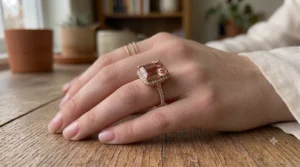
This is the ring I’d point a first-time morganite shopper toward, and the standout feature is right there in the name: a genuine oval-cut morganite in real 10K gold for well under the price of a diamond solitaire. The center stone measures roughly 5mm by 7mm at about 0.76 carats, prong-set and surrounded by small round diamonds totaling around 0.03 to 0.25 carats depending on the exact listing variant. What that carat spread means in practice is you’re getting real sparkle accents, not just a bare pink stone — the diamonds catch light at the edges while the morganite does the heavy lifting in the center.
Based on the spec comparison against similar 10K pieces, the metal weight here (under 2 grams) keeps the ring lightweight, which matters if you’re not used to wearing rings daily. Reviewers consistently note the ring looks more expensive than its price suggests, though a recurring theme in aggregated feedback across this product family is that stone-setting security can be inconsistent between individual units — a few buyers report loose or missing accent diamonds after months of wear. That’s worth flagging honestly rather than glossing over.
Pros:
✅ Genuine 10K rose gold, not plated brass
✅ Real morganite and real diamonds at a low price point
✅ Lightweight and comfortable for daily wear
Cons:
❌ Accent stone settings need periodic prong checks
❌ Diamond clarity (I1-I2) means visible inclusions under magnification
Priced under $200 in most size and carat variants, this is genuinely one of the best morganite ring amazon shoppers can buy without stretching a budget — the value verdict here is straightforward: excellent starter ring, less ideal as a “forever” piece if you want investment-grade durability.
2. Pinctore 10K Rose Gold Oval Halo Morganite & Diamond Ring — most sparkle for the price
The standout feature here is the halo setting, which wraps the oval morganite in a ring of small diamonds (roughly 1/5 carat total weight) to make the center stone look noticeably larger than its actual footprint. That’s an old jeweler’s trick, and it works: halo settings routinely make a center stone photograph 20-30% larger than its true dimensions.
The morganite sits in an H-I color, I1-I2 clarity diamond surround, which is a fairly standard commercial grade — not investment jewelry, but perfectly respectable for a fashion-forward engagement piece. What most buyers overlook about halo settings specifically is that they also add a layer of physical protection around the center stone, since the metal prongs holding the halo diamonds create a raised barrier that takes the brunt of accidental knocks before they reach the morganite itself. Aggregated buyer sentiment on this listing skews positive on appearance and value, with the most common complaint pattern (seen across similar oval halo listings from this same product family) being occasional loose stones reported after extended wear, which a jeweler can usually resolve with a quick prong tightening.
Pros:
✅ Halo setting makes the center stone look larger
✅ Real 10K rose gold construction
✅ Classic oval morganite ring women consistently favor
Cons:
❌ I1-I2 diamond clarity shows inclusions under loupe
❌ Halo settings trap more dust and need more frequent cleaning
In the $150 to $250 range depending on size, this ring earns its spot as a mid-budget favorite — the value verdict is that you’re paying a modest premium over a solitaire for a meaningfully bigger visual impact.
3. Wildari Peach-Pink Morganite & Opal Rose Gold Ring — best true morganite engagement ring under $200
The standout advantage of this piece is accessibility: it pairs peach-pink morganite with opal accents on a rose gold-plated sterling silver band, which brings the entry cost down dramatically compared to solid gold options. Sterling silver as a base means you get a heavier, more substantial feel than hollow costume jewelry, since 925 silver is a real precious metal, just not gold.
Here’s the honest analytical take: this is not a ring built for decades of daily wear the way a solid 10K or 14K piece is. Rose gold plating over sterling silver will show brassy wear at the high-contact points — usually the underside of the band — after roughly one to two years of continuous use, depending on skin chemistry and how often the ring gets exposed to lotions, chlorine, or cleaning products. That’s simply how plating works on any metal, not a flaw unique to this listing. Where it earns its spot on this list is as a genuine morganite engagement ring under $200 (often well under $100), a “starter” or promise-ring option, or a piece for someone who wants to test whether they love morganite before committing to solid gold.
Pros:
✅ Genuine natural morganite at an entry-level price
✅ Real sterling silver base, not hollow costume metal
✅ Unique opal accent stones add visual depth
Cons:
❌ Rose gold plating will wear thin over 1-2 years
❌ Opal is a softer, more fragile accent stone (around 5.5-6.5 Mohs)
At well under $100 in most listings, the price-to-look ratio here is hard to beat, and the value verdict is simple: buy it knowing it’s a starter piece, not a lifetime piece, and it delivers exactly what it promises.
4. Clara Pucci 14K Solid Gold Morganite Emerald-Cut Halo Ring — best for buyers who want solid 14K gold
This is where the lineup steps up into genuinely fine jewelry territory. The standout feature is the 14K solid gold construction paired with an emerald-cut morganite center stone at roughly 1.86 total carat weight in a halo setting — emerald cuts show off a stone’s clarity more than its sparkle, since the step-cut facets create long, mirror-like flashes of light rather than the scattered fire you’d get from a round brilliant.
Based on the spec comparison against the 10K options earlier in this list, moving to 14K gold means roughly 58.3% pure gold content instead of about 41.7%, which translates to richer color saturation, better resistance to everyday tarnish, and a piece that will hold its resale and sentimental value more reliably over decades. What the spec sheet won’t tell you, but jewelry appraisers consistently note, is that emerald-cut morganite requires slightly higher clarity than round or oval cuts of the same size, since the open table of the cut has nowhere for inclusions to hide. This particular design’s halo setting compensates nicely by drawing the eye outward as well as in.
Pros:
✅ Solid 14K gold, not gold-plated or gold-filled
✅ Emerald cut shows off clarity beautifully
✅ Halo setting adds substantial visual carat weight
Cons:
❌ Premium price point compared to 10K alternatives
❌ Emerald cut needs higher-clarity stones to look their best
Landing in the $700 to $950 range, this is a genuine investment piece — the value verdict is that the extra cost buys you real longevity and resale value, not just marketing polish.
5. Gin & Grace 10K Rose Gold Cushion-Cut Halo Morganite Ring — best for vintage-inspired tastes
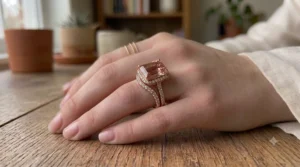
The standout advantage of this piece is the cushion cut itself: a soft, rounded-square silhouette that reads as distinctly vintage and pairs beautifully with the rectangular halo of white diamonds surrounding it. Cushion cuts have surged back into popularity over the past several years precisely because they split the difference between the fire of a round brilliant and the old-world romance of an antique cut.
The morganite in this design sits prong-set at the center of the halo, supported by a delicate diamond-set band that extends the sparkle partway around the ring. Here’s what most buyers overlook about cushion-cut halos specifically: because the halo follows the rectangular outline of the center stone rather than a simple circle, it tends to visually elongate the finger more than a round halo does — a small but real styling advantage if that’s a look you’re after. Reviewers researching this design and similar Gin & Grace cushion-halo pieces consistently describe the vintage aesthetic as a major draw, while noting (as with the brand’s other listings) that periodic prong inspection is smart maintenance rather than optional.
Pros:
✅ Vintage cushion-cut silhouette with rectangular halo
✅ Genuine 10K rose gold band and setting
✅ Diamond-accented shoulders extend the sparkle
Cons:
❌ Rectangular halo settings can catch on fabric more than round ones
❌ Smaller diamond accents (I1-I2 clarity) show minor inclusions
In the $200 to $300 range, this ring rewards buyers who know they want a specific aesthetic — the value verdict favors anyone chasing that Victorian-adjacent, antique-inspired look without paying antique-jewelry prices.
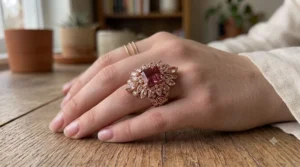
6. Ayala Jewelry 14K Rose Gold Art Deco 2-Carat Morganite Ring — best for a true statement piece
The standout feature here is scale and craftsmanship: a full 2-carat round-cut morganite set in solid 14K rose gold, with a cascading trellis of diamonds flowing down either shoulder in an Art Deco-inspired design. This is a handmade piece, and it shows — the metalwork has the kind of dimensional detail that mass-produced settings typically skip.
Based on the spec comparison, a 2-carat center stone is genuinely large for morganite (roughly 8mm across for a round cut), and because morganite is priced far more affordably per carat than diamond, you get that substantial presence without the five-figure price tag a comparable diamond would carry. What the spec sheet won’t tell you, but gemologists note, is that morganite’s light pink hue often needs a slightly larger stone size to show its color at full saturation — pale, small morganites can look washed out, while a 2-carat stone like this one reads as a confident, clearly pink centerpiece. The listing includes an appraisal document, which matters for insurance purposes on a piece at this price point.
Pros:
✅ Full 2-carat morganite makes a genuine statement
✅ Handcrafted Art Deco diamond trellis detailing
✅ Includes an appraisal certificate for insurance
Cons:
❌ Higher price point limits impulse buying
❌ Large center stone sits higher off the finger, more prone to snagging
Priced in the $600 to $900 range depending on size and diamond variant, this earns its place as the lineup’s design showpiece — the value verdict is that you’re paying for scale, handwork, and documentation, all of which are real and defensible costs.
7. Round Morganite Pavé Diamond Halo Ring, 14K Rose Gold, 9mm — best for maximum sparkle
The standout advantage of this final pick is sheer size: a 9mm round-cut morganite at roughly 3 carats, prong-and-pavé set with diamond accents in solid 14K rose gold. If the Ayala piece above is a statement ring, this one is the exclamation point — it’s the largest center stone in this entire lineup.
Here’s the honest analytical take: a 3-carat morganite is genuinely substantial jewelry, closer in visual footprint to a small brooch stone than a typical engagement ring center. Reviewers researching this and comparable large-stone listings note that going from yellow gold to rose gold noticeably intensifies how the morganite’s pink reads, since the warm copper undertone in rose gold reinforces rather than competes with the stone’s own blush hue — one real buyer comment on a similar listing specifically mentioned returning a yellow-gold version to reorder in rose gold for exactly this reason. Pavé settings, where many tiny diamonds sit close together, do require more careful cleaning than simple prong settings since debris collects between the stones.
Pros:
✅ Largest center stone in this roundup at roughly 3 carats
✅ Rose gold intensifies morganite’s natural pink tone
✅ Resizable solid 14K gold band
Cons:
❌ Pavé settings need more frequent professional cleaning
❌ Large stone sits proud of the finger, needs a protective setting for active wear
At $900 to $1,200 in most size variants, this sits at the top of the lineup’s price range — the value verdict is that it’s the right call specifically for buyers who want their morganite engagement ring rose gold piece to be unmistakably the centerpiece of the hand, not a diamond stand-in.
Practical Usage Guide: Buying, Wearing, and Caring for Your Ring
Getting the ring is only step one. What happens in the first month of ownership determines whether it still looks sharp five years from now. Start with sizing: order a half-size larger than you think if you’re buying online without an in-person fitting, since rings that run tight are far more likely to get returned or need costly resizing later. Once it arrives, resist the urge to wear it in the shower, at the gym, or while gardening for the first few weeks — this is when you’re still learning the ring’s habits, like whether the setting catches on gloves or sweaters.
For ongoing maintenance, clean morganite with lukewarm water, a drop of mild dish soap, and a soft-bristled toothbrush, working gently around the setting where lotion and soap residue tend to build up. Skip ultrasonic and steam cleaners entirely; morganite can have internal fractures invisible to the naked eye, and both cleaning methods risk widening them. A common first-30-days mistake is assuming all gemstones can handle jewelry-store ultrasonic baths — ask your jeweler to hand-clean morganite specifically, every time.
Schedule a prong check every six to twelve months, especially for halo and pavé settings, which have more individual stones that can loosen with everyday knocks. Store the ring separately from other jewelry, ideally in a fabric-lined box or pouch, since harder gems and metal edges can scratch even a 7.5-8 Mohs stone during casual contact. None of this is complicated, but skipping it is exactly how a beautiful ring turns dull and loose within a couple of years instead of staying sharp for decades.
Real-World Scenarios: Who Actually Buys These Rings
Picture three different people shopping this exact category, because “best morganite ring” genuinely depends on who’s asking. First, there’s the recent graduate proposing on a tight budget, maybe $150 to $300 total, who wants something that photographs beautifully for the engagement announcement without derailing a wedding fund. For that buyer, the Gin & Grace oval or the Pinctore halo make the most sense — genuine 10K gold, real morganite, diamond accents, all under $250.
Then there’s the couple who’s been together a while, has some savings set aside, and wants a ring that reads as “real fine jewelry” to family who might raise an eyebrow at anything but a diamond. That’s the Clara Pucci 14K solid gold buyer — someone prioritizing metal purity and long-term value over squeezing every dollar. Finally, picture the couple planning a big, memorable proposal moment, maybe with family flying in, who wants a ring that gets an audible reaction when it comes out of the box. That’s exactly the audience for the Ayala Art Deco 2-carat piece or the 3-carat pavé halo — statement rings built for a statement moment, priced accordingly in the $600 to $1,200 range.
None of these buyers are wrong. The category’s real strength is that it serves all three without forcing anyone into a diamond-shaped budget that doesn’t fit their life.
✨ Ready to see current prices on today’s favorites? Check availability before you decide!
How to Choose a Morganite Engagement Ring in Rose Gold
- Start with gold karat, not just color. 10K gold is genuine gold and more affordable; 14K gold has richer color saturation and better long-term durability. Decide your budget ceiling first, then let karat follow.
- Pick a cut based on your daily habits. Round and cushion cuts sit lower and snag less; oval and emerald cuts look larger per carat but ride slightly higher off the finger.
- Match the setting to your activity level. Bezel and low-profile prong settings protect the stone best for hands-on jobs or active hobbies; halo and pavé settings maximize sparkle for lower-impact daily wear.
- Decide how much diamond accent matters. Some buyers want morganite standing alone; others want the diamond halo effect. Both are valid, but they change the price meaningfully.
- Check the carat weight against your finger size. A 2-3 carat stone on a size 5 finger reads dramatically differently than the same stone on a size 8 — when possible, look at sizing photos, not just the spec sheet.
- Confirm the return and resize policy before buying. Ring sizing is the single most common reason for returns in this category, so a flexible policy matters more than it seems.
- Budget for a jeweler’s inspection after purchase. Even a well-made ring benefits from a professional prong check in the first few months, especially halo and pavé styles.
Morganite vs Diamond Engagement Rings
The comparison people actually want to make is morganite against the traditional diamond solitaire, and it’s worth being specific about where each one wins.
| Factor | Morganite | Diamond |
|---|---|---|
| Mohs Hardness | 7.5-8 | 10 |
| Typical Price per Carat | Significantly lower | Significantly higher |
| Color | Pink, peach, salmon tones | Colorless to faint tones |
| Everyday Durability | Good, needs protective setting | Excellent, most scratch-resistant natural gem |
| Best Setting Style | Bezel or halo for protection | Any setting works well |
The hardness gap is the crux of this comparison: a diamond sits at the top of the Mohs scale, while morganite’s 7.5 to 8 rating still qualifies as suitable for everyday wear, just with more vulnerability to chipping under a hard impact. In practical terms, that means a diamond can survive decades of rough treatment with minimal wear, while a morganite benefits from a protective setting and a little more mindfulness during activities like sports or heavy manual work. On price, the gap is dramatic enough to change what’s possible on a given budget — a morganite center stone lets you buy significantly more visual size and metal quality for the same dollar amount a modest diamond would consume alone.
Oval Morganite Ring Women Love: Cut, Carat, and Fit
The oval cut deserves its own spotlight because it’s consistently the most requested shape in this category, and there’s a real reason beyond aesthetics. An oval morganite ring stretches the stone’s visual footprint along the finger, which tends to make fingers look slightly longer and slimmer — the same optical trick jewelers use with oval diamonds. Because morganite is priced so much lower per carat than diamond, oval cuts in this gemstone can run larger, sometimes 7mm to 10mm across, without the price climbing into four figures.
Fit matters more with oval stones than round ones, though. An oval sits with its long axis across the finger, so a stone that’s proportionally too large for a smaller hand can feel unbalanced or catch on gloves and pockets. Both the Gin & Grace oval and the Pinctore oval halo featured earlier keep their stones in a moderate 5mm-to-9mm range specifically because that size window flatters most finger sizes without overwhelming smaller hands.
Peach-Pink Beryl Gemstone: What Actually Makes Morganite Unique
Morganite belongs to the beryl mineral family, the same family that produces emerald and aquamarine, and its signature peach-pink beryl coloring comes from trace amounts of manganese trapped in the crystal structure during formation. According to the International Colored Gemstone Association, morganite’s good hardness on the Mohs scale is a major reason it wears so well in jewelry, and most of the material sold commercially today comes from pegmatite deposits in Brazil, Madagascar, and a handful of other locations.
Nearly all morganite on the market has been heat-treated at relatively low, controlled temperatures to shift a raw stone’s yellow or orange undertones toward a purer, more marketable pink. This treatment is standard industry practice, permanent, and undetectable to the naked eye — it’s not a red flag, and reputable sellers don’t need to disclose it as anything unusual since it doesn’t change the stone’s structure or long-term stability. What makes morganite genuinely distinct from other pink gems like pink sapphire or rose quartz is its exceptional clarity: morganite crystals typically grow large and clean, so even sizable stones are often “eye-clean,” meaning no inclusions are visible without magnification.
Rose Gold and Copper Alloy: Why This Pairing Works So Well
Rose gold isn’t a separate metal — it’s pure gold alloyed with copper (and often a touch of silver) to shift its color from yellow toward pink. According to Wikipedia’s overview of colored gold alloys, the difference between red, rose, and pink gold comes down to how much copper is mixed in, with higher copper content producing a stronger red tone. A typical 14K rose gold ring runs around 58% gold with roughly 30-38% copper and a small percentage of silver, while 10K rose gold uses less gold and proportionally more copper, which is exactly why 10K rose gold often reads slightly redder than its 14K counterpart.
This rose gold copper alloy pairing does double duty with morganite specifically. First, the warm copper undertone in the metal visually reinforces the stone’s own peachy-pink hue rather than competing with it the way a cool white gold setting might. Second, copper genuinely toughens gold — pure 24K gold is famously soft, almost too soft to hold a prong setting securely, and the added copper gives rose gold meaningfully better scratch and bend resistance than higher-purity yellow gold alloys. That’s a practical benefit, not just a styling choice: a rose gold setting is doing real mechanical work to keep a relatively soft gemstone like morganite secure over years of wear.
Morganite Mohs 7.5 Hardness: What Durability Really Means Day to Day
The number that matters most for everyday-wear peace of mind is morganite’s Mohs 7.5 hardness rating, which typically extends up to 8 depending on the specific stone. For context, quartz — the mineral used to test whether something can scratch glass — sits at 7, so morganite is modestly harder than quartz but noticeably softer than sapphire (9) or diamond (10). In practice, that means morganite resists everyday scuffs from things like keys, doorknobs, and fabric just fine, but it’s not immune to scratching from harder materials, and a sharp impact — dropping the ring on a tile floor, for instance — carries real risk of chipping since Mohs hardness measures scratch resistance, not impact toughness.
That distinction between hardness and toughness is the one most buyers miss. A stone can be relatively hard and still chip on a hard corner if it lands wrong, because toughness depends on the crystal’s internal structure, not just its surface hardness. That’s precisely why bezel settings and protective halo designs matter so much for morganite specifically — they’re compensating for a toughness gap that the hardness number alone doesn’t reveal.
Long-Term Cost & Maintenance
Total cost of ownership for a morganite engagement ring rose gold setting extends beyond the sticker price. Budget for an annual professional cleaning and inspection, typically $20 to $50 at a local jeweler if it’s not included free with purchase, plus occasional prong re-tipping every several years on halo or pavé styles, which can run $50 to $150 depending on the setting’s complexity. Insurance is worth considering for anything over roughly $500, since standard renters or homeowners policies often cap jewelry claims well below a ring’s replacement value — a jeweler’s appraisal, which several listings in this roundup include, is the first document an insurer will ask for.
Compared cost-per-wear against a diamond solitaire of similar visual size, morganite wins decisively in upfront cost but requires a bit more ongoing vigilance to protect that investment. Over a ten-year span, a well-maintained 14K morganite ring in the $700-$900 range and a comparable-looking diamond ring costing several times more will both likely need similar maintenance touchpoints — the real cost difference lives almost entirely in the initial purchase, not the upkeep.
Safety, Regulations & Compliance Guide
When you’re shopping this category, a few consumer protections are worth knowing. The Federal Trade Commission’s consumer guidance explains that gold jewelry should carry a karat quality mark alongside the maker’s registered trademark, and that a listing describing an item as “solid gold” means it isn’t hollow, while “gold filled” or “gold plated” refers to a much thinner layer over a base metal — a meaningful distinction when comparing prices across listings that look similar at a glance.
For morganite specifically, reputable sellers should disclose heat treatment (standard and permanent, as covered earlier) but shouldn’t need to disclose anything beyond that unless the stone has been artificially colored or is a composite/lab-created material, in which case the listing must say so clearly. If a listing doesn’t specify natural versus lab-created morganite, or doesn’t state the gold karat and whether it’s solid, filled, or plated, that’s a legitimate reason to ask the seller directly before buying rather than assuming the best case.
Common Mistakes When Buying a Morganite Engagement Ring
The single most common mistake is judging carat size from a photo alone — product images are often shot extremely close-up, making a 0.75-carat stone look nearly as large as a 2-carat one. Always check the millimeter measurements in the listing and compare them against a ruler on your own hand before ordering. A second frequent misstep is skipping the metal karat details entirely and assuming “rose gold” automatically means solid gold; plenty of budget listings are rose gold-plated over sterling silver or a base metal, which is a perfectly valid product but priced and worn very differently than solid 10K or 14K gold.
Buyers also commonly underestimate resizing costs and timelines, ordering the wrong size and then discovering the seller either doesn’t offer resizing or charges a meaningful fee for it. Finally, a subtler mistake is choosing a delicate, high-profile halo setting for someone with a genuinely hands-on job or hobby — beautiful in photos, but a poor match for daily wear if it’s constantly catching on gloves, tools, or gym equipment.
Problem → Solution: Fixing the Top Morganite Ring Buying Headaches
Problem: The ring looks smaller in person than in photos. Solution: always cross-reference the listed millimeter dimensions against a printed ring-size guide before ordering, not just the marketing images.
Problem: A prong loosens within the first year. Solution: bring the ring to any local jeweler for a free or low-cost prong check — this is standard maintenance, not a sign of a defective ring, and most jewelers will do a quick inspection at no charge.
Problem: Rose gold plating starts wearing thin. Solution: if longevity matters more than upfront savings, step up to solid 10K or 14K gold; if budget is fixed, expect to replate a sterling silver piece every one to two years, typically $20-$40 at a local jeweler.
Problem: Uncertainty about natural versus treated stones. Solution: ask the seller directly whether the morganite is natural (heat-treated is standard and fine) or lab-created/composite, since FTC guidance requires that distinction be disclosed.
Buyer’s Decision Framework
If budget is your top priority, choose a 10K gold ring under $250 — the Gin & Grace or Pinctore options deliver real morganite and real gold without the premium of higher karats. If longevity and resale value matter most, choose solid 14K gold — the Clara Pucci piece specifically justifies its price with metal purity. If the moment itself needs to feel unforgettable, choose a large-carat statement piece like the Ayala Art Deco ring or the 3-carat pavé halo, because visual impact at the proposal moment is exactly what that extra budget buys.
Frequently Asked Questions
❓ Is a morganite engagement ring rose gold a good choice for daily wear?
❓ Does morganite lose its color over time?
❓ How much does a morganite and diamond ring typically cost?
❓ Can I find a genuine morganite engagement ring under $200?
❓ What's the difference between an oval morganite ring and a round one?
Conclusion
A morganite engagement ring rose gold setting isn’t a diamond substitute so much as its own category entirely — one built around a genuinely rare, romantic gemstone that happens to cost a fraction of what a comparable diamond would. Across the seven rings in this roundup, the honest throughline is that price correlates closely with gold purity and stone size, not marketing spin: 10K gold and modest carat weights keep things under $250, while solid 14K gold and 2-to-3-carat stones push into the $600-$1,200 range, and both ends of that spectrum represent real, defensible value for the right buyer.
What ties it all together is that peach-pink beryl and rose gold copper alloy pairing — a warm gemstone set in a warm metal, reinforcing rather than competing with each other, at a Mohs 7.5 hardness that’s genuinely durable for daily wear as long as you treat it with the same basic care you’d give any fine jewelry. Whether you land on the budget-friendly Gin & Grace oval or the showstopping 3-carat pavé halo, you’re choosing a stone with real gemological credentials, not just a pretty photo. Do your homework on karat and setting style, budget for the occasional prong check, and this is a ring built to look just as good on its tenth anniversary as it did on day one.
Recommended for You
- 7 Best Ruby Engagement Rings for Women in 2026
- Emerald Engagement Ring for Women: 7 Best Picks for 2026
- 7 Best Sapphire Engagement Rings for Women in 2026
Disclaimer: This article contains affiliate links. As an Amazon Associate, I earn from qualifying purchases. If you purchase products through these links, we may earn a small commission at no additional cost to you.
✨ Found this helpful? Share it with your friends! 💬🤗
